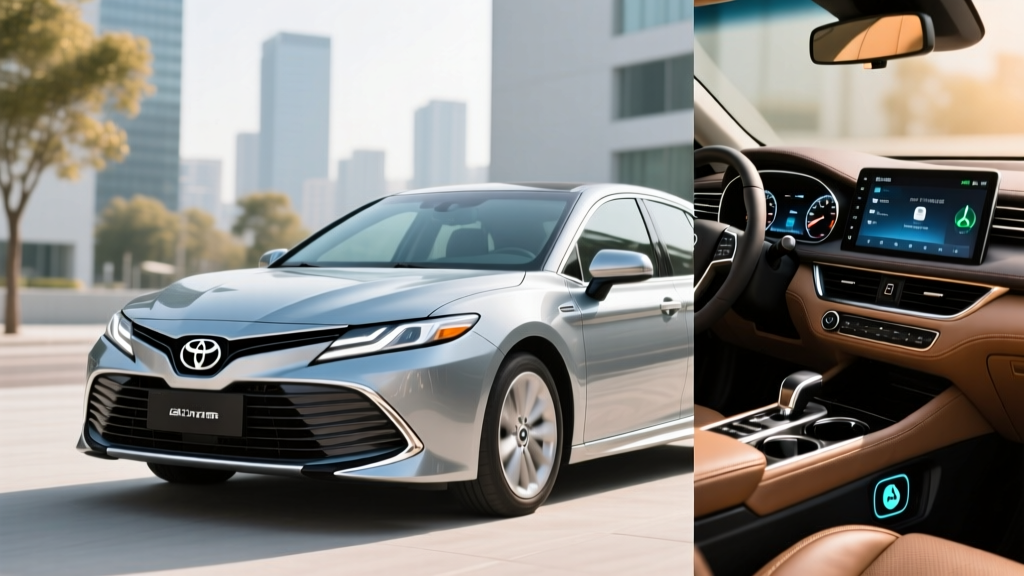
The 2024 Toyota Camry Hybrid occupies a specific niche that full battery-electric vehicles still struggle to fill: it delivers exceptional fuel economy without requiring any change to your fueling habits. No chargers to install, no range planning, no plug. As Toyota transitions the Camry lineup to an all-hybrid strategy for the 2025 model year, the 2024 Camry Hybrid represents the final model year of the gasoline-only/hybrid split — making its pricing and trim structure particularly relevant for buyers shopping new and certified pre-owned inventory in 2026.
This guide breaks down every trim's MSRP, the real-world MPG you can actually expect, battery longevity data, and how the Camry Hybrid stacks up against plug-in hybrids and full EVs for different driving patterns.
2024 Toyota Camry Hybrid MSRP by Trim Level
The 2024 Camry Hybrid is available in four core trims, with the option of front-wheel drive (FWD) or electronic all-wheel drive (AWD-e) on select configurations. Toyota added a Nightshade Edition for 2024, slotting between the SE and XLE. Here is the complete pricing structure at launch:
| Trim | Drivetrain | MSRP (2024) | Key Additions Over LE |
|---|---|---|---|
| LE Hybrid | FWD | $28,855 | Base: 7" touchscreen, TSS 2.5+, wireless CarPlay/Android Auto |
| LE Hybrid | AWD-e | $30,380 | Electronic AWD, 50-state emissions |
| SE Hybrid | FWD | $30,390 | Sport-tuned suspension, 18" black alloy wheels, SofTex seats |
| SE Hybrid | AWD-e | $31,915 | Same sport features + AWD-e |
| Nightshade Hybrid | AWD-e | $33,490 | Black exterior accents, 19" black wheels, dark badging |
| XLE Hybrid | FWD | $33,845 | 9" touchscreen, leather, heated front seats, ambient lighting |
| XLE Hybrid | AWD-e | $35,370 | Full premium package + AWD-e |
Destination charge: $1,095 added to all trims, bringing the effective starting price to $29,950 for the LE FWD.
For 2026 shoppers looking at certified pre-owned or remaining new-old-stock inventory, expect discounts of $1,500–$3,500 off original MSRP depending on market, as dealers clear space for the redesigned 2025+ Camry (which is now exclusively hybrid across all trims).
How Many MPG Does the 2024 Camry Hybrid Actually Get?
The EPA rates the Camry Hybrid differently depending on trim and wheel size, since larger wheels and sport-tuned suspensions increase rolling resistance. Here are the official figures from fueleconomy.gov:
| Trim / Config | City MPG | Highway MPG | Combined MPG |
|---|---|---|---|
| LE (FWD, 16" wheels) | 51 | 53 | 52 |
| LE (AWD-e) | 44 | 47 | 46 |
| SE / Nightshade (18"-19" wheels) | 44 | 47 | 46 |
| XLE (FWD, 18" wheels) | 44 | 47 | 46 |
| XLE (AWD-e) | 44 | 47 | 46 |
The 6 MPG gap between the LE (52 combined) and other trims (46 combined) comes down to two factors: the LE's smaller 16-inch low-rolling-resistance tires and its lighter curb weight (roughly 100 lbs less than the XLE AWD-e). If maximum fuel economy is your priority, the LE is the efficiency champion.
Powertrain Specs: Engine, Motors, and Combined Output
The 2024 Camry Hybrid uses Toyota's fourth-generation hybrid synergy drive, a proven system shared across the Toyota lineup:
| Component | Specification |
|---|---|
| Engine | 2.5L inline-4 Atkinson-cycle (176 hp, 163 lb-ft) |
| Front Electric Motor | Permanent-magnet synchronous (118 hp, 149 lb-ft) |
| Rear Motor (AWD-e only) | 40 hp, 89 lb-ft (engages automatically under acceleration/low-traction) |
| Net System Output | 208 hp (FWD) / 219 hp (AWD-e) |
| Transmission | eCVT (planetary gearset, no fixed gears) |
| Hybrid Battery | 1.6 kWh lithium-ion (sealed NiMH on some early builds) |
| 0–60 mph | 7.2 seconds (FWD) / 7.0 seconds (AWD-e) |
| Fuel Tank | 13.2 gallons |
| Total Range (LE, combined) | ~686 miles per tank |
The 208–219 hp output places the Camry Hybrid well above the base 4-cylinder gas Camry (203 hp) and delivers genuinely responsive acceleration from stops, where the electric motor's instant torque fills in before the engine builds RPM. The eCVT operates without shift shock — it's a power-split device, not a belt-driven CVT — and remains one of the smoothest hybrid transmissions on the market.
Conventional Hybrid (HEV) vs. Plug-In Hybrid (PHEV): Where the Camry Fits
The 2024 Camry Hybrid is a conventional hybrid (HEV), meaning it has no plug, no electric-only driving mode beyond very low-speed creep (under ~1 mile at speeds below 25 mph), and charges its small battery entirely through regenerative braking and engine power. This is a critical distinction from plug-in hybrids like the Toyota RAV4 Prime or Prius Prime.
HEV (Camry Hybrid)
- No plug required — fuel only at gas stations
- 1.6 kWh battery (not externally chargeable)
- 0 miles electric-only range (brief low-speed EV mode only)
- 46–52 MPG combined depending on trim
- No federal tax credit for new purchases
- Lower MSRP: starts ~$29,950 with destination
PHEV (e.g., Prius Prime)
- Plug-in charging: Level 1 (120V) or Level 2 (240V)
- 13.6 kWh battery (Prius Prime)
- 39–44 miles electric-only range
- 48–52 MPG combined after battery depletes
- Up to $3,750 federal credit (§30D, income/sourcing rules apply)
- Higher MSRP: Prius Prime starts ~$33,445
Toyota does not offer a Camry PHEV in the US market. If you want a Toyota sedan with plug-in capability, the closest equivalent is the Prius Prime, which offers 44 miles of electric-only range on the SE trim and qualifies for a partial federal tax credit. For a midsize sedan with plug-in capability outside Toyota, the Hyundai Sonata PHEV (discontinued after 2024) or the BMW 330e are the remaining options.
Does the 2024 Camry Hybrid Qualify for Any Tax Credit?
Federal §30D clean vehicle credit: No. The Camry Hybrid is a conventional HEV, not a plug-in vehicle. The federal tax credit under IRS §30D applies only to battery-electric vehicles (BEVs) and plug-in hybrids (PHEVs) with a battery capacity of at least 7 kWh. The Camry Hybrid's 1.6 kWh battery does not meet this threshold.
State and local incentives: A handful of states offer modest rebates or HOV lane access for conventional hybrids, but these programs are increasingly focused on zero-emission vehicles. Check your state energy office or AFDC's state incentive database for current programs. Some utilities offer time-of-use electricity rates that benefit EV and PHEV owners but do not apply to HEVs.
Used hybrid consideration: The federal used clean vehicle credit (§25E, up to $4,000) also requires the vehicle to be a plug-in (BEV or PHEV). A pre-owned 2024 Camry Hybrid does not qualify.
Hybrid Battery Warranty, Lifespan, and Replacement Cost
Toyota's hybrid battery longevity data is among the strongest in the industry. The Prius, which uses a similar hybrid synergy drive architecture, routinely reaches 200,000+ miles on the original battery pack. The Camry Hybrid's 1.6 kWh lithium-ion pack operates in a narrow state-of-charge window (roughly 40–80% SoC), which dramatically reduces degradation compared to a full EV battery that cycles through a wider range.
Out-of-warranty replacement cost: If the hybrid battery does require replacement beyond the warranty period, expect to pay $2,500–$4,000 for a new OEM battery pack installed at a Toyota dealer. Independent hybrid specialists often offer refurbished packs for $1,500–$2,500. This is substantially less than EV battery replacement ($8,000–$20,000+) because the hybrid pack is small and modular.
The 12V auxiliary battery (a separate, conventional battery that powers electronics when the hybrid system is off) typically needs replacement every 4–6 years at a cost of $200–$350, similar to any conventional vehicle.
Reliability Ratings and Ownership Costs
The 2024 Camry Hybrid benefits from the Camry platform's longstanding reliability reputation and Toyota's hybrid system track record. Key data points:
- IIHS: 2024 Camry earned Top Safety Pick+ rating with acceptable headlights on all trims (iihs.org)
- NHTSA: 5-star overall safety rating
- Toyota Safety Sense 2.5+: Standard on all trims — includes pre-collision braking with pedestrian detection, full-speed adaptive cruise control, lane departure alert with steering assist, lane tracing assist, and automatic high beams
- Projected 5-year maintenance: ~$2,800 (hybrid components add minimal maintenance; no transmission fluid changes on the eCVT under normal use)
- Insurance: Average annual premium of $1,600–$2,100 depending on state, trim, and driver profile — typically 5–8% higher than the gas Camry due to the hybrid system's replacement cost
Toyota's hybrid-specific maintenance is minimal. The inverter coolant and transaxle fluid are "lifetime" fills under normal driving. The brake pads often last 80,000+ miles because regenerative braking handles the majority of deceleration, reducing wear on the friction brakes.
Camry Hybrid vs. PHEV vs. Full EV: Which Should You Choose?
Decision Framework
Choose the Camry Hybrid (HEV) if:
- You cannot install a home charger (apartment, street parking, no garage)
- You regularly drive 400+ miles between stops and don't want to plan charging
- Your budget is under $35,000 and you want maximum fuel savings with minimum upfront cost
- You drive 12,000–18,000 miles/year and want to spend ~$900/year on fuel instead of ~$2,000 (gas Camry) or ~$550 (EV on home charging)
Choose a PHEV (Prius Prime, etc.) if:
- You can charge at home (Level 1 or 2) and your daily commute is under 40 miles
- You want electric-only daily driving but need gas flexibility for road trips
- You qualify for a partial federal or state PHEV credit
Choose a full EV (Tesla Model 3, Hyundai Ioniq 6, etc.) if:
- You have reliable home Level 2 charging and your daily driving is under 250 miles
- You want the lowest per-mile fuel cost and zero tailpipe emissions
- You qualify for the full $7,500 §30D federal credit (subject to income, MSRP, and battery sourcing rules per irs.gov)
- You want minimal maintenance (no engine oil, no spark plugs, reduced brake wear)
Pros and Cons of the 2024 Camry Hybrid
Pros
- 52 MPG combined (LE) — among the highest of any midsize sedan
- No charging infrastructure needed — zero lifestyle change
- 686-mile total range eliminates fuel stops on most road trips
- 10-year/150,000-mile hybrid battery warranty
- Strong resale value; proven reliability track record
- Standard Toyota Safety Sense 2.5+ on every trim
- AWD-e available for snow-belt buyers
Cons
- No federal tax credit (HEV, not a plug-in)
- AWD-e and sport trims drop to 46 MPG combined
- No electric-only driving mode for zero-emission city operation
- Infotainment interface (7" base screen) feels dated vs. competitors
- Rear seat headroom slightly compromised vs. some midsize rivals
- Final year of this generation — 2025 redesign brings updated platform
Frequently Asked Questions
Can I plug in the 2024 Camry Hybrid to charge it?
No. The Camry Hybrid is a conventional hybrid (HEV), not a plug-in hybrid. Its 1.6 kWh battery charges exclusively through regenerative braking and the gasoline engine. There is no charge port, no plug, and no electric-only driving range beyond brief low-speed maneuvering. If you want a Toyota with plug-in capability, look at the Prius Prime or RAV4 Prime.
How much does it cost to fuel the Camry Hybrid per year?
At 15,000 miles per year and $3.40/gallon regular unleaded, the LE trim (52 MPG combined) costs approximately $981/year in fuel. The SE/XLE/AWD-e trims at 46 MPG combined cost about $1,109/year. By comparison, a 2024 gas-only Camry LE (32 MPG combined) would cost roughly $1,594/year — a savings of $485–$613 annually for the hybrid.
Is the hybrid battery expensive to replace?
Out-of-warranty replacement runs $2,500–$4,000 at a dealer, or $1,500–$2,500 through an independent hybrid specialist. However, Toyota's hybrid batteries routinely last 200,000+ miles, and the 10-year/150,000-mile warranty covers the vast majority of ownership periods. The risk of needing a replacement is statistically low based on two decades of Toyota hybrid data.
Does the Camry Hybrid have enough power for highway merging?
With 208 hp (FWD) or 219 hp (AWD-e), the Camry Hybrid accelerates to 60 mph in roughly 7.0–7.2 seconds. The electric motor's instant torque (149 lb-ft from 0 RPM) makes initial acceleration brisk, and the system handles highway merging confidently. It's not a performance sedan, but it's noticeably quicker than the base 4-cylinder gas Camry in real-world passing situations.
Should I buy the 2024 Camry Hybrid or wait for the 2025 redesign?
The 2025 Camry is now exclusively hybrid and rides on an updated platform with refreshed styling and a larger infotainment screen. However, 2024 models are available at meaningful discounts from original MSRP, and the core hybrid powertrain is largely carried over. If you prioritize value and don't need the latest infotainment, the 2024 remains an excellent choice — especially as certified pre-owned inventory becomes available with extended warranty coverage.
What is the difference between the Camry Hybrid LE and SE?
The LE prioritizes efficiency (52 MPG combined on 16" low-rolling-resistance tires, soft-tuned suspension, cloth seats, 7" screen). The SE trades 6 MPG for sportier character (46 MPG, 18" alloy wheels, sport-tuned suspension, SofTex sport seats, paddle shifters, black exterior accents). The mechanical hybrid powertrain is identical — the difference is entirely in chassis tuning, wheels, and interior materials.