Quick Verdict: The Efficiency Benchmark
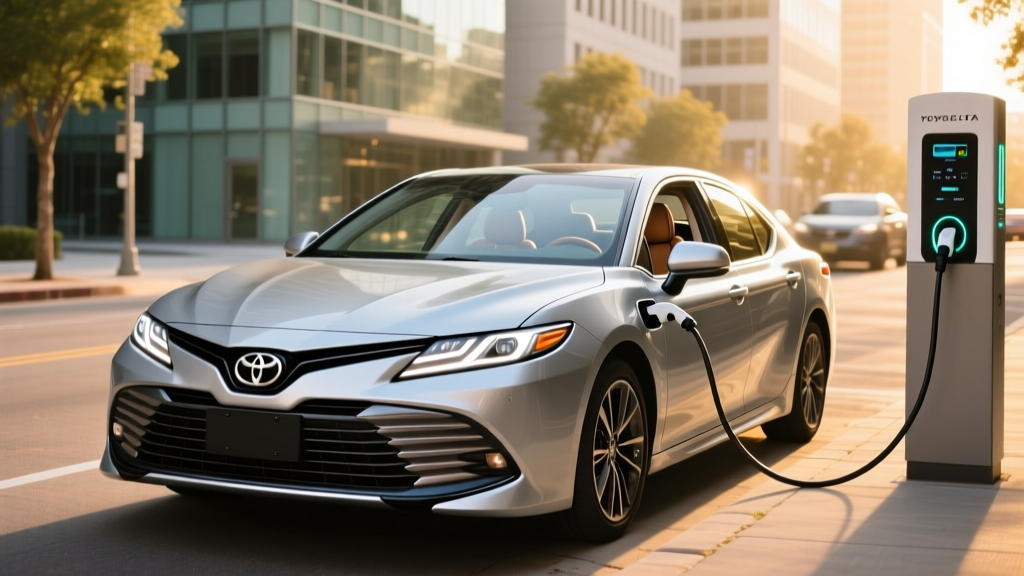
The 2024 Toyota Camry Hybrid LE remains one of the most fuel-efficient midsize sedans available without a plug. As the final model year of the XV70 generation before Toyota's redesigned 2025 Camry arrives with a hybrid-only lineup, the 2024 model represents a proven, mature platform with a decade of real-world reliability data behind its powertrain. For buyers who want maximum fuel economy without changing their fueling habits, the Camry Hybrid LE's EPA-estimated 52 MPG combined is difficult to beat at its $29,790 starting price.
Before we break down the numbers, one important clarification: the Camry Hybrid is a conventional hybrid (HEV), not a plug-in hybrid (PHEV). You never plug it in. It generates electricity through regenerative braking and its gasoline engine, storing energy in a small battery that assists acceleration and enables brief electric-only driving at low speeds.
HEV vs PHEV vs EV: Where the Camry Hybrid Fits
Electrified vehicles exist on a spectrum. Understanding where the Camry Hybrid LE sits helps you decide if it's the right choice versus a plug-in alternative or a full battery-electric vehicle.
| Feature | HEV (Camry Hybrid) | PHEV (e.g., Prius Prime) | BEV (e.g., Tesla Model 3) |
|---|---|---|---|
| Plug-in charging | No | Yes | Yes |
| Electric-only range | ~1 mile at low speed | 25-44 miles typical | 250-360+ miles |
| Fuel needed | Gasoline always | Gasoline after EV range | Electricity only |
| Home charging install | Not required | Recommended (Level 2) | Essential (Level 2) |
| Federal tax credit (§30D) | Not eligible | Up to $7,500* | Up to $7,500* |
| Upfront price premium | Low ($1,000-$3,000 over gas) | Medium ($4,000-$7,000) | High ($5,000-$15,000+) |
*§30D federal tax credit eligibility depends on buyer income limits, vehicle MSRP caps, and battery critical-mineral sourcing requirements. Check current IRS rules and consult a tax professional.
The Camry Hybrid LE is ideal if you lack home charging access, drive long highway miles regularly, or simply want fuel savings without altering your routine. A PHEV makes more sense if you have a garage with a 120V or 240V outlet and a short commute. A full BEV suits those with reliable charging access who want to eliminate gasoline entirely.
Fuel Economy: EPA Ratings and Real-World MPG
The headline number for the 2024 Camry Hybrid LE is its EPA-estimated fuel economy, which leads the midsize sedan segment.
| Metric | Value |
|---|---|
| City MPG | 51 |
| Highway MPG | 53 |
| Combined MPG | 52 |
| Fuel tank capacity | 13.2 gallons |
| Total range (estimated) | ~686 miles |
Source: fueleconomy.gov
A few notes on how the Camry Hybrid LE achieves these numbers and what to expect in practice:
City driving favors hybrids. The EPA city rating (51 MPG) is nearly identical to the highway rating (53 MPG) because regenerative braking recaptures energy during stop-and-go driving that a conventional gas car wastes as heat. In real-world city commuting with frequent stops, many owners report matching or even slightly exceeding the 51 MPG city figure.
Highway reality check. Sustained 75-80 MPH highway driving reduces efficiency. Expect 44-48 MPG on long interstate trips, particularly in hilly terrain or with a full passenger and cargo load. This is still exceptional for a midsize sedan, but it's below the EPA sticker.
Cold-weather impact. Hybrid batteries are less efficient in freezing temperatures, and the gasoline engine runs more frequently to provide cabin heat (since there's no resistive heater running off a large battery pack as in a BEV). Expect a 10-15% fuel economy reduction in sustained sub-30°F weather, bringing combined MPG to roughly 44-47.
Higher trims lose efficiency. The Camry Hybrid SE and XLE trims, with larger 18-inch wheels and additional equipment, drop to an EPA-estimated 44-46 MPG combined. The LE's lighter weight and 16-inch wheels are key to its class-leading number.
Powertrain Specifications
| Specification | Value |
|---|---|
| Engine | 2.5L 4-cylinder Atkinson-cycle |
| Engine horsepower | 176 hp @ 5,700 rpm |
| Electric motor output | 88 kW (118 hp) |
| Net combined system horsepower | 208 hp |
| Drivetrain | Front-wheel drive (AWD available on SE/XLE) |
| Transmission | Electronically controlled CVT (eCVT) |
| 0-60 MPH (est.) | ~7.5 seconds |
| Hybrid battery type | Lithium-ion |
| Hybrid battery capacity | ~1.0 kWh (nominal) |
The Camry Hybrid uses Toyota's fourth-generation Hybrid Synergy Drive system. The Atkinson-cycle engine sacrifices some low-RPM torque for higher thermal efficiency, while the electric motor fills in the torque gap during acceleration. The eCVT is not a belt-driven CVT like those in some conventional cars — it's a planetary gearset that seamlessly blends power from the engine and motor with no traditional shifting.
The ~1.0 kWh battery is small by PHEV or BEV standards, but it's not designed for range. It serves as an energy buffer: storing recaptured braking energy and deploying it for electric assist during acceleration, engine stop/start events, and very low-speed maneuvers.
Battery Warranty, Lifespan, and Replacement Cost
Toyota covers the 2024 Camry Hybrid's battery and hybrid system components for 10 years or 150,000 miles (whichever comes first) under its Hybrid System Warranty. This applies to the hybrid battery pack, inverter, and associated control modules. California-emissions states may see slightly different coverage terms — check your warranty booklet.
Hybrid battery longevity is one of the most common buyer concerns, and the data is reassuring. Toyota's hybrid battery packs in the Camry and Prius have demonstrated 150,000-250,000+ mile lifespans with proper maintenance. Unlike BEV batteries, which are stressed by deep charge/discharge cycles and DC fast charging, the Camry's small hybrid battery operates within a narrow state-of-charge window (roughly 40-80% SoC) managed by the vehicle's computer. This shallow cycling dramatically extends cell life.
If replacement is needed outside warranty: A new OEM hybrid battery from Toyota typically costs $2,000-$4,000 including installation. Refurbished or aftermarket options are available for $1,000-$2,500. Individual battery modules can sometimes be replaced for a few hundred dollars if only a single cell group has degraded. Given the 10-year/150,000-mile warranty and typical hybrid battery longevity, most original owners will never face this expense.
Pricing, Trims, and Tax Credit Eligibility
| Trim | MSRP (incl. destination) | EPA Combined MPG |
|---|---|---|
| LE (FWD) | $29,790 | 52 |
| SE (FWD) | $31,390 | 46 |
| SE (AWD) | $32,790 | 45 |
| XLE (FWD) | $33,890 | 46 |
| XLE (AWD) | $35,290 | 44 |
Prices reflect 2024 MSRP including $1,095 destination charge. Dealer pricing may vary.
Federal tax credit: The 2024 Camry Hybrid LE does not qualify for the IRS §30D Clean Vehicle Credit. This credit applies only to plug-in electric vehicles (BEVs and PHEVs) that meet battery capacity, sourcing, MSRP, and buyer income requirements. As a conventional hybrid, the Camry Hybrid relies solely on fuel savings — not purchase incentives — for its cost advantage.
State incentives: A small number of states offer rebates or HOV-lane access for conventional hybrids, but these programs are increasingly rare as incentives shift toward plug-in vehicles. Check your state's energy office or DMV for current programs.
Ownership Economics: 5-Year Cost Snapshot
To put the Camry Hybrid LE's value in perspective, here's a comparison of estimated 5-year fuel costs versus a comparable gasoline-only midsize sedan (EPA 30 MPG combined) and a PHEV alternative.
| Vehicle | Combined MPG | Gallons Used | 5-Year Fuel Cost |
|---|---|---|---|
| 2024 Camry Hybrid LE | 52 | 1,442 | $5,048 |
| Gas midsize sedan (30 MPG) | 30 | 2,500 | $8,750 |
| Savings vs. gas car | 1,058 fewer gallons | $3,702 saved | |
Over a typical 10-year ownership period, fuel savings alone could reach $7,000-$8,000 compared to a 30 MPG gasoline sedan — enough to offset the Camry Hybrid's modest price premium over a gas-only competitor and then some. The hybrid also benefits from reduced brake wear (regenerative braking handles much of the deceleration) and Toyota's strong resale value.
Who Should Choose the Camry Hybrid LE?
Choose the Camry Hybrid LE if:
- You lack access to home or workplace charging (apartment, street parking)
- Your commute involves heavy stop-and-go city traffic where hybrid efficiency peaks
- You regularly drive 400+ miles per tank and don't want to plan charging stops
- You want proven long-term reliability with minimal behavioral change
- Your budget is under $30,000 for a fuel-efficient midsize sedan
Look elsewhere if:
- You have home charging and a short commute — a PHEV (e.g., Prius Prime) eliminates most gas use
- You want zero tailpipe emissions — consider a BEV like the Hyundai Ioniq 6 or Tesla Model 3
- You prioritize acceleration and driving dynamics over efficiency (the Camry Hybrid is competent but not sporty)
- You need a plug-in to qualify for a federal tax credit (up to $7,500 for eligible PHEVs/BEVs)
Frequently Asked Questions
Does the 2024 Camry Hybrid LE need to be plugged in?
No. The Camry Hybrid is a conventional self-charging hybrid (HEV). It charges its small battery through regenerative braking and the gasoline engine. You fuel it like any other car at a gas station and never need a charging cable or outlet.
How many MPG does the 2024 Camry Hybrid LE actually get in real driving?
The EPA rates it at 52 MPG combined (51 city / 53 highway). In real-world driving, most owners report 48-52 MPG in mixed commuting. Pure highway driving at 75+ MPH typically yields 44-48 MPG. Cold weather can reduce efficiency by 10-15%. These figures make it one of the most fuel-efficient non-plug-in vehicles available.
How long will the hybrid battery last, and what does replacement cost?
Toyota's hybrid batteries routinely last 150,000-250,000+ miles. The factory warranty covers the hybrid battery for 10 years / 150,000 miles. Out-of-warranty replacement runs $2,000-$4,000 for a new OEM pack, or $1,000-$2,500 for a refurbished unit. Most owners never need a replacement.
Does the 2024 Camry Hybrid qualify for any federal tax credit?
No. The IRS §30D Clean Vehicle Credit applies only to plug-in vehicles (BEVs and PHEVs). The Camry Hybrid is a conventional HEV and is not eligible. Your savings come entirely from reduced fuel consumption, not purchase incentives.
Is the Camry Hybrid LE available with all-wheel drive?
No. AWD is available on the SE and XLE hybrid trims (adding a rear-mounted electric motor), but the LE trim is front-wheel drive only. If AWD is a priority, you'll need to step up to the SE Hybrid ($32,790 AWD) or XLE Hybrid ($35,290 AWD), which carry slightly lower EPA ratings of 44-45 MPG combined.
How does the 2024 Camry Hybrid compare to the 2025 redesigned Camry?
The 2025 Camry is fully redesigned and comes exclusively as a hybrid with Toyota's fifth-generation hybrid system. It offers slightly more power (up to 225 hp with AWD), updated infotainment, and a refreshed design. However, 2024 models may be available at significant dealer discounts as inventory clears, making them a strong value play for buyers who prioritize proven reliability over the latest features.