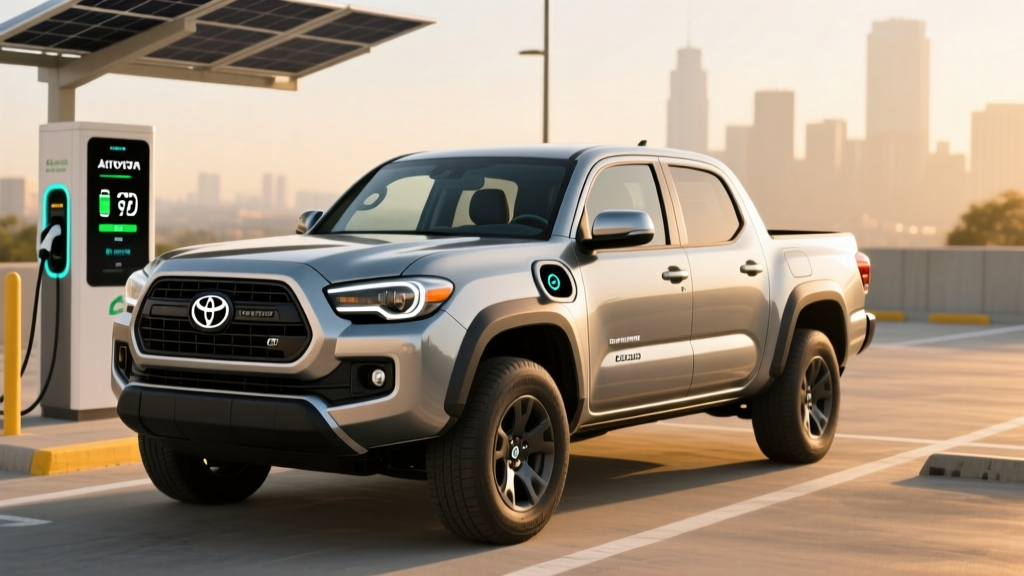
The midsize pickup segment finally got a serious hybrid contender when Toyota introduced the i-FORCE MAX powertrain in the fourth-generation Tacoma. Unlike the outgoing V6, the 2024 Tacoma Hybrid pairs a turbocharged four-cylinder with an electric motor integrated directly into the transmission — prioritizing torque and towing capability over maximum fuel-sipping efficiency. If you came here searching for the 2024 Tacoma Hybrid and wondering whether it actually saves fuel, how the hybrid system works, and whether it qualifies for any federal tax credits, this guide covers every spec that matters.
Before we get into the numbers, one clarification that trips up many truck shoppers: the Tacoma Hybrid is a conventional hybrid (HEV), not a plug-in hybrid (PHEV). You never plug it in. The small battery recharges through regenerative braking and the gasoline engine. If you want electric-only driving, you need to look at PHEV trucks like the Ford Maverick PHEV (when available) or step up to a full BEV like the Rivian R1T.
HEV vs PHEV: Where the Tacoma Hybrid Fits
Toyota has been deliberate about which vehicles get plug-in capability and which stay with conventional hybrid systems. Here's how the Tacoma's HEV setup compares to a PHEV alternative:
| Feature | Tacoma Hybrid (HEV) | Typical PHEV Truck/SUV |
|---|---|---|
| Plug-in charging required | No — self-charging | Yes — Level 1 or Level 2 |
| Electric-only range | None (motor assists engine) | 20–40 miles typical |
| Battery size | ~1.87 kWh (nickel-metal hydride) | 12–18 kWh (lithium-ion) |
| Federal tax credit (§30D) | Not eligible | Up to $7,500 if requirements met |
| Best use case | No home charging access; want simplicity | Home charger + short daily commute |
| Complexity / maintenance | Lower — no charging hardware | Higher — onboard charger, charge port |
The Tacoma's hybrid system exists to boost low-end torque for towing and off-road crawling while modestly improving fuel economy over the non-hybrid turbo four-cylinder. It is not designed to drive on electricity alone for meaningful distances.
i-FORCE MAX Powertrain: Engine, Motor, and Horsepower
The heart of the 2024 Tacoma Hybrid is Toyota's i-FORCE MAX powertrain, which combines:
- 2.4-liter turbocharged inline-4 engine producing 278 hp and 317 lb-ft of torque
- 48-hp electric motor integrated between the engine and the 8-speed automatic transmission
- Combined system output: 326 hp and 465 lb-ft of torque
That 465 lb-ft figure is the headline number — it's available low in the rev range thanks to the electric motor filling in torque before the turbo spools fully. For a midsize truck, this puts the Tacoma Hybrid ahead of most competitors in stock torque output and gives it genuine towing and trail-riding credibility.
| Specification | Value |
|---|---|
| Engine | 2.4L turbocharged I-4 |
| Electric motor | 48 hp, integrated in transmission |
| Combined horsepower | 326 hp |
| Combined torque | 465 lb-ft |
| Transmission | 8-speed automatic |
| Battery type | Nickel-metal hydride (NiMH) |
| Battery capacity | ~1.87 kWh |
| Drivetrain | RWD or 4WD (trim dependent) |
| Max towing capacity | 6,000 lbs (properly equipped) |
Note that the hybrid battery is nickel-metal hydride (NiMH), not lithium-ion. Toyota has used NiMH extensively in its hybrid lineup for decades due to proven durability and thermal stability, though it sacrifices some energy density compared to modern lithium chemistries.
EPA MPG Ratings and Real-World Fuel Economy
Fuel economy is where expectations need calibration. The i-FORCE MAX hybrid was engineered primarily for performance and towing torque, not Prius-level efficiency. Here are the official EPA estimates depending on configuration:
| Configuration | City MPG | Highway MPG | Combined MPG |
|---|---|---|---|
| 4x2 (RWD) | 23 | 27 | 24 |
| 4x4 (4WD) | 22 | 26 | 23 |
| TRD Off-Road / Pro (4WD, off-road tires) | 22 | 25 | 23 |
For comparison, the non-hybrid 2024 Tacoma with the standard i-FORCE 2.4L turbo (278 hp) achieves an EPA-estimated 20 city / 26 highway / 23 combined in 4x2 form. The hybrid's advantage is most pronounced in city and mixed driving, where the electric motor's torque fill reduces the engine's workload during acceleration. On the highway, the difference narrows because the electric motor contributes less at steady cruising speeds.
Hybrid Battery Warranty, Lifespan, and Replacement Cost
Battery longevity is the number-one concern for hybrid buyers, and Toyota has addressed it with one of the strongest warranty packages in the industry.
In practice, Toyota's NiMH hybrid batteries have demonstrated exceptional longevity. Data from fleets and long-term owners of the Prius, Camry Hybrid, and Highlander Hybrid shows many original batteries lasting 200,000+ miles with minimal degradation. The Tacoma's relatively small 1.87 kWh pack experiences shallow charge/discharge cycles — it rarely drops below 40% state of charge or exceeds 80% — which is ideal for NiMH chemistry longevity.
If the battery does eventually need replacement outside of warranty, expect to pay between $2,000 and $3,500 for a new OEM pack at a Toyota dealer, including labor. Refurbished and aftermarket options are emerging as earlier Toyota hybrids age, which may reduce costs further. Given the 10-year/150,000-mile warranty and the proven track record of Toyota NiMH packs, battery replacement risk is low for most original owners.
Pricing, Trims, and Tax Credit Eligibility
The i-FORCE MAX hybrid powertrain is available across multiple Tacoma trims for the 2024 model year. Here's the approximate MSRP breakdown (destination charges included):
- Tacoma Limited (4WD): ~$52,000
- Tacoma TRD Pro: ~$63,000
- Tacoma Trailhunter: ~$62,000
- Tacoma TRD Off-Road (hybrid option): ~$47,000–$50,000
The hybrid powertrain adds roughly $2,000–$3,000 over the equivalent non-hybrid turbo four-cylinder configuration, depending on trim. That premium buys you the additional 88 lb-ft of torque and modestly improved city fuel economy.
Federal Tax Credit: Does the Tacoma Hybrid Qualify?
No. Under the IRS §30D Clean Vehicle Credit rules, only battery electric vehicles (BEVs) and plug-in hybrid electric vehicles (PHEVs) with a minimum battery capacity of 7 kWh are eligible. The Tacoma Hybrid's ~1.87 kWh NiMH battery and conventional HEV architecture do not meet this threshold.
This means you will not receive the up-to-$7,500 federal tax credit for purchasing a Tacoma Hybrid, regardless of your income, the vehicle's MSRP, or where it was assembled. If a federal hybrid tax credit becomes available in future legislation, that could change — but as of current law, conventional hybrids receive no purchase incentive at the federal level.
Some states and local utilities offer modest rebates or HOV lane access for hybrids, but these vary widely by jurisdiction. Check your state's energy office or utility provider for current programs.
Who Should Buy the Tacoma Hybrid vs a Full EV or Gas Truck
Pros
- 465 lb-ft torque from low RPM — excellent for towing and off-road
- No plug-in charging required — works like a normal truck
- 10-year/150,000-mile hybrid battery warranty
- Better city MPG than non-hybrid Tacoma
- Proven Toyota hybrid reliability track record
- Available across many trims (not limited to top-tier)
Cons
- No federal tax credit eligibility
- Highway MPG barely beats non-hybrid (22–24 real-world)
- ~$2,000–$3,000 price premium over non-hybrid
- Small battery means no electric-only driving capability
- TRD Pro / Trailhunter trims push MSRP above $60K
- Towing fuel economy drops to 12–16 mpg (typical for class)
Decision Framework
Choose the Tacoma Hybrid if: You want a midsize truck with strong low-end torque for towing and trail use, you don't have access to home charging, you want Toyota's proven hybrid reliability, and you value the 10-year battery warranty. The hybrid makes the most sense on TRD Off-Road or Limited trims where the price premium is reasonable relative to the overall vehicle cost.
Stick with the gas-only Tacoma if: You mostly drive highway miles (where the hybrid advantage is minimal), you want the lowest possible purchase price, or you're buying a base SR/SR5 trim where the hybrid option isn't available.
Consider a full EV truck (Rivian R1T, Chevrolet Silverado EV) if: You have reliable home Level 2 charging, your daily driving is under 250 miles, you want zero tailpipe emissions, and you're willing to accept current EV truck limitations on towing range and charging infrastructure in remote areas.
Frequently Asked Questions
How many MPG does the 2024 Tacoma Hybrid get?
The EPA rates the 2024 Tacoma Hybrid at 22 city / 26 highway / 23 combined in 4WD form, and 23/27/24 in RWD. In real-world driving, expect city MPG to slightly exceed the EPA estimate thanks to regenerative braking, while highway and towing figures may fall below.
Can the Tacoma Hybrid drive on electric power only?
Not for any meaningful distance. The 48-hp electric motor can move the truck at very low speeds (parking lots, creeping in traffic) for brief moments, but the gasoline engine engages almost immediately under normal acceleration. This is by design — the system prioritizes torque assist, not electric-only range.
Does the Tacoma Hybrid need to be plugged in?
No. The Tacoma Hybrid is a conventional (self-charging) hybrid. The 1.87 kWh battery recharges through regenerative braking and the gasoline engine. There is no charge port and no plug-in capability.
Is the Tacoma Hybrid reliable, and what does battery replacement cost?
Toyota's hybrid systems have an industry-leading reliability record, backed by a 10-year/150,000-mile hybrid battery warranty. If replacement is needed out of warranty, expect $2,000–$3,500 for a new OEM NiMH pack. Many Toyota hybrid batteries last 200,000+ miles based on long-term fleet data.
Does the 2024 Tacoma Hybrid qualify for a federal tax credit?
No. Under current IRS §30D rules, only BEVs and PHEVs with at least 7 kWh of battery capacity qualify for the federal Clean Vehicle Credit. The Tacoma Hybrid's 1.87 kWh pack and conventional HEV architecture make it ineligible. No federal purchase incentive applies.
How does the Tacoma Hybrid compare to the Ford Maverick Hybrid?
The Ford Maverick Hybrid is a smaller, unibody compact truck with a more efficiency-focused hybrid system, achieving an EPA-estimated 42 city / 33 highway / 37 combined. It sacrifices towing capacity (2,000 lbs) and off-road capability for dramatically better fuel economy. The Tacoma Hybrid is a body-on-frame midsize truck built for towing (6,000 lbs) and off-road use, with fuel economy as a secondary benefit. They serve fundamentally different buyer needs.