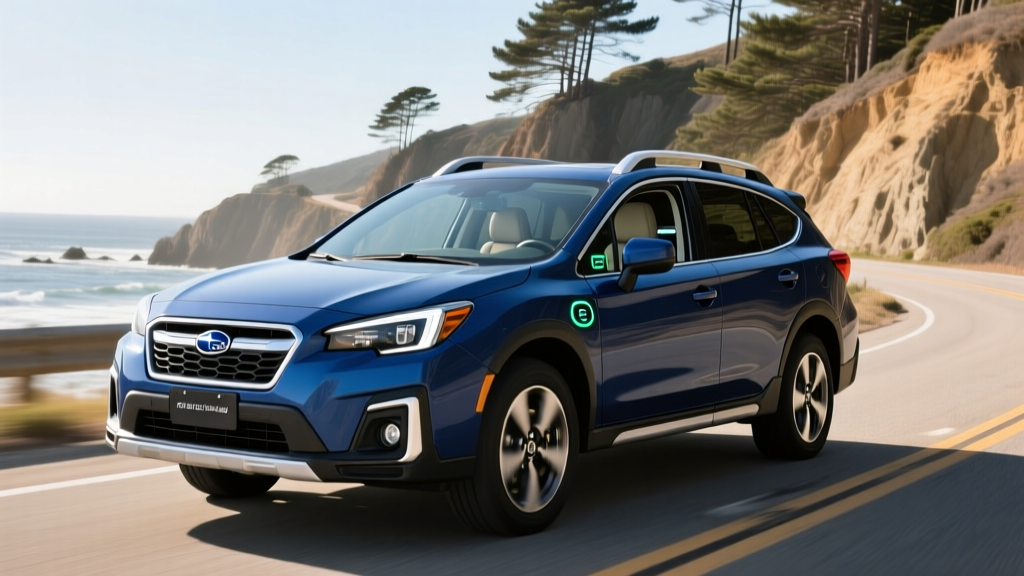
The 2024 Subaru Crosstrek Hybrid occupies a specific niche: it's a plug-in hybrid (PHEV) compact crossover built for buyers who want electric commuting capability without sacrificing Subaru's trademark all-wheel-drive confidence and 8.7 inches of ground clearance. But with a modest 17-mile electric-only range and a price premium over the gas-only Crosstrek, does the math work for your daily drive? This guide breaks down every number that matters — from EPA MPG to battery warranty to federal tax credit eligibility — so you can decide whether this PHEV earns a spot in your driveway.
| Spec | 2024 Crosstrek Hybrid |
|---|---|
| Powertrain Type | Plug-in Hybrid (PHEV) |
| Combined Horsepower | 219 hp |
| Engine | 2.0L 4-cylinder + 2 electric motors |
| Battery Capacity (usable) | 8.8 kWh (13.6 kWh gross), lithium-ion |
| EPA Electric-Only Range | 17 miles |
| EPA Combined Range (EV + Gas) | 420 miles |
| EPA MPGe (EV mode) | 92 MPGe |
| EPA MPG (hybrid mode) | 35 combined (33 city / 38 highway) |
| Level 2 Charge Time (0-100%) | ~2.5 hours at 240V |
| DC Fast Charging | Not available |
| Drivetrain | Symmetrical AWD (standard) |
| 0-60 mph | ~6.8 seconds |
| Base MSRP | $36,845 |
| Battery Warranty | 8 years / 100,000 miles |
Understanding the Crosstrek Hybrid: PHEV vs. Conventional Hybrid
Before diving into specs, it's critical to clarify what the 2024 Crosstrek Hybrid actually is — because Subaru's naming can create confusion.
Hybrid (HEV) vs. Plug-in Hybrid (PHEV)
Conventional Hybrid (HEV): Uses a small battery recharged solely by the engine and regenerative braking. You never plug it in. The Toyota RAV4 Hybrid is a classic example — it captures energy from braking and the gas engine to assist acceleration and improve MPG. Typical electric-only driving is limited to brief low-speed coasting.
Plug-in Hybrid (PHEV): Carries a larger battery (8.8 kWh usable in the Crosstrek Hybrid) that you can plug in to charge at home or at public Level 2 stations. This enables genuine electric-only driving — in this case, 17 EPA-rated miles — before the gas engine engages. Once the battery depletes, it operates like a conventional hybrid.
The 2024 Crosstrek Hybrid is strictly a PHEV. There is no conventional HEV version of the Crosstrek in the U.S. market for this model year. If you don't plan to plug in regularly, you'll still benefit from its hybrid-mode efficiency (35 MPG combined), but you'll be paying a premium for battery capacity you're not utilizing.
Fuel Economy: EPA Numbers and Real-World MPG
The Crosstrek Hybrid's efficiency story splits into two chapters depending on whether you're driving on battery or gas.
| Driving Mode | City | Highway | Combined |
|---|---|---|---|
| EV Mode (MPGe) | 105 MPGe | 80 MPGe | 92 MPGe |
| Hybrid Mode (MPG) | 33 MPG | 38 MPG | 35 MPG |
Source: EPA Fuel Economy
Real-World MPG vs. EPA Estimates
Plug-in hybrids often exceed their EPA city MPG estimates in real-world driving because regenerative braking recaptures more energy in stop-and-go traffic. Owners who plug in nightly and commute under 17 miles may use almost no gasoline for weeks. However, on sustained highway trips above 70 mph — especially with the Crosstrek's boxy crossover profile and all-terrain tires — expect hybrid-mode fuel economy to land closer to 32-34 MPG. In cold weather (below 30°F), the engine starts sooner to provide cabin heat, which reduces electric-only range to roughly 12-14 miles.
The total combined range of approximately 420 miles (17 electric + ~403 on the 13.2-gallon fuel tank in hybrid mode) means road-trip range anxiety is essentially nonexistent. You'll stop for gas long before the tank runs dry.
Electric-Only Range and Charging: What to Expect
The 17-mile EPA electric-only range is the Crosstrek Hybrid's most debated figure. For context, the average American one-way commute is roughly 16 miles, according to Census Bureau data — so this PHEV can theoretically cover many commutes entirely on electricity. But it's tight. Any detour, errand, or highway-speed driving will eat into that buffer quickly.
Charging Speeds and Connector Details
The Crosstrek Hybrid uses a standard J1772 connector for AC charging and does not support DC fast charging — a significant limitation compared to full EVs. Here's what charging looks like:
- Level 1 (120V household outlet): Approximately 5 hours for a full charge, adding roughly 3-4 miles of range per hour of charging.
- Level 2 (240V home or public station): Approximately 2.5 hours from empty to full. This is practical for overnight charging or topping up during a workday.
Because the usable battery is only 8.8 kWh, even a standard 120V outlet can meaningfully replenish the pack overnight. Many PHEV owners find Level 1 sufficient — a key advantage over full EVs, which practically require Level 2 home installations.
Powertrain Performance: 219 HP with AWD Confidence
The Crosstrek Hybrid pairs a 2.0-liter horizontally opposed (Boxer) 4-cylinder engine with two electric motors integrated into Subaru's symmetrical all-wheel-drive system. The combined output is 219 horsepower — a substantial 67-hp bump over the gas-only Crosstrek's 152 hp.
That extra power is immediately noticeable. The 0-60 mph time drops to approximately 6.8 seconds (compared to ~9.5 seconds for the gas model), making highway merging and passing far more confident. The electric motors deliver instant torque at low speeds, and the continuously variable transmission (CVT) operates more smoothly in EV mode since the engine isn't running.
The AWD system remains fully functional in EV mode — a meaningful advantage over some PHEV competitors that rely on the engine to power the rear wheels. Subaru's system uses the second electric motor to drive the rear axle independently, maintaining traction capability even on battery power alone.
Pricing, Trims, and Tax Credit Eligibility
The 2024 Crosstrek Hybrid starts at $36,845 (including destination), available in a single well-equipped trim level. Standard features include EyeSight driver-assistance technology (SAE Level 2 — the driver must remain engaged at all times), an 8-inch touchscreen with wireless Apple CarPlay and Android Auto, heated front seats, and roof rails.
Federal Tax Credit: Does It Qualify?
Under the current IRS §30D rules, the 2024 Crosstrek Hybrid is eligible for a partial federal tax credit. Because its battery is manufactured in Japan and its critical minerals sourcing does not fully meet the 2024 thresholds, it qualifies for $3,750 (the critical-minerals half of the credit only — it does not meet the battery-component requirement). This credit is subject to:
- Buyer income caps: Modified AGI must not exceed $150,000 (single), $225,000 (head of household), or $300,000 (joint filers).
- MSRP cap: The vehicle must have an MSRP under $80,000 for SUVs/CUVs — the Crosstrek Hybrid easily clears this.
- Point-of-sale transfer: As of 2024, buyers can transfer the credit to the dealer for an immediate price reduction at purchase, rather than waiting to claim it on their tax return.
For detailed eligibility rules, consult the IRS clean vehicle credit page and verify with a tax professional before purchasing. State-level incentives vary by jurisdiction — check your state's energy office or DMV for local rebates that may stack on top of the federal credit.
Battery Warranty and Replacement Cost
Subaru covers the Crosstrek Hybrid's lithium-ion battery pack with an 8-year / 100,000-mile warranty (10 years / 150,000 miles in California-emissions states). This warranty guarantees the battery will retain sufficient capacity to function as a PHEV — typically defined as maintaining above 60-70% of original capacity. If the battery degrades below the threshold within the warranty period, Subaru will repair or replace it at no cost.
Out-of-warranty replacement costs are estimated between $6,000 and $9,000 including labor, based on comparable Toyota/Subaru PHEV battery pricing. However, PHEV batteries experience less stress than full EV batteries due to their smaller size and frequent shallow cycling, and real-world data from the Toyota Prius Prime (which shares similar battery architecture) shows most packs last well beyond 150,000 miles with minimal degradation.
Reliability and Long-Term Ownership
Subaru's PHEV powertrain is derived from the Toyota Prius Prime's proven hybrid architecture — a result of the Subaru-Toyota partnership. This is a significant reliability advantage: the hybrid system has been iterated over millions of vehicles across two decades. The 2.0L Boxer engine is less stressed than in the gas-only Crosstrek because the electric motors share acceleration loads.
Owner-reported reliability for the Crosstrek Hybrid has been strong, with no widespread battery failure patterns. The primary long-term ownership costs to budget for are standard Subaru maintenance (CVT fluid service, brake inspections — though regen braking extends pad life significantly) and the eventual A/C compressor or inverter replacement that all hybrid vehicles face at high mileage.
Who Should Choose the Crosstrek Hybrid vs. a Full EV or Gas Car?
Pros
- Standard AWD with full electric-mode traction
- 219 hp makes it the quickest Crosstrek variant
- No range anxiety — 420-mile total range
- Level 1 charging is practical (no panel upgrade needed)
- 8.7 inches ground clearance for light off-road use
- $3,750 federal tax credit (income permitting)
Cons
- Only 17 miles electric-only range — tight for many commutes
- No DC fast charging capability
- Single trim limits customization
- $36,845 MSRP is ~$10,000 more than base gas Crosstrek
- Cargo space reduced vs. gas model (battery placement)
- Partial tax credit only ($3,750 vs. full $7,500)
Decision Framework: Hybrid vs. PHEV vs. Full EV
Which Powertrain Fits Your Situation?
Choose the Crosstrek Hybrid (PHEV) if:
- Your daily round-trip commute is under 20 miles and you can charge at home
- You need AWD and ground clearance for snow, dirt roads, or outdoor recreation
- You take regular road trips and don't want to plan around charging stations
- You live in a cold climate where EV range loss is a concern
- You can't install a Level 2 charger (Level 1 is sufficient for this PHEV)
Choose a full EV (like the Hyundai Ioniq 5 or Subaru Solterra) if:
- Your daily driving exceeds 30 miles but stays under 250 miles
- You have reliable home Level 2 charging and access to DC fast chargers for road trips
- You want maximum fuel-cost savings and zero tailpipe emissions
- You qualify for the full $7,500 federal tax credit on an eligible EV
Choose the gas-only Crosstrek if:
- You can't charge at home or at work
- Your budget is closer to $25,000-$28,000
- You drive fewer than 8,000 miles per year (the fuel savings won't offset the PHEV premium)
Frequently Asked Questions
How many MPG does the 2024 Subaru Crosstrek Hybrid get?
In hybrid mode (after the battery is depleted), the Crosstrek Hybrid achieves an EPA-rated 35 MPG combined — 33 city and 38 highway. In EV mode, it earns 92 MPGe combined. Real-world city driving with frequent regenerative braking often yields 36-38 MPG in hybrid mode, while sustained highway driving at 75+ mph may drop to 32-34 MPG.
How far can the Crosstrek Hybrid go on electric only?
The EPA rates it at 17 miles of electric-only range. In mild weather at moderate speeds (under 45 mph), you may stretch this to 19-20 miles. In cold weather or at highway speeds, expect 12-14 miles. The total combined range (electric + gas) is approximately 420 miles.
Does the 2024 Crosstrek Hybrid qualify for a tax credit?
Yes — it qualifies for a partial federal tax credit of $3,750 under IRS §30D rules, subject to buyer income limits ($150K single / $300K joint). It does not qualify for the full $7,500 because its battery components do not meet the domestic sourcing threshold. The credit can be transferred to the dealer at point of sale. Always verify current eligibility on irs.gov before purchasing.
Is the Crosstrek Hybrid reliable and what does battery replacement cost?
Reliability has been strong, thanks to the Toyota-derived hybrid system. The battery is warrantied for 8 years / 100,000 miles (10/150K in CARB states). Out-of-warranty replacement is estimated at $6,000-$9,000, though most PHEV batteries from this architecture last well beyond 150,000 miles with gradual, manageable degradation.
Do I need to install a Level 2 charger at home for the Crosstrek Hybrid?
No — and this is a major PHEV advantage. The 8.8 kWh battery charges fully in about 5 hours on a standard 120V household outlet (Level 1). If you plug in every night, Level 1 is sufficient. A Level 2 (240V) installation reduces charge time to about 2.5 hours and is worth considering if you want faster mid-day top-ups or plan to own a full EV in the future.
How does the Crosstrek Hybrid compare to the Toyota RAV4 Prime?
The RAV4 Prime offers a significantly longer 42-mile electric-only range, 302 combined horsepower, and a higher starting price (~$43,000). If your commute is longer than 17 miles, the RAV4 Prime's larger battery is a compelling upgrade. The Crosstrek Hybrid is more affordable, more compact for city driving, and offers comparable ground clearance for outdoor use.
Note: The 2024 Subaru Crosstrek Hybrid was a carryover model. Subaru has signaled shifts in its electrification strategy for subsequent model years. Always verify the latest specs, pricing, and tax credit eligibility on Subaru's official site and with your local dealer before purchasing.