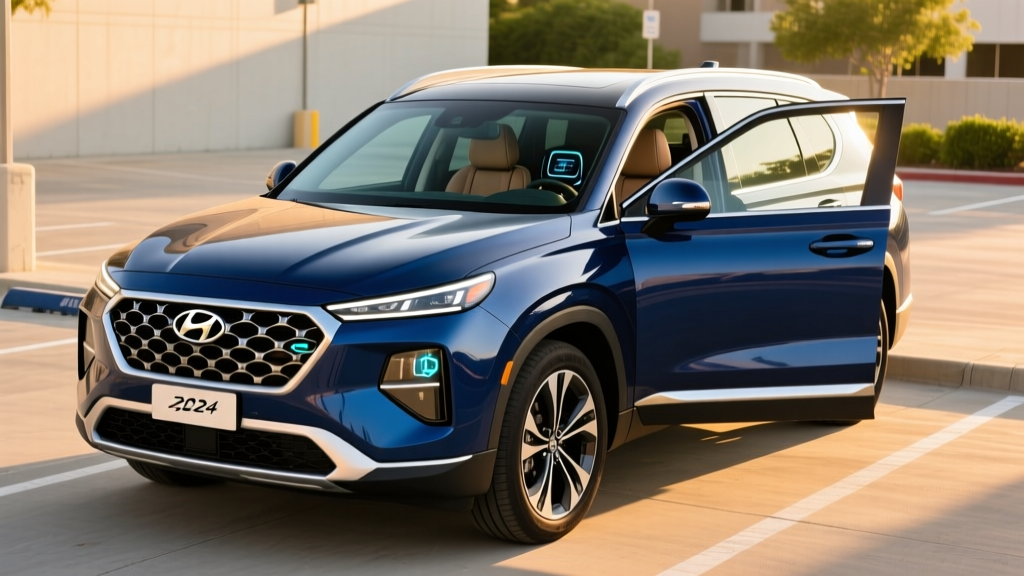
Quick Verdict: The 2024 Hyundai Santa Fe Hybrid Calligraphy
The 2024 Hyundai Santa Fe Hybrid Calligraphy sits at the top of Hyundai's three-row midsize SUV lineup, pairing a turbocharged 1.6-liter hybrid powertrain with the brand's most luxurious trim. If you need three rows, want meaningful fuel savings over a gas-only SUV, but aren't ready to commit to charging infrastructure, this is one of the most compelling hybrid options on the market. The Calligraphy trim commands a premium at $47,650 MSRP (plus destination), but delivers a near-luxury interior, a 12.3-inch dual-screen setup, and EPA-estimated 34 MPG combined — a figure that holds up well in real-world mixed driving.
This is a conventional hybrid (HEV), not a plug-in hybrid. You never plug it in. The 1.49 kWh lithium-ion battery charges exclusively through regenerative braking and the gasoline engine. If you're looking for electric-only driving range, you'll want the Santa Fe Plug-in Hybrid (PHEV) variant instead — we cover that distinction below.
HEV vs PHEV: Which Santa Fe Hybrid Is This?
Hyundai sells the redesigned Santa Fe in three powertrain configurations for the 2024 model year, and buyers frequently confuse them. Here's the breakdown:
| Attribute | Santa Fe Hybrid (HEV) | Santa Fe Plug-In Hybrid (PHEV) | Santa Fe Gas (ICE) |
|---|---|---|---|
| Powertrain | 1.6L Turbo + electric motor | 1.6L Turbo + larger electric motor | 2.5L Turbo 4-cylinder |
| Combined HP | 230 hp | 258 hp | 277 hp |
| Battery Capacity | 1.49 kWh | 13.8 kWh | N/A |
| Plug-In Required? | No — self-charging | Yes — Level 1 or Level 2 | No |
| Electric-Only Range | N/A (motor assists only) | ~30 miles (EPA est.) | N/A |
| EPA Combined MPG | 34 MPG | 33 MPG (gas mode) / 79 MPGe (electric) | 22-24 MPG |
| Federal Tax Credit | Not eligible | Not eligible (§30D sourcing rules) | Not eligible |
Key takeaway: The Calligraphy trim is available on both the HEV and PHEV. This review focuses on the conventional hybrid (HEV) — the version that requires no charging and operates like a traditional gas car with dramatically improved fuel economy. The HEV uses its small 1.49 kWh battery for electric motor assist during acceleration, low-speed crawling, and regenerative braking energy recapture. You'll never see an EV-only range figure because the battery is too small to propel the vehicle independently at meaningful speeds.
Fuel Economy: EPA Numbers and Real-World MPG
The EPA rates the 2024 Hyundai Santa Fe Hybrid at 35 MPG city / 31 MPG highway / 34 MPG combined for front-wheel-drive models, according to fueleconomy.gov. The Calligraphy trim is offered exclusively with HTRAC all-wheel drive, which adjusts those figures to 33 MPG city / 30 MPG highway / 32 MPG combined.
| Driving Cycle | EPA Estimate | Real-World Expectation |
|---|---|---|
| City | 33 MPG | 34-37 MPG (hybrids often exceed EPA in stop-and-go) |
| Highway | 30 MPG | 28-30 MPG (aerodynamic drag limits regen benefit) |
| Combined | 32 MPG | 31-34 MPG depending on driving mix |
Real-world note: Conventional hybrids like the Santa Fe HEV tend to outperform their EPA city estimates because regenerative braking recovers more energy in stop-and-go traffic than the test cycle captures. On suburban commutes with frequent stops, owners routinely report 35-37 MPG. Highway-only road trips at 75+ MPH will dip closer to 27-29 MPG — the electric motor provides minimal assistance at sustained high speeds, and the boxy, three-row bodywork creates significant aerodynamic drag.
With a 17.7-gallon fuel tank, the AWD Calligraphy delivers roughly 565 miles of total range at combined EPA figures. In favorable city-heavy driving, you could stretch that past 600 miles between fill-ups.
Powertrain and Performance Specs
| Specification | Value |
|---|---|
| Engine | 1.6L turbocharged GDI 4-cylinder |
| Electric Motor | 47.7 kW (64 hp) permanent-magnet synchronous |
| Combined System Output | 230 hp / 271 lb-ft torque |
| Transmission | 6-speed automatic |
| Drivetrain | HTRAC AWD (standard on Calligraphy) |
| Hybrid Battery | 1.49 kWh lithium-ion (self-charging) |
| 0-60 MPH | ~7.8 seconds (est.) |
| Towing Capacity | 2,000 lbs (braked) |
| Cargo Volume (behind 3rd/2nd/1st row) | 14.6 / 40.5 / 79.6 cu ft |
| Curb Weight | ~4,550 lbs |
The 1.6-liter turbo four-cylinder produces 178 hp on its own, and the integrated electric motor adds 64 hp for a combined system output of 230 hp and 271 lb-ft of torque. Unlike Toyota's e-CVT hybrid system, Hyundai uses a conventional 6-speed automatic transmission, which delivers more natural-feeling acceleration without the rubber-band effect some drivers dislike in CVT-equipped hybrids.
The electric motor's primary roles are torque fill during initial acceleration (eliminating turbo lag), regenerative energy capture during deceleration, and enabling engine-off coasting and low-speed electric assist in stop-and-go traffic. You won't get silent EV-mode cruising at highway speeds, but around town, the engine shuts off frequently — at stoplights, in parking lots, and during gentle deceleration.
Pricing, Trims, and Tax Credit Eligibility
The 2024 Hyundai Santa Fe Hybrid is offered in three trims, all with the same powertrain:
- SEL Premium: $40,350 MSRP (+ $1,495 destination)
- Limited: $43,850 MSRP (+ $1,495 destination)
- Calligraphy: $47,650 MSRP (+ $1,495 destination)
The Calligraphy adds Nappa leather seating surfaces, a head-up display, Hyundai Digital Key 2, a 12.3-inch dual-screen panoramic display, second-row USB-C fast-charging ports, remote smart parking assist, and 20-inch alloy wheels. It's the most expensive hybrid Santa Fe, pushing close to $50,000 out the door with destination and any dealer-installed accessories.
Federal tax credit: The conventional hybrid Santa Fe does not qualify for the IRS §30D Clean Vehicle Credit. That credit applies only to plug-in electric vehicles (BEVs and PHEVs) that meet battery sourcing, MSRP, and buyer income requirements. Even the Santa Fe Plug-In Hybrid currently fails the §30D critical minerals and battery component sourcing requirements, meaning no 2024 Santa Fe variant — HEV or PHEV — is eligible for the federal credit as of current IRS qualified vehicle lists.
Some states offer separate hybrid or clean-fuel rebates (California's CVRP, for example, has historically targeted zero-emission vehicles and typically excludes conventional hybrids). Check your state's energy office or Alternative Fuels Data Center for local incentive eligibility.
Battery Warranty, Reliability, and Long-Term Costs
The 1.49 kWh hybrid battery in the Santa Fe HEV is small and operates within a narrow state-of-charge window — typically between 40% and 80% SoC — managed by the vehicle's battery management system. This shallow cycling strategy dramatically extends cell life compared to full-charge/discharge cycles. Hyundai has used similar hybrid battery architectures across the Sonata Hybrid, Tucson Hybrid, and Ioniq Hybrid for years with minimal widespread failure reports.
Battery replacement cost: If the hybrid battery does fail outside warranty (unlikely before 150,000+ miles based on industry data), replacement cost for the Santa Fe HEV battery pack is estimated at $2,000-$4,000 including labor. This is significantly cheaper than a full EV traction battery replacement because the pack is small — 1.49 kWh versus the 60-100 kWh packs in battery-electric vehicles.
The 2024 Santa Fe is a redesigned model (fifth generation), so long-term reliability data specific to this generation is still accumulating. Hyundai's hybrid systems have generally performed well in J.D. Power and Consumer Reports assessments, though the brand's overall reliability ratings trail Toyota and Honda. The turbocharged 1.6L engine adds a complexity variable compared to naturally aspirated hybrid powertrains — turbo failures are uncommon but not unheard of past 100,000 miles.
Who Should Buy the Santa Fe Hybrid Calligraphy?
- You need three rows but don't want a minivan or full-size SUV
- You drive 15,000+ miles/year and want to cut fuel costs without plugging in
- Your home lacks charging access (apartment, street parking, no garage)
- You want a premium interior without paying luxury-brand pricing ($55K+)
- You take frequent road trips where EV charging infrastructure is sparse
Consider a full EV instead if:
- You can install a Level 2 home charger and drive under 300 miles/day
- You want zero tailpipe emissions and the lowest per-mile fuel cost
- You're eligible for the $7,500 federal tax credit on a qualifying BEV
- You want minimal maintenance (no oil changes, no transmission fluid)
Consider the gas Santa Fe (2.5T) if:
- You tow more than 2,000 lbs regularly (the 2.5T tows 3,500 lbs)
- You drive under 8,000 miles/year and the hybrid fuel savings won't offset the price premium
The Calligraphy trim specifically targets buyers who want luxury-adjacent features — Nappa leather, head-up display, premium audio — without stepping into Genesis or European luxury territory. At roughly $49,000 out the door, it undercuts comparably equipped luxury three-row SUVs by $15,000-$25,000 while delivering better fuel economy than any of them.
Pros and Cons
- 32-34 MPG combined in a three-row AWD SUV
- No plug-in charging required — works with existing gas infrastructure
- 10-year / 100,000-mile hybrid battery warranty
- Premium Calligraphy interior rivals entry-level luxury brands
- 6-speed automatic avoids CVT drone
- Strong city MPG that often exceeds EPA estimate
- No federal tax credit eligibility (HEV or PHEV)
- Highway MPG drops to 28-30 at 75+ MPH
- 2,000-lb towing capacity limits utility for boat/trailer owners
- Calligraphy price approaches $50K with destination
- Third row is tight for adults on longer trips
- Redesigned generation — limited long-term reliability data
Frequently Asked Questions
How many MPG does the 2024 Hyundai Santa Fe Hybrid Calligraphy get?
The AWD Calligraphy is EPA-rated at 33 MPG city, 30 MPG highway, and 32 MPG combined. In real-world city-heavy driving, expect 34-37 MPG thanks to regenerative braking. Highway-only driving at 75+ MPH will return closer to 27-29 MPG.
Does the Santa Fe Hybrid need to be plugged in?
No. The Santa Fe Hybrid (HEV) is a self-charging conventional hybrid. The 1.49 kWh battery charges through regenerative braking and the gasoline engine. You fuel it exclusively at gas stations. Only the Santa Fe Plug-In Hybrid (PHEV) variant requires or accepts plug-in charging.
Does the 2024 Santa Fe Hybrid qualify for any tax credit?
No. The conventional hybrid does not qualify for the IRS §30D federal clean vehicle credit, which is limited to plug-in vehicles meeting battery sourcing requirements. The Santa Fe PHEV also currently fails sourcing requirements. Some state-level incentives may apply — check your state's energy office or the Alternative Fuels Data Center.
How reliable is the Santa Fe Hybrid and what does a battery replacement cost?
Hyundai covers the hybrid battery with a 10-year / 100,000-mile warranty. The small 1.49 kWh pack operates in a shallow charge cycle that promotes longevity. Out-of-warranty replacement is estimated at $2,000-$4,000 — far less than an EV battery. Long-term reliability data for the redesigned 2024 generation is still accumulating, but Hyundai's hybrid systems have a solid track record in prior models.
Hybrid vs PHEV vs EV — which Santa Fe should I buy?
Choose the HEV (this vehicle) if you can't charge at home, drive long distances regularly, or want the simplest ownership experience. Choose the PHEV if you have home Level 2 charging, commute under 30 miles round-trip, and want electric-only daily driving with a gas backup. Choose a full EV (like the Hyundai Ioniq 5 or Kia EV9) if you have reliable home charging, want the lowest operating costs, and your daily driving stays under 250 miles.
How does the Santa Fe Hybrid compare to the Toyota Highlander Hybrid?
The Toyota Highlander Hybrid AWD is EPA-rated at 35 MPG combined — 3 MPG higher than the Santa Fe Hybrid AWD. However, the Santa Fe offers a more modern interior design, more standard technology features at equivalent trims, and Hyundai's longer 10-year powertrain warranty versus Toyota's 5-year/60,000-mile powertrain coverage. The Highlander Hybrid has stronger long-term reliability data and higher resale value, making it the safer conservative pick. The Santa Fe Hybrid is the more design-forward, feature-rich choice.