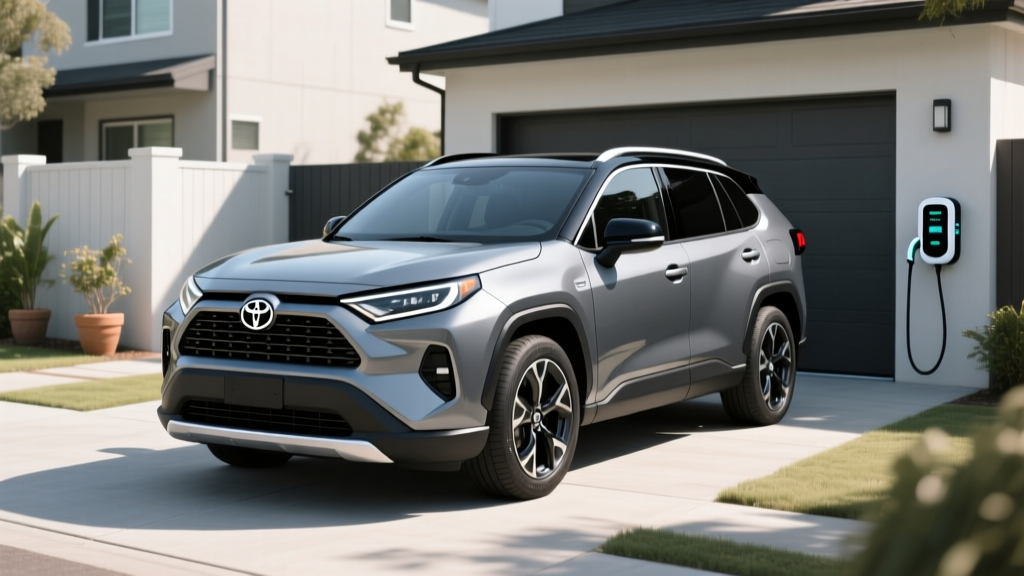
The 2024 Toyota RAV4 Plug-In Hybrid — marketed as the RAV4 Prime — occupies a rare sweet spot in the electrified SUV market: 42 miles of EPA-rated electric-only range, standard all-wheel drive, 302 combined horsepower, and the cargo practicality of a compact SUV. For buyers who want to commute on electricity without surrendering the flexibility of a gas engine for road trips, the Prime remains one of the most compelling PHEVs available, even as newer competitors arrive.
But at a starting MSRP near $44,000 and with limited dealer availability, does the math actually work? Below we break down every number that matters — from real-world MPG and charging times to federal tax credit eligibility and long-term battery reliability.
HEV vs. PHEV: What the RAV4 Prime Actually Is
Toyota sells two electrified RAV4 variants. Understanding the difference is essential before you visit a dealer:
- RAV4 Hybrid (HEV): A conventional, self-charging hybrid. No plug, no electric-only driving beyond very low speeds. EPA-rated 39–41 MPG combined. Starts around $32,000. Cannot qualify for the federal EV tax credit.
- RAV4 Prime (PHEV): A plug-in hybrid with an 18.1 kWh lithium-ion battery. You plug it in to charge. It delivers 42 miles of pure electric range before the gas engine engages. 302 hp combined. Starts around $44,000. Eligible for the $7,500 federal tax credit under current IRS §30D rules (subject to income, sourcing, and MSRP caps).
If you never plug it in, the Prime still functions as a conventional hybrid — but you're paying a premium for a battery you're not using. This vehicle rewards owners who charge daily.
Electric-Only Range, Total Range, and Efficiency
| Metric | EPA Rating | Real-World Expectation |
|---|---|---|
| Electric-only range | 42 miles | 35–40 mi (highway/cold); 42–46 mi (city/mild weather) |
| MPGe (electric mode) | 94 MPGe combined | Varies with driving style and temperature |
| Gas-only MPG (hybrid mode) | 38 MPG combined (40 city / 36 hwy) | 36–42 MPG city; 33–37 MPG highway |
| Total combined range | ~600 miles | 550–620 mi depending on conditions |
| Battery capacity (gross / usable) | 18.1 kWh gross | ~14.5 kWh usable (buffer protects longevity) |
The 42-mile electric range is generous enough to cover most daily commutes. In our experience and owner reports, mild-weather city driving can push past 45 miles on a charge thanks to regenerative braking. Highway driving at 70+ mph and winter temperatures below freezing will compress that figure to the mid-30s. The gas engine starts seamlessly when the battery depletes, and the transition is nearly imperceptible from the driver's seat.
Once operating as a hybrid, the Prime's 38 MPG combined rating is slightly lower than the standard RAV4 Hybrid's 39–41 MPG — the penalty of carrying roughly 300 extra pounds of battery. In city driving, hybrids often exceed their EPA highway figures because regenerative braking recovers energy at every stop. Expect 40+ MPG in stop-and-go traffic once the battery is depleted.
Powertrain: 302 HP and Standard AWD
The RAV4 Prime pairs a 2.5-liter four-cylinder Atkinson-cycle engine (176 hp, 163 lb-ft) with two electric motors — one on each axle — for a combined system output of 302 horsepower. That makes it the quickest RAV4 in the lineup, with Toyota estimating a 0–60 mph time of 5.7 seconds.
Electronic on-demand all-wheel drive is standard across all Prime trims. The rear motor provides torque to the rear wheels during acceleration and slippery conditions without a mechanical driveshaft. It's not a hardcore off-road system, but it handles rain, snow, and light trails competently.
Drive modes include EV (electric-only priority), HV (hybrid), and Auto EV/HV, which lets the system decide. There's also a Charge Mode that uses the gas engine to replenish the battery while driving — useful if you're approaching a low-emission zone or want to save electric range for later.
Charging: Level 1, Level 2, and the DC Fast-Charge Question
| Charging Level | Power (kW) | 0–Full Time | Notes |
|---|---|---|---|
| Level 1 (120V household) | ~1.4 kW | ~12 hours | Included cord; adequate for overnight if daily use is low |
| Level 2 (240V, SE/XSE trims) | 3.3 kW | ~5.5 hours | Requires 16A circuit |
| Level 2 (240V, XSE Premium pkg) | 6.6 kW | ~2.5 hours | Optional onboard charger upgrade |
| DC Fast Charge | Not supported | N/A | No CCS or CHAdeMO port |
The RAV4 Prime does not support DC fast charging. This is the single biggest practical limitation of the vehicle. If you need to charge away from home quickly, you're limited to Level 2 public chargers — and even then, the 3.3 kW onboard charger (standard) means a full charge takes over five hours. The available 6.6 kW onboard charger, bundled in the XSE Premium package, cuts that roughly in half and is strongly recommended for anyone without a dedicated home charger.
For most owners, a home Level 2 setup is the ideal charging solution. A 240V outlet in the garage means you wake up to a full battery every morning, making the 42-mile electric range repeatable daily. Home Level 2 installation typically costs $500–$1,500 depending on electrical panel proximity and local permit requirements.
Pricing, Trims, and Federal Tax Credit Eligibility
The 2024 RAV4 Prime comes in two main trims:
- SE: Starting MSRP ~$43,690 (includes destination). Standard 3.3 kW charger, SofTex seats, 8-inch touchscreen.
- XSE: Starting MSRP ~$47,560. Adds panoramic glass roof option, heated steering wheel, 9-inch touchscreen, available 6.6 kW charger via Premium package.
Options like the Premium Package, Advanced Technology Package, and solar roof panel can push a fully loaded XSE above $52,000.
Federal Tax Credit (§30D) — Current Rules
Under IRS §30D, the RAV4 Prime may qualify for up to $7,500 in federal tax credit, available as a point-of-sale rebate at the dealer. However, eligibility depends on several factors that change periodically:
- MSRP cap: SUVs must be under $80,000. The RAV4 Prime clears this easily.
- Buyer income cap: Modified AGI must not exceed $150,000 (single) / $300,000 (joint). Check your tax situation.
- Battery sourcing requirements: Critical minerals and battery components must meet escalating domestic-content thresholds. Toyota has historically sourced components from qualifying suppliers, but confirm eligibility at purchase via the IRS portal or your dealer.
- Point-of-sale transfer: Since 2024, buyers can transfer the credit to the dealer for an immediate price reduction at purchase, rather than waiting for a tax refund.
Tax rules evolve. Consult a tax professional and verify current eligibility on irs.gov before purchasing.
Reliability, Battery Warranty, and Replacement Costs
Toyota's hybrid system is among the most proven in the industry, with over two decades of real-world deployment since the original Prius. The RAV4 Prime's hybrid powertrain benefits from that institutional knowledge.
Battery warranty: Toyota covers the hybrid battery for 10 years or 150,000 miles (whichever comes first) across all 50 states. This applies to both the standard RAV4 Hybrid and the Prime's larger PHEV battery.
Hybrid system warranty: Hybrid-specific components (inverter, electric motors, control module) are covered for 8 years / 100,000 miles.
Replacement cost: If the PHEV battery requires replacement out of warranty, expect a cost in the range of $5,000–$8,000 including parts and labor, based on current Toyota hybrid battery pricing. However, Toyota's hybrid batteries have demonstrated excellent longevity — many first-generation Prius batteries exceeded 200,000 miles before significant degradation. The Prime's larger battery operates with a generous buffer (roughly 3.5 kWh held in reserve), which reduces stress on individual cells and should extend useful life well beyond the warranty period.
Toyota's broader vehicle warranty covers 3 years / 36,000 miles (basic) and 5 years / 60,000 miles (powertrain). The IIHS has rated the RAV4 Prime a Top Safety Pick+ when equipped with specific headlights.
Real-World Ownership: Who Should Buy the RAV4 Prime?
Pros
- 42-mile electric range covers most commutes
- 302 hp makes it genuinely quick (5.7s 0–60)
- Standard AWD; confident in rain and snow
- 600+ mile total range eliminates road-trip anxiety
- Proven Toyota hybrid reliability; 10-yr battery warranty
- Eligible for $7,500 federal credit (if sourcing/income qualify)
Cons
- No DC fast charging — road-trip charging is slow
- Dealer markups common; hard to find at MSRP
- 3.3 kW base charger is slow; 6.6 kW requires expensive package
- Cargo space slightly reduced vs. gas RAV4 (~33.5 cu ft behind rear seats)
- Infotainment interface feels dated vs. competitors
The Right Buyer for the RAV4 Prime
This PHEV is ideal if you:
- Have a commute under 40 miles round-trip and can charge at home nightly
- Take road trips several times a year and don't want to plan around DC fast chargers
- Live in an apartment or area where reliable public charging isn't guaranteed
- Want EV-like daily driving without committing to a full BEV
Consider a Full EV Instead If:
- You already have reliable home and workplace charging
- Your daily driving is under 30 miles and you rarely take long road trips
- You want to eliminate gas station visits entirely and reduce maintenance (no oil changes, fewer brake replacements)
- Models like the Hyundai Ioniq 5 or Tesla Model Y offer the range and charging speed that fit your lifestyle
Consider the Standard RAV4 Hybrid Instead If:
- You cannot charge at home or at work
- The $10,000+ price premium over the HEV doesn't pencil out against your fuel savings
- You simply want excellent MPG without managing a plug
2024 RAV4 Prime vs. Competing PHEV SUVs
| Spec | Toyota RAV4 Prime | Hyundai Tucson PHEV | Ford Escape PHEV |
|---|---|---|---|
| Electric-only range | 42 mi | 33 mi | 37 mi |
| Combined HP | 302 hp | 261 hp | 210 hp |
| Gas-mode MPG (combined) | 38 MPG | 35 MPG | 40 MPG |
| AWD | Standard | Standard | FWD only |
| DC Fast Charge | No | No | No |
| Starting MSRP | ~$43,690 | ~$39,000 | ~$40,000 |
| Federal credit eligible | Yes (verify sourcing) | No (Korea-built) | No (not assembled in US for all trims) |
The RAV4 Prime leads in electric range and power but commands a price premium. The Tucson PHEV is more affordable but sacrifices range and credit eligibility. The Escape PHEV offers the best gas-mode MPG but lacks AWD. For buyers prioritizing all-weather capability and maximum electric range, the Prime stands alone in this segment.
Frequently Asked Questions
How many MPG does the 2024 RAV4 Prime get?
Once the battery is depleted and it operates as a conventional hybrid, the EPA rates it at 38 MPG combined (40 city / 36 highway). In electric mode, it achieves 94 MPGe combined. Real-world city driving in hybrid mode often yields 40–42 MPG thanks to regenerative braking; highway driving typically returns 34–37 MPG. See fueleconomy.gov for official figures.
How far can the RAV4 Prime go on electric only?
The EPA rates it at 42 miles of electric-only range. In mild weather with city driving, owners frequently report 44–46 miles. Highway speeds and cold temperatures reduce this to 33–38 miles. The total combined range (electric + gas) exceeds 600 miles.
Does the RAV4 Prime qualify for a tax credit?
It may qualify for up to $7,500 under the federal §30D credit, subject to buyer income limits, battery sourcing requirements, and MSRP caps. The credit can be transferred to the dealer at point of sale for an immediate price reduction. State incentives vary — check your local energy office. Always verify current eligibility on irs.gov or with a tax professional.
Is the RAV4 Prime reliable? What does a battery replacement cost?
Toyota's hybrid systems have an exceptional reliability track record spanning 25+ years. The hybrid battery is warrantied for 10 years / 150,000 miles. Out-of-warranty replacement is estimated at $5,000–$8,000, but real-world data suggests Toyota hybrid batteries routinely exceed 200,000 miles with the built-in charge buffer protecting cell health.
Hybrid vs. PHEV vs. EV — which is right for me?
HEV (conventional hybrid): Best if you can't charge at home. No plug required. Great MPG. No electric-only range. Lowest price.
PHEV (plug-in hybrid like the Prime): Best if you can charge at home and want electric commuting plus gas-engine flexibility for road trips. Higher price, partially offset by tax credits.
BEV (full electric): Best if you have reliable charging access, want zero tailpipe emissions, minimal maintenance, and your daily driving plus road-trip habits align with available range and charging infrastructure.
Can the RAV4 Prime DC fast charge?
No. The RAV4 Prime only accepts AC charging — Level 1 (120V) or Level 2 (240V). There is no DC fast-charge port. This is the most significant limitation for owners who want to top up quickly during road trips. Plan to rely on the gas engine for long-distance travel or charge overnight at hotels with Level 2 stations.
What's the difference between the RAV4 Hybrid and RAV4 Prime?
The standard RAV4 Hybrid is a conventional HEV — no plug, ~40 MPG, ~$32,000 starting price. The RAV4 Prime is a plug-in hybrid with a larger 18.1 kWh battery, 42 miles of electric-only range, 302 hp, standard AWD, a ~$44,000 starting price, and potential federal tax credit eligibility. If you can charge at home, the Prime delivers dramatically lower fuel costs on daily commutes.
Sources: EPA fueleconomy.gov, IRS §30D Clean Vehicle Credit, Toyota Motor North America press specifications.