Quick Verdict: The 2024 RAV4 Hybrid XLE at a Glance
The 2024 Toyota RAV4 Hybrid XLE remains one of the most pragmatic compact SUVs on the market. With an EPA-estimated 41 city / 38 highway / 39 combined MPG, standard all-wheel drive, and a starting MSRP of $33,425 (including destination), it undercuts most plug-in rivals on price while delivering fuel economy that many drivers will actually exceed in everyday city commuting. It's a conventional hybrid (HEV) — no plug required — which makes it ideal for buyers without home charging access who still want electrified efficiency.
| Specification | 2024 RAV4 Hybrid XLE |
|---|---|
| Powertrain | 2.5L 4-cyl + 3 electric motors (AWD) |
| Combined Horsepower | 219 hp |
| EPA MPG (City / Hwy / Combined) | 41 / 38 / 39 |
| Fuel Tank Capacity | 14.5 gallons |
| Total Driving Range | ~565 miles |
| 0–60 mph | 7.4 seconds (est.) |
| Cargo Volume (rear seats up / down) | 37.6 / 69.8 cu ft |
| Towing Capacity | 1,750 lbs |
| Hybrid Battery Warranty | 10 years / 150,000 miles |
| Base MSRP (incl. destination) | $33,425 |
| Federal Tax Credit (§30D) | Not eligible (HEV) |
Fuel Economy: EPA Numbers vs. Real-World MPG
The EPA rates the 2024 RAV4 Hybrid XLE at 41 MPG city, 38 MPG highway, and 39 MPG combined. These figures apply across all RAV4 Hybrid trims — Toyota uses the same powertrain calibration throughout the lineup. But as with all hybrids, the sticker number only tells part of the story.
| Driving Scenario | EPA Estimate | Real-World Expectation |
|---|---|---|
| City / Stop-and-Go | 41 MPG | 42–46 MPG (regenerative braking thrives here) |
| Highway (65–75 mph) | 38 MPG | 34–37 MPG (aero drag reduces hybrid advantage) |
| Combined Mixed Driving | 39 MPG | 37–42 MPG (varies with route profile) |
| Cold Weather (below 32°F) | — | 33–37 MPG (engine runs more for cabin heat) |
Hybrids like the RAV4 actually tend to beat their EPA city rating in warm-weather urban driving because the electric motor handles low-speed propulsion and regenerative braking recaptures energy that a gas car would waste as heat. On the highway, however, the advantage narrows — at sustained 70+ mph speeds, the gas engine does most of the work and aerodynamic drag dominates. Expect a noticeable efficiency dip in winter; the engine must run more frequently to provide cabin heat and maintain catalytic converter temperature.
Source: EPA Fuel Economy Guide — 2024 Toyota RAV4 Hybrid AWD
HEV vs. PHEV: Understanding the RAV4 Hybrid Lineup
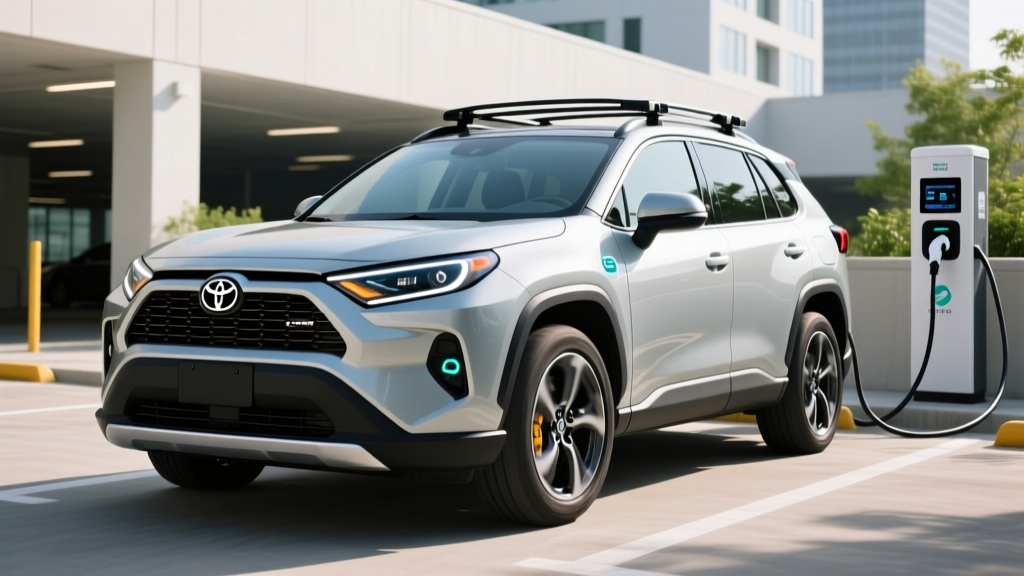
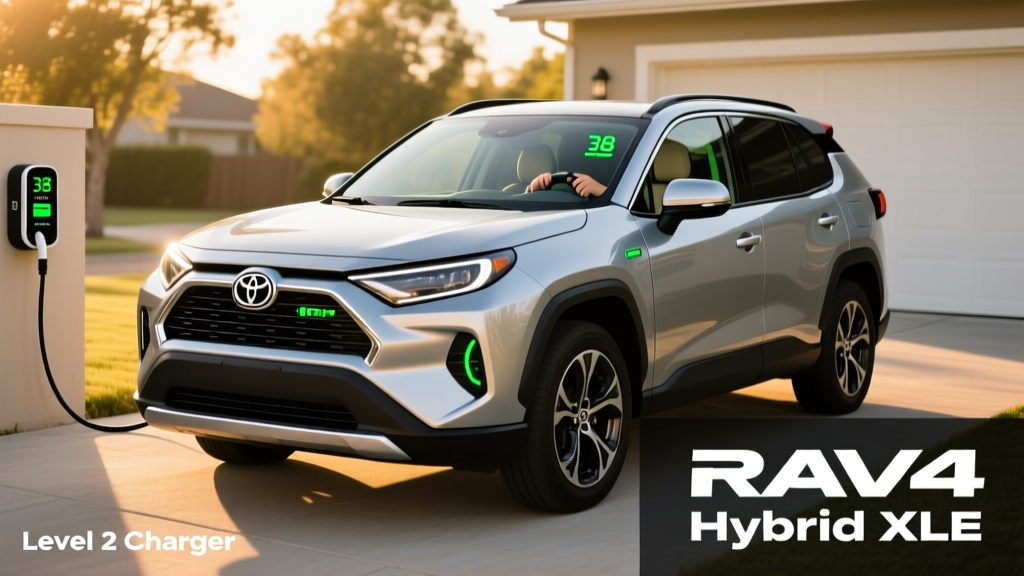
Toyota offers the RAV4 in three powertrain flavors: a conventional gas model, the RAV4 Hybrid (HEV), and the RAV4 Prime (PHEV). The XLE trim discussed here is a conventional hybrid — it charges its small battery entirely through regenerative braking and the gas engine. You never plug it in.
| Feature | RAV4 Hybrid (HEV) | RAV4 Prime (PHEV) |
|---|---|---|
| Plug-In Required? | No — self-charging | Yes — 18.1 kWh battery |
| Electric-Only Range | ~1 mile at low speed | 42 miles (EPA) |
| Combined Horsepower | 219 hp | 302 hp |
| EPA Combined MPG / MPGe | 39 MPG | 94 MPGe (elec+gas) / 38 MPG (gas only) |
| Level 2 Charge Time | N/A | ~2.5 hours (240V, 3.3 kW) |
| DC Fast Charging | N/A | Not supported |
| Federal Tax Credit (§30D) | Not eligible | Up to $7,500 (eligibility varies) |
| Starting MSRP | $31,925 (LE) | $43,690 (SE) |
The RAV4 Prime (PHEV) is a compelling upgrade if you have reliable home charging and a commute under 42 miles — you'd burn almost no gasoline on most days. But the Prime carries a $12,000+ premium over the Hybrid XLE and has faced persistent allocation constraints at dealers. For buyers who can't plug in at home or who want a lower upfront cost, the conventional RAV4 Hybrid XLE is the more accessible choice.
Powertrain and Driving Impressions
The 2024 RAV4 Hybrid pairs a 2.5-liter Atkinson-cycle four-cylinder engine with three electric motors — two on the front axle and one on the rear — delivering a combined 219 horsepower and standard electronic all-wheel drive (AWD). The rear motor activates on demand for traction, meaning there's no mechanical driveshaft connecting the axles, which saves weight and packaging space.
Acceleration to 60 mph takes approximately 7.4 seconds — adequate for highway merging and confident around town. The CVT (continuously variable transmission) keeps the engine in its most efficient rev range, though it can produce a characteristic drone under hard acceleration. In normal driving, the transition between electric and gas power is nearly imperceptible.
The AWD system is reactive rather than performance-oriented. It engages the rear motor during acceleration from a stop, in low-traction conditions, and under certain cornering loads. Don't expect it to rival a Subaru's full-time system on icy mountain roads, but for rain, light snow, and gravel driveways, it's entirely competent.
Pricing, Trims, and Tax Credit Eligibility
The 2024 RAV4 Hybrid XLE starts at $33,425 (including $1,425 destination charge). Key standard equipment includes:
- 8-inch touchscreen with wireless Apple CarPlay and Android Auto
- Toyota Safety Sense 2.5+ (pre-collision, lane departure, adaptive cruise, blind-spot monitoring)
- Smart Key with push-button start
- LED headlights and taillights
- Dual-zone automatic climate control
- 18-inch alloy wheels
Popular options that push the XLE toward $36,000–$38,000 include the Convenience Package (power liftgate, auto-dimming mirror), the Weather Package (heated seats, heated steering wheel, de-icer), and a moonroof.
Federal Tax Credit: What You Need to Know
Important: The conventional RAV4 Hybrid (HEV) does not qualify for the federal §30D plug-in vehicle tax credit. That credit — up to $7,500 for new vehicles — is reserved for plug-in hybrids (PHEVs) and battery-electric vehicles (BEVs) meeting battery sourcing, MSRP caps, and buyer income limits as defined by the IRS. The RAV4 Prime (PHEV) may qualify, but eligibility depends on the buyer's modified adjusted gross income, the vehicle's MSRP, and battery component/mineral sourcing requirements that change annually. Consult a tax professional for your specific situation.
Some states and utilities offer separate rebates for conventional hybrids, though these are less common than EV/PHEV incentives. Check your state energy office or utility provider for current programs.
Battery Warranty, Reliability, and Replacement Cost
Hybrid battery longevity is consistently one of the top concerns buyers raise, and Toyota's track record here is strong. The 2024 RAV4 Hybrid uses a nickel-metal hydride (NiMH) battery pack — a chemistry Toyota has refined over two decades of hybrid production. Unlike the lithium-ion packs in EVs, NiMH is less energy-dense but extremely durable under the shallow charge/discharge cycles that hybrids employ.
Warranty Coverage: Toyota covers the hybrid battery for 10 years or 150,000 miles (whichever comes first), transferable to subsequent owners. The broader hybrid system (inverter, control module, motors) carries the same coverage. This applies to all 50 states.
In practice, Toyota hybrid batteries frequently last well beyond the warranty period. Taxi fleets and high-mileage drivers have reported original batteries lasting 200,000+ miles in Prius and Camry Hybrid applications. The RAV4 Hybrid's battery management system keeps the pack in a narrow state-of-charge window (roughly 40–80%), which dramatically reduces degradation.
If replacement becomes necessary out of warranty, a new OEM hybrid battery for the RAV4 Hybrid typically costs between $2,500 and $4,000 including labor. Refurbished and aftermarket options are emerging in the $1,500–$2,500 range. For context, this is far less than an EV traction battery replacement, which can exceed $10,000–$20,000.
Source: Toyota Warranty Guide
Who Should Buy the RAV4 Hybrid XLE?
Pros
- 39 MPG combined — real-world city driving often exceeds 42 MPG
- No plug-in needed — works for apartment dwellers and street parkers
- Standard AWD included at no premium
- 10-year/150,000-mile hybrid battery warranty
- Strong cargo space (37.6 cu ft) with no battery-pack floor intrusion
- Toyota Safety Sense 2.5+ standard on all trims
Cons
- No federal tax credit eligibility (HEV, not PHEV)
- CVT drone under hard acceleration
- Infotainment is functional but dated vs. rivals' larger screens
- 1,750-lb towing limit — not suited for trailers or boats
- Highway MPG drops noticeably above 70 mph
- XLE lacks premium features without expensive add-on packages
Decision Framework
Choose the RAV4 Hybrid XLE if: You want maximum fuel savings without changing your fueling habits, you lack access to home or workplace charging, your commute is city-heavy, and you want a proven, low-risk ownership experience.
Choose the RAV4 Prime (PHEV) instead if: You have Level 2 home charging, your daily round-trip commute is under 42 miles, you want electric-only driving most days, and the $12,000+ premium (offset partially by a potential tax credit) makes financial sense for your mileage.
Choose a full EV (like a Tesla Model Y or Hyundai Ioniq 5) instead if: You have reliable home charging, your daily driving is under 250 miles, you want zero tailpipe emissions, and you're comfortable with public DC fast charging for road trips.
Ownership Costs: 5-Year Estimate
Below is a simplified 5-year / 75,000-mile ownership comparison assuming $3.50/gallon regular unleaded and 15,000 miles/year. The RAV4 Hybrid's fuel savings are meaningful but not as dramatic as a PHEV or EV running on inexpensive home electricity.
| Cost Category | RAV4 Hybrid XLE | RAV4 Gas AWD (LE) | RAV4 Prime (SE) |
|---|---|---|---|
| 5-Year Fuel Cost | ~$6,730 | ~$9,375 | ~$3,800 (est. mix of elec+gas) |
| Purchase Price (MSRP) | $33,425 | $31,425 | $43,690 |
| Federal Tax Credit | $0 | $0 | Up to $7,500* |
| Net 5-Year Fuel + Purchase | ~$40,155 | ~$40,800 | ~$40,090* |
*RAV4 Prime tax credit eligibility varies by buyer income, MSRP cap compliance, and battery sourcing rules per IRS §30D guidelines. Verify with a tax professional.
The Hybrid XLE essentially breaks even with the gas model on total cost within the first 2–3 years through fuel savings alone, and its higher resale value typically widens the gap by year five.
Frequently Asked Questions
How many MPG does the 2024 RAV4 Hybrid XLE get?
The EPA rates it at 41 city / 38 highway / 39 combined MPG. In real-world city driving with warm weather, many owners report 42–46 MPG. Highway driving at 70+ mph typically yields 34–37 MPG. Cold weather reduces efficiency by roughly 10–15%.
Do I need to plug in the RAV4 Hybrid?
No. The RAV4 Hybrid is a conventional hybrid (HEV). Its battery charges through regenerative braking and the gas engine. You fuel it like any other car — at a gas station. Only the RAV4 Prime (PHEV) requires or accepts a plug.
Does the 2024 RAV4 Hybrid qualify for a federal tax credit?
No. The IRS §30D clean vehicle credit applies only to plug-in vehicles (PHEVs and BEVs). The conventional RAV4 Hybrid does not qualify. The RAV4 Prime (PHEV) may qualify for up to $7,500, subject to income, MSRP, and battery-sourcing requirements.
How long will the RAV4 Hybrid battery last?
Toyota warranties the hybrid battery for 10 years / 150,000 miles. In practice, Toyota's NiMH hybrid batteries regularly last 150,000–200,000+ miles with normal use. The battery management system keeps the pack in a shallow charge cycle to minimize wear.
What does it cost to replace the hybrid battery?
An OEM replacement hybrid battery for the RAV4 Hybrid typically costs $2,500–$4,000 including labor. Refurbished options are available for $1,500–$2,500. This is substantially less than EV battery replacement.
Is the RAV4 Hybrid XLE better than the gas-only RAV4?
For most buyers, yes. The hybrid costs roughly $2,000 more upfront but saves $500–$600/year in fuel (at 15,000 miles/year and $3.50/gallon), pays back the premium in 3–4 years, delivers standard AWD, and offers smoother, quieter low-speed driving. It also holds stronger resale value.
How does the RAV4 Hybrid compare to a full EV?
A full EV (like a Tesla Model Y or Hyundai Ioniq 5) offers lower per-mile energy costs, zero tailpipe emissions, and less maintenance. But EVs require home charging access, cost more upfront, and involve range planning on road trips. The RAV4 Hybrid is the right pick if you can't charge at home, frequently drive 300+ miles without stopping, or want the lowest-risk entry into electrified driving.