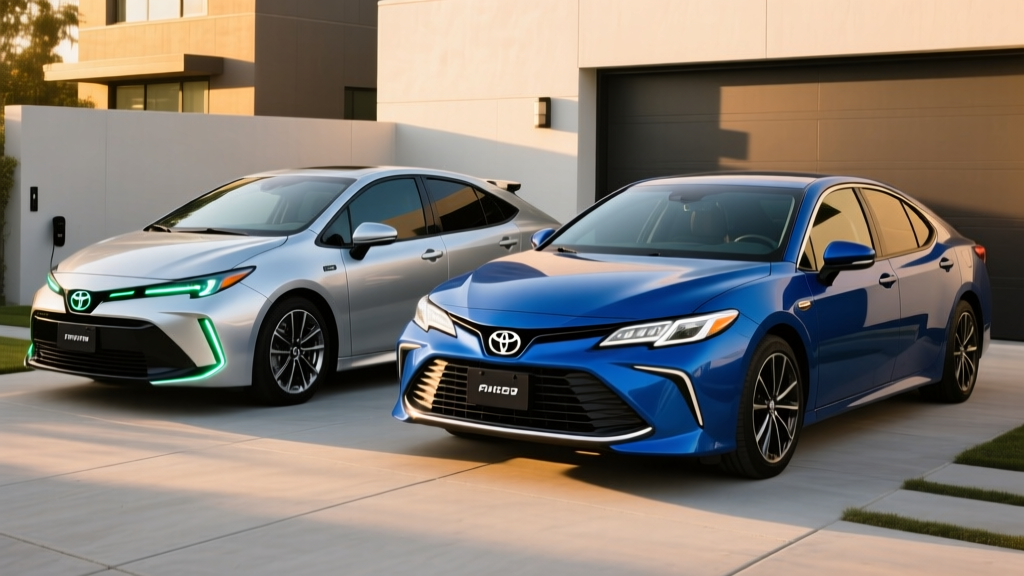
Toyota's two most popular hybrids now occupy different lanes. The redesigned 2024 Prius arrived as a style-first efficiency leader with up to 57 MPG combined and a plug-in variant (Prius Prime) that delivers 44 miles of electric-only range. The fully refreshed 2025 Camry Hybrid pivoted to an all-hybrid lineup, pairing a 2.5-liter four-cylinder with standard electronic on-demand AWD across every trim. Both are Toyota. Both are hybrids. But the engineering choices underneath make them very different ownership propositions.
This comparison breaks down EPA and real-world MPG, powertrain output, battery warranties, pricing, and tax-credit eligibility so you can pick the right tool for your commute — or decide whether a full BEV makes more sense.
HEV vs. PHEV: Understanding the Prius and Camry Lineups
Before comparing numbers, the architecture matters. Toyota sells two distinct Prius flavors and one Camry hybrid configuration:
Conventional Hybrid (HEV) — No Plug Required
The Prius and Camry Hybrid are self-charging hybrids. A small traction battery (under 2 kWh) captures energy from regenerative braking and the gas engine. You never plug them in. They run on electric power at low speeds and blend seamlessly with the engine at higher loads.
Plug-In Hybrid (PHEV) — Prius Prime Only
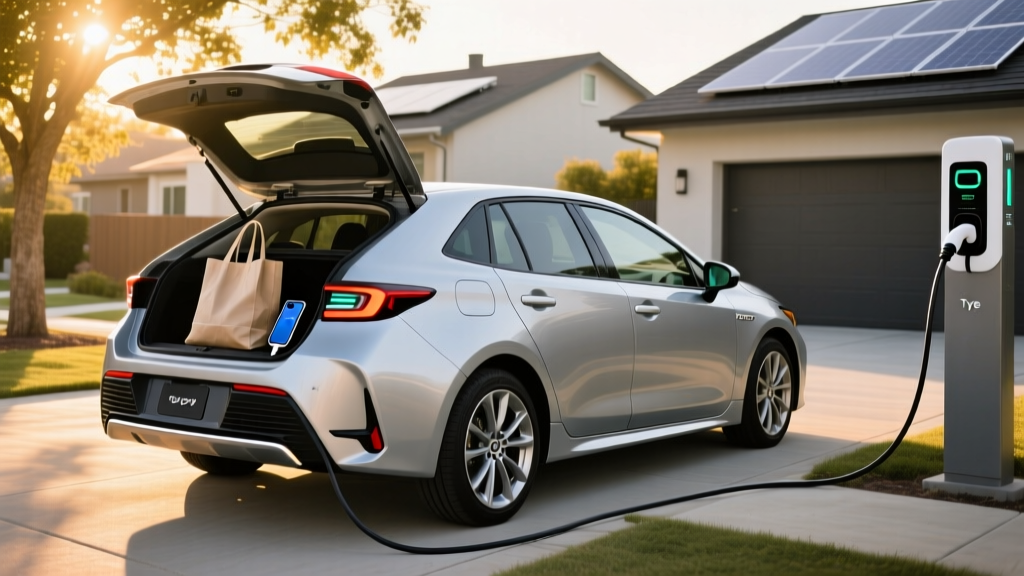
The Prius Prime adds a larger 13.6 kWh battery and a charge port. It delivers 44 miles of EPA-rated electric-only range before the gas engine engages. You plug it into a standard 120V outlet (Level 1, ~4 hours to full) or a 240V Level 2 charger (~2.5 hours). It does not support DC fast charging — a deliberate Toyota engineering choice to preserve battery longevity and reduce cost.
The 2025 Camry is offered exclusively as a conventional HEV. There is no Camry plug-in variant for this model year.
EPA Fuel Economy: City, Highway, and Combined MPG
| Model | City MPG | Highway MPG | Combined MPG | Drivetrain |
|---|---|---|---|---|
| 2024 Prius LE (FWD) | 57 | 56 | 57 | Front-wheel drive |
| 2024 Prius XLE/Limited (FWD) | 52 | 52 | 52 | Front-wheel drive |
| 2024 Prius AWD (all trims) | 49 | 50 | 49 | Electronic AWD |
| 2024 Prius Prime (PHEV) | 52 (hybrid mode) | 48 (hybrid mode) | 50 (hybrid) / 127 MPGe (EV mode) | Front-wheel drive |
| 2025 Camry Hybrid LE (FWD) | 53 | 50 | 51 | Front-wheel drive |
| 2025 Camry Hybrid (AWD, all trims) | 51 | 49 | 50 | Electronic AWD |
Source: fueleconomy.gov — EPA estimates. Your mileage will vary with driving style, terrain, and climate.
Real-World MPG: What Owners Actually Report
EPA numbers tell only part of the story. Toyota's hybrid synergy drive system excels in stop-and-go city traffic where regenerative braking recaptures energy repeatedly. Highway cruising at 75+ mph reduces the electric motor's advantage, and both cars see efficiency drops in sustained high-speed driving.
2024 Prius LE (FWD): Owners on Fuelly and Toyota forums consistently report 52–60 MPG in mixed suburban driving. In cold weather (below 32°F), expect a 5–10% drop as the engine runs more frequently to generate cabin heat. Highway-only trips at 75 mph typically yield 48–52 MPG.
2025 Camry Hybrid LE: Real-world reports cluster around 47–54 MPG combined. The Camry's larger cabin, heavier curb weight (~3,560 lbs vs. the Prius's ~3,097 lbs), and more powerful engine tune trade a few MPG for noticeably stronger acceleration. City-heavy commuters often exceed the 53 MPG EPA city rating.
Prius Prime (PHEV): If you charge daily and your commute is under 44 miles, you may use almost no gasoline for weeks. Once the battery depletes, the Prime operates as a conventional hybrid at roughly 48–50 MPG combined — slightly less than the standard Prius due to the heavier battery pack.
Powertrain Output: Horsepower and Acceleration
| Specification | 2024 Prius / Prius Prime | 2025 Camry Hybrid |
|---|---|---|
| Engine | 2.0L 4-cyl + 2 motor-generators | 2.5L 4-cyl + 2 motor-generators |
| Combined Net Horsepower | 196 hp (FWD) / 199 hp (AWD) | 225 hp (FWD) / 232 hp (AWD) |
| 0–60 mph (est.) | ~7.0 sec (FWD) | ~6.8 sec (FWD) |
| AWD System | Electronic rear motor (AWD trims) | Electronic rear motor (all trims standard) |
| Transmission | eCVT | eCVT |
| Curb Weight | ~3,097–3,340 lbs | ~3,560–3,670 lbs |
The fifth-generation Prius shed its reputation as the slowest car on the road. With 196 hp, it merges confidently onto highways and holds its own in passing maneuvers. The Camry Hybrid's 225–232 hp gives it a meaningful edge in acceleration feel, especially when loaded with passengers or climbing grades. Both use Toyota's eCVT — a planetary gearset, not a belt-driven CVT — which delivers smooth, linear power without the rubber-band sensation of conventional CVTs.
Notably, the 2025 Camry makes AWD standard on every trim, adding a rear electric motor that engages automatically when slippage is detected. This is a significant value proposition for buyers in snow-belt states who previously had to upgrade to higher trims for all-wheel drive.
Battery Warranty, Lifespan, and Replacement Cost
Toyota Hybrid Battery Warranty: 10 years or 150,000 miles (whichever comes first) on the hybrid battery pack for all 2024 Prius and 2025 Camry Hybrid models. This applies nationwide regardless of state emissions requirements.
General Powertrain Warranty: 5 years / 60,000 miles.
Toyota's hybrid battery packs have demonstrated exceptional longevity. Data from fleet operators and long-term owners shows most Prius and Camry hybrid batteries retain above 80% capacity well past 150,000 miles. The nickel-metal hydride (NiMH) packs in earlier Prius generations routinely lasted 200,000+ miles. The current-generation lithium-ion packs are lighter, more energy-dense, and managed by more sophisticated thermal controls.
Out-of-warranty replacement cost: A new OEM hybrid battery for the Prius or Camry Hybrid typically runs $2,500–$4,000 including labor at a Toyota dealer. Third-party refurbishers offer remanufactured packs for $1,500–$2,500. For the Prius Prime's larger 13.6 kWh PHEV battery, expect replacement costs in the $4,000–$6,500 range due to the larger cell count.
The 10-year/150,000-mile warranty effectively eliminates battery-replacement risk for the vast majority of first and second owners. If you plan to keep either car beyond 150,000 miles, budgeting for a potential battery replacement in years 12–15 is prudent but statistically unlikely to be needed.
Pricing, Trims, and Tax Credit Eligibility
| Model / Trim | Base MSRP | Federal Tax Credit |
|---|---|---|
| 2024 Prius LE | $27,950 | Not eligible (HEV) |
| 2024 Prius XLE | $31,395 | Not eligible (HEV) |
| 2024 Prius Limited | $34,695 | Not eligible (HEV) |
| 2024 Prius Prime SE (PHEV) | $32,975 | Up to $3,750* |
| 2024 Prius Prime XSE (PHEV) | $36,220 | Up to $3,750* |
| 2025 Camry Hybrid LE | $28,855 | Not eligible (HEV) |
| 2025 Camry Hybrid SE | $30,390 | Not eligible (HEV) |
| 2025 Camry Hybrid XLE | $33,490 | Not eligible (HEV) |
*The Prius Prime qualifies for a partial IRS §30D clean vehicle credit of up to $3,750, contingent on the buyer meeting income caps ($150K single / $300K joint AGI), the vehicle's MSRP staying under the $55,000 sedan cap, and battery critical-mineral and component sourcing requirements. The conventional Prius and Camry Hybrid do not qualify for any federal purchase credit because they are not plug-in vehicles. State-level incentives vary — check your state's energy office or AFDC state incentive database.
For most buyers, the Prius LE at under $28,000 represents the lowest entry price into Toyota's current hybrid lineup. The Camry Hybrid LE at ~$28,855 is close in price but delivers a midsize sedan with substantially more rear-seat legroom (38.0" vs. 34.8" in the Prius) and a larger trunk (15.1 cu ft vs. 20.3 cu ft — though the Prius hatchback design offers more flexible cargo loading).
2024 Prius — Pros
- Class-leading 57 MPG combined (LE FWD)
- Hatchback cargo versatility
- Prius Prime offers 44 mi electric-only + $3,750 credit potential
- Lower curb weight, nimble handling
- Starting MSRP under $28,000
2024 Prius — Cons
- Tight rear seat (34.8" legroom)
- AWD trims drop to 49 MPG combined
- Road noise noticeable at highway speeds
- No DC fast charging on Prime
2025 Camry Hybrid — Pros
- Standard AWD on every trim
- 225–232 hp — strongest hybrid acceleration in its class
- Spacious midsize cabin, comfortable highway cruiser
- 51 MPG combined with AWD is exceptional for its size
- Toyota Safety Sense 3.0 standard
2025 Camry Hybrid — Cons
- No plug-in variant available
- Sedan trunk limits cargo flexibility vs. hatchback
- Higher curb weight reduces city MPG slightly vs. Prius
- No federal tax credit eligibility
Hybrid vs. PHEV vs. Full EV: Which Fits Your Life?
The right electrified vehicle depends on three variables: charging access, daily mileage, and budget.
Choose a conventional hybrid (Prius or Camry Hybrid) if:
- You live in an apartment or lack reliable home charging access
- You want zero behavior change — just fill up at any gas station
- Your budget is under $35,000
- You drive more than 300 miles between fill-ups regularly
Choose the Prius Prime (PHEV) if:
- You can charge at home (even a standard 120V outlet works overnight)
- Your daily commute is under 44 miles round-trip
- You want to drive mostly on electricity but need gas-engine flexibility for road trips
- You qualify for the partial $3,750 federal credit
Choose a full battery-electric vehicle (BEV) if:
- You have reliable Level 2 home charging
- Your daily driving is under 250 miles and you can plan road-trip charging stops
- You want to eliminate gasoline costs entirely and qualify for the full $7,500 §30D credit on eligible models
- You want the lowest per-mile fuel cost (electricity at $0.14/kWh averages ~$0.04/mile vs. ~$0.08–0.10/mile in these hybrids at $3.50/gallon)
Frequently Asked Questions
How many MPG does the 2024 Prius get in real-world driving?
The EPA rates the Prius LE at 57 combined MPG. Real-world owners typically report 52–60 MPG in mixed driving. Cold weather and sustained highway speeds above 70 mph reduce this to 45–52 MPG. City-heavy commuters often exceed the EPA rating thanks to regenerative braking.
How far can the Prius Prime go on electric only?
The 2024 Prius Prime delivers 44 miles of EPA-rated electric-only range from its 13.6 kWh battery pack. In mild weather with gentle driving, some owners report 47–50 miles. In cold weather or at highway speeds, expect 35–40 miles before the gas engine engages. Total combined range (electric + gas) exceeds 550 miles.
Does the 2025 Camry Hybrid come with AWD?
Yes. For 2025, Toyota made electronic on-demand AWD standard on every Camry Hybrid trim — LE, SE, XLE, and XSE. The rear electric motor engages automatically when front-wheel slip is detected. This is a significant upgrade from prior years when AWD was limited to higher trims.
Is the Toyota hybrid battery reliable, and what does replacement cost?
Toyota's hybrid batteries carry a 10-year/150,000-mile warranty and have a strong track record of lasting 180,000–250,000+ miles in real-world use. Out-of-warranty replacement costs $2,500–$4,000 for the standard Prius and Camry Hybrid, and $4,000–$6,500 for the Prius Prime's larger pack. Third-party refurbished options are available for less.
Do the Prius or Camry Hybrid qualify for any tax credit?
The conventional Prius and Camry Hybrid are not plug-in vehicles and do not qualify for any federal purchase tax credit. The Prius Prime (PHEV) qualifies for up to $3,750 under IRS §30D, subject to buyer income limits, MSRP caps, and battery sourcing requirements. Consult a tax professional and check the IRS clean vehicle credit page for current eligibility rules.
Which is better for a long highway commute — Prius or Camry Hybrid?
The Camry Hybrid is the better highway cruiser. Its longer wheelbase, more compliant suspension, lower cabin noise, and 225+ hp output make it noticeably more comfortable and confident at 75–80 mph. The Prius is efficient but transmits more road noise and feels less planted at sustained highway speeds. If your commute is primarily highway, the Camry's ~6 MPG deficit is a worthwhile trade-off.
Can I charge the Prius Prime at a DC fast charger?
No. The Prius Prime supports Level 1 (120V, ~4 hours) and Level 2 (240V, ~2.5 hours) charging only. There is no DC fast-charge port. This is a deliberate design choice by Toyota to reduce battery degradation and keep the vehicle cost lower. For a 44-mile electric range, overnight Level 1 charging is sufficient for most daily needs.