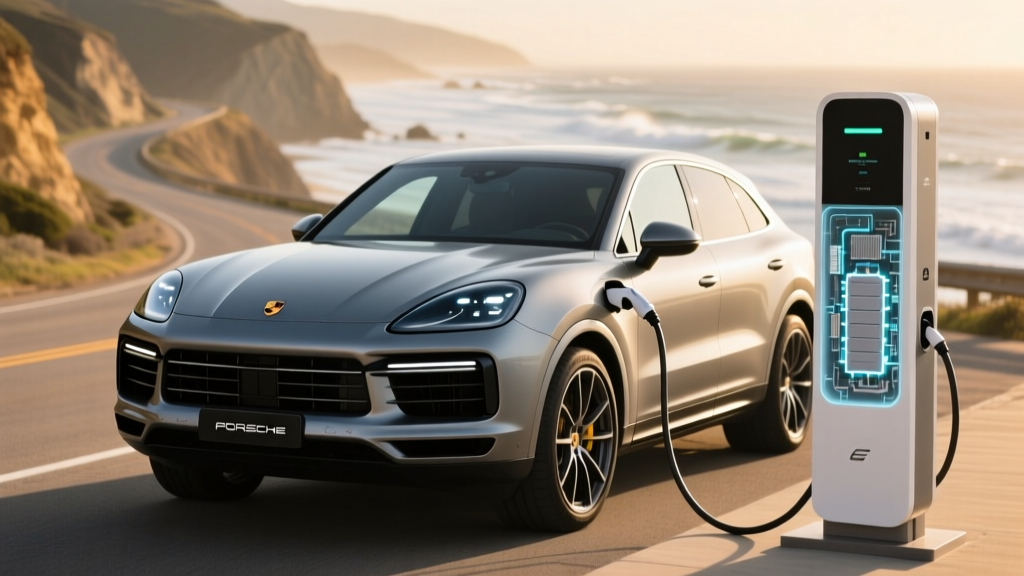
The 2024 Porsche Cayenne E-Hybrid occupies a narrow but compelling lane: genuine sports-SUV dynamics wrapped in a plug-in hybrid powertrain that can handle short commutes on electricity alone. For buyers who want the Cayenne badge and everyday usability but aren't ready to commit to a fully electric SUV like the Macan Electric or Audi Q8 e-tron, this PHEV offers a bridge — provided you understand exactly what it can and cannot do.
This guide breaks down the 2024 Cayenne E-Hybrid's electric range, fuel economy, charging logistics, powertrain specs, pricing, and long-term ownership considerations with the exact numbers you need to make an informed decision.
HEV vs PHEV: What the Cayenne E-Hybrid Actually Is
Before examining specs, it's critical to distinguish between hybrid types, because the Cayenne E-Hybrid is a plug-in hybrid (PHEV), not a conventional hybrid (HEV).
| Feature | Conventional Hybrid (HEV) | Plug-In Hybrid (PHEV) |
|---|---|---|
| Plugs in to charge? | No — regenerates via braking/engine | Yes — plugs into Level 1 or Level 2 |
| Electric-only driving | Brief, low-speed assist only | Extended range at highway speeds |
| Battery size | ~1–2 kWh | ~15–30 kWh (Cayenne: 25.9 kWh usable) |
| Example | Toyota RAV4 Hybrid | Porsche Cayenne E-Hybrid |
The 2024 Cayenne E-Hybrid has a large traction battery and an electric motor integrated into its eight-speed Tiptronic transmission. You can drive it purely on electricity for roughly 30 miles, or let the gasoline V6 and electric motor work together for full performance. If you never plug it in, it still functions as a heavy, somewhat thirsty hybrid — but you'll miss the entire point of the powertrain.
Electric-Only Range and Total Driving Range
The 2024 Cayenne E-Hybrid uses a 25.9 kWh usable battery (gross capacity is slightly higher). The EPA rates it at 32 miles of electric-only range on a full charge when equipped with standard 20-inch wheels. Opting for larger 21- or 22-inch wheels reduces that figure modestly.
EPA Electric Range: 32 miles
Real-World Expectation: 25–30 miles in mixed driving; 20–24 miles at sustained highway speeds (70+ mph) or in cold weather below 40°F. The Cayenne's 5,000+ lb curb weight and aerodynamic profile work against electric efficiency at speed.
Once the battery depletes, the 3.0-liter turbocharged V6 takes over, and the vehicle operates as a conventional hybrid. Total combined range (electric + gasoline) is approximately 430 miles, depending on driving style and conditions.
Fuel Economy: EPA MPG and Real-World Numbers
PHEV fuel economy is expressed two ways: MPGe (miles-per-gallon-equivalent) when accounting for electricity, and standard MPG when running on gasoline alone after battery depletion.
| Metric | City | Highway | Combined |
|---|---|---|---|
| MPGe (with full charge) | 50 MPGe combined (EPA) | ||
| Gas-only MPG (battery depleted) | 21 | 22 | 21 |
Source: fueleconomy.gov
The gas-only figure of 21 MPG combined is unremarkable for a midsize luxury SUV, and that's the reality if you don't charge regularly. The 50 MPGe figure only materializes if you plug in nightly and keep most trips under 32 miles. Owners who charge diligently and drive short commutes report real-world efficiency well above the EPA combined gas figure in city driving, where regenerative braking recaptures energy effectively. Highway-heavy drivers who rarely charge will see 19–21 MPG consistently.
Powertrain and Performance Specs
| Specification | 2024 Cayenne E-Hybrid |
|---|---|
| Engine | 3.0L turbocharged V6 |
| Electric Motor | Integrated into transmission, 134 HP (100 kW) |
| Combined Output | 389 HP / 435 lb-ft torque |
| 0–60 mph | 5.2 seconds (4.9 with Sport Chrono) |
| Transmission | 8-speed Tiptronic automatic |
| Drivetrain | All-wheel drive (AWD) |
| Battery (usable) | 25.9 kWh |
| EPA Electric Range | 32 miles |
| Base MSRP | $91,900 (SUV) / $98,400 (Coupe) |
The V6 produces 296 HP on its own; the electric motor adds 134 HP. Combined system output is 389 HP — enough for confident passing and genuine Porsche acceleration feel, if not the neck-snap thrust of the Cayenne Turbo E-Hybrid (which pairs a V8 for 729 combined HP at a significantly higher price).
Charging: Speed, Connectors, and Home Setup
The 2024 Cayenne E-Hybrid charges via a J1772 connector (the standard for non-Tesla PHEVs in North America). Here's what to expect at each level:
| Charging Level | Power | Full Charge Time (0–100%) | Notes |
|---|---|---|---|
| Level 1 (120V household) | ~1.4 kW | ~18–20 hours | Impractical for daily use |
| Level 2 (240V, 32A) | ~7.2 kW | ~4 hours | Recommended; overnight top-up |
| Level 2 (240V, 48A) | ~9.6 kW (vehicle limited to ~7.2 kW) | ~4 hours | No benefit over 32A circuit |
| DC Fast Charge | Not supported | N/A | No CCS or CHAdeMO port |
A key limitation: the Cayenne E-Hybrid does not support DC fast charging. This is common for PHEVs — the battery is small enough that Level 2 overnight charging is sufficient for daily needs. If you need rapid roadside top-ups, a full BEV is the better choice.
For home installation, budget $800–$2,500 for a Level 2 charger and electrician labor, depending on panel capacity and run length. A 40-amp circuit (delivering 32A continuous) is the sweet spot for this vehicle. If your home's electrical panel is maxed out, a panel upgrade can add $1,500–$3,000.
Pricing, Trims, and Tax Credit Eligibility
The 2024 Cayenne E-Hybrid starts at $91,900 for the SUV body style and $98,400 for the Coupe. Porsche's options strategy means most examples leave the dealer well above $100,000 — Premium Package, Sport Chrono, larger wheels, and adaptive air suspension add up quickly.
Federal §30D Tax Credit Eligibility (2024 rules):
- MSRP Cap: SUVs/vans/pickups must be ≤$80,000. The Cayenne E-Hybrid exceeds this cap — it does NOT qualify for the federal §30D new EV credit.
- Battery Sourcing: Even if under the cap, critical-mineral and battery-component sourcing requirements apply.
- Income Cap: Buyer AGI must be ≤$150K single / $300K joint.
Source: IRS.gov §30D
Bottom line: at a base price above $91,000, the Cayenne E-Hybrid is ineligible for the $7,500 federal credit regardless of your income or the battery's origin. Some states (California, Colorado, New York, and others) offer separate PHEV rebates that have higher MSRP caps or no cap at all — check your state energy office or the AFDC state incentive database for specifics. Consult a tax professional before making purchase decisions based on incentives.
Battery Warranty, Reliability, and Replacement Cost
Porsche High-Voltage Battery Warranty: 8 years / 100,000 miles (whichever comes first), with a capacity retention threshold of 70% of original capacity. If the battery degrades below 70% within the warranty period, Porsche will repair or replace it.
Porsche's PHEV powertrain has been in production since the 2019 Cayenne E-Hybrid launch, and the system is well-proven across the Porsche/VW Group platform (shared architecture with the Audi Q8 PHEV and Bentley Bentayga Hybrid). The 3.0L V6 is a known quantity with a long service history.
Out-of-warranty battery replacement is the concern that keeps PHEV buyers up at night. Based on current dealer pricing and labor, a full high-voltage battery replacement for the Cayenne E-Hybrid runs approximately $15,000–$20,000. Module-level repairs (replacing individual failed cells or modules rather than the entire pack) can reduce that to $5,000–$10,000 depending on the fault. Porsche's 8-year/100K-mile coverage is competitive with BMW and Mercedes but shorter than Toyota/Lexus's 10-year/150K-mile hybrid battery warranty.
For reliability data, check NHTSA.gov for any open recalls or technical service bulletins on the 2024 model year. IIHS does not always rate low-volume luxury vehicles, so NHTSA is your primary safety reference.
Who Should Buy the Cayenne E-Hybrid — And Who Shouldn't
Pros
- 32 miles electric covers most daily commutes gas-free
- Genuine Porsche handling and 5.2-second 0–60
- No range anxiety — V6 takes over seamlessly
- Premium interior, strong build quality
- Towing capacity up to 7,700 lbs (when equipped)
Cons
- No DC fast charging
- Gas-only MPG is poor (21 combined) if you don't plug in
- Base price exceeds $91K; no federal tax credit
- Electric range drops to ~20–24 mi in cold/highway use
- Heavy (~5,100 lbs) — affects tire and brake wear
Choose the Cayenne E-Hybrid if: You have home Level 2 charging, your daily round-trip commute is under 30 miles, you want a luxury performance SUV that can tow, and you take road trips too often to rely on a BEV's range alone.
Choose a full EV (e.g., BMW iX, Audi Q8 e-tron) if: You want zero gasoline stops, DC fast charging for road trips, lower per-mile fuel costs, and you have reliable home and workplace charging.
Choose the gas Cayenne if: You lack home charging access, your commute is long and highway-heavy, and the $15K+ PHEV price premium over the base Cayenne doesn't pencil out given your mileage.
Frequently Asked Questions
How many MPG does the 2024 Cayenne E-Hybrid get?
The EPA rates it at 50 MPGe combined when factoring in electric driving. Once the battery is depleted and it runs on gasoline only, expect 21 MPG combined (21 city / 22 highway). Real-world gas-only figures range from 19–22 MPG depending on driving style and conditions.
How far can the Cayenne E-Hybrid go on electric only?
The EPA rates it at 32 miles electric-only. In real-world driving — particularly at highway speeds or in cold weather — expect 20–30 miles before the gasoline engine engages.
Does the 2024 Cayenne E-Hybrid qualify for a tax credit?
No. At a base MSRP of $91,900, it exceeds the $80,000 SUV cap for the federal §30D new clean vehicle credit. State incentives may still apply depending on where you live.
Is the Cayenne E-Hybrid reliable?
The powertrain is well-established across the VW Group. The high-voltage battery carries an 8-year/100,000-mile warranty with a 70% capacity retention guarantee. Out-of-warranty battery replacement costs $15,000–$20,000 for a full pack.
Can I charge the Cayenne E-Hybrid at a DC fast charger?
No. The Cayenne E-Hybrid only supports Level 1 and Level 2 AC charging (up to ~7.2 kW). It does not have a CCS or CHAdeMO port for DC fast charging.
Hybrid vs PHEV vs EV — which fits me?
A conventional hybrid (HEV) is best if you can't charge at home and want better MPG with no behavior change. A PHEV like the Cayenne E-Hybrid fits if you have home charging, a short commute, and still want gas-engine range for road trips. A full EV (BEV) is ideal if you want the lowest running costs, have charging access, and are comfortable planning longer trips around DC fast chargers.