Quick Verdict: The Only Plug-In Hybrid Minivan Left Standing
The 2024 Chrysler Pacifica Hybrid occupies a category of one. As the sole plug-in hybrid minivan on the US market, it offers a compelling proposition for families who want daily electric commuting without sacrificing the cross-country flexibility of a gasoline engine. With 32 miles of EPA-rated electric-only range and a combined 82 MPGe, the Pacifica Hybrid rewards those who plug in regularly — but its value proposition collapses if you treat it like a conventional hybrid and never charge.
For 2024, Chrysler streamlined the trim lineup and bumped the starting MSRP to $51,095 (including destination). The powertrain carries over: a 3.6-liter Pentastar V6 paired with a dual-motor eFlite electrically variable transmission producing 262 combined horsepower. The 16 kWh lithium-ion battery pack sits beneath the second-row floor, preserving the Pacifica's signature Stow 'n Go third-row seats — though the second-row seats do not fold into the floor as they do on the gas-only model.
| Specification | Value |
|---|---|
| EPA Electric-Only Range | 32 miles |
| Total Combined Range (Electric + Gas) | 520 miles |
| MPGe (Combined, Electric Mode) | 82 MPGe |
| MPG Combined (Gas-Only, Charge-Sustaining) | 30 MPG |
| Battery Capacity | 16 kWh (lithium-ion) |
| Combined Horsepower | 262 hp |
| Engine | 3.6L V6 + dual electric motors (eFlite EVT) |
| Level 2 Charge Time (240V, 32A) | ~2 hours (0–100%) |
| Level 1 Charge Time (120V, 12A) | ~14 hours (0–100%) |
| DC Fast Charging | Not available |
| 0–60 mph | ~7.1 seconds |
| Base MSRP (Pinnacle) | $51,095 |
| Battery Warranty | 10 years / 100,000 miles |
PHEV vs. Conventional Hybrid: What the Pacifica Actually Is
Before evaluating the Pacifica Hybrid, it's essential to distinguish between the two hybrid architectures buyers encounter:
| Feature | Conventional Hybrid (HEV) | Plug-In Hybrid (PHEV) |
|---|---|---|
| Plug-in charging required? | No — charges via regenerative braking and engine | Yes — plugs in to maximize electric range and savings |
| Electric-only driving | Very limited (typically under 1 mile at low speed) | 20–40+ miles depending on model |
| Battery size | Small (1–2 kWh) | Medium (10–25+ kWh) |
| Federal tax credit eligibility | No (discontinued for new purchases after 2022) | Yes, if §30D requirements are met |
| Best for | Drivers without home charging access | Drivers with home/workplace charging who commute short distances |
The 2024 Pacifica Hybrid is a plug-in hybrid (PHEV). It has a 16 kWh battery that you charge by plugging into a standard 120V outlet or a 240V Level 2 charger. When the battery is depleted, it transitions seamlessly to charge-sustaining hybrid mode, operating much like a conventional HEV with its 30 MPG combined rating. Chrysler does not offer a non-plug-in hybrid Pacifica for 2024 — the gas-only Pacifica is a traditional ICE vehicle with no hybrid variant.
Fuel Economy: EPA Numbers and Real-World MPG
| Mode | City | Highway | Combined |
|---|---|---|---|
| Electric Mode (MPGe) | 84 MPGe | 80 MPGe | 82 MPGe |
| Gas-Only (Charge-Sustaining) MPG | 29 MPG | 30 MPG | 30 MPG |
According to EPA data on fueleconomy.gov, the 2024 Pacifica Hybrid delivers 82 MPGe combined when operating in electric mode and 30 MPG combined once the battery is depleted and the gasoline engine takes over.
Real-world expectations: PHEVs are notoriously sensitive to driver behavior. If you charge daily and your round-trip commute is under 32 miles, you may burn almost zero gasoline for weeks at a time — effectively achieving infinite MPG for daily driving. Owners on Fuelly and similar tracking platforms report real-world gas-only MPG in the 27–31 range depending on driving conditions, which aligns closely with the EPA estimate. Highway-only trips at 75+ mph with a depleted battery tend to land around 26–28 MPG due to the Pacifica's 4,800-pound curb weight and minivan aerodynamics. In cold weather (below 30°F), expect the electric-only range to drop by 15–25%, reducing that 32-mile EPA figure to roughly 24–27 miles as the battery's usable capacity shrinks and cabin heating draws additional energy.
Powertrain and Charging: How the eFlite System Works
The Pacifica Hybrid's powertrain centers on the 3.6-liter Pentastar V6, which produces 262 horsepower and 262 lb-ft of torque on its own. However, the eFlite electrically variable transmission integrates two electric motors that can drive the front wheels independently or in concert with the engine. Combined system output remains 262 hp — the electric motors supplement rather than dramatically add to the engine's output in this architecture.
The 16 kWh lithium-ion battery pack is mounted beneath the second-row floor. This placement is clever: it preserves the Pacifica's third-row Stow 'n Go folding capability, a feature no competing three-row SUV PHEV (such as the Toyota Grand Highlander Hybrid MAX or Hyundai Santa Fe PHEV) can match. However, the battery does prevent the second-row seats from folding into the floor — they must be removed manually for maximum cargo space.
Charging Speeds and Practicalities
The Pacifica Hybrid accepts AC charging only — there is no DC fast charging capability, which is typical for PHEVs in this class.
| Charging Level | Voltage / Amperage | Power (kW) | Time (0–100%) | Miles of Range per Hour |
|---|---|---|---|---|
| Level 1 (standard outlet) | 120V / 12A | ~1.4 kW | ~14 hours | ~2 miles/hr |
| Level 2 (home/public AC) | 240V / 32A | ~7.2 kW | ~2 hours | ~16 miles/hr |
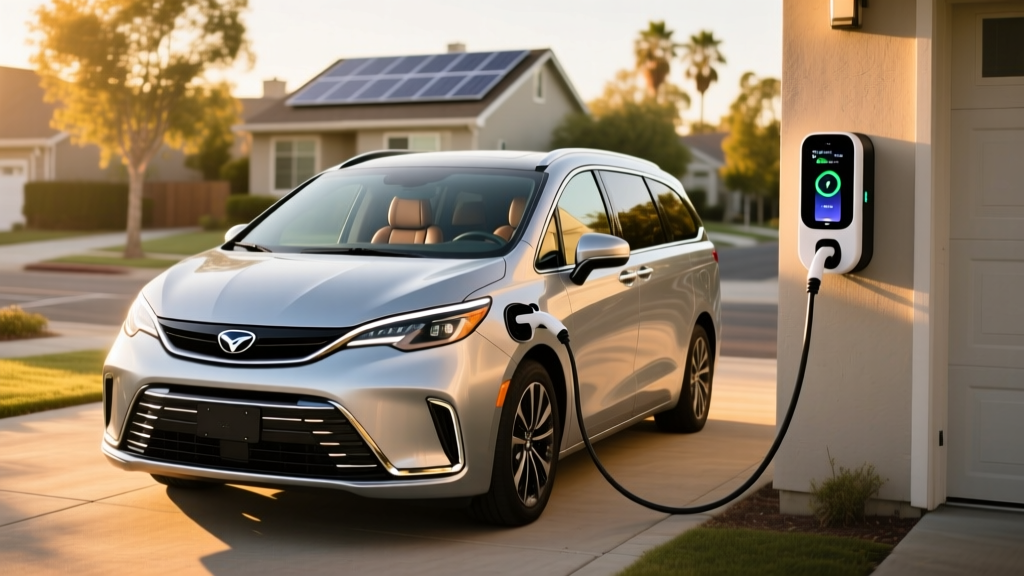
For most owners, a Level 2 home charger is the practical choice. A 2-hour charge time means you can fully replenish the battery during a workday or overnight. The included Level 1 cord works for occasional top-ups but is too slow for daily full recharges. The Pacifica Hybrid uses a standard J1772 connector for AC charging — no adapter needed for any home or public Level 2 station.
Pricing, Trims, and Federal Tax Credit Eligibility
For 2024, the Pacifica Hybrid is offered in three trims:
- Select: $51,095 MSRP
- Select Premium (S Appearance): ~$53,095 MSRP
- Pinnacle: ~$57,095 MSRP
All trims include the 16 kWh battery, power-sliding doors, a 10.1-inch Uconnect 5 infotainment display, wireless Apple CarPlay/Android Auto, and a comprehensive suite of ADAS features including adaptive cruise control with stop-and-go, lane-keeping assist, and automatic emergency braking.
Federal §30D Tax Credit: Does the Pacifica Hybrid Qualify?
Under current IRS §30D rules, the 2024 Pacifica Hybrid may qualify for up to $7,500 in federal tax credits — but eligibility depends on multiple factors:
- MSRP Cap: Vans/SUVs must have an MSRP at or below $80,000 — all Pacifica Hybrid trims qualify.
- Buyer Income Cap: Modified AGI must not exceed $150,000 (single), $225,000 (head of household), or $300,000 (joint filers).
- Battery Sourcing: The critical minerals and battery component requirements phase in progressively. Chrysler has confirmed that the Pacifica Hybrid meets partial sourcing requirements, but the exact credit amount ($3,750 or $7,500) depends on the vehicle's build date and battery supply chain compliance. Check the IRS's official qualified vehicle list for your specific VIN.
- Point-of-Sale Transfer: As of 2024, eligible buyers can transfer the credit to the dealer at purchase, reducing the purchase price directly rather than waiting for a tax refund.
- Tax Liability: The credit is non-refundable — you must have sufficient federal tax liability to claim it (unless transferred at point of sale).
Important: Tax credit rules change frequently and depend on your individual tax situation. Consult a tax professional and verify your specific vehicle's eligibility on the IRS and DOE websites before purchasing.
Battery Longevity, Warranty, and Replacement Cost
PHEV battery degradation is generally less severe than full EV battery degradation because the system uses a buffer — the Pacifica Hybrid doesn't allow the battery to fully discharge or charge to true 100%, which reduces stress on the cells. In practice, most PHEV owners report minimal noticeable range loss over 5–7 years of ownership, typically in the range of 5–10% capacity reduction.
Replacement cost: If the battery fails outside of warranty, a replacement 16 kWh pack for the Pacifica Hybrid currently runs approximately $7,000–$9,000 for the part, plus $1,500–$2,500 in labor, for a total of roughly $8,500–$11,500. This is a meaningful expense, but it's worth noting that the 10-year/100,000-mile warranty provides substantial coverage, and most batteries outlast their warranty period.
Is the Pacifica Hybrid Reliable?
The Pacifica Hybrid's reliability record has improved since its troubled 2017–2019 launch, when early models experienced battery recall issues and powertrain software glitches. Chrysler issued recalls for battery pack fire risks on 2017–2018 models (NHTSA recall 20V-631), which were addressed through software updates and, in some cases, battery replacements.
For 2024 models, the powertrain is a mature, well-understood system. The Pentastar V6 is one of the most widely produced engines in Stellantis's portfolio with a long reliability track record. The eFlite EVT, developed in partnership with Aisin, has proven robust in the years since the early recalls were resolved. Consumer Reports rates recent-model Pacifica Hybrids as average to slightly above average for predicted reliability, though minivans as a segment tend to score lower than sedans due to the complexity of power-sliding doors, power liftgates, and folding seat mechanisms.
The 2024 Pacifica Hybrid earned a Top Safety Pick rating from IIHS in prior model years, and the current generation maintains strong crash-test performance with standard automatic emergency braking, lane-departure warning, and blind-spot monitoring.
Pacifica Hybrid vs. Full EV vs. Gas Minivan: Which Fits Your Family?
Choosing between the Pacifica Hybrid, a full battery-electric vehicle, and the conventional gas Pacifica depends on your charging access, driving patterns, and budget.
- Choose the Pacifica Hybrid if: You have home Level 2 charging, your daily driving is under 30 miles, you need a minivan specifically, and you take regular road trips exceeding 200+ miles where charging infrastructure may be sparse.
- Choose a full EV (e.g., Kia EV9, Tesla Model X) if: You have reliable home charging, want zero tailpipe emissions, your daily driving is under 250 miles, and you're comfortable planning DC fast charging stops on road trips.
- Choose the gas-only Pacifica if: You lack home charging access, your budget is tighter (the gas Pacifica starts ~$12,000 lower), or you drive primarily long highway routes where the PHEV's electric range offers minimal benefit.
The Pacifica Hybrid's strongest competitive position is against three-row electric SUVs like the Kia EV9 (EPA range up to 304 miles, starting ~$54,900). The EV9 offers more interior technology and lower operating costs, but it cannot match the Pacifica's sliding-door convenience, Stow 'n Go flexibility, or 520-mile total range without stopping. For families who prioritize minivan practicality and want to reduce — but not eliminate — gasoline consumption, the Pacifica Hybrid remains without a direct alternative.
- Only PHEV minivan available — no direct competitor
- 32 miles electric-only covers most daily school/activity runs
- Stow 'n Go third row preserved despite battery placement
- 520-mile total range eliminates road-trip charging anxiety
- 10-year/100,000-mile battery and powertrain warranty
- Eligible for up to $7,500 federal tax credit (verify eligibility)
- Starting price over $51,000 — $12K+ more than gas Pacifica
- No DC fast charging — Level 2 only
- Second-row seats don't fold into the floor (must be removed)
- Heavy at ~4,800 lbs — gas-only MPG is merely average at 30 combined
- Early model-year recalls may concern used buyers
- Electric range drops 15–25% in cold weather
Frequently Asked Questions
How many MPG does the 2024 Pacifica Hybrid get?
The EPA rates the 2024 Pacifica Hybrid at 82 MPGe combined in electric mode and 30 MPG combined in gas-only (charge-sustaining) mode. In gas mode, it returns 29 MPG city and 30 MPG highway. Real-world gas-only MPG typically ranges from 26 to 31 depending on speed, temperature, and terrain.
How far can the Pacifica Hybrid go on electric only?
The EPA rates the Pacifica Hybrid at 32 miles of electric-only range. In real-world driving, expect 28–32 miles in mild weather and 24–27 miles in cold conditions or at sustained highway speeds. Once the battery is depleted, the gasoline engine engages seamlessly and the vehicle operates as a conventional hybrid.
Does the 2024 Pacifica Hybrid qualify for a federal tax credit?
The Pacifica Hybrid may qualify for up to $7,500 under the IRS §30D Clean Vehicle Credit, subject to buyer income limits ($300,000 joint / $150,000 single), MSRP caps (under $80,000 for vans — all trims qualify), and battery sourcing requirements. The credit can be transferred to the dealer at point of sale as of 2024. Always verify your specific vehicle and tax situation on the IRS website and with a tax professional.
How long does the Pacifica Hybrid battery last, and what does replacement cost?
Chrysler warranties the 16 kWh battery for 10 years or 100,000 miles. PHEV batteries typically experience 5–10% capacity loss over 5–7 years. Out-of-warranty replacement costs approximately $8,500–$11,500 including parts and labor. Most batteries outlast their warranty period.
Should I get the Pacifica Hybrid or a full electric vehicle?
Choose the Pacifica Hybrid if you need minivan-specific features (sliding doors, Stow 'n Go), regularly drive beyond 200 miles, or lack reliable DC fast charging on your typical routes. Choose a full EV like the Kia EV9 if you have home charging, want zero tailpipe emissions, and are comfortable with DC fast charging on road trips. The Pacifica Hybrid is the better bridge solution; a full EV offers lower long-term operating costs and no gasoline dependency.
Can the Pacifica Hybrid charge on DC fast chargers?
No. The Pacifica Hybrid supports only AC charging — Level 1 (120V) and Level 2 (240V). This is standard for most PHEVs, which have smaller batteries that don't justify the cost and weight of DC fast charging hardware. A full Level 2 charge takes approximately 2 hours.