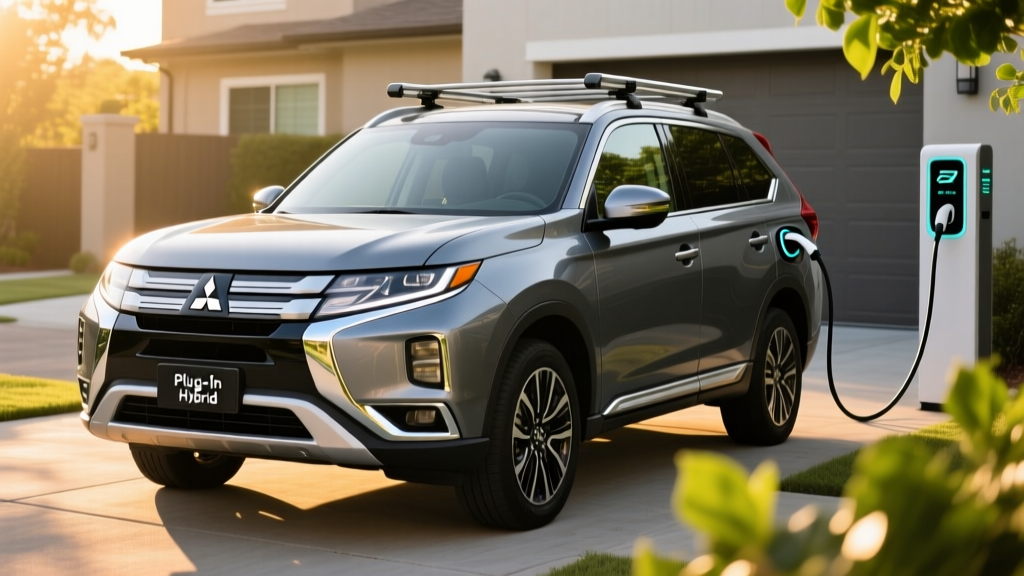
The 2024 Mitsubishi Outlander Plug-In Hybrid occupies a specific niche: a three-row compact SUV that lets you commute on electricity alone while keeping a gas engine for road trips. With a refreshed powertrain, standard all-wheel drive, and a usable battery that covers most daily driving, it targets buyers who want EV-like daily operation without committing to a full battery-electric vehicle. Here's every number you need to evaluate whether it fits your garage.
| Spec | Value |
|---|---|
| Battery (gross / usable) | 20.0 kWh / ~17.5 kWh |
| EPA Electric-Only Range | 38 miles |
| EPA Combined Range (EV + Gas) | 402 miles |
| MPGe (combined, EV mode) | 64 MPGe |
| MPG (combined, gas-only) | 26 MPG |
| Combined System Horsepower | 248 hp |
| Drivetrain | S-AWC (standard AWD) |
| DC Fast Charge (CHAdeMO) | Yes, ~22 kW peak |
| Level 2 Charge Time (0–100%) | ~6.5 hours (240V, 15A) |
| 0–60 mph | ~7.1 seconds |
| Towing Capacity | 1,500 lbs |
| Base MSRP (ES trim) | $39,845 |
| Battery Warranty | 10 years / 100,000 miles |
How the Outlander PHEV Powertrain Actually Works
The 2024 Outlander PHEV pairs a 2.4-liter Atkinson-cycle four-cylinder engine with twin electric motors — one on each axle — producing a combined 248 horsepower and 332 lb-ft of torque. Mitsubishi's Super All-Wheel Control (S-AWC) system is standard across all trims, making this one of the few PHEVs in its class with true standard AWD.
The 20.0 kWh lithium-ion battery (approximately 17.5 kWh usable) sits beneath the floor and provides the EPA-rated 38 miles of electric-only range. The system operates in three modes: EV (pure electric), Series Hybrid (engine generates electricity for the motors), and Parallel Hybrid (engine drives the front wheels directly at highway speeds). The transition between modes is mostly seamless, though you'll hear the engine engage under hard acceleration or when the battery depletes.
Unlike a conventional hybrid (HEV) such as the Toyota RAV4 Hybrid, the Outlander PHEV has a charge port and a meaningfully larger battery. You plug it in to unlock its full electric range. If you never plug it in, it functions as a heavier, less efficient conventional hybrid — you'd be carrying dead battery weight and getting roughly 26 MPG combined, which is worse than purpose-built HEVs.
Electric-Only Range: 38 Miles EPA, What to Expect in Reality
Real-world expectation: 30–35 miles in mixed driving; 25–28 miles in sustained highway or cold weather (below 40°F); up to 38 miles in mild city driving under 45 mph.
The 38-mile EPA rating is competitive for the segment — it covers the average American's one-way commute of roughly 16 miles, according to Federal Highway Administration data, with margin to spare. In practice, electric range varies significantly with conditions:
- City driving, mild weather: You can extract the full 38 miles, sometimes slightly more, because regenerative braking recovers energy at every stop.
- Highway driving at 70+ mph: Expect 28–32 miles. Aerodynamic drag and the lack of regen opportunities reduce efficiency.
- Cold weather (below 40°F): Battery chemistry slows, cabin heating draws energy, and range drops to 25–28 miles. Using the seat heaters instead of cranking the cabin heat helps preserve range.
- Hilly terrain: Uphill segments consume energy quickly, but downhill regen partially compensates.
Once the battery depletes, the Outlander PHEV switches to hybrid mode and delivers 26 MPG combined (25 city / 27 highway per the EPA). That's unremarkable compared to the Toyota RAV4 Hybrid's 39 MPG combined, but acceptable given the PHEV's heavier battery pack and the fact that most daily miles should be covered electrically.
Fuel Economy Breakdown: MPG and MPGe Explained
| Mode | City | Highway | Combined |
|---|---|---|---|
| Electric (MPGe) | 68 MPGe | 61 MPGe | 64 MPGe |
| Gas-Only (MPG) | 25 MPG | 27 MPG | 26 MPG |
The MPGe figure (miles per gallon equivalent) measures energy efficiency when running on electricity, converting kWh consumption into a gasoline-equivalent number. At 64 MPGe combined, the Outlander PHEV is efficient in EV mode but trails the Toyota RAV4 Prime's 94 MPGe. The gap reflects the Outlander's larger, heavier three-row body and less energy-dense battery packaging.
Real-world MPG observation: Owners who charge nightly and commute within the 38-mile electric envelope report using very little gasoline — sometimes going months between fill-ups. If your daily round trip is under 35 miles and you charge at home, your effective "MPG" is essentially infinite for daily driving, with gasoline reserved for longer trips. Conversely, if you never charge and drive it purely as a hybrid, 26 MPG combined is the realistic figure — and at that point, a conventional hybrid would serve you better.
Charging Specs: Level 1, Level 2, and DC Fast Charging
The Outlander PHEV is one of the few plug-in hybrids that supports DC fast charging — a meaningful advantage for apartment dwellers or road-trippers who need a quick top-up. Here's the full charging breakdown:
| Charge Level | Power | Time (0–100%) | Connector |
|---|---|---|---|
| Level 1 (120V household) | ~1.4 kW | ~14 hours | J1772 |
| Level 2 (240V home/public) | ~3.6 kW | ~6.5 hours | J1772 |
| DC Fast Charge | ~22 kW peak | 0–80% in ~38 min | CHAdeMO |
Critical connector note: The Outlander PHEV uses the CHAdeMO DC fast-charging standard, not CCS or NACS. CHAdeMO infrastructure has been declining in the U.S. as Electrify America and other networks prioritize CCS and Tesla's NACS connector. Before relying on DC fast charging, verify that CHAdeMO chargers exist along your routes using apps like PlugShare. This is a genuine limitation for long-term ownership as the industry consolidates around NACS.
For home charging, a standard 120V outlet (Level 1) will replenish the battery overnight if you drive less than the full 38-mile range daily. A 240V Level 2 home charger is ideal and fills the battery in roughly 6.5 hours — easily done overnight. The onboard charger is limited to 3.6 kW, so installing a 48-amp Level 2 charger won't speed things up; a more affordable 16-amp unit delivers the same result.
Pricing, Trims, and Federal Tax Credit Eligibility
The 2024 Outlander PHEV starts at $39,845 (ES trim, including destination) and ranges up to approximately $48,545 for the top SEL Touring trim. All trims include standard AWD, which is a value advantage over competitors that charge extra for all-wheel drive.
- Credit amount: Up to $7,500, split between critical minerals ($3,750) and battery components ($3,750)
- MSRP cap: SUVs must be under $80,000 — Outlander PHEV qualifies
- Buyer income cap: AGI must not exceed $150,000 (single) / $300,000 (joint)
- Battery sourcing: Critical minerals and component requirements have tightened annually since 2023; Mitsubishi's supply chain eligibility varies by model year and must be confirmed on the IRS clean vehicle list
- Point-of-sale transfer: Eligible buyers can apply the credit as an upfront discount at the dealer
Important caveat: Tax credit eligibility for the Outlander PHEV depends on battery component and critical-mineral sourcing requirements that change annually. The credit amount may be $0, $3,750, or the full $7,500 depending on the current year's sourcing rules. Always check the fueleconomy.gov tax credit tracker before purchasing, and consult a tax professional for your specific situation. Some states offer additional PHEV rebates — check your state's energy office for local programs.
Hybrid vs. PHEV vs. Full EV: Which Fits Your Situation?
| Factor | Conventional Hybrid (HEV) | Plug-In Hybrid (PHEV) | Battery Electric (BEV) |
|---|---|---|---|
| Plug in required? | No | Yes (for EV range) | Yes |
| Electric-only range | 0 miles | 25–45 miles typical | 200–400+ miles |
| Home charging needed | No | Recommended | Essential |
| Road-trip convenience | Excellent | Excellent | Requires planning |
| Daily fuel cost (short commute) | Low | Very low (electricity) | Very low (electricity) |
| Maintenance | Low | Moderate (engine + EV systems) | Lowest |
| Best for | No home charging access | Home charging + road trips | Home charging + mostly local |
Choose the Outlander PHEV if: You have access to home or workplace charging, your daily commute is under 35 miles round-trip, you take road trips several times a year where charging infrastructure may be sparse, and you want three rows of seating without committing to a full EV.
Choose a full EV instead if: You have reliable home charging, rarely drive more than 250 miles in a single day, want the lowest maintenance costs, and want access to the full federal tax credit without sourcing complications.
Choose a conventional hybrid (like the Toyota RAV4 Hybrid) if: You cannot charge at home or at work. A PHEV you never plug in is simply a heavier, less efficient hybrid — you'd be paying a premium for battery capacity you never use.
Battery Longevity, Warranty, and Replacement Cost
Lithium-ion battery degradation in PHEVs tends to be gradual. Based on data from Mitsubishi's earlier Outlander PHEV generations (sold since 2014 globally), owners typically report 85–92% state of health (SoH) after 5 years and 60,000 miles. The smaller battery cycles more frequently than a full EV's pack, but Mitsubishi's thermal management and conservative usable buffer (roughly 2.5 kWh held in reserve) help mitigate accelerated wear.
Battery replacement cost: If the battery falls below the 70% capacity threshold within the warranty period, Mitsubishi replaces it at no charge. Out of warranty, a full PHEV battery replacement currently ranges from $8,000 to $12,000 including labor, based on dealer estimates. Individual module replacement (if only some cells degrade) may cost less. As with all PHEVs, battery costs are expected to decline as the supply chain matures.
Maximizing battery life: Avoid routinely charging to 100% and then letting the car sit in hot weather — the combination of high state of charge and heat accelerates degradation. If your daily commute only needs 20 miles of range, setting the charge limit to 80% (if the vehicle's software allows) will extend long-term battery health. Mitsubishi's battery management system already includes protective buffers, so everyday use shouldn't cause alarm.
Reliability, Safety, and Ownership Costs
The 2024 Outlander PHEV carries over the redesigned platform introduced for 2023, which earned a TOP SAFETY PICK+ rating from the IIHS when equipped with specific headlights. Standard safety equipment includes automatic emergency braking with pedestrian detection, lane-keeping assist, adaptive cruise control, and blind-spot monitoring.
Long-term reliability data for the 2023+ generation is still accumulating, but the previous-generation Outlander PHEV (2014–2022 globally) proved durable in markets like Japan and Europe where it was a top-selling PHEV for years. Common owner-reported issues have centered on infotainment software glitches rather than powertrain failures. Mitsubishi's 5-year/60,000-mile basic warranty and 10-year/100,000-mile powertrain warranty provide strong coverage.
Total cost of ownership advantage: If you charge at home at the U.S. average electricity rate of ~$0.16/kWh, fully charging the 17.5 kWh usable battery costs approximately $2.80 — delivering 38 miles for less than $3. The equivalent gasoline cost at 26 MPG and $3.50/gallon would be $5.12. Over a year of 12,000 miles (assuming 70% electric driving), fuel savings can reach $800–$1,200 compared to a gas-only Outlander.
Pros
- Standard AWD across all trims — no upcharge
- Three-row seating (rare for PHEV compact SUVs)
- DC fast charging capability (CHAdeMO)
- 38-mile EV range covers most commutes
- 10-year/100,000-mile battery warranty
- IIHS TOP SAFETY PICK+ (with qualifying headlights)
Cons
- 26 MPG gas-only is below competing HEVs
- CHAdeMO connector is a declining standard in the U.S.
- Third row is tight — best for small children only
- Only 3.6 kW Level 2 onboard charger limits charging speed
- Towing limited to 1,500 lbs
- Tax credit eligibility uncertain due to battery sourcing rules
Frequently Asked Questions
How many MPG does the 2024 Mitsubishi Outlander PHEV get?
The EPA rates it at 64 MPGe combined when running on electricity and 26 MPG combined (25 city / 27 highway) when operating as a gas-only hybrid after the battery depletes. Real-world gas MPG may reach 27–28 MPG in gentle driving but drops to 23–24 MPG under heavy loads or sustained highway speeds above 75 mph.
How far can the Outlander PHEV go on electric only?
The EPA rates it at 38 miles of electric-only range. In real-world conditions, expect 30–35 miles in mixed driving, 25–28 miles in cold weather or sustained highway use, and up to 38 miles in mild-weather city driving. Once the battery depletes, the gas engine takes over seamlessly for a total combined range of 402 miles.
Does the Outlander PHEV qualify for a federal tax credit?
It may qualify for up to $7,500 under the §30D clean vehicle credit, but eligibility depends on battery component and critical-mineral sourcing requirements that change annually. The MSRP is under the $80,000 SUV cap, and buyer income limits apply ($150,000 single / $300,000 joint AGI). Always verify current eligibility on irs.gov before purchasing.
Is the Outlander PHEV reliable, and what does a battery replacement cost?
The Outlander PHEV's powertrain has proven reliable globally since 2014. Mitsubishi backs the battery with a 10-year/100,000-mile warranty covering capacity loss below 70%. Out-of-warranty battery replacement is estimated at $8,000–$12,000. Most owners report minimal degradation within the warranty period thanks to conservative battery management.
Should I buy the Outlander PHEV or a full EV?
Choose the Outlander PHEV if you need three rows, take frequent road trips beyond charging infrastructure, and have home charging for daily electric commuting. Choose a full EV (like the Kia EV9 or Tesla Model Y) if you have reliable charging, want the lowest maintenance costs, and rarely exceed 250 miles in a day. If you cannot charge at home, skip the PHEV and choose a conventional hybrid instead — an unplugged PHEV wastes money and efficiency.
Can I charge the Outlander PHEV at a Tesla Supercharger?
Not directly. The Outlander PHEV uses a J1772 connector for Level 2 and CHAdeMO for DC fast charging. Tesla Superchargers use the NACS connector. No adapter currently allows CHAdeMO vehicles to access NACS Superchargers. For Level 2 public charging, a J1772-to-NACS adapter may work at some Tesla destination chargers, but DC fast charging remains limited to CHAdeMO stations.
The 2024 Mitsubishi Outlander Plug-In Hybrid isn't the most efficient PHEV in its class, and its CHAdeMO connector is a genuine concern as U.S. charging networks pivot to NACS. But for buyers who need three rows, standard AWD, and a practical electric commute buffer — without sacrificing road-trip flexibility — it remains one of the few vehicles that checks every box. Verify tax credit eligibility, confirm CHAdeMO availability in your area, and ensure you have home charging access before signing.