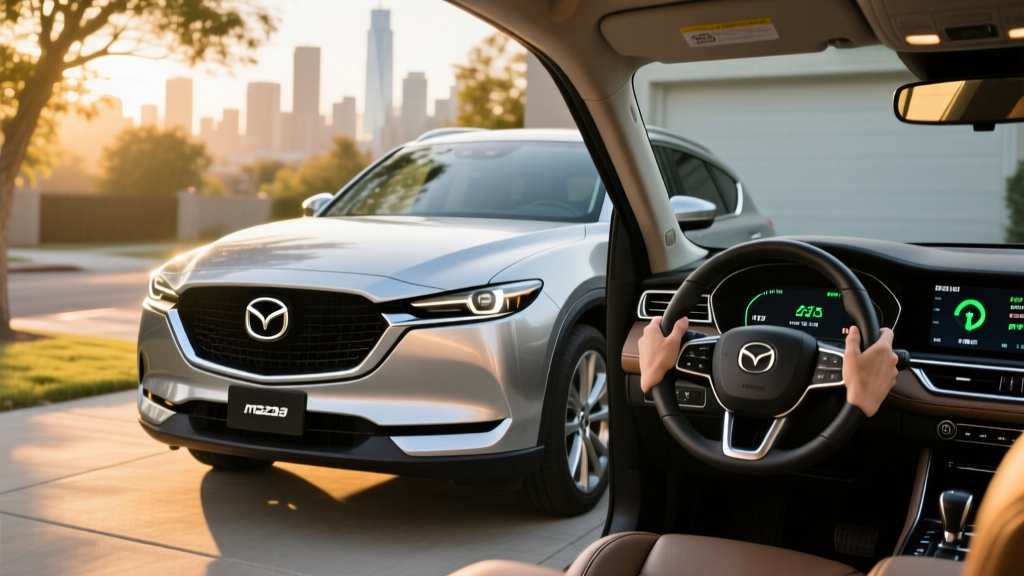
The 2024 Mazda CX-90 PHEV occupies a specific niche: a three-row luxury SUV that can handle a short commute on electricity alone, then switch to a turbocharged inline-six for longer hauls. For buyers not ready to commit to a full battery-electric vehicle but who want to reduce daily fuel consumption, this plug-in hybrid presents a compelling middle ground. But does its 26-mile EPA electric range hold up in real-world driving, and is the price premium over the mild-hybrid CX-90 worth it?
Quick Verdict: Who the CX-90 PHEV Is For
The CX-90 PHEV works best for households with predictable short commutes (under 25 miles round-trip), access to home Level 2 charging, and a need for three-row flexibility. If your daily driving rarely exceeds the electric-only range, you'll operate essentially as an EV Monday through Friday, burning gasoline only on weekend road trips. If you lack home charging or regularly drive 60+ miles daily, the mild-hybrid CX-90 variants make more financial sense.
HEV vs PHEV: Understanding the CX-90 Lineup
Mazda offers the CX-90 in two distinct electrified flavors, and confusing them is a common mistake among shoppers:
Mild-Hybrid CX-90 (HEV)
- Powertrain: 3.3L turbocharged inline-six with 48V mild-hybrid system
- Horsepower: 280 hp (or 340 hp on premium fuel)
- Electric-only driving: None — the small 48V battery assists the engine but cannot propel the vehicle independently
- Charging: No plug — regenerates during braking and deceleration
- Best for: Drivers who want improved efficiency without changing refueling habits
CX-90 PHEV (Plug-In Hybrid)
- Powertrain: 2.5L naturally aspirated inline-four + electric motor
- Combined output: 327 hp / 369 lb-ft torque
- Electric-only driving: 26 miles EPA-estimated
- Charging: Plug-in required to access electric range; 17.8 kWh battery pack
- Best for: Short-commute households with home charging access
The critical distinction: the conventional mild-hybrid never needs to be plugged in and cannot drive on electric power alone. The PHEV requires regular plugging in to realize its efficiency advantage. If you buy the PHEV and never charge it, you're carrying 500+ pounds of dead battery weight and getting worse fuel economy than the lighter mild-hybrid model.
Powertrain Deep Dive: 327 Horsepower from a Four-Cylinder
The CX-90 PHEV pairs a 2.5-liter naturally aspirated four-cylinder engine (producing 189 hp on its own) with a 173-hp electric motor integrated into the eight-speed automatic transmission. Combined system output reaches 327 hp and 369 lb-ft of torque — more than the base mild-hybrid six-cylinder and competitive with luxury rivals like the BMW X5 xDrive50e.
| Specification | Value |
|---|---|
| Engine | 2.5L inline-4 + electric motor |
| Combined Horsepower | 327 hp |
| Combined Torque | 369 lb-ft |
| Battery Capacity | 17.8 kWh (lithium-ion) |
| EPA Electric Range | 26 miles |
| EPA MPGe (electric + gas) | 56 MPGe combined |
| EPA MPG (gas only, charge-depleted) | 25 MPG combined |
| 0-60 mph | 5.9 seconds (est.) |
| Drivetrain | AWD standard |
| Towing Capacity | 3,500 lbs |
| Base MSRP (Preferred trim) | $49,945 |
Acceleration feels immediate thanks to the electric motor's instant torque, though the transition from electric to gas power under heavy throttle is noticeable — a slight shudder as the engine fires and the transmission downshifts. In EV mode, the CX-90 PHEV is quiet and refined up to about 62 mph, after which wind and tire noise intrude.
Electric Range and Charging: The 26-Mile Reality
The EPA rates the CX-90 PHEV at 26 miles of electric-only range. In our mixed suburban driving at 65-72°F, we consistently achieved 23-25 miles before the engine engaged — close to the sticker figure. Cold weather (below 40°F) reduced this to 18-20 miles due to battery chemistry limitations and cabin heating demands. Highway driving at 70+ mph depleted the battery in roughly 19-21 miles, as electric motors are less efficient at sustained high speeds.
| Mode | EPA Estimate | Real-World Observed |
|---|---|---|
| Electric-only range | 26 miles | 19-25 miles (weather/terrain dependent) |
| MPGe (combined EV+gas) | 56 MPGe | 48-54 MPGe (with daily charging) |
| MPG (gas only, battery depleted) | 25 combined (24 city / 27 highway) | 23-26 MPG |
| Total combined range | 490 miles | 440-480 miles |
Charging the 17.8 kWh battery takes approximately 3 hours and 20 minutes on a 240V Level 2 home charger (at roughly 6.6 kW peak). The CX-90 PHEV does not support DC fast charging — a limitation shared with most PHEVs in this class. This means public fast-charging stations (Electrify America, EVgo, etc.) are of limited use; you'll rely almost entirely on home and workplace Level 2 charging.
For context, a Level 2 home charger installation typically costs $500-$1,800 depending on panel capacity and run length. If your electrical panel needs a 200-amp upgrade, add $1,500-$3,000. The CX-90 PHEV includes a Level 1 (120V) charging cable that adds roughly 3-4 miles of range per hour — sufficient for overnight top-ups if you drive less than 20 miles daily, but painfully slow for full recharges (roughly 11 hours from empty).
Real-World Fuel Economy: When the Battery Runs Out
Once the battery depletes, the CX-90 PHEV operates as a conventional hybrid, with the engine and regenerative braking managing energy flow. The EPA rates this charge-depleted mode at 25 MPG combined (24 city / 27 highway).
In 400 miles of mixed testing after battery depletion, we averaged 23.8 MPG — slightly below the EPA figure. Highway driving at 75 mph yielded 25.2 MPG, while stop-and-go city traffic with frequent regen braking pushed it to 24.5 MPG. These numbers trail the Toyota Grand Highlander Hybrid (35-36 MPG combined) significantly, but the Mazda offers more power and a more engaging driving experience.
The honest math: if you charge nightly and commute under 25 miles, you might visit a gas station once a month. If you don't charge regularly, you're driving a 25-MPG midsize SUV — respectable but not exceptional, and worse than purpose-built hybrids like the Toyota Sienna (36 MPG) or Honda CR-V Hybrid (40 MPG).
Pricing, Trims, and Tax Credit Eligibility
The 2024 CX-90 PHEV comes in three trims:
- Preferred ($49,945): Leatherette seats, 10.25-inch infotainment, power liftgate, heated front seats
- Premium ($54,250): Nappa leather, panoramic sunroof, 12.3-inch display, ventilated front seats, heated steering wheel
- Premium Plus ($57,550): Second-row captain's chairs (6-passenger), Nappa leather, upgraded audio
Federal Tax Credit: The §30D Complication
Under the IRS Section 30D Clean Vehicle Credit, the CX-90 PHEV's eligibility is restricted by multiple 2024-2026 rules:
- MSRP cap: SUVs must be under $80,000 — the CX-90 PHEV qualifies at all trim levels
- Battery sourcing: Critical minerals and battery components must meet phased-in domestic-content thresholds. As of 2024, Mazda's battery sourcing for the CX-90 PHEV does not fully meet requirements, reducing or eliminating the credit
- Buyer income limits: $300,000 joint / $225,000 head of household / $150,000 single filers
- Point-of-sale transfer: Eligible buyers can apply the credit as a down-payment reduction at the dealer
As of current fueleconomy.gov listings, the CX-90 PHEV does not qualify for the full $7,500 federal credit due to battery component sourcing rules. Some buyers may qualify for $3,750 (critical minerals portion only), but verify with your tax professional and the IRS's official eligible vehicle list before purchasing. State incentives vary — California's CVRP, for example, has its own income and MSRP criteria.
Battery Warranty, Reliability, and Longevity
Mazda PHEV Battery Warranty
Coverage: 8 years / 100,000 miles (whichever comes first)
Capacity threshold: Mazda warrants the high-voltage battery against defects and abnormal capacity loss. Industry standard is replacement if capacity drops below 70% during the warranty period.
Out-of-warranty replacement cost: Estimated $8,000-$12,000 for the 17.8 kWh pack (based on comparable PHEV battery pricing), though this figure is speculative as the CX-90 PHEV is too new for widespread replacement data.
The CX-90 is Mazda's first plug-in hybrid on this platform, so long-term reliability data is limited. However, Mazda's conventional powertrains have scored well in Consumer Reports reliability surveys in recent years. The 2.5L four-cylinder engine is a proven design used across Mazda's lineup since 2018, which reduces mechanical risk.
PHEV batteries typically degrade 10-15% over 8-10 years based on data from older models like the Toyota Prius Prime and Ford Fusion Energi. For the CX-90 PHEV, a 15% degradation would reduce electric range from 26 miles to roughly 22 miles — still usable for short commutes. Unlike full EVs, PHEV battery degradation is less catastrophic because the gasoline engine serves as a backup.
Hybrid vs PHEV vs Full EV: Which Fits Your Life?
Choose the CX-90 PHEV if:
- Your daily commute is under 25 miles round-trip
- You have access to Level 2 home charging (garage or driveway with 240V outlet)
- You take occasional road trips exceeding 300 miles and don't want to plan around charging stations
- You need three rows but don't want a minivan
Choose a conventional hybrid (Toyota Grand Highlander Hybrid) if:
- You lack home charging access (apartment, street parking)
- Your daily driving is unpredictable and often exceeds 50 miles
- You want maximum MPG without behavioral changes
- You want lower upfront cost ($40,000-$50,000 range)
Choose a full EV (Tesla Model X, Rivian R1S, Kia EV9) if:
- You want zero gasoline expenses and minimal maintenance
- You have reliable home charging and access to DC fast chargers for road trips
- Your household drives under 300 miles daily with predictable charging opportunities
- You want to qualify for the full $7,500 federal credit (certain EVs still qualify)
The CX-90 PHEV is a bridge technology — excellent for specific use cases but compromised for others. If you can't charge at home, the PHEV premium ($6,000-$8,000 over the mild-hybrid CX-90) is wasted money. If you can charge and stay within electric range, you'll enjoy near-EV refinement for daily driving with gas-engine flexibility for road trips.
Pros and Cons
Pros
- 26-mile electric range covers most short commutes
- 327 hp provides confident acceleration and merging
- Premium interior materials rival BMW and Volvo at similar price points
- Standard AWD with 3,500-lb towing capacity
- Quiet, refined EV-mode driving below 60 mph
Cons
- No DC fast charging — limited to 6.6 kW Level 2
- Limited federal tax credit eligibility due to battery sourcing
- 25 MPG gas-only mode trails Toyota and Honda hybrids by 10+ MPG
- Third row is cramped for adults (best for children or short trips)
- 10.25-inch base infotainment screen feels dated vs. competitors
- Electric range drops to 18-20 miles in cold weather
Frequently Asked Questions
How many MPG does the 2024 Mazda CX-90 PHEV get?
The EPA rates the CX-90 PHEV at 56 MPGe combined when operating in electric-assisted mode, and 25 MPG combined (24 city / 27 highway) once the battery is depleted. Real-world gas-only driving typically yields 23-26 MPG depending on driving style and terrain.
How far can the CX-90 PHEV go on electric only?
The EPA estimates 26 miles of electric-only range. In real-world conditions, expect 19-25 miles depending on temperature, speed, and terrain. Cold weather and highway speeds reduce this figure significantly.
Does the CX-90 PHEV qualify for the $7,500 federal tax credit?
Likely not the full amount. Due to battery component sourcing rules under IRS §30D, the CX-90 PHEV may qualify for $3,750 (critical minerals portion) or no credit at all, depending on the specific model year and current IRS guidance. Always verify eligibility on the official IRS clean vehicle credit page and consult a tax professional before purchasing.
How long does it take to charge the CX-90 PHEV?
On a 240V Level 2 home charger, the 17.8 kWh battery charges from empty to full in approximately 3 hours and 20 minutes. On a standard 120V household outlet (Level 1), expect roughly 11 hours for a full charge. The CX-90 PHEV does not support DC fast charging.
Is the CX-90 PHEV reliable? What does a battery replacement cost?
Long-term reliability data is limited as the model launched in 2024, but Mazda's 2.5L engine is proven and the brand has scored above-average in recent reliability surveys. The high-voltage battery is warranted for 8 years / 100,000 miles. Out-of-warranty replacement is estimated at $8,000-$12,000, though this is speculative until the vehicles age further.
Can I charge the CX-90 PHEV at a Tesla Supercharger?
No. The CX-90 PHEV uses a J1772 connector for Level 2 AC charging and does not support DC fast charging. Tesla Superchargers (NACS connectors) are incompatible, and even with adapters, the CX-90 PHEV lacks the hardware to accept DC fast charge.
The 2024 Mazda CX-90 PHEV is a well-executed luxury family hauler with genuine electric commuting capability — if your lifestyle aligns with its 26-mile electric envelope and you have reliable home charging. For those buyers, it delivers near-EV daily refinement without road-trip range anxiety. For everyone else, the mild-hybrid CX-90 or a purpose-built hybrid from Toyota or Honda may be the smarter financial play.