Quick Verdict: A Luxury Off-Roader With a Plug
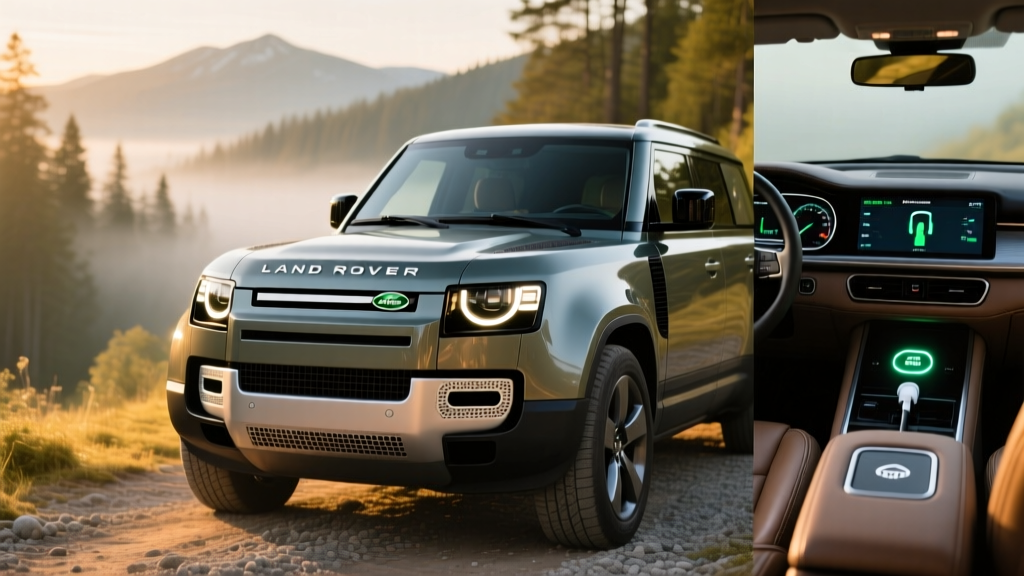
The 2024 Land Rover Defender P110e is the plug-in hybrid (PHEV) variant of Land Rover's iconic boxy SUV, pairing a 3.0-liter inline-six with a 105 kW electric motor for a combined 498 horsepower. With a 19.2 kWh (usable) battery, it delivers an EPA-estimated 32 miles of electric-only driving before the gas engine takes over — enough for most daily commutes without burning a drop of fuel. But at a starting MSRP near $86,000 and with real-world electric range that drops in cold weather or under hard acceleration, this is a PHEV for buyers who want genuine off-road capability and luxury first, with efficiency as a bonus.
| Spec | 2024 Defender P110e (PHEV) |
|---|---|
| Powertrain | 3.0L turbo I-6 + 105 kW electric motor |
| Combined Output | 498 HP / 516 lb-ft torque |
| Battery (usable) | 19.2 kWh, lithium-ion (NMC chemistry) |
| EPA Electric-Only Range | 32 miles |
| EPA Combined MPGe | 56 MPGe (charge-depleting) |
| EPA MPG (gas-only, charge-sustaining) | 19 city / 22 hwy / 20 combined |
| Total Combined Range | ~430 miles |
| 0–60 mph | 5.4 seconds |
| Max AC Charge Rate | 7.2 kW (Level 2) |
| DC Fast Charging | Not available |
| 10–80% Charge Time (Level 2) | ~2 hours |
| Towing Capacity | 6,613 lbs (with brake) |
| Base MSRP (Defender 110 P400e/P110e) | ~$86,500 |
| Federal §30D Tax Credit | Not eligible (see pricing section) |
| Battery Warranty | 8 years / 100,000 miles |
HEV vs. PHEV: What the Defender Hybrid Actually Is
Land Rover offers the Defender in several powertrain configurations, and the terminology matters. The PHEV variant (badged P400e in the 110 body style for the US market, with the P110e designation appearing in certain configurations and markets) is a plug-in hybrid, not a conventional hybrid (HEV). Here is the practical difference:
| Feature | Conventional Hybrid (HEV) | Plug-In Hybrid (PHEV) — Defender P400e/P110e |
|---|---|---|
| Battery Size | 1–2 kWh | 19.2 kWh usable |
| Electric-Only Range | 0–1 mile at low speed | 32 miles EPA |
| Plug-In Required? | No (regenerative braking only) | Yes, for full EV benefit |
| DC Fast Charging | No | No (AC Level 2 only) |
| Gas Engine | Always available | Always available after battery depletes |
| Best For | Drivers without home charging | Drivers with home/workplace charging who want EV commute + gas road trips |
The Defender does not come as a conventional HEV in the US market. If you want any form of electrification in the 2024 Defender lineup, you are looking at the PHEV. (The Defender also offers mild-hybrid (MHEV) six-cylinder engines with a small 48-volt system that assists the engine but provides no electric-only driving — this is not a true hybrid in the way buyers typically mean.)
Fuel Economy: EPA Numbers vs. Real-World MPG
The EPA rates the 2024 Defender 110 PHEV at 56 MPGe when operating in charge-depleting mode (electric + gas combined) and approximately 19 city / 22 highway / 20 combined MPG once the battery is depleted and the gas engine runs solo, according to fueleconomy.gov.
| Driving Mode | City | Highway | Combined |
|---|---|---|---|
| Charge-Depleting (EV + Gas) | 56 MPGe combined | 56 MPGe | |
| Charge-Sustaining (Gas Only) | 19 MPG | 22 MPG | 20 MPG |
| Electric-Only | ~2.1 kWh/mile (32 mi range) | ||
Real-world expectations: The Defender is a heavy, boxy, body-on-frame SUV weighing over 5,700 lbs. In practice, if you charge nightly at home and your commute falls within 25–30 miles, you may go weeks without visiting a gas station. However, on a road trip with a depleted battery, expect fuel economy closer to 17–19 MPG at sustained highway speeds — the aerodynamic penalty of the Defender's flat roofline and upright windshield is significant above 65 mph. Cold weather (below 35°F) reduces electric-only range by roughly 20–30%, bringing real-world EV range down to 22–26 miles.
Electric Range, Charging, and Battery Details
The 19.2 kWh usable battery (approximately 23.7 kWh gross capacity) uses NMC (nickel-manganese-cobalt) lithium-ion cells. On a Level 2 home charger at 7.2 kW, a full 0–100% charge takes roughly 2.5 hours. The Defender PHEV does not support DC fast charging — this is a notable limitation for a vehicle in this price range, and it means you cannot top up quickly at highway rest stops.
EPA Electric Range: 32 miles
Real-World Expectation: 25–30 miles in mild weather with moderate driving; 22–26 miles in cold conditions or aggressive acceleration; 28–32 miles in ideal city driving under 45 mph.
For daily commuting, 32 miles is sufficient for many drivers — the Federal Highway Administration reports the average American drives roughly 37 miles per day. But if your commute exceeds 30 miles each way, you will regularly dip into gas mode.
Charging setup: The Defender PHEV uses a standard J1772 connector for AC charging. A dedicated Level 2 home charger (240V, 32A or 40A circuit) is strongly recommended to achieve the full 7.2 kW rate. Charging on a standard 120V household outlet (Level 1) delivers roughly 1.4 kW, meaning a full charge takes approximately 14 hours — feasible overnight but impractical for mid-day top-ups.
Powertrain and Performance
The 2024 Defender PHEV pairs a 3.0-liter turbocharged inline-six engine (producing approximately 300 HP on its own) with a 105 kW (141 HP) electric motor integrated into the 8-speed automatic transmission. Combined output reaches 498 horsepower and 516 lb-ft of torque, routed through Land Rover's permanent all-wheel-drive system with a two-speed transfer case.
The 0–60 mph sprint takes 5.4 seconds — genuinely quick for a vehicle of this mass. The electric motor provides instant torque at low speeds, making the Defender feel responsive around town even before the turbo spools. In EV mode, acceleration is more subdued but adequate for city driving. The transition between electric and gas power is generally smooth, though under heavy throttle demands the inline-six can be heard engaging abruptly.
Off-road, the PHEV's electric motor offers precise low-speed torque control — an advantage in rock-crawling scenarios where throttle modulation matters. The air suspension provides up to 11.5 inches of ground clearance, and wading depth reaches 35.4 inches, matching the non-hybrid Defender's capability.
Pricing, Trims, and Tax Credit Eligibility
The 2024 Defender 110 PHEV starts at approximately $86,500 MSRP for the base P400e trim, rising to over $100,000 with options packages (Advanced Off-Road Capability, premium leather, Meridian audio, head-up display).
Federal tax credit status: The 2024 Defender PHEV does not qualify for the federal §30D clean vehicle tax credit (up to $7,500). Under current IRS rules, eligibility requires meeting critical-mineral sourcing and battery-component manufacturing thresholds that Land Rover's supply chain does not satisfy for the US market. Additionally, the SUV MSRP cap of $80,000 under §30D eliminates higher-trim configurations regardless of sourcing compliance. Buyers should not factor a federal credit into their purchase decision for this vehicle.
State incentives: Some states offer separate PHEV rebates or HOV-lane access. California's Clean Vehicle Rebate Project (CVRP) and New York's Drive Clean Rebate have historically included PHEVs, but amounts and eligibility change frequently — check your state's current program before purchase.
Battery Warranty, Reliability, and Replacement Cost
High-Voltage Battery Warranty: 8 years / 100,000 miles, whichever comes first. Coverage applies if battery capacity drops below approximately 70% of original capacity (Land Rover's stated threshold). The 12V auxiliary battery carries a separate 4-year/50,000-mile warranty.
Reliability context: Land Rover as a brand consistently ranks in the lower tier of J.D. Power dependability studies and Consumer Reports reliability surveys. The PHEV powertrain adds complexity — the high-voltage system, electric motor, and associated power electronics represent additional failure points beyond a conventional gas Defender. Early P400e models (2021–2022) had relatively few widespread battery-related recalls, but long-term data on the 19.2 kWh pack is still limited given the platform's youth.
Battery replacement cost: Out-of-warranty replacement for the high-voltage battery is estimated at $12,000–$18,000 including labor, based on comparable JLR PHEV platforms. This is a significant potential expense beyond the warranty period. However, PHEV batteries experience less stress than full BEV batteries due to smaller cycle depths and the buffer maintained by the battery management system.
Who Should Buy the Defender PHEV — And Who Shouldn't
Choose the Defender PHEV if:
- You want genuine off-road capability (locking differentials, air suspension, 35" wading) with a luxury interior
- You have home Level 2 charging and a commute under 30 miles
- You take regular road trips where full EV range would be limiting
- You value the Defender's design and don't want a crossover-shaped EV
- Towing (up to 6,613 lbs) is a priority — PHEVs retain gas-engine towing range
Consider a full EV instead if:
- You want zero tailpipe emissions and the lowest per-mile energy cost
- You have reliable DC fast-charging access and drive mostly under 300 miles/day
- You want federal tax credit eligibility ($7,500 with qualifying vehicles)
- Maintenance simplicity matters (no oil changes, no gas engine to service)
Consider a conventional gas Defender if:
- You lack home charging access entirely
- You want a lower purchase price (the P400 mild-hybrid starts ~$15,000 less)
- You rarely drive short commutes where PHEV EV mode provides benefit
Pros
- 32 miles EV range covers most commutes
- 498 HP / 5.4-sec 0–60 is genuinely quick
- Class-leading off-road hardware preserved
- Quiet, torque-rich EV mode around town
- No range anxiety on long trips
Cons
- No DC fast charging
- Gas-only MPG of ~19–20 is poor once battery depletes
- No federal tax credit eligibility
- $86,500+ starting price is steep
- Brand reliability track record is weak
- Heavy weight reduces efficiency vs. unibody PHEV SUVs
Frequently Asked Questions
How many MPG does the 2024 Land Rover Defender hybrid get?
The EPA rates the Defender 110 PHEV at 56 MPGe in combined charge-depleting mode and approximately 19 city / 22 highway / 20 combined MPG once the battery is depleted and the vehicle runs on gasoline alone. Real-world highway MPG with a depleted battery may drop to 17–19 MPG due to the Defender's aerodynamic profile and weight.
How far can the Defender PHEV go on electric only?
The EPA estimates 32 miles of electric-only range. In real-world conditions, expect 25–30 miles in moderate temperatures, dropping to 22–26 miles in cold weather. Highway-speed electric driving depletes the battery faster than city driving.
Does the 2024 Defender PHEV qualify for the federal EV tax credit?
No. The Defender PHEV does not meet the critical-mineral and battery-component sourcing requirements under IRS §30D, and many configurations exceed the $80,000 SUV MSRP cap. Consult a tax professional and check IRS.gov for the latest rules.
Can the Defender PHEV DC fast charge?
No. The 2024 Defender PHEV supports AC charging only, at a maximum rate of 7.2 kW on Level 2. A full charge takes approximately 2.5 hours. DC fast charging is not available on this platform.
Is the Defender PHEV reliable, and what does battery replacement cost?
Land Rover ranks below average in major reliability surveys. The high-voltage battery carries an 8-year/100,000-mile warranty covering capacity loss below ~70%. Out-of-warranty battery replacement is estimated at $12,000–$18,000. The PHEV system adds complexity compared to the gas-only Defender.
Hybrid vs. PHEV vs. EV — which powertrain fits me?
If you have home charging and a sub-30-mile commute, the Defender PHEV lets you drive electric daily while keeping gas for road trips. A full EV (like the Rivian R1S or BMW iX) offers lower running costs and zero tailpipe emissions but requires planning for longer trips. A conventional hybrid (not available in the US Defender lineup) would suit drivers without charging access who still want some efficiency gains.