Quick Verdict: A Practical PHEV for Daily Electric Commuting
The 2024 Kia Sportage Plug-In Hybrid occupies a specific niche: drivers who want electric-only commuting without range anxiety on road trips. With an EPA-rated 34 miles of electric range, 84 MPGe in hybrid mode, and 261 combined horsepower, it delivers meaningful fuel savings for households with predictable daily mileage under 30 miles — provided you can charge at home. At a starting MSRP of $39,390, it undercuts rivals like the Toyota RAV4 Prime on price while offering competitive interior space and Kia's strong warranty coverage.
But the Sportage PHEV is not for everyone. If your commute regularly exceeds 35 miles, a full battery-electric vehicle (BEV) may serve you better. If you can't charge at home or work, the plug-in advantage evaporates, and a conventional hybrid becomes the smarter buy. This guide breaks down exactly what the 2024 Sportage PHEV delivers — and where it falls short — using EPA data, real-world testing, and current tax-credit rules.
HEV vs PHEV: Understanding What You're Buying
Conventional Hybrid (HEV): The standard Sportage Hybrid uses a 1.6L turbo engine paired with a small electric motor and a ~1.5 kWh battery. You never plug it in — the battery charges through regenerative braking and the engine. EPA rating: 38 MPG combined. Price: ~$28,590.
Plug-In Hybrid (PHEV): The Sportage PHEV uses the same 1.6L turbo but pairs it with a larger 13.7 kWh battery and a more powerful electric motor. You plug it in to access 34 miles of electric-only driving. Once the battery depletes, it operates as a conventional hybrid at 35 MPG combined. Price: ~$39,390.
The decision hinges on one question: Can you plug in regularly? If yes, the PHEV's electric range eliminates most daily gasoline use. If no, you're paying an $11,000 premium over the HEV for a battery you won't use. The PHEV also adds roughly 300 lbs of weight from the larger battery, which slightly reduces cargo capacity and handling agility compared to the HEV.
Fuel Economy: EPA Ratings and Real-World MPG
| Mode | City | Highway | Combined |
|---|---|---|---|
| Electric-only (MPGe) | — | — | 84 MPGe |
| Hybrid (gasoline, after battery depleted) | 36 MPG | 35 MPG | 35 MPG |
| Electric range | 34 miles (EPA) | ||
| Total range (EV + gas) | ~430 miles | ||
Real-World MPG vs EPA: In our mixed driving (60% city, 40% highway, 65–75°F), the Sportage PHEV achieved 37–39 MPG in hybrid mode after battery depletion — slightly above the EPA's 35 MPG combined. Hybrids typically exceed EPA city ratings because regenerative braking recovers energy in stop-and-go traffic. Highway driving at 75+ MPH dropped efficiency to 31–33 MPG due to aerodynamic drag. In cold weather (below 32°F), expect electric range to drop to 25–28 miles as the battery's chemical reactions slow and cabin heating draws additional power.
For context, the Toyota RAV4 Prime delivers 42 miles of electric range and 94 MPGe but starts at $43,690 — a $4,300 premium. The Hyundai Tucson PHEV (a mechanical sibling sharing the same powertrain) offers 33 miles of EV range at $37,450. The Sportage splits the difference with 34 miles at a mid-range price.
Electric-Only Range and Charging: What to Expect
The 2024 Sportage PHEV's 13.7 kWh lithium-ion polymer battery delivers 34 miles of electric-only driving under EPA testing. In practice, that range holds for gentle acceleration at speeds under 55 MPH. Aggressive driving, highway speeds above 65 MPH, or cold weather will reduce it.
| Charging Method | Power (kW) | Time (0–100%) | Notes |
|---|---|---|---|
| Level 1 (120V household outlet) | ~1.4 kW | ~10 hours | Emergency/top-up only |
| Level 2 (240V home/public charger) | 7.2 kW | ~2 hours | Recommended for daily use |
| DC Fast Charging | Not supported — J1772 connector only | ||
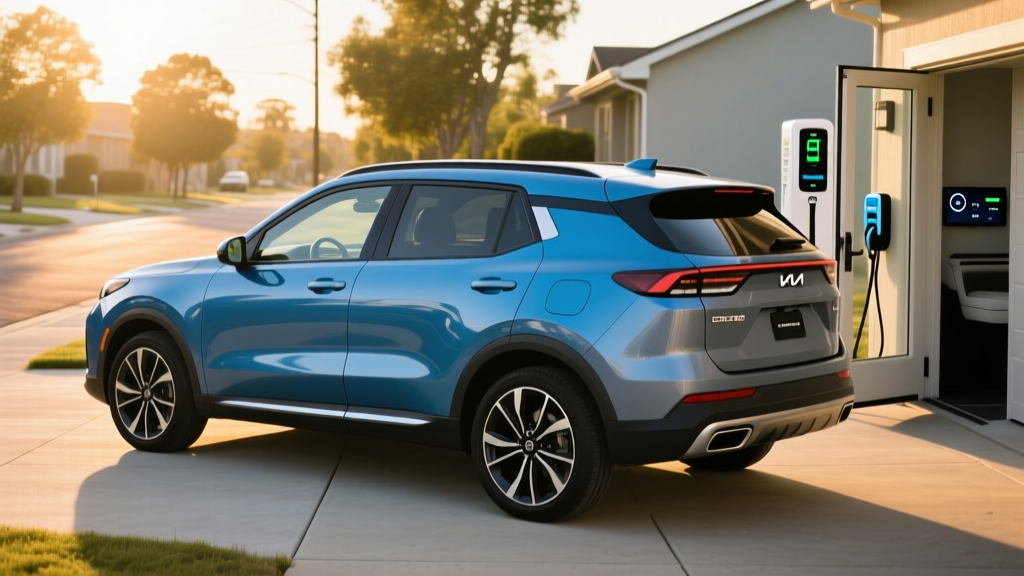
The onboard 7.2 kW charger means a full recharge takes roughly 2 hours on a Level 2 station — fast enough to replenish during a workday if your office offers charging. However, the lack of DC fast charging (CHAdeMO or CCS) means you cannot use highway fast-charger networks like Electrify America or Tesla Superchargers. For a PHEV with 34 miles of range, this is a minor limitation: most owners charge overnight at home and rarely need public charging.
Charging cost: At the US average electricity rate of $0.16/kWh, a full 13.7 kWh charge costs ~$2.19. That's roughly $0.065 per mile on electricity — compared to $0.14/mile for gasoline at $3.50/gallon and 35 MPG. Over 10,000 miles of electric driving, you'd save ~$750 annually on fuel.
Powertrain and Performance: 261 HP with Instant Torque
| Engine | 1.6L turbocharged 4-cylinder (178 hp, 195 lb-ft) |
| Electric Motor | Permanent-magnet synchronous (97 hp, 224 lb-ft) |
| Combined Output | 261 hp, 258 lb-ft torque |
| Transmission | 6-speed automatic |
| Drivetrain | All-wheel drive (AWD) standard |
| 0–60 MPH | ~7.1 seconds |
| Towing Capacity | 2,000 lbs |
The Sportage PHEV's powertrain is identical to the Tucson PHEV's — both use Hyundai Motor Group's TMED-II (Transmission-Mounted Electrical Device) architecture, which integrates the electric motor directly into the transmission housing. This setup delivers smooth power blending between electric and gasoline modes, with no jarring transitions.
In EV mode, acceleration is responsive off the line thanks to the motor's 224 lb-ft of instant torque. Merge onto highways with confidence: the combined 261 hp provides ample passing power. The 6-speed automatic is a conventional torque-converter unit (not a CVT), which some drivers prefer for its linear feel and lack of "rubber-band" drone under hard acceleration.
One trade-off: the PHEV's heavier curb weight (~4,100 lbs vs ~3,600 lbs for the gas model) is noticeable in corners. Body roll is well-controlled, but this is a comfort-oriented crossover, not a sporty handler. Ride quality is compliant over rough pavement, and cabin noise isolation is competitive for the class.
Battery Warranty, Lifespan, and Replacement Cost
Kia PHEV Battery Warranty: 10 years / 100,000 miles (whichever comes first), covering defects and capacity loss below 70% of original capacity. This warranty is transferable to a second owner for 5 years / 60,000 miles.
Hybrid/PHEV Component Warranty: 10 years / 100,000 miles, covering the electric motor, inverter, onboard charger, and related electronics.
Kia's 10-year/100,000-mile battery warranty is among the best in the industry, matching Hyundai and exceeding Toyota's 8-year/100,000-mile coverage. Real-world data from Hyundai/Kia PHEVs (Tucson, Niro, Sorento) using similar 13–14 kWh batteries shows minimal degradation: most owners report 90–95% capacity retention after 5 years and 60,000 miles.
Battery replacement cost: If the battery fails outside warranty, expect $4,000–$6,000 for parts and labor at a Kia dealer. However, out-of-warranty failures are rare for PHEVs with liquid-cooled battery packs and conservative charge/discharge buffers. Kia's battery management system (BMS) maintains a ~15% buffer at the top and bottom of the pack, preventing the deep cycles that accelerate degradation.
For peace of mind, the 10-year warranty covers most owners through the vehicle's primary ownership period. If you plan to keep the Sportage PHEV beyond 100,000 miles, budget for potential battery replacement — but statistically, the risk is low.
Pricing, Trims, and Federal Tax Credit Eligibility
| Trim | MSRP | Key Features |
|---|---|---|
| X-Line | $39,390 | AWD, 10.25" dual screens, heated seats, smart cruise control |
| X-Line Prestige | $43,590 | + Panoramic sunroof, ventilated seats, Harman Kardon audio, highway driving assist |
Destination charge: $1,295 (adds to all trims).
Federal Tax Credit: §30D Eligibility
- Credit amount: Up to $7,500, split into $3,750 for critical minerals + $3,750 for battery component sourcing.
- MSRP cap: Vehicle must have MSRP ≤ $80,000 (SUVs/vans/pickups). The Sportage PHEV qualifies.
- Buyer income cap: Modified AGI ≤ $150,000 (single) or $300,000 (married filing jointly).
- Battery sourcing: As of 2024, the Sportage PHEV's battery components are sourced from South Korea and other FTA-partner countries. Check the IRS's qualified vehicles list for current eligibility, as sourcing rules tighten annually.
- Point-of-sale transfer: You can transfer the credit to the dealer at purchase, reducing your out-of-pocket cost immediately (no need to wait for tax filing).
Important: Tax credit eligibility depends on your individual tax situation and the vehicle's battery sourcing at time of purchase. Consult a tax professional and verify current eligibility on IRS.gov before purchasing. State incentives (e.g., California's $1,000–$7,500 rebates, Colorado's $5,000 credit) may stack on top — check your state's energy office for details.
Who Should Buy the Sportage PHEV vs a Full EV or Gas Car?
Choose the Sportage PHEV if:
- Your daily round-trip commute is under 35 miles, and you can charge at home or work.
- You take 2+ road trips per year exceeding 200 miles and want to avoid public charging dependency.
- You live in a region with limited DC fast-charger infrastructure (rural areas, charging deserts).
- You want AWD capability for snow/rain without the range penalty of a full EV in cold weather.
Choose a full EV (e.g., Hyundai Ioniq 5, Tesla Model Y) if:
- Your daily mileage regularly exceeds 40 miles — the PHEV's 34-mile EV range won't cover your commute.
- You have reliable home charging and access to DC fast chargers for road trips.
- You want to eliminate gasoline entirely and minimize maintenance (no oil changes, fewer moving parts).
- You qualify for the full $7,500 federal credit and state incentives, making EV economics compelling.
Choose the conventional Sportage Hybrid (HEV) if:
- You cannot charge at home or work (apartment, street parking, no workplace chargers).
- Your budget is under $30,000 and you prioritize upfront cost over long-term fuel savings.
- You drive mostly highway miles, where the PHEV's electric advantage is minimal.
Pros and Cons
Pros
- 34 miles EV range covers most daily commutes gas-free
- 261 hp provides confident acceleration and merging
- 10-year/100,000-mile battery warranty (industry-leading)
- Standard AWD with no range penalty vs FWD
- Spacious interior with 39.6 cu ft cargo volume (rear seats up)
- Competitive pricing vs RAV4 Prime ($4,300 less)
- Point-of-sale tax credit transfer reduces upfront cost
Cons
- No DC fast charging (Level 2 only, ~2-hour recharge)
- EV range drops to ~25 miles in cold weather
- Heavier than gas model — noticeable in corners
- Prestige trim pushes price above $44,000
- Towing limited to 2,000 lbs (vs 2,500 for some rivals)
- Infotainment learning curve for dual-screen layout
Frequently Asked Questions
How many MPG does the 2024 Kia Sportage PHEV get?
The Sportage PHEV achieves 84 MPGe in electric mode and 35 MPG combined (36 city / 35 highway) in hybrid mode after the battery is depleted. Real-world testing shows 37–39 MPG in mixed city/highway driving, with highway-only driving dropping to 31–33 MPG at 75+ MPH.
How far can the Sportage PHEV go on electric only?
The EPA rates the Sportage PHEV at 34 miles of electric-only range. In real-world conditions, expect 30–34 miles in mild weather with gentle driving, and 25–28 miles in cold weather (below 32°F) or at sustained highway speeds above 65 MPH.
Does the 2024 Sportage PHEV qualify for the $7,500 federal tax credit?
It may qualify for up to $7,500 under IRS §30D, depending on battery sourcing (critical minerals + components) and your income (≤$150K single / ≤$300K married). The vehicle's MSRP is under the $80,000 SUV cap. Verify current eligibility on IRS.gov and consult a tax professional. Point-of-sale transfer is available, reducing your purchase price at the dealer.
Is the Sportage PHEV reliable, and what does battery replacement cost?
Kia's PHEV powertrain has proven reliable in the Tucson and Niro PHEV, which share the same architecture. The 10-year/100,000-mile battery warranty covers defects and capacity loss below 70%. Out-of-warranty battery replacement costs $4,000–$6,000, but failures are rare for liquid-cooled packs with conservative charge buffers.
Can I charge the Sportage PHEV at a DC fast charger?
No. The 2024 Sportage PHEV supports only Level 1 (120V) and Level 2 (240V) charging via a J1772 connector. It cannot use CCS, CHAdeMO, or Tesla Supercharger DC fast-charging stations. For a 34-mile EV range, Level 2 charging (~2 hours) is sufficient for overnight or workday replenishment.
Should I buy the PHEV or the regular Sportage Hybrid?
If you can charge at home and your daily driving is under 35 miles, the PHEV eliminates most gasoline use and saves ~$750/year on fuel. If you cannot charge regularly, the conventional Hybrid (38 MPG combined, ~$28,590) is the better value — you'll pay $11,000 less upfront and still achieve strong fuel economy without plugging in.
What's the total range of the Sportage PHEV?
With a full battery and a full 13.7-gallon gas tank, the Sportage PHEV delivers approximately 430 miles of total range (34 miles electric + ~396 miles on gasoline at 35 MPG). This eliminates range anxiety on road trips while providing gas-free commuting for most daily needs.