Quick Verdict: A Three-Row PHEV That Actually Makes Sense
If you need three rows of seating but aren't ready to commit to a full battery-electric vehicle, the 2024 Kia Sorento Plug-In Hybrid occupies a narrow and increasingly valuable slice of the market. With an EPA-rated 32 miles of electric-only driving, a combined 261 horsepower, and the ability to function as a conventional hybrid once the battery is depleted, it solves the "what if I need to road-trip" problem that keeps many buyers from going fully electric.
But the Sorento PHEV isn't without compromises. Its 13.7 kWh battery doesn't support DC fast charging, third-row space is tight for adults, and federal tax credit eligibility has become complicated under current §30D sourcing rules. Here's the full breakdown — with real-world numbers, not just brochure specs.
HEV vs. PHEV: Which Sorento Are We Talking About?
Kia sells the Sorento in three powertrain flavors, and confusing them is easy at the dealership. Here's the distinction that matters:
| Feature | Sorento HEV (Hybrid) | Sorento PHEV (Plug-In Hybrid) |
|---|---|---|
| Plug-in charging? | No — self-charging via regen & engine | Yes — plug in to get electric-only miles |
| Battery size | 1.49 kWh | 13.7 kWh (usable) |
| Electric-only range | ~1 mile at low speed | 32 miles (EPA) |
| Combined horsepower | 227 hp | 261 hp |
| EPA combined (gas) | 37 MPG | 35 MPG (charge-sustaining) |
| MPGe (electric+gas) | N/A | 79 MPGe |
| Starting MSRP | ~$38,390 | ~$50,290 |
The conventional HEV is the right call if you can't charge at home or work. The PHEV rewards owners who plug in nightly — those 32 electric miles cover the average American's daily commute (according to EPA data on fueleconomy.gov), meaning many owners burn gasoline only on road trips.
Fuel Economy: EPA Numbers vs. Real-World Driving
Let's address the question every buyer asks: how many MPG does the 2024 Kia Sorento Plug-In Hybrid actually get?
| Mode | City | Highway | Combined |
|---|---|---|---|
| Electric-only (MPGe) | 84 MPGe | 74 MPGe | 79 MPGe |
| Charge-sustaining (gas only, MPG) | 36 MPG | 34 MPG | 35 MPG |
Real-world context: Hybrid powertrains typically outperform their EPA city ratings in stop-and-go traffic because regenerative braking recaptures energy that a gas car wastes as heat. Owners who drive mostly in urban environments report 37–39 MPG in charge-sustaining mode. Highway cruising at 75+ MPH tends to drop efficiency to 31–33 MPG, as the turbocharged 1.6L engine works harder without regen assistance.
Total range reality: With a full charge and a full 12.4-gallon tank, expect roughly 420–450 miles total in mixed driving. That 32-mile electric range drops to approximately 24–26 miles in freezing weather (below 32°F) due to cabin heating demands and reduced battery efficiency. If you use the seat and steering-wheel heaters instead of cranking cabin heat, you can claw back 2–3 miles of that loss.
Electric-Only Range, Battery, and Charging Details
The Sorento PHEV's 13.7 kWh lithium-ion polymer battery pack (located under the floor) delivers an EPA-rated 32 miles of electric-only range. In practice, drivers who precondition the cabin while plugged in and use the "EV Priority" drive mode consistently achieve 28–34 miles before the 1.6L turbo engine fires up.
| Specification | 2024 Sorento PHEV |
|---|---|
| Battery capacity (usable) | 13.7 kWh |
| Battery chemistry | Lithium-ion polymer (NMC) |
| Onboard charger | 7.2 kW (Level 2 AC) |
| DC fast charging | Not supported |
| Level 1 (120V) charge time | ~11 hours (0–100%) |
| Level 2 (240V, 32A) charge time | ~3 hours 25 min (0–100%) |
| Charge connector | J1772 (CCS-compatible inlet) |
| Electric-only range (EPA) | 32 miles |
| Gas-only range (est.) | ~400 miles |
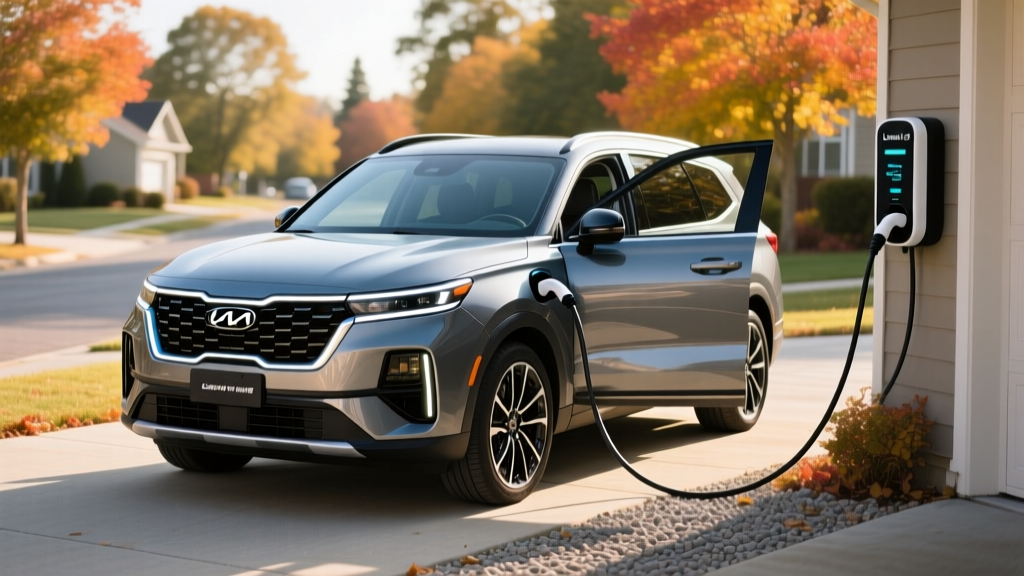
Critical charging note: The Sorento PHEV cannot DC fast charge. There is no CCS DC inlet — only an AC J1772 port. This means public fast-charging stations (Electrify America, EVgo, Tesla Superchargers) are irrelevant for this vehicle. All charging happens at home or at Level 2 destination chargers. For most PHEV owners who charge overnight on a 240V outlet, this is perfectly adequate. But if you were hoping to top up at a highway fast charger during a road trip, that's not an option here.
Powertrain: 261 HP With Turbo and Electric Assist
The Sorento PHEV pairs a 1.6-liter turbocharged GDI inline-4 (producing 178 hp and 195 lb-ft on its own) with a 66.9 kW (90 hp) permanent-magnet electric motor integrated into the transmission housing. Combined system output is 261 horsepower and 258 lb-ft of torque, routed through a 6-speed automatic to standard all-wheel drive.
This makes it the most powerful Sorento variant short of the discontinued V6, and the electric motor's instant torque fills in the low-RPM gap that turbo lag normally creates. The 0–60 MPH sprint takes approximately 7.5 seconds — respectable for a 4,400-pound three-row crossover.
The AWD system is fully electric (no mechanical driveshaft to the rear axle). Under electric-only driving, the rear motor provides all-wheel traction. Under hard acceleration or low-truction conditions, both the engine and motor work together.
Pricing, Trims, and Federal Tax Credit Eligibility
The 2024 Sorento PHEV comes in two trims:
| Trim | MSRP (incl. destination) |
|---|---|
| EX AWD | $50,290 |
| SX Prestige AWD | $53,090 |
The SX Prestige adds a panoramic sunroof, ventilated front seats, a head-up display, Nappa leather, and a surround-view monitor.
Does the 2024 Sorento PHEV Qualify for the Federal Tax Credit?
This is where things get complicated. Under the IRS §30D Clean Vehicle Credit rules (as detailed on irs.gov), the Sorento PHEV meets the basic vehicle requirements — it has a battery capacity over 7 kWh, is assembled in North America (West Point, Georgia), and falls under the SUV MSRP cap of $80,000.
However, the critical minerals and battery component sourcing requirements that took effect in 2024 significantly narrowed eligibility. The credit amount depends on whether the vehicle meets battery-sourcing thresholds, which shift annually. Additionally:
- Buyer income cap: AGI must not exceed $150,000 (single), $225,000 (head of household), or $300,000 (joint)
- MSRP cap: SUVs/vans capped at $80,000 — Sorento PHEV clears this easily
- Battery sourcing: Critical minerals and components must meet escalating domestic/free-trade-agreement percentages
- Point-of-sale transfer: Eligible buyers can transfer the credit to the dealer for an immediate price reduction
Because Kia sources battery cells from Korean manufacturers (LG Energy Solution, SK On), the Sorento PHEV's credit eligibility has fluctuated. Always verify current eligibility on fueleconomy.gov before purchasing, as the IRS updates qualified-vehicle lists periodically. Some buyers may qualify for $3,750 (partial credit) rather than the full $7,500, while others may find the vehicle temporarily removed from the eligible list entirely.
State incentives vary widely — check your state energy office or DSIRE database for local rebates. Some states offer additional PHEV rebates of $1,000–$3,000.
Battery Warranty, Reliability, and Replacement Costs
Hybrid battery longevity remains the top concern for first-time PHEV buyers. Here's what Kia provides:
| Component | Warranty Coverage |
|---|---|
| High-voltage battery | 10 years / 100,000 miles |
| Hybrid system components | 10 years / 100,000 miles |
| Powertrain (engine, transmission) | 10 years / 100,000 miles |
| Bumper-to-bumper | 5 years / 60,000 miles |
| Capacity retention guarantee | Battery warranted against falling below ~70% capacity during coverage period |
Is the 2024 Sorento PHEV reliable? Kia's 1.6L turbo hybrid powertrain has been in production since 2020 across multiple models (Sorento, Tucson, Sportage). Early-generation units had some software-related rough shifting complaints, but no widespread battery failure pattern has emerged. Hyundai-Kia's PHEV systems use conservative thermal management, which tends to favor long-term battery health over maximum performance.
Battery replacement cost: If the high-voltage battery fails out of warranty (unlikely within the first decade based on current degradation data), a replacement pack for the Sorento PHEV currently ranges from $4,500 to $6,500 including labor. Individual module replacement can reduce this cost if only a portion of the pack has degraded. However, real-world data from similar Kia/Hyundai PHEVs shows minimal degradation — typically 5–8% capacity loss over the first 100,000 miles with normal use.
Who Should Buy the Sorento PHEV vs. a Full EV or Gas Car?
The Sorento PHEV serves a specific buyer profile. Here's the decision framework:
Choose the Sorento PHEV if:
- You need three rows but drive mostly under 35 miles/day
- You can install a Level 2 (240V) charger at home
- You take 3+ road trips per year and don't want to plan around charging stations
- You want AWD for snow/rain without the efficiency penalty of a gas-only SUV
Choose a full EV (like the Kia EV9) if:
- Your daily driving is under 250 miles and you have reliable home charging
- You want zero maintenance on the powertrain (no oil changes, no spark plugs)
- You want the full $7,500 federal credit with fewer sourcing complications
Choose the Sorento HEV (conventional hybrid) if:
- You can't charge at home (apartment, street parking, no garage)
- You want lower upfront cost ($12,000 less than the PHEV)
- Your daily commute exceeds 40+ miles, making the PHEV's electric range less impactful
Pros
- 32-mile electric range covers most commutes gasoline-free
- 261 hp with AWD — confident merging and passing
- Three-row seating in a PHEV (rare in this price bracket)
- 35 MPG even when battery is depleted
- Industry-leading 10-year/100,000-mile powertrain warranty
Cons
- No DC fast charging — road-trip top-ups limited to Level 2
- Third row is cramped for adults on long trips
- $50,290 starting price is steep; federal credit is uncertain
- Electric motor whine noticeable under hard acceleration
- Cargo space reduced vs. gas-only Sorento due to battery placement
Frequently Asked Questions
How many MPG does the 2024 Kia Sorento Plug-In Hybrid get?
The EPA rates it at 79 MPGe combined when using both electric and gas, and 35 MPG combined once the battery is depleted and it operates as a conventional hybrid. In real-world city driving, expect 37–39 MPG in hybrid mode thanks to aggressive regenerative braking. Highway cruising at 75+ MPH drops to around 31–33 MPG.
How far can the Sorento PHEV go on electric only?
The EPA rates it at 32 miles of electric-only range. In moderate weather (50–80°F) with conservative driving, owners report 28–34 miles. In freezing temperatures, expect 24–26 miles due to cabin heating loads and reduced battery efficiency.
Does the Sorento PHEV qualify for the $7,500 federal tax credit?
Eligibility depends on current IRS battery-sourcing rules under §30D, which change periodically. The vehicle meets MSRP and assembly requirements, but critical-mineral and battery-component thresholds may reduce the credit to $3,750 or disqualify it entirely depending on the purchase date. Verify on fueleconomy.gov before buying. Buyer income caps also apply ($150K single / $300K joint).
Can I DC fast charge the Sorento PHEV?
No. The Sorento PHEV only accepts AC charging via a J1772 connector. Level 2 charging at 7.2 kW takes approximately 3 hours 25 minutes for a full charge. Level 1 (standard 120V outlet) takes about 11 hours. DC fast chargers like Electrify America or Tesla Superchargers cannot charge this vehicle.
Is the hybrid battery reliable, and what does replacement cost?
Kia warranties the high-voltage battery for 10 years / 100,000 miles, including a capacity-retention guarantee (typically ~70% threshold). Out-of-warranty replacement runs $4,500–$6,500. Real-world degradation data from similar Hyundai-Kia PHEVs shows only 5–8% capacity loss over 100,000 miles with normal use, making premature failure unlikely.
Hybrid vs. PHEV vs. EV — which should I choose?
If you have home charging and a daily commute under 30 miles, the PHEV gives you electric driving most days with gas-engine backup for road trips. If you can't charge at home, the conventional HEV delivers strong MPG without any plug-in hassle. If your daily driving is predictable and under 250 miles with reliable charging access, a full BEV eliminates maintenance and fuel costs entirely — but requires more trip planning on longer drives.