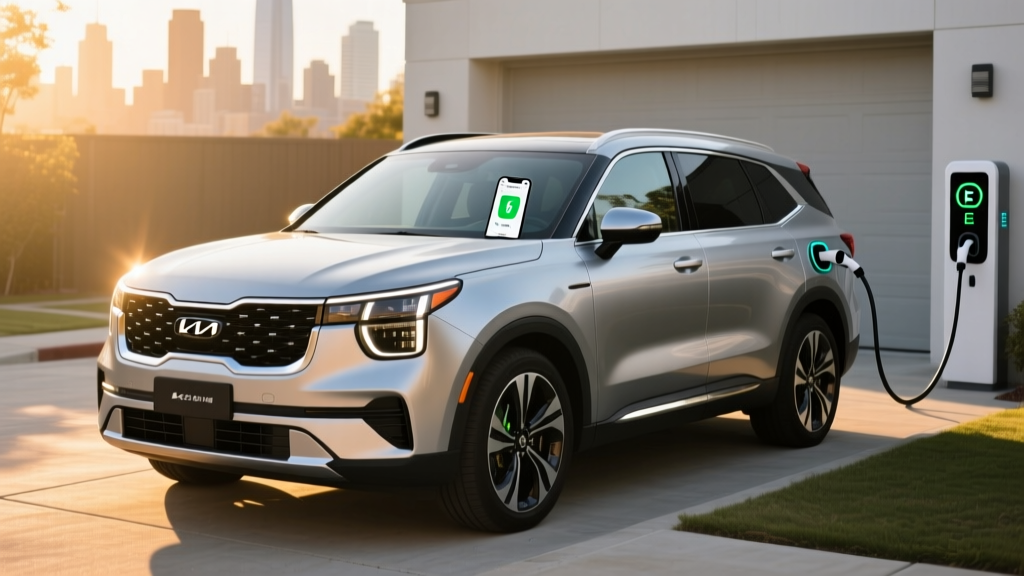
Three-row SUVs that actually return mid-30s MPG at the pump remain rare, and the 2024 Kia Sorento Hybrid occupies a narrow lane: a compact family hauler with genuine third-row seating, standard all-wheel drive, and fuel economy that embarrasses many sedans. For buyers weighing a gas-only midsize SUV against a full electric vehicle, the Sorento HEV (and its plug-in sibling, the Sorento PHEV) offers a pragmatic middle path. Here is every number that matters.
HEV vs PHEV: Which Sorento Hybrid Are We Talking About?
Kia sells two electrified Sorento variants, and confusing them is the single most common buyer mistake. The distinction changes everything from your fuel budget to your garage wiring.
| Attribute | Sorento Hybrid (HEV) | Sorento Plug-In Hybrid (PHEV) |
|---|---|---|
| Needs to plug in? | No — charges via regenerative braking and engine | Yes — 13.8 kWh battery, Level 2 charging |
| EPA Combined MPG / MPGe | 37 MPG (combined) | 79 MPGe (electric+gas) / 34 MPG (gas only) |
| Electric-only range | Not applicable | 32 miles (EPA) |
| Battery capacity | 1.49 kWh (small, self-charging) | 13.8 kWh (plug-in capable) |
| Combined horsepower | 227 hp | 261 hp |
| Drivetrain | AWD standard | AWD standard |
| Starting MSRP (2024) | ~$36,990 (S trim) | ~$49,590 (EX trim) |
The conventional hybrid (HEV) is the volume seller and the focus of this review. The PHEV is a separate animal, covered in depth below.
Fuel Economy: EPA Ratings and Real-World MPG
| Trim | City MPG | Highway MPG | Combined MPG |
|---|---|---|---|
| S / EX (AWD) | 36 | 37 | 37 |
| SX Prestige (AWD, larger wheels) | 34 | 34 | 34 |
Per fueleconomy.gov, the S Hybrid and EX trims return 37 MPG combined. The top SX Prestige drops to 34 MPG due to its 20-inch wheels and heavier equipment load.
Real-World Expectations
Hybrids consistently outperform their EPA city ratings in stop-and-go traffic because regenerative braking recovers energy that a gas car wastes as heat. Owners routinely report 38-41 MPG in urban commuting. Highway driving at 75+ MPH, however, often yields 31-33 MPG — the electric motor contributes less at sustained speed, and aerodynamic drag dominates.
In cold weather (below 30°F), expect a 5-10% efficiency drop. The engine runs more frequently to heat the cabin and maintain battery temperature, reducing the electric motor's contribution. This penalty is smaller than the 20-30% range loss a full EV experiences in the same conditions.
Powertrain Specs: What Moves the Sorento Hybrid
| Engine | 1.6L turbocharged 4-cylinder |
| Engine output | 178 hp / 195 lb-ft torque |
| Electric motor | 44 kW (59 hp) integrated into transmission |
| Combined system output | 227 hp / 258 lb-ft torque |
| Transmission | 6-speed automatic (no CVT) |
| Drivetrain | AWD (torque-vectoring rear axle) |
| 0-60 MPH | ~7.9 seconds (est.) |
| Towing capacity | 2,000 lbs |
| Fuel tank | 14.8 gallons |
| Total driving range | ~548 miles (at 37 MPG combined) |
The 6-speed automatic is a deliberate choice. Kia avoids the rubber-band feel of the CVTs found in the Toyota Highlander Hybrid and Honda CR-V Hybrid. Shifts are perceptible and traditional, which some drivers prefer, though it sacrifices a fraction of efficiency versus a CVT's continuous optimization.
The 227 hp combined output provides adequate acceleration for merging and passing. The turbo engine fills in low-end torque while the electric motor smooths out the stop-start experience. This is not a performance SUV — it is a family transporter that happens to sip fuel.
Pricing, Trims, and Tax Credit Eligibility
| Trim | MSRP (incl. destination) | Key Features |
|---|---|---|
| S | $36,990 | 10.25" touchscreen, wireless CarPlay/Android Auto, heated front seats, Smart Cruise Control |
| EX | $39,890 | Leatherette seats, power liftgate, Highway Driving Assist, 2nd-row captain's chairs available |
| SX Prestige | $43,590 | Leather, panoramic sunroof, 12-speaker Bose audio, 20" wheels, head-up display |
Does the Sorento Hybrid Qualify for a Federal Tax Credit?
No. The conventional Sorento Hybrid (HEV) does not qualify for the federal §30D Clean Vehicle Credit. That credit applies only to plug-in electric vehicles — battery-electric vehicles (BEVs) and plug-in hybrids (PHEVs) with at least 7 kWh of battery capacity. A standard hybrid's ~1.5 kWh battery falls far short of this threshold.
The Sorento PHEV may qualify for up to $7,500 under §30D, but eligibility depends on several conditions that change frequently under current IRS rules:
- MSRP cap: SUVs must have an MSRP at or below $80,000 (Sorento PHEV qualifies)
- Buyer income cap: AGI must not exceed $150,000 (single) / $300,000 (joint)
- Battery sourcing: Critical minerals and battery components must meet escalating domestic-content thresholds — verify current-year requirements with your dealer and tax professional
- Point-of-sale transfer: Eligible buyers can apply the credit as a down-payment reduction at purchase rather than waiting to claim it on their tax return
State-level incentives vary widely. Some states offer additional credits or rebates for PHEVs; most offer nothing for conventional hybrids. Check your state energy office or AFDC incentive database for specifics.
Battery Warranty, Reliability, and Replacement Cost
| Hybrid battery warranty | 10 years / 100,000 miles |
| Hybrid system components | 10 years / 100,000 miles |
| Basic vehicle warranty | 5 years / 60,000 miles |
| Powertrain warranty | 10 years / 100,000 miles |
| Capacity retention guarantee | Below 70% triggers warranty replacement |
Kia's 10-year/100,000-mile hybrid battery warranty is among the strongest in the segment, matching Hyundai and exceeding the 8-year/100,000-mile federal minimum that applies to many competitors.
Is the Sorento Hybrid Reliable?
Kia's 1.6L turbo hybrid powertrain has been in service since the 2021 model year across the Sorento and Tucson platforms. Early models saw some transmission software complaints, but no systemic battery failure pattern has emerged. The hybrid battery is a lithium-ion polymer unit operating in a narrow state-of-charge window (roughly 40-80%), which significantly reduces degradation compared to full EVs that cycle from 10-100%.
Based on industry data from similar Kia/Hyundai hybrid platforms, battery replacement outside warranty would cost approximately $2,500-$4,000 for the HEV's small 1.49 kWh pack — a fraction of the $10,000-$20,000+ a full EV battery replacement might command. The PHEV's larger 13.8 kWh pack would cost more, likely in the $6,000-$9,000 range out of warranty.
Sorento PHEV Deep Dive: 32 Miles Electric, Then Gas
For buyers with a short commute and access to Level 2 charging at home, the Sorento PHEV deserves serious consideration. Here are the critical numbers:
| Battery capacity | 13.8 kWh (lithium-ion polymer) |
| EPA electric-only range | 32 miles |
| Total range (electric + gas) | ~440 miles |
| Combined system output | 261 hp / 258 lb-ft |
| Level 2 charging (240V) | ~3 hours 25 minutes (full charge at 3.3 kW onboard charger) |
| DC fast charging | Not supported |
| EPA MPGe (combined) | 79 MPGe |
| EPA MPG (gas only, battery depleted) | 34 MPG combined |
| Starting MSRP | $49,590 (EX) |
The PHEV's 3.3 kW onboard charger means no DC fast charging — a full Level 2 charge takes about 3.5 hours. This is fine for overnight charging but limits midday top-ups. If your daily round-trip commute is under 30 miles and you charge nightly, you could go weeks without visiting a gas station.
Once the battery depletes, the PHEV operates as a conventional hybrid at 34 MPG combined — still excellent for a 3-row AWD SUV, though 3 MPG short of the HEV due to the PHEV's ~350 lbs of additional battery weight.
Who Should Buy the Sorento Hybrid vs a Full EV or Gas SUV?
Choose the Sorento Hybrid (HEV) if:
- You want a 3-row SUV under $40,000 with no charging infrastructure needed
- Your driving mix includes frequent road trips where charging deserts remain a concern
- You rent or live where home charging installation is impractical
- You want to cut fuel costs by 30-40% versus a gas-only 3-row SUV without changing habits
Choose the Sorento PHEV if:
- Your daily commute is under 32 miles round-trip and you can install a Level 2 charger at home
- You qualify for the §30D tax credit (bringing effective price closer to the HEV)
- You want electric daily driving but gas flexibility for weekend trips
- You want the most powerful Sorento variant (261 hp vs 227 hp)
Choose a full EV (like the Kia EV9 or Hyundai Ioniq 5) if:
- You have reliable home charging and your trips rarely exceed 250 miles
- You want zero tailpipe emissions and minimal maintenance (no oil changes, no transmission fluid)
- You qualify for the full $7,500 federal tax credit and your state offers additional EV incentives
- You accept that a 3-row electric SUV currently starts around $55,000-$60,000
Pros
- 37 MPG combined in a genuine 3-row SUV — best in class for non-plug-in
- Standard AWD with no fuel economy penalty versus FWD
- 10-year/100,000-mile hybrid battery warranty
- 6-speed automatic avoids CVT drone
- Third row usable for children; fold-flat for cargo flexibility
- Sub-$37,000 starting price undercuts Highlander Hybrid by ~$4,000
Cons
- Third row is tight for adults — best for kids or short trips
- 2,000-lb towing capacity trails body-on-frame competitors
- SX Prestige 20" wheels drop efficiency to 34 MPG
- No federal tax credit for the HEV variant
- Turbo engine requires premium fuel for maximum output (regular acceptable with slight power reduction)
- Cargo space behind 3rd row is just 12.6 cu ft
Frequently Asked Questions
How many MPG does the 2024 Kia Sorento Hybrid actually get?
The EPA rates the S and EX trims at 36 city / 37 highway / 37 combined. Real-world city driving often yields 38-41 MPG thanks to regenerative braking. Highway cruising at 75+ MPH typically returns 31-33 MPG. The SX Prestige trim with 20-inch wheels drops to 34 MPG combined.
How far can the Sorento PHEV go on electric only?
The EPA rates the Sorento PHEV at 32 miles of electric-only range. Real-world results vary: gentle city driving in mild weather may stretch to 34-35 miles, while cold weather or aggressive acceleration can reduce this to 25-28 miles. Once depleted, the gas engine takes over at 34 MPG combined.
Does the Sorento Hybrid need to be plugged in?
No. The conventional Sorento Hybrid (HEV) charges its small 1.49 kWh battery through regenerative braking and the gasoline engine. You never plug it in. The Sorento PHEV, however, does require plugging in to access its 32 miles of electric range — without charging, it functions as a slightly heavier, slightly less efficient conventional hybrid.
Is the Kia Sorento Hybrid reliable?
Kia's 1.6T hybrid powertrain has been in production since 2021 with no widespread battery failure reports. The hybrid battery operates in a narrow charge window that minimizes degradation. Kia backs the battery and hybrid components with a 10-year/100,000-mile warranty. Long-term reliability data from IIHS and owner surveys suggest average-to-above-average durability for the segment.
What does it cost to replace the Sorento Hybrid battery?
Out of warranty, the HEV's 1.49 kWh hybrid battery would cost approximately $2,500-$4,000 to replace — far less than a full EV battery. The PHEV's larger 13.8 kWh pack would run roughly $6,000-$9,000. However, hybrid batteries rarely require full replacement; individual module repairs are often possible at lower cost. Given the 10-year warranty, most original owners will never face this expense.
Does the 2024 Sorento Hybrid qualify for any tax credit?
The conventional HEV does not qualify for any federal tax credit — §30D applies only to plug-in vehicles. The Sorento PHEV may qualify for up to $7,500 depending on buyer income, battery sourcing requirements, and MSRP caps. Always verify current eligibility on IRS.gov and consult a tax professional before relying on credit availability.
How does the Sorento Hybrid compare to the Toyota Highlander Hybrid?
The Highlander Hybrid returns 35-36 MPG combined (slightly less than the Sorento) but offers a larger third row and a V6-based powertrain. The Sorento starts roughly $4,000 lower, has a longer hybrid battery warranty (10 vs 10 years on battery, but 5 vs 3 on basic), and provides a more car-like driving experience. If you need adult-friendly third-row seating, the Highlander wins. If budget and fuel economy are priorities and the third row is for kids, the Sorento is the sharper choice.