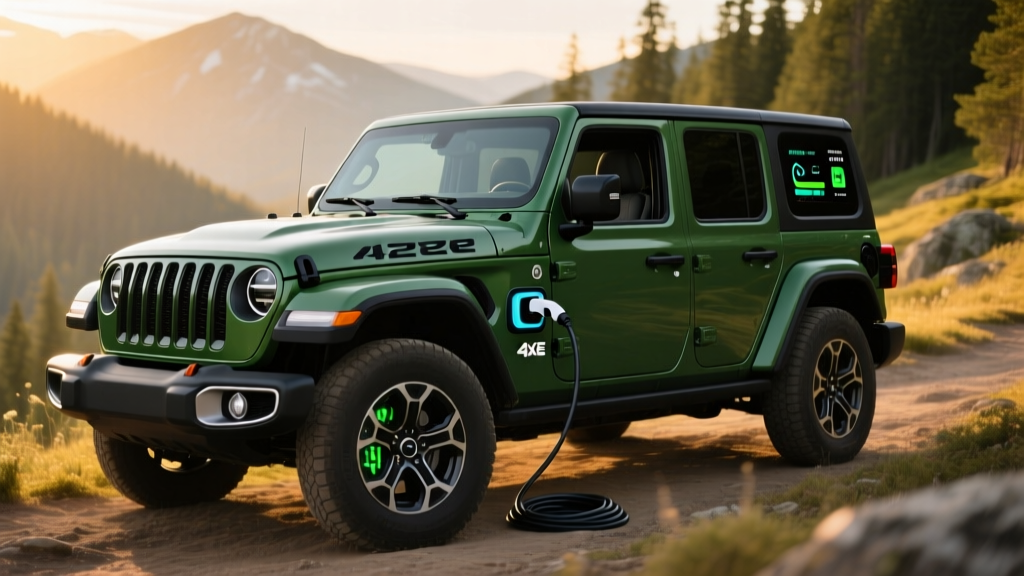
The Jeep Wrangler 4xe is the plug-in hybrid variant of America's most recognizable off-roader. For the 2024 model year, Jeep pairs a 2.0-liter turbocharged inline-four with two electric motors and a 17.3 kWh battery pack, delivering 375 combined horsepower and 470 lb-ft of torque. The result is a vehicle that can crawl the Rubicon Trail on electric power alone and still tow 3,500 pounds. But how does the 2024 Jeep Wrangler hybrid stack up in daily driving, and does the plug-in premium pay off?
2024 Jeep Wrangler 4xe: Key Specifications at a Glance
| Specification | Value |
|---|---|
| Powertrain Type | Plug-in Hybrid (PHEV) |
| Engine | 2.0L Turbo I-4 + 2 Electric Motors |
| Combined Horsepower | 375 hp |
| Combined Torque | 470 lb-ft |
| Transmission | 8-Speed Automatic (TorqueFlite) |
| Battery (Usable) | 17.3 kWh (NMC Lithium-Ion) |
| EPA Electric-Only Range | 22 miles |
| EPA Combined (Gas+Electric) | 49 MPGe |
| EPA MPG (Gas Only, Combined) | 20 MPG |
| Max DC Fast Charge | Not Supported (Level 2 AC Only) |
| Level 2 Charge Time (0-100%) | ~2.5 hours at 7.2 kW |
| 0-60 mph | |
| Towing Capacity | 3,500 lbs |
| Starting MSRP | $49,995 (Willys 4xe) |
HEV vs PHEV: What the Wrangler 4xe Actually Is
Before diving deeper, it's critical to distinguish between conventional hybrids (HEVs) and plug-in hybrids (PHEVs), because the Wrangler lineup includes both.
Conventional Hybrid (HEV)
The 2024 Wrangler also offers a mild-hybrid system (eTorque) on the 3.6L V6. This is a 48-volt belt-driven system that assists the engine during stop-start and light acceleration. It cannot drive on electric power alone, does not plug in, and provides a marginal fuel economy bump (roughly 1-2 MPG). The battery is small (~0.5 kWh) and recharges solely through regenerative braking and the engine.
Plug-in Hybrid (PHEV) — The 4xe
The 4xe is a full plug-in hybrid. It has a substantially larger 17.3 kWh battery, an integrated electric motor between the engine and transmission, and a front-mounted motor/generator. It can drive up to 22 miles on electricity alone, plugs into a wall or charging station, and qualifies for certain federal incentives that the eTorque mild-hybrid does not.
Bottom line: When people search for the "2024 Jeep Wrangler hybrid," they're almost always looking for the 4xe PHEV. The eTorque mild-hybrid is a footnote by comparison.
Fuel Economy Breakdown: EPA Numbers and Real-World MPG
| Driving Mode | City | Highway | Combined |
|---|---|---|---|
| Charge-Sustaining (Gas Only) | — | — | 20 MPG |
| Blended (Gas + Electric, MPGe) | — | — | 49 MPGe |
| Electric-Only Efficiency | 49 MPGe (equivalent) | ||
The 49 MPGe figure only applies when you're regularly charging and driving within the 22-mile electric window. Once the battery is depleted, the Wrangler 4xe operates as a heavy hybrid, returning about 20 MPG combined — a figure consistent with the non-hybrid 2.0L turbo Wrangler. According to fueleconomy.gov, the 4-door Wrangler 4xe achieves this 20 MPG combined in charge-sustaining mode.
Real-World MPG vs. EPA Estimates
The Wrangler 4xe's real-world fuel economy depends heavily on your charging habits:
- Daily commuter (charges nightly, drives under 22 miles): You may use almost zero gasoline for weeks. Effective "MPG" is essentially infinite for those trips.
- Mixed driver (charges occasionally, drives 30-50 miles/day): Expect 22-28 MPG combined, since a significant portion of miles are electric.
- Road-trip or never-charge driver: Expect 18-21 MPG highway. The 4xe carries roughly 600 lbs of extra battery and motor weight versus the gas-only Wrangler, which hurts efficiency when the electric system isn't contributing.
On the highway at 75 mph, owners consistently report 18-20 MPG once the battery is depleted. The boxy aerodynamics, all-terrain tires, and solid front axle work against efficiency regardless of powertrain. This is the trade-off for unmatched off-road capability.
Electric-Only Range and Charging Details
The EPA rates the 2024 Wrangler 4xe at 22 miles of electric-only range. In real-world conditions, expect 18-22 miles depending on temperature, terrain, and speed. Highway driving at 70+ mph can reduce electric range to 14-16 miles. In cold weather (below 32°F), expect a 20-30% reduction, bringing electric range down to roughly 12-16 miles.
Total combined range (full battery + full 17.2-gallon fuel tank) is approximately 370 miles.
Charging the Wrangler 4xe
The 4xe uses a standard J1772 connector for Level 1 and Level 2 AC charging. It does not support DC fast charging — a notable limitation compared to PHEVs like the Toyota RAV4 Prime (which also lacks DCFC) or the Chrysler Pacifica Hybrid.
| Charging Level | Power | Time (0-100%) | Notes |
|---|---|---|---|
| Level 1 (120V Household) | ~1.4 kW | ~12 hours | Emergency/trickle only |
| Level 2 (240V, 32A) | 7.2 kW | ~2.5 hours | Recommended for daily use |
| DC Fast Charge | N/A | N/A | Not supported |
A Level 2 home charger is practically essential for 4xe ownership. A 2.5-hour charge time means you can top off during the workday or overnight without issue. Jeep includes a Level 1 cordset with the vehicle, but a dedicated 240V Level 2 station (such as a ChargePoint Home Flex or Emporia Vue) dramatically improves the daily experience. Budget $500-$800 for the charger and $800-$2,000 for professional installation, depending on your electrical panel.
Powertrain Performance: 375 HP and Trail-Rated Capability
The 2024 Wrangler 4xe powertrain combines:
- 2.0L Turbocharged I-4: 270 hp, 295 lb-ft (engine alone)
- Electric Motor (P2, between engine and transmission): 134 hp, 181 lb-ft
- Front Motor/Generator: 63 hp (primarily for regeneration and engine start)
- Combined System Output: 375 hp, 470 lb-ft
The electric motor sits between the engine and the 8-speed TorqueFlite automatic, meaning full electric torque is available from zero RPM. This gives the 4xe a surprisingly punchy feel off the line — the 0-60 mph time of approximately 6.0 seconds is quicker than the V6 Wrangler and on par with the 392 V8 in everyday driving.
Off-road, the 4xe excels. Electric mode provides silent, precise throttle control for rock crawling. The Rubicon 4xe retains the front and rear locking differentials, electronic sway-bar disconnect, and 33-inch all-terrain tires. Water fording depth remains 30 inches — the battery pack is sealed and mounted under the rear seat.
Three drive modes let you manage the powertrain:
- Hybrid (default): Blends electric and gas for optimal efficiency.
- Electric: Forces electric-only driving until the battery is depleted (or you floor it, which kicks on the engine).
- e-Save: Preserves battery charge for later use — useful when you want to save electric miles for city driving or a quiet trail approach.
Pricing, Trims, and Federal Tax Credit Eligibility
The 2024 Jeep Wrangler 4xe is available across several trims:
| Trim | Starting MSRP |
|---|---|
| Willys 4xe | $49,995 |
| Sport S 4xe | $51,995 |
| Sahara 4xe | $55,995 |
| Rubicon 4xe | $58,995 |
| High Altitude 4xe | $63,995 |
All prices include the $1,995 destination charge. The Wrangler 4xe qualifies as a PHEV under the IRS §30D Clean Vehicle Credit, but eligibility depends on several factors that change periodically:
- MSRP Cap: SUVs must have an MSRP under $80,000 — all 4xe trims qualify.
- Buyer Income Cap: AGI must not exceed $150,000 (single), $225,000 (head of household), or $300,000 (joint).
- Battery Sourcing: Critical minerals and battery components must meet phased-in percentages from US or FTA-partner countries. This requirement tightens annually — check current-year rules at IRS.gov.
- Point-of-Sale Transfer: As of 2024, buyers can transfer the credit to the dealer at purchase, reducing the out-of-pocket cost immediately rather than waiting for tax filing.
The maximum federal credit for the Wrangler 4xe is $3,750 (as of recent model-year sourcing compliance — the vehicle has historically qualified for the partial credit due to battery component sourcing, not the full $7,500). Always verify current eligibility with your tax professional before purchasing, as sourcing rules tighten each year.
Battery Warranty, Reliability, and Replacement Costs
2024 Jeep Wrangler 4xe Battery Warranty
Jeep covers the high-voltage battery pack for 8 years or 100,000 miles (whichever comes first). The warranty guarantees the battery will retain at least 70% of its original capacity. If capacity drops below this threshold under normal use, Jeep will repair or replace the pack at no cost.
The Wrangler 4xe's 17.3 kWh NMC (nickel-manganese-cobalt) battery pack is mounted under the rear seats, protecting it from trail damage while keeping the center of gravity low. PHEV batteries experience less stress than full EV batteries because they operate in a narrower state-of-charge window (typically 15-85%), which reduces degradation.
Reliability Track Record
The 4xe powertrain has been in production since the 2021 model year, giving it a multi-year track record. Common concerns reported by owners and tracked by NHTSA include:
- Electrical gremlins: Some 2021-2022 models experienced infotainment and instrument cluster issues, largely addressed through software updates.
- Recall history: Jeep issued a recall for certain 2021-2023 4xe models related to a high-voltage battery fire risk when charging at high states of charge in hot weather. Jeep's remedy involved software updates and, in some cases, battery module replacement. Verify that any used 4xe has had all recall work completed (check via NHTSA.gov).
- Overall powertrain: The 2.0L turbo engine and ZF 8-speed transmission are well-proven across the Stellantis lineup. The electric motor system has been largely trouble-free.
Battery Replacement Cost
Out-of-warranty replacement for the 4xe battery pack is estimated at $8,000-$12,000 including labor, based on Stellantis parts pricing and dealer service rates. Individual module replacement (if only a portion of the pack is degraded) can reduce this cost significantly. For context, most PHEV battery packs show minimal degradation in the first 100,000 miles when properly maintained — keeping the battery between 20-80% charge and avoiding prolonged exposure to extreme heat extends lifespan.
Who Should Buy the Wrangler 4xe — And Who Shouldn't
Pros
- 375 hp and instant electric torque make it the quickest Wrangler in everyday driving
- 22 miles of silent electric range is ideal for short commutes and stealthy trail crawling
- Retains full Rubicon off-road capability with no compromises
- Federal tax credit reduces effective purchase price (verify current eligibility)
- No range anxiety — 370+ miles total range with gas engine backup
Cons
- 20 MPG once the battery depletes — no better than the gas 2.0L Wrangler
- No DC fast charging — impractical for road-trip recharging
- 600+ lbs of extra weight vs. gas Wrangler hurts handling and braking
- Higher starting price ($49,995+) with a long payback period on fuel savings
- Past battery-related recalls require verification on used models
Wrangler 4xe vs. Full EV vs. Gas Wrangler: Decision Framework
Choose the Wrangler 4xe (PHEV) If:
- Your daily commute is under 25 miles and you can charge at home every night
- You need serious off-road capability but also want some electric driving
- You regularly take road trips where charging infrastructure is sparse
- You want the tax credit but aren't ready to commit to a full EV
Choose the Gas Wrangler (3.6L V6 or 2.0T) If:
- You cannot charge at home (no garage, no outlet access)
- You drive mostly highway miles where the 4xe's electric advantage disappears
- You want the lowest purchase price and simplest maintenance
- You don't care about fuel savings or electric driving
Choose a Full EV (e.g., Rivian R1S, Ford Bronco — if/when EV) If:
- You want zero tailpipe emissions and the lowest per-mile fuel cost
- You have reliable home and workplace charging
- Your daily driving rarely exceeds 250 miles
- You want minimal maintenance (no oil changes, no transmission fluid)
Frequently Asked Questions
How many MPG does the 2024 Jeep Wrangler 4xe hybrid get?
The EPA rates the Wrangler 4xe at 49 MPGe when operating in blended gas-and-electric mode, and 20 MPG combined once the battery is depleted and you're running on gasoline alone. Real-world highway MPG on gas is typically 18-21 MPG. Your actual economy depends heavily on how often you charge and how many miles you drive within the 22-mile electric window.
How far can the Wrangler 4xe go on electric only?
The EPA rates the 2024 Wrangler 4xe at 22 miles of electric-only range. In real-world driving, expect 18-22 miles in mild conditions, 14-16 miles at highway speeds, and 12-16 miles in cold weather. The total combined range (electric + gas) is approximately 370 miles.
Does the 2024 Jeep Wrangler 4xe qualify for a federal tax credit?
The Wrangler 4xe qualifies for a partial federal tax credit under IRS §30D — historically $3,750, though the exact amount depends on current-year battery sourcing requirements. The buyer must meet income caps ($150K single / $300K joint) and the vehicle MSRP must be under $80,000 (all trims qualify). The credit can now be transferred to the dealer at point of sale. Always confirm current eligibility at IRS.gov or with a tax professional.
Is the Wrangler 4xe reliable, and what does a battery replacement cost?
The 4xe has been in production since 2021 and the powertrain is generally reliable, though early models had some battery-related recalls that should be verified on used examples. The high-voltage battery is warrantied for 8 years / 100,000 miles (70% capacity retention). Out-of-warranty battery replacement is estimated at $8,000-$12,000. Proper charging habits (avoiding extreme states of charge) help maximize battery life.
Can the Wrangler 4xe DC fast charge?
No. The 2024 Wrangler 4xe only supports AC charging — Level 1 (120V, ~12 hours) or Level 2 (240V at 7.2 kW, ~2.5 hours). There is no DC fast-charging capability. For a PHEV with a 22-mile electric range, this is less of a practical limitation than it would be for a full EV, since most 4xe charging happens at home overnight.
What's the difference between the Wrangler 4xe and the eTorque mild hybrid?
The 4xe is a full plug-in hybrid with a 17.3 kWh battery, electric-only driving capability, and a charge port. The eTorque system (available on the 3.6L V6 Wrangler) is a 48-volt mild-hybrid that provides minor engine assist and smoother stop-start but cannot drive on electric power alone and does not plug in. The 4xe is the significantly more capable electrified option.