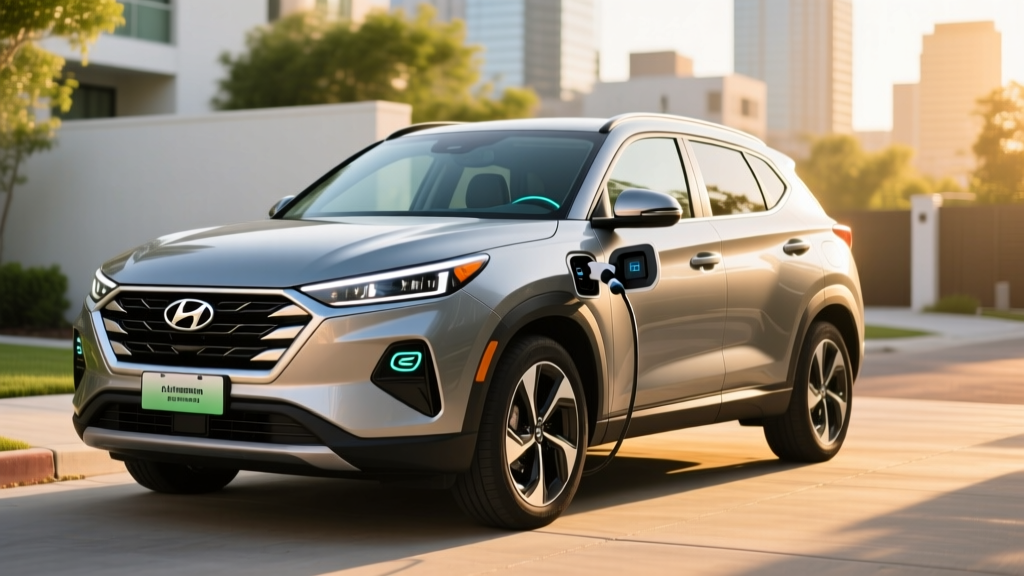
The 2024 Hyundai Tucson Plug-In Hybrid occupies a specific and increasingly crowded niche: a compact SUV that can handle daily commutes on electricity alone while retaining the range flexibility of a gasoline engine for road trips. With 33 miles of EPA-rated electric-only range and a combined 261 horsepower, it's positioned as a bridge for buyers who want EV-like daily driving without committing to a full battery-electric vehicle. But does the math work when you factor in charging logistics, real-world efficiency, and current federal tax credit rules? Let's break down every number that matters.
HEV vs PHEV: Which Tucson Hybrid Is Which?
Hyundai sells two electrified Tucson variants, and confusing them is the most common buyer mistake. The conventional hybrid (HEV) uses a small battery charged exclusively through regenerative braking and the gasoline engine — you never plug it in. The plug-in hybrid (PHEV) carries a much larger 13.8 kWh battery that you charge from a wall outlet or public charger, enabling genuine electric-only driving.
Tucson HEV vs Tucson PHEV at a Glance
| Attribute | Tucson Hybrid (HEV) | Tucson Plug-In Hybrid (PHEV) |
|---|---|---|
| Plugs in? | No | Yes |
| Battery capacity | 1.49 kWh | 13.8 kWh |
| Electric-only range | ~1 mile (low-speed assist) | 33 miles (EPA) |
| Combined horsepower | 226 hp | 261 hp |
| EPA combined MPG (hybrid mode) | 38 MPG | 35 MPG |
| EPA MPGe (electric + gas) | N/A | 80 MPGe |
| Federal tax credit (§30D) | Not eligible | Eligibility varies — see below |
| Base MSRP (2024) | ~$32,575 | ~$38,725 |
The PHEV commands a ~$6,000 premium but delivers meaningfully more power and the ability to drive most commutes without burning gasoline.
Electric-Only Range and Total Range
The 2024 Tucson PHEV's 13.8 kWh lithium-ion polymer battery delivers an EPA-rated 33 miles of electric-only range. In real-world driving, expect that figure to hold fairly well in mild weather with moderate city driving — many owners report 30–35 miles on a full charge in suburban conditions. Highway driving at 70+ mph and cold-weather operation (below 40°F) will reduce that to approximately 25–28 miles due to increased energy consumption and cabin heating demands.
Real-world expectation: 25–35 miles depending on temperature, speed, and terrain
Total combined range (electric + gas): approximately 400+ miles with a full tank and full charge
Once the battery depletes, the Tucson PHEV operates as a conventional hybrid, returning an EPA-estimated 35 MPG combined (33 city / 37 highway). That's slightly lower than the HEV's 38 MPG combined — the extra weight of the larger battery and more powerful electric motor accounts for the difference. On long road trips where you never plug in, the HEV is marginally more efficient.
Powertrain, Performance, and Charging
The Tucson PHEV pairs a 1.6-liter turbocharged four-cylinder engine (178 hp, 195 lb-ft torque) with a 66.9 kW electric motor integrated into a six-speed automatic transmission. Combined system output is 261 horsepower and 258 lb-ft of torque, making it the most powerful Tucson variant short of the N Line performance model. The 0–60 mph sprint takes approximately 7.1 seconds — respectable for a compact SUV prioritizing efficiency over sportiness.
A critical note on DC fast charging: The Tucson PHEV does not support DC fast charging. This is standard for most plug-in hybrids — the 13.8 kWh battery is small enough that Level 2 charging fully replenishes it in roughly two hours, making DC infrastructure unnecessary for daily use. You charge at home overnight and start every morning with a full battery.
For home charging, a standard 120V household outlet (Level 1) will recharge the battery in approximately 12 hours — workable if you park for long stretches but tight for daily turnover. A 240V Level 2 home charger (such as a ChargePoint Home Flex or Hyundai's own wallbox) at 7.2 kW brings that down to about two hours. Most PHEV owners install a Level 2 unit in their garage for $500–$1,500 including equipment and basic electrical work.
Fuel Economy: EPA Numbers vs Real-World MPG
Source: fueleconomy.gov
Real-world MPG observations: PHEVs are highly sensitive to charging habits. Owners who plug in nightly and drive within the 33-mile electric window may burn very little gasoline for weeks — effectively achieving 100+ MPGe on short commutes. Once the battery is depleted and you're driving on the hybrid system alone, expect 33–36 MPG in mixed driving. City-heavy routes tend to push toward the higher end thanks to regenerative braking recapturing energy, while sustained highway cruising at 75+ mph may yield 32–34 MPG.
Compared to the gas-only Tucson AWD (26 MPG combined), the PHEV in hybrid mode alone saves roughly 9 MPG — a 35% improvement. If you charge regularly and stay within the electric range, the fuel savings become dramatically larger.
Pricing, Trims, and Tax Credit Eligibility
The 2024 Tucson PHEV is offered in three trims, all with standard HTRAC all-wheel drive:
- SEL Convenience: ~$38,725 MSRP
- Limited: ~$43,425 MSRP
(Destination charges add approximately $1,335.)
Federal Tax Credit (§30D) — Current Rules
The Tucson PHEV may qualify for up to $3,750 of the federal plug-in vehicle tax credit, but eligibility depends on several factors that change frequently under the Inflation Reduction Act:
- MSRP cap: SUVs must have an MSRP at or below $80,000 — all Tucson PHEV trims qualify.
- Buyer income cap: Modified AGI must not exceed $150,000 (single), $225,000 (head of household), or $300,000 (joint).
- Battery sourcing: The credit is split into two halves ($3,750 for critical minerals + $3,750 for battery components). Sourcing requirements tighten annually. As of 2024–2025 rules, the Tucson PHEV's battery supply chain may qualify for partial credit ($3,750), but full $7,500 eligibility is unlikely due to component sourcing constraints.
- Point-of-sale transfer: Buyers can transfer the credit to the dealer at purchase, reducing the upfront price rather than waiting for a tax refund.
Always verify current eligibility on IRS.gov and consult a tax professional before relying on credit amounts in your purchase decision. Rules and eligible vehicle lists are updated periodically.
Battery Warranty, Reliability, and Replacement Costs
Hyundai Hybrid/PHEV Battery Warranty
- Hybrid battery: 10 years / 100,000 miles (whichever comes first)
- Hybrid system components: 10 years / 100,000 miles
- Capacity retention threshold: Hyundai replaces the battery if capacity drops below approximately 70% during the warranty period
- Powertrain warranty: 10 years / 100,000 miles
- New vehicle warranty: 5 years / 60,000 miles
Hyundai's 10-year hybrid battery warranty is among the best in the industry and applies to the original owner. Second-owner coverage may vary — check the window sticker or dealer documentation.
Reliability outlook: Hyundai's 1.6L turbo hybrid powertrain has been in production across multiple models (Tucson, Santa Fe, Sonata, Ioniq) since 2020, giving it a reasonable track record. The six-speed automatic is a conventional torque-converter unit rather than a CVT, which some buyers prefer for durability and driving feel. Common PHEV-specific concerns are minimal — the electric motor and power electronics have few moving parts, and the battery is liquid-cooled for thermal management.
Battery replacement cost: If the 13.8 kWh battery requires replacement out of warranty (rare within the first decade based on degradation data from similar Hyundai/Kia PHEVs), expect a cost between $4,000 and $6,500 including parts and labor at a dealership. Independent hybrid-battery specialists may offer refurbished units at lower cost. Given the 10-year/100,000-mile warranty and the relatively small battery size, this is a low-probability expense for most owners.
Who Should Buy the Tucson PHEV — and Who Shouldn't?
Choose the Tucson PHEV if:
- Your daily round-trip commute is under 30 miles and you can charge at home
- You take road trips several times a year and don't want to plan around charging stations
- You live in an area with limited DC fast-charging infrastructure
- You want AWD as standard without the EV range penalty of cold winters
- You want to reduce gasoline consumption significantly without full EV commitment
Look elsewhere if:
- You cannot charge at home or at work (a PHEV without regular charging is just a heavier, less efficient hybrid)
- Your commute exceeds 40+ miles one way — a full EV like the Ioniq 5 or a longer-range PHEV would serve you better
- You want DC fast charging for public top-ups
- You prioritize maximum cargo space (the PHEV battery slightly reduces under-floor storage vs. the HEV)
- Budget is tight — the HEV saves ~$6,000 upfront with only marginally lower efficiency
Quick Decision Framework
Choose the Tucson PHEV if your typical daily driving is ≤33 miles and you have reliable home Level 2 charging. You'll drive most days on electricity at roughly $0.04–$0.06 per mile (depending on local electricity rates) and use gasoline only for longer trips.
Choose the Tucson HEV if you can't charge at home, drive more than 40 miles daily, or want to minimize upfront cost while still getting excellent fuel economy.
Choose a full EV (e.g., Ioniq 5) if your daily driving is under 250 miles, you have home charging, and you're ready to eliminate gasoline entirely with 300+ miles of EPA range.
Real-World Ownership Economics
Let's model a realistic ownership scenario. Assume 12,000 miles per year, a 20-mile round-trip commute (well within the 33-mile electric range), home charging at $0.14/kWh (national average), and gasoline at $3.50/gallon:
With regular charging, the PHEV saves roughly $450–$965 per year versus the HEV and gas-only models respectively. Over a 5-year ownership period, that's $2,250–$4,825 in fuel savings — partially offsetting the PHEV's higher purchase price. Factor in any applicable tax credit, and the breakeven point moves closer.
Frequently Asked Questions
How many MPG does the 2024 Tucson Plug-In Hybrid get?
In hybrid mode (after the battery is depleted), the Tucson PHEV returns an EPA-estimated 33 city / 37 highway / 35 combined MPG. In electric mode, it's rated at 80 MPGe combined. Real-world hybrid-mode MPG typically falls between 33–36 MPG depending on driving conditions.
How far can the Tucson PHEV go on electric only?
The EPA rates it at 33 miles of electric-only range. Real-world results vary from about 25 miles in cold highway driving to 35 miles in mild-weather city conditions. Once depleted, the gasoline engine takes over seamlessly.
Does the Tucson PHEV qualify for a federal tax credit?
It may qualify for up to $3,750 under the §30D clean vehicle credit, depending on battery component and critical mineral sourcing requirements, your income, and the vehicle's MSRP. Full $7,500 eligibility is unlikely under current rules. Always check fueleconomy.gov and the IRS clean vehicle credit page for the latest eligible vehicle list before purchasing.
Is the Tucson PHEV reliable, and what does a battery replacement cost?
Hyundai backs the hybrid battery and powertrain with a 10-year/100,000-mile warranty, one of the longest in the industry. Out-of-warranty battery replacement is estimated at $4,000–$6,500, though this is uncommon within the first decade. The 1.6L turbo hybrid system has been in production across multiple Hyundai/Kia models since 2020 with no widespread failure patterns.
Can the Tucson PHEV DC fast charge?
No. Like most plug-in hybrids, the Tucson PHEV supports only Level 1 (120V) and Level 2 (240V) AC charging via a J1772 connector. Level 2 fully charges the 13.8 kWh battery in approximately 2 hours, which is sufficient for overnight home charging.
Hybrid vs PHEV vs EV — which should I choose?
If you can charge at home and your daily driving is under 33 miles, the PHEV offers the best of both worlds — electric commuting with gas-engine range for road trips. If you can't charge at home, the conventional HEV gives excellent MPG with zero behavior change. If you have home charging and want to eliminate gasoline entirely, a full EV like the Hyundai Ioniq 5 (303 miles EPA range) offers lower running costs and less maintenance, though at a higher upfront price and with road-trip charging planning required.