Quick Verdict: The Tucson Hybrid Sweet Spot
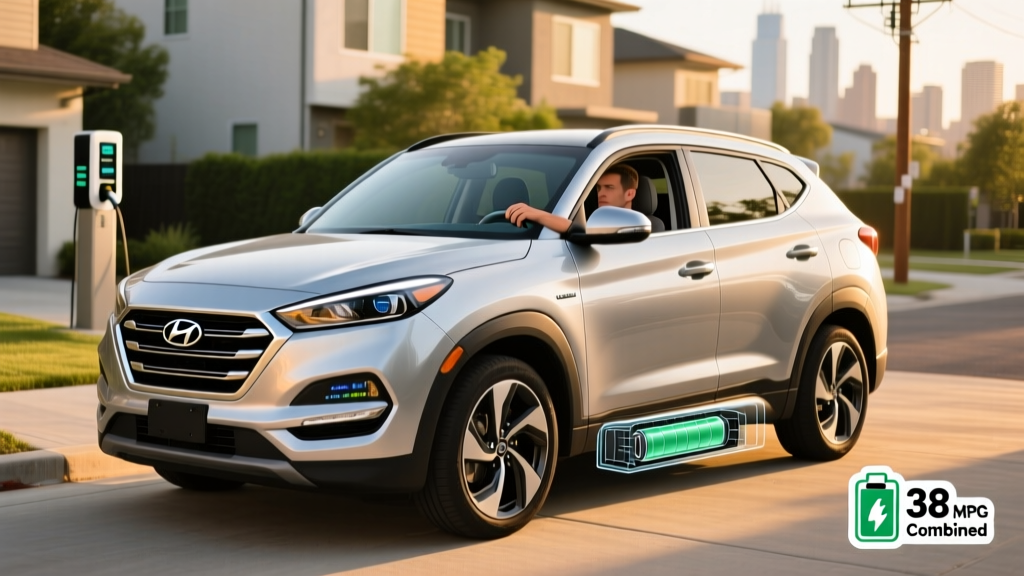
The 2024 Hyundai Tucson Hybrid occupies a practical middle ground for buyers who want meaningful fuel savings without changing their refueling habits. With an EPA-estimated 38 MPG combined, 226 combined horsepower, and a starting MSRP around $32,575, it undercuts most competitors on price while delivering competitive efficiency. But the real story is the Tucson Plug-In Hybrid variant, which adds 33 miles of electric-only range for commuters with charging access. Let's separate what the sticker says from what you'll actually experience on the road.
HEV vs PHEV: Which Tucson Hybrid Are We Talking About?
Hyundai sells two electrified Tucson variants for 2024, and confusing them is the most common buyer mistake. Here's the distinction:
Conventional Hybrid (HEV)
The Tucson Hybrid uses a 1.6L turbocharged engine paired with an electric motor and a small battery (roughly 1.49 kWh). You never plug it in. Regenerative braking and the engine recharge the battery. It operates like a gas car with better fuel economy — no charging cables, no range anxiety, no behavior change required.
Plug-In Hybrid (PHEV)
The Tucson Plug-In Hybrid pairs the same 1.6L turbo with a more powerful electric motor and a 13.8 kWh battery pack. You plug it in to unlock its 33-mile electric-only range. Once the battery depletes, it reverts to hybrid mode at roughly 35 MPG combined. It requires access to a Level 2 home charger to realize its full value.
Fuel Economy: EPA Numbers vs Real-World MPG
| Model | City MPG | Highway MPG | Combined MPG | Elec. Range (PHEV) |
|---|---|---|---|---|
| 2024 Tucson Hybrid (HEV) Blue | 38 | 38 | 38 | N/A |
| 2024 Tucson Hybrid (HEV) SEL/Limited | 37 | 36 | 37 | N/A |
| 2024 Tucson PHEV (all trims) | 37 (hybrid mode) | 34 (hybrid mode) | 35 (hybrid mode) | 33 mi |
Source: EPA / fueleconomy.gov
What You'll Actually See
Hyundai's hybrid system, like Toyota's, tends to exceed EPA city estimates in stop-and-go traffic because regenerative braking recovers energy that gas cars waste as heat. In real-world mixed driving, owners frequently report 39–42 MPG in the HEV around town. Highway driving at 75+ MPH drops efficiency to roughly 33–35 MPG due to aerodynamic drag — a physics limitation shared by all crossovers in this class.
For the PHEV, the 33-mile electric-only estimate assumes moderate temperatures and speeds under 65 MPH. In cold weather (below 35°F), expect that electric range to contract to 25–28 miles due to cabin heating demands and battery chemistry limitations. On warm days with light acceleration, some owners report 35–36 miles before the engine engages.
Powertrain and Performance Specs
| Spec | Tucson HEV | Tucson PHEV |
|---|---|---|
| Engine | 1.6L Turbo I4 | 1.6L Turbo I4 |
| Combined Output | 226 HP / 258 lb-ft | 261 HP / 258 lb-ft |
| Electric Motor | 44.2 kW (59 HP) | 66.9 kW (90 HP) |
| Battery Capacity | 1.49 kWh | 13.8 kWh |
| Transmission | 6-speed automatic | 6-speed automatic |
| Drivetrain | AWD (standard) | AWD (standard) |
| 0–60 MPH (est.) | ~7.1 sec | ~6.3 sec |
| Towing Capacity | 2,000 lbs | 2,000 lbs |
The PHEV's larger motor gives it noticeably stronger acceleration, particularly in EV mode where the engine stays dormant. Both variants come with all-wheel drive as standard — a differentiator against the Toyota RAV4 Hybrid's optional AWD on certain trims.
PHEV Charging: Times, Connectors, and Limitations
The Tucson PHEV charges via a standard J1772 connector (the universal Level 1/Level 2 plug for non-Tesla EVs). Here's what to expect:
- Level 1 (120V household outlet): ~1.4 kW — approximately 10–11 hours for a full charge. Usable only for overnight top-ups if you drive under 30 miles daily.
- Level 2 (240V home charger, 32A): ~7.2 kW onboard charger — approximately 2 hours from empty to full. This is the practical daily charging method.
- DC Fast Charging: Not supported. The Tucson PHEV has no DC fast-charge port. This is typical for PHEVs in this price segment — the battery is too small to justify the hardware cost.
Most PHEV owners charge nightly on a Level 2 home charger and rarely visit public stations. If your daily commute is under 30 miles round-trip, you could drive months without the engine engaging — meaning near-zero fuel consumption on weekdays with full gas-engine flexibility for road trips.
Pricing, Trims, and Tax Credit Eligibility
| Trim | Body Style | MSRP (2024) |
|---|---|---|
| Blue | HEV | $32,575 |
| SEL Convenience | HEV | $35,225 |
| Limited | HEV | $39,400 |
| SEL Convenience | PHEV | $40,400 |
| Limited | PHEV | $47,600 |
Destination charge: ~$1,335 additional. Prices per Hyundai's 2024 MSRP sheets.
Does It Qualify for Federal Tax Credits?
HEV (conventional hybrid): No federal tax credit. The IRS §30D credit applies only to plug-in electric vehicles with sufficient battery capacity. Conventional hybrids are ineligible.
PHEV: The 2024 Tucson PHEV may qualify for up to $7,500 under IRS §30D, but eligibility depends on three conditions that change frequently:
- Buyer income cap: Modified AGI must not exceed $150,000 (single), $225,000 (head of household), or $300,000 (joint).
- MSRP cap: The vehicle MSRP must not exceed $80,000 for SUVs (the Tucson PHEV clears this easily).
- Battery sourcing requirements: Critical minerals and battery components must meet phased-in percentages from US or free-trade-agreement countries. These requirements tighten annually.
As of 2024, Hyundai confirmed the Tucson PHEV qualifies for the full $7,500 — and the point-of-sale transfer option allows dealers to apply it as an immediate discount rather than a tax-year credit. Always verify current eligibility at IRS.gov before purchase, as sourcing rules shift.
Battery Warranty, Reliability, and Replacement Cost
Hybrid battery longevity is the top concern for first-time hybrid buyers. Here's what Hyundai covers:
- HEV Battery Warranty: 10 years / 100,000 miles (whichever comes first). Covers capacity loss below a manufacturer-defined threshold and defects.
- PHEV Battery Warranty: 10 years / 100,000 miles. Same coverage terms.
- Hybrid System Components: 10 years / 100,000 miles — includes the electric motor, inverter, and related control electronics.
Hyundai's 10-year hybrid battery warranty is among the best in the industry, matching Toyota and exceeding most European brands. Real-world data from earlier Hyundai hybrids (Ioniq, Sonata Hybrid) shows minimal degradation — most owners report less than 5% capacity loss after 100,000 miles.
Should a replacement be needed out of warranty, industry estimates place the Tucson HEV battery pack replacement at approximately $2,500–$4,000 (parts and labor), while the larger PHEV pack runs $5,000–$8,000. However, with Hyundai's generous warranty window and the proven durability of lithium-ion hybrid packs, most owners will sell or trade the vehicle before facing this cost.
Hyundai's overall reliability ratings from IIHS are strong, with the 2024 Tucson earning Top Safety Pick status when equipped with specific headlights.
Who Should Choose the Tucson Hybrid vs PHEV vs Full EV?
Choose the Tucson HEV If:
- You have no access to home or workplace charging
- Your daily driving is unpredictable and often exceeds 50 miles
- You want a lower purchase price ($32,575 base) with zero behavior change
- You frequently tow or take long road trips and want maximum simplicity
Choose the Tucson PHEV If:
- You can install a Level 2 home charger (garage or driveway access)
- Your weekday commute is under 30 miles round-trip (you'll rarely burn gas)
- You want EV-like daily driving with gas-engine freedom for weekend trips
- You qualify for the $7,500 federal credit, bringing effective cost near HEV pricing
Choose a Full BEV (like the Hyundai Ioniq 5) If:
- You have reliable home Level 2 charging and your daily driving is under 250 miles
- You want to eliminate oil changes, transmission fluid, and all engine maintenance
- You want the lowest per-mile energy cost (electricity at ~$0.04/mile vs gas at ~$0.12/mile)
- You're ready to plan around DC fast charging on road trips
Pros and Cons at a Glance
Pros
- 38 MPG combined (HEV) beats most compact SUV competitors
- Standard AWD across all hybrid trims
- 226–261 HP provides confident highway merging
- 10-year/100,000-mile hybrid battery warranty
- PHEV qualifies for $7,500 federal credit (with caveats)
- Spacious interior with 38.7 cu ft cargo (seats up)
Cons
- HEV fuel economy drops to ~33 MPG at sustained highway speeds
- PHEV lacks DC fast charging (2-hour Level 2 charge)
- PHEV Limited trim pushes $47,600+ before incentives
- 6-speed automatic feels less refined than competitors' e-CVT systems under hard acceleration
- No spare tire — tire inflator kit only
Frequently Asked Questions
How many MPG does the 2024 Tucson Hybrid actually get in real driving?
The EPA rates the Tucson HEV Blue at 38 MPG combined. In real-world city driving with frequent stops, owners commonly see 39–42 MPG thanks to aggressive regenerative braking. Sustained highway driving at 75+ MPH drops that to roughly 33–35 MPG. Mixed daily driving typically lands at 36–39 MPG.
How far can the Tucson PHEV go on electric power alone?
The EPA rates the Tucson PHEV at 33 miles of electric-only range. In warm weather with gentle acceleration, expect 33–36 miles. In cold weather (below 35°F), plan for 25–28 miles due to cabin heating loads and reduced battery efficiency.
Do I need to plug in the Tucson Hybrid (HEV)?
No. The conventional Tucson Hybrid never plugs in. It recharges its small battery through regenerative braking and the gasoline engine. You fuel it exclusively at gas stations, exactly like a traditional vehicle.
Is the Tucson Hybrid battery expensive to replace?
Out of warranty, HEV battery replacement is estimated at $2,500–$4,000; the PHEV pack runs $5,000–$8,000. However, Hyundai covers the hybrid battery for 10 years/100,000 miles, and real-world data shows minimal degradation within that window. Most owners will never face this cost.
Does the 2024 Tucson Hybrid qualify for any tax credit?
The conventional HEV does not qualify for federal tax credits. The Tucson PHEV may qualify for up to $7,500 under IRS §30D, subject to buyer income caps ($150K single / $300K joint), the $80K SUV MSRP cap (which it clears), and battery sourcing requirements. The credit can be transferred to the dealer as a point-of-sale discount. Verify current eligibility at IRS.gov before purchasing.
How does the Tucson Hybrid compare to the Toyota RAV4 Hybrid?
The RAV4 Hybrid rates at 39–41 MPG combined (slightly higher) with 219 HP (slightly less). The Tucson Hybrid offers more cargo space, a longer warranty, and a more powerful PHEV option. The RAV4 Hybrid has a longer track record and marginally better highway efficiency. Both are strong choices — the decision often comes down to styling preference and dealer availability.