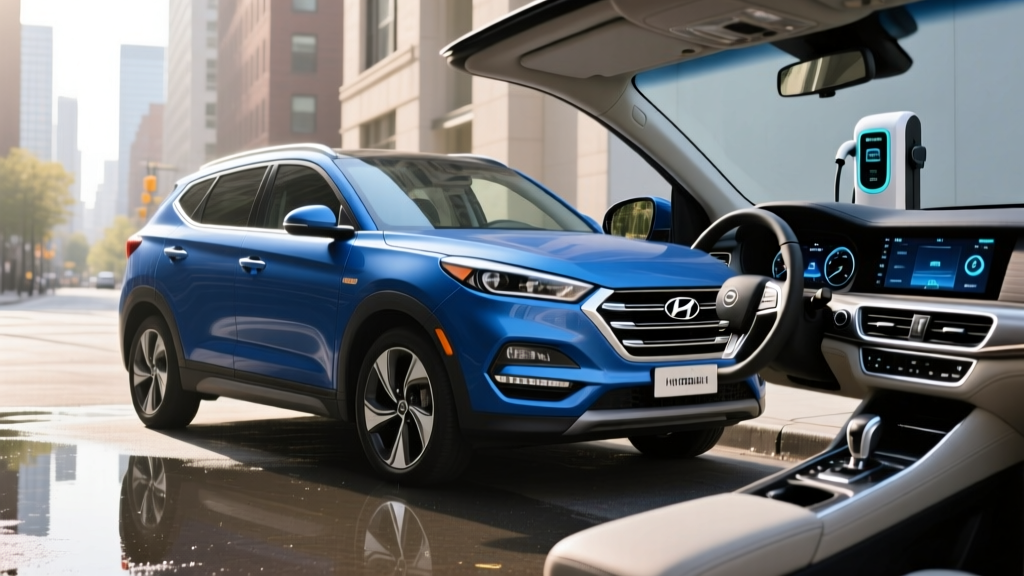
The 2024 Hyundai Tucson Hybrid Blue occupies a specific and increasingly popular niche: a compact SUV that sips fuel without requiring you to plug it in, change your driving habits, or worry about range. With an EPA-estimated 38 MPG combined and a starting MSRP around $32,575, it undercuts many competitors on price while delivering hybrid efficiency that shines especially in stop-and-go city driving. But how does it stack up against the Tucson PHEV, a full battery-electric vehicle, or even its own gas-only sibling? This guide breaks down every number that matters.
2024 Hyundai Tucson Hybrid Blue: Quick Specs at a Glance
| Specification | 2024 Tucson Hybrid Blue |
|---|---|
| Powertrain | 1.6L turbocharged 4-cylinder + electric motor |
| Combined Horsepower | 231 hp / 271 lb-ft torque |
| Transmission | 6-speed automatic |
| Drivetrain | AWD (standard on all Hybrid trims) |
| EPA Fuel Economy | 38 city / 38 highway / 38 combined MPG |
| Fuel Tank Capacity | 13.7 gallons |
| Total Driving Range | ~520 miles (EPA estimate) |
| Battery Type | 1.49 kWh lithium-ion polymer (HEV) |
| 0-60 mph | ~7.1 seconds |
| Cargo Volume (behind 2nd row) | 38.7 cu ft |
| Starting MSRP | $32,575 (Blue trim) |
| Battery Warranty | 10 years / 100,000 miles |
How Many MPG Does the Tucson Hybrid Blue Actually Get?
The EPA rates the 2024 Hyundai Tucson Hybrid Blue at 38 MPG city, 38 highway, and 38 combined, according to fueleconomy.gov. The identical city and highway figures are a hallmark of Hyundai's hybrid tuning: the electric motor assists heavily at low speeds, while the turbocharged engine takes over more on the highway.
| Driving Scenario | EPA Estimate | Real-World Expectation |
|---|---|---|
| City (stop-and-go) | 38 MPG | 36–42 MPG (hybrids often exceed EPA in city) |
| Highway (70 mph cruise) | 38 MPG | 33–36 MPG (aerodynamic drag, less regen benefit) |
| Combined | 38 MPG | 35–39 MPG depending on driving mix |
| Cold weather (below 32°F) | N/A | 30–34 MPG (engine runs more for cabin heat) |
In real-world driving, conventional hybrids like the Tucson tend to exceed their EPA city estimate because regenerative braking recaptures energy during frequent stops — the exact conditions the EPA city cycle simulates, but real commuters often brake even more. Highway driving is where hybrids lose their edge relative to city driving, since there's less braking to recapture energy and aerodynamic drag increases with speed. Expect roughly 33–36 MPG on sustained 70+ mph highway runs, which is still competitive for an AWD compact SUV.
Cold weather impacts all vehicles, but hybrids take a slightly bigger hit than gas cars in winter because the engine must run more frequently to generate cabin heat (there's no waste heat from a large battery pack as in a full EV). Plan for 30–34 MPG in sub-freezing conditions.
HEV vs. PHEV: Which Tucson Hybrid Is Right for You?
Hyundai sells two electrified Tucson variants, and confusing them is a common buyer mistake. Here's the fundamental difference:
Conventional Hybrid (HEV) — Tucson Hybrid Blue
- No plug required. The 1.49 kWh battery charges solely through regenerative braking and the gasoline engine.
- Electric-only driving: Very short distances at low speeds (under ~1 mile, under 25 mph). The motor assists the engine; it does not replace it for meaningful distances.
- Fuel economy: 38 MPG combined regardless of driving pattern.
- Total range: ~520 miles per tank.
- Starting price: $32,575.
Plug-In Hybrid (PHEV) — Tucson Plug-In Hybrid
- Plug-in charging required to access electric-only driving. Features a larger 13.8 kWh battery pack.
- Electric-only range: EPA-estimated 33 miles on electricity alone before the gas engine engages.
- Combined range: ~400+ miles total (33 miles electric + remaining on gasoline).
- Fuel economy (hybrid mode after battery depletes): ~35 MPG combined, per fueleconomy.gov.
- Combined output: 261 hp (more powerful than the HEV).
- Starting price: ~$39,590 (SEL trim).
- DC fast charging: No. Level 2 (240V) charging only; full charge in approximately 2 hours.
The HEV is the simpler, more affordable choice for drivers who want better fuel economy without changing their routine. The PHEV makes sense if you have home charging access and a commute under 33 miles round-trip — you could drive months without visiting a gas station on weekdays, then take a road trip without range concerns.
Powertrain Deep Dive: What's Under the Hood
The Tucson Hybrid Blue pairs a 1.6-liter turbocharged GDI four-cylinder engine (producing 180 hp and 195 lb-ft on its own) with a 47.7 kW (64 hp) electric motor integrated into the transmission housing. Combined system output is 231 hp and 271 lb-ft of torque.
Unlike Toyota's planetary-gear hybrid system (used in the RAV4 Hybrid), Hyundai uses a conventional 6-speed automatic transmission with the electric motor sandwiched between the engine and gearbox. This gives the Tucson Hybrid a more familiar driving feel — shifts are perceptible, and acceleration is linear rather than the rubber-band sensation some associate with CVTs. The trade-off is slightly less seamless low-speed electric assist compared to Toyota's e-CVT system.
The 1.49 kWh lithium-ion polymer battery pack is small by EV standards — it's not designed to store meaningful energy for electric-only driving. Instead, it acts as a buffer, capturing energy from regenerative braking and deploying it for acceleration assist and engine-off coasting at low speeds.
Pricing, Trims, and Tax Credit Eligibility
The 2024 Tucson Hybrid is available in three trims:
- Blue: $32,575 — the efficiency-focused base model with 18-inch aero wheels, LED headlights, 8-inch touchscreen, wireless Apple CarPlay/Android Auto, and Hyundai SmartSense safety suite.
- SEL Convenience: $36,225 — adds panoramic sunroof, 10.25-inch digital cluster, power liftgate, heated front seats, and leatherette upholstery.
- Limited: $40,675 — adds 10.25-inch navigation, Bose premium audio, ventilated front seats, heated steering wheel, and Highway Driving Assist.
Federal Tax Credit Status
The 2024 Hyundai Tucson Hybrid (HEV) does NOT qualify for the federal §30D Clean Vehicle Credit. The $7,500 credit applies only to battery-electric vehicles (BEVs) and plug-in hybrids (PHEVs) that meet battery-sourcing, critical-mineral, MSRP, and buyer-income requirements under current IRS rules. Conventional hybrids that cannot be plugged in are ineligible.
The Tucson Plug-In Hybrid may qualify for up to $7,500 under §30D, but eligibility depends on battery component and critical mineral sourcing requirements that change annually. Buyers should verify current-year rules at IRS.gov and consult a tax professional. The PHEV must also meet the $80,000 MSRP cap for SUVs and buyer income limits ($150,000 single / $300,000 married filing jointly for modified AGI).
Some states offer additional incentives for PHEVs (not HEVs). Check your state's energy or environmental agency for current programs. The HEV's lower purchase price partially offsets the lack of federal incentives — it costs roughly $7,000 less than the PHEV at the base trim level.
Battery Warranty, Reliability, and Replacement Costs
Hybrid battery longevity is the single most common concern among first-time hybrid buyers. Hyundai addresses this with one of the strongest warranties in the industry:
- Hybrid Battery Warranty: 10 years / 100,000 miles (whichever comes first)
- Hybrid System Components Warranty: 10 years / 100,000 miles (includes electric motor, inverter, and related electronics)
- Powertrain Warranty: 10 years / 100,000 miles
- New Vehicle Limited Warranty: 5 years / 60,000 miles
The 1.49 kWh battery in the Tucson HEV is far less stressed than a full EV battery. Because it operates in a narrow state-of-charge window (typically 40–80% SoC) and never undergoes deep discharge cycles, degradation is minimal. Hyundai's lithium-ion polymer chemistry has proven durable across the Ioniq and Sonata Hybrid lineages, with most owners reporting negligible capacity loss even after 100,000+ miles.
If replacement is ever needed outside warranty, a hybrid battery for the Tucson typically costs between $2,000 and $4,000 including labor — a fraction of what a full EV battery replacement would cost. However, based on Hyundai's track record and the conservative battery management in their HEV systems, most Tucson Hybrids will never need a battery replacement during typical ownership.
The Tucson earned an IIHS Top Safety Pick rating for the 2024 model year, with Good ratings across all crashworthiness tests. Hyundai's SmartSense suite includes forward collision-avoidance assist, blind-spot collision warning, rear cross-traffic collision-avoidance, lane keeping assist, and driver attention warning as standard equipment across all Hybrid trims.
Tucson Hybrid vs. PHEV vs. Full EV: Which Should You Choose?
The decision between a conventional hybrid, a plug-in hybrid, and a full battery-electric vehicle depends on three factors: your charging access, your daily mileage, and your budget.
Choose the Tucson Hybrid (HEV) If:
- You don't have access to home or workplace charging
- You want a lower purchase price ($32,575 vs. $39,590+ for PHEV)
- Your driving is a mix of city and highway with no predictable short commute
- You want zero lifestyle changes — just fill up with gas as usual
- You regularly take long road trips and don't want to plan charging stops
Choose the Tucson PHEV If:
- You can install a Level 2 charger at home
- Your round-trip commute is under 33 miles
- You want to drive mostly electric on weekdays but gas-free on road trips
- You qualify for the §30D federal tax credit (up to $7,500)
- You want more power (261 hp vs. 231 hp)
Choose a Full EV (e.g., Hyundai Ioniq 5) If:
- You have reliable home charging (Level 2)
- You want zero tailpipe emissions and lowest per-mile fuel cost
- Your daily driving is under 250 miles and you can plan DC fast-charging stops on road trips
- You want to eliminate oil changes, spark plugs, and transmission fluid entirely
- You qualify for the full $7,500 federal credit plus potential state incentives
Stick With a Gas-Only Tucson If:
- Your budget is under $30,000 (gas Tucson starts ~$28,575)
- You drive very few miles per year (under 8,000 — fuel savings won't offset the hybrid premium)
- You prioritize maximum towing capacity (gas models tow slightly more)
Real-World Ownership Costs: 5-Year Projection
Here's how the Tucson Hybrid Blue stacks up on operating costs over five years, assuming 15,000 miles/year and $3.50/gallon regular unleaded:
| Cost Category | Tucson Hybrid Blue (HEV) | Tucson Gas (AWD, 26 MPG) | Tucson PHEV |
|---|---|---|---|
| Purchase Price (base MSRP) | $32,575 | $28,575 | $39,590 |
| Federal Tax Credit | $0 | $0 | Up to $7,500* |
| Effective Purchase Price | $32,575 | $28,575 | ~$32,090* |
| 5-Year Fuel Cost | ~$10,090 | ~$14,760 | ~$5,500 (est., varies by electric vs. gas miles) |
| Maintenance (5 yr est.) | ~$3,000 | ~$3,500 | ~$2,800 |
| 5-Year Total (purchase + fuel + maint.) | ~$45,665 | ~$46,835 | ~$40,390* |
*PHEV tax credit eligibility depends on current-year IRS §30D sourcing and income rules. Verify at IRS.gov.
The Hybrid Blue saves approximately $1,170 over the gas model across five years in fuel and maintenance — modest, but it also delivers better acceleration (231 hp vs. 187 hp for the 2.5L gas engine) and standard AWD. The PHEV wins on total cost if you qualify for the full federal credit and charge regularly at home.
Frequently Asked Questions
Does the 2024 Hyundai Tucson Hybrid need to be plugged in?
No. The Tucson Hybrid (HEV) is a conventional hybrid. It charges its small 1.49 kWh battery through regenerative braking and the gasoline engine. You never plug it in. If you want plug-in capability with electric-only driving, you need the Tucson Plug-In Hybrid (PHEV), which has a larger 13.8 kWh battery and an EPA-estimated 33 miles of electric-only range.
How reliable is the Tucson Hybrid battery, and what does replacement cost?
Hyundai covers the hybrid battery for 10 years or 100,000 miles. The 1.49 kWh pack operates in a shallow charge window, which greatly extends its lifespan. Based on Hyundai's hybrid track record with the Sonata and Ioniq, significant degradation is uncommon even beyond 100,000 miles. Out-of-warranty replacement typically costs $2,000–$4,000, but most owners will never need one.
Does the Tucson Hybrid Blue qualify for any federal tax credit?
No. The §30D Clean Vehicle Credit applies only to plug-in vehicles (BEVs and PHEVs) that meet battery sourcing, critical mineral, MSRP, and buyer income requirements. Conventional hybrids that cannot be plugged in are categorically ineligible. The Tucson PHEV may qualify — check current rules at IRS.gov.
How does the Tucson Hybrid Blue compare to the Toyota RAV4 Hybrid?
The 2024 RAV4 Hybrid is rated at 41 MPG combined (vs. 38 for the Tucson Hybrid Blue) and starts around $31,925. The RAV4 uses Toyota's e-CVT system, which delivers smoother low-speed electric assist but a less engaging driving feel. The Tucson offers more standard cargo space (38.7 vs. 37.5 cu ft), a longer warranty (10yr/100k vs. Toyota's 8yr/100k hybrid battery), and a more conventional transmission feel. Both are strong choices; the RAV4 wins on MPG, the Tucson on interior space and warranty.
Is the Tucson Hybrid good for highway driving?
It's competent but not where the hybrid system shines. Expect 33–36 MPG at sustained highway speeds — the electric motor provides less benefit at 70+ mph, and the 6-speed automatic keeps the turbo four-cylinder in its efficient range. Where the Tucson Hybrid truly excels is city and suburban driving with frequent stops, where regenerative braking maximizes fuel savings.
What is the total driving range on a full tank?
With a 13.7-gallon fuel tank and an EPA rating of 38 MPG combined, the Tucson Hybrid Blue delivers approximately 520 miles of total range. Real-world range will vary: expect roughly 450–480 miles on a mostly highway trip and potentially 530+ miles in heavy city traffic where the hybrid system is most efficient.