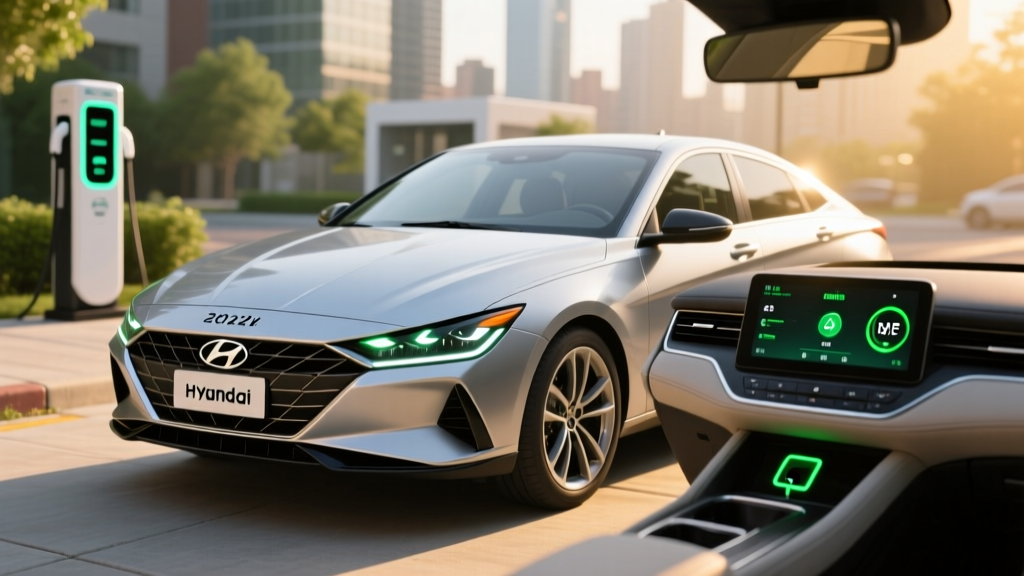
The 2024 Hyundai Elantra Hybrid occupies a specific niche: a compact sedan that squeezes maximum efficiency out of every gallon without requiring a plug, a lifestyle change, or a premium price tag. With an EPA-estimated 54 MPG combined in its top-efficiency Blue trim, it rivals the Toyota Prius while offering a more conventional sedan silhouette and Hyundai's strong warranty backing. But EPA stickers don't tell the whole story. This review breaks down the real-world fuel economy, the 1.6-liter hybrid powertrain, ownership costs, and whether this HEV makes more sense for your commute than a plug-in hybrid or a full battery-electric vehicle.
2024 Hyundai Elantra Hybrid: Core Specifications
| Specification | Blue Trim | Limited Trim |
|---|---|---|
| Powertrain | 1.6L I4 + Electric Motor | 1.6L I4 + Electric Motor |
| Combined Horsepower | 139 hp | 139 hp |
| Combined Torque | 195 lb-ft | 195 lb-ft |
| Transmission | 6-Speed Dual-Clutch Automatic | 6-Speed Dual-Clutch Automatic |
| Battery Type | 1.32 kWh Lithium-Ion Polymer | 1.32 kWh Lithium-Ion Polymer |
| EPA City MPG | 53 | 49 |
| EPA Highway MPG | 56 | 52 |
| EPA Combined MPG | 54 | 50 |
| Fuel Tank Capacity | 11.1 gallons | 11.1 gallons |
| Total Driving Range | ~599 miles | ~555 miles |
| 0-60 mph (est.) | ~8.2 seconds | ~8.2 seconds |
| Base MSRP | $26,250 | $29,150 |
| Drivetrain | Front-Wheel Drive | Front-Wheel Drive |
HEV vs PHEV vs EV: Where the Elantra Hybrid Fits
Before evaluating the Elantra Hybrid's numbers, it's critical to understand what it is — and what it isn't. The 2024 Elantra Hybrid is a conventional hybrid electric vehicle (HEV). It cannot be plugged in. Its small 1.32 kWh battery recharges entirely through regenerative braking and the gasoline engine. You will never see an electric-only range figure for this car because it doesn't have one — the electric motor assists the gas engine and enables brief low-speed electric motoring, but it cannot propel the car on electricity alone for meaningful distances.
Hybrid Type Comparison
| Feature | HEV (Elantra Hybrid) | PHEV (e.g., Prius Prime) | BEV (e.g., Ioniq 6) |
|---|---|---|---|
| Plugs In? | No | Yes | Yes |
| Electric-Only Range | N/A (motor assist only) | ~40-44 miles | 270-360 miles |
| Needs Home Charger? | No | Recommended | Essential |
| Fuel / Energy | Gasoline only | Gasoline + Electricity | Electricity only |
| Best For | No plug access, long commutes | Short daily commute + plug access | Home charging + mostly electric driving |
| Federal Tax Credit | Not eligible | Up to $7,500 (§30D) | Up to $7,500 (§30D) |
This distinction matters because Hyundai does not currently offer a plug-in hybrid (PHEV) version of the Elantra in the U.S. market for 2024. If you want plug-in capability in a Hyundai, you'd look at the Tucson PHEV or Ioniq PHEV (discontinued). If you want the Elantra nameplate with zero tailpipe emissions, the Elantra is not available as a full EV — you'd step to the Ioniq 6 or Kona Electric. The Elantra Hybrid is strictly a self-charging HEV designed for buyers who want maximum MPG with zero behavior change.
Fuel Economy: EPA Ratings vs Real-World MPG
EPA Fuel Economy Breakdown
| Trim | City | Highway | Combined | Annual Fuel Cost* |
|---|---|---|---|---|
| Blue | 53 MPG | 56 MPG | 54 MPG | ~$1,050 |
| Limited | 49 MPG | 52 MPG | 50 MPG | ~$1,150 |
*Based on 15,000 miles/year, $3.50/gallon regular unleaded, per fueleconomy.gov estimates.
The Blue trim's 54 MPG combined is the headline number, but the real-world story is more nuanced — and often better. Conventional hybrids like the Elantra Hybrid tend to exceed their EPA city estimates in stop-and-go driving because regenerative braking recovers energy that a gas car wastes as heat. Owners reporting on fuel-tracking platforms regularly log 55-60 MPG in urban and suburban driving during mild weather.
Highway driving tells a different story. At sustained 70-80 mph speeds, the electric motor contributes less and the 1.6-liter engine does most of the work. Expect highway fuel economy in the 48-52 MPG range for the Blue trim — still excellent, but a noticeable drop from the city figure. The Limited trim's larger 17-inch alloy wheels and additional equipment add weight and rolling resistance, costing roughly 4 MPG across the board.
Cold weather impacts all vehicles, but hybrids lose proportionally more efficiency in winter because the engine must run more frequently to maintain cabin heat and battery temperature. In sub-freezing conditions, expect a 10-15% reduction in fuel economy, bringing the Blue trim down to roughly 46-48 MPG combined until temperatures recover. This is still far better than a comparable gas-only compact sedan, which typically drops to 28-32 MPG combined in winter.
Powertrain Deep Dive: 1.6L Engine Meets Electric Motor
The Elantra Hybrid's powertrain pairs a 1.6-liter Atkinson-cycle four-cylinder engine (producing 104 hp and 109 lb-ft on its own) with a 32 kW electric motor integrated into the transmission housing. Combined system output is 139 horsepower and 195 lb-ft of torque — adequate for daily commuting and highway merging, but not sporty by any measure.
Hyundai uses a 6-speed dual-clutch automatic (DCT) rather than the continuously variable transmission (CVT) found in the Prius and many competing hybrids. This choice gives the Elantra Hybrid more natural-feeling acceleration with distinct gear shifts, avoiding the "rubber-band" drone common to CVT-equipped hybrids. The trade-off is that the DCT can occasionally hesitate during low-speed maneuvers — a characteristic of dual-clutch designs rather than a defect.
The 1.32 kWh lithium-ion polymer battery pack sits behind the rear seats. This is a small battery by any standard — a PHEV would carry 10-18 kWh, and a BEV would carry 50-80 kWh. Its purpose is energy buffering: capturing regenerative braking energy and deploying it to assist acceleration or power brief electric-only motoring at very low speeds (under ~15 mph in light-throttle situations). You won't drive across town on electric power, but the motor's torque fill smooths out the engine's power delivery and reduces fuel consumption meaningfully.
Pricing, Trims, and Tax Credit Eligibility
The 2024 Elantra Hybrid is offered in two trims:
- Blue: $26,250 MSRP (includes $1,150 destination charge)
- Limited: $29,150 MSRP (includes $1,150 destination charge)
The Blue trim is the efficiency champion and comes well-equipped: 8-inch touchscreen with wireless Apple CarPlay/Android Auto, LED headlights, smart cruise control with stop-and-go, lane-keeping assist, forward collision-avoidance assist, and blind-spot collision warning. The Limited trim adds a 10.25-inch digital instrument cluster, 10.25-inch navigation touchscreen, leather seats, heated/ventilated front seats, Highway Driving Assist, and a Bose premium audio system.
Federal Tax Credit Status
The 2024 Hyundai Elantra Hybrid does not qualify for the IRS §30D Clean Vehicle Credit (up to $7,500). This credit applies only to plug-in electric vehicles — both battery-electric vehicles (BEVs) and plug-in hybrids (PHEVs) with a minimum battery capacity of 7 kWh. As a conventional HEV with a 1.32 kWh battery, the Elantra Hybrid falls outside the program's scope.
Some states offer separate incentives for hybrid vehicles, though these are increasingly rare as programs shift focus to zero-emission vehicles. Check your state's energy office or department of environmental quality for current hybrid rebates. Consult a tax professional for personalized guidance on available credits per IRS guidelines.
Battery Warranty, Reliability, and Replacement Costs
Hybrid Battery Warranty Coverage
| Component | Coverage |
|---|---|
| Hybrid Battery | 10 years / 100,000 miles |
| Hybrid System Components | 10 years / 100,000 miles |
| Powertrain (engine, transmission) | 10 years / 100,000 miles |
| New Vehicle Limited Warranty | 5 years / 60,000 miles |
Source: Hyundai USA Warranty Information
Hyundai's 10-year/100,000-mile hybrid battery warranty is among the strongest in the industry and directly addresses the top concern for hybrid buyers: battery longevity. The warranty guarantees the hybrid battery against defects and excessive capacity loss (typically defined as falling below 70% of original capacity) for the full coverage period.
In practice, the Elantra Hybrid's small 1.32 kWh battery experiences far less stress than a BEV or PHEV battery because it operates within a narrow state-of-charge window — the vehicle's battery management system never allows it to fully charge or fully deplete, which dramatically reduces degradation. Real-world data from Hyundai's hybrid fleet (including the Ioniq Hybrid, which used a similar architecture) shows minimal measurable capacity loss even at 150,000+ miles.
If a replacement is ever needed outside warranty, a new OEM hybrid battery for the Elantra Hybrid typically costs between $2,000 and $3,500 installed — substantially less than a PHEV or BEV battery replacement. Third-party reconditioned batteries are available for $1,000-$1,800. For context, most conventional hybrid batteries outlast the vehicle's useful economic life when properly managed by the onboard thermal and charge-management systems.
Overall reliability ratings for the 2024 Elantra Hybrid are strong. The 1.6L Atkinson-cycle engine is a proven, low-stress design. The dual-clutch transmission has been in Hyundai's hybrid lineup since 2017 with iterative improvements. The IIHS named the 2024 Elantra a Top Safety Pick when equipped with specific headlights, reflecting strong crash-test performance.
Driving Impressions and Daily Livability
The Elantra Hybrid prioritizes comfort and efficiency over engagement. Ride quality is composed, with the suspension absorbing most road imperfections effectively. Cabin noise is well-managed at city speeds, though tire noise becomes noticeable on coarse-pavement highways — a common trait in this segment.
The regenerative braking system offers multiple levels selectable via steering-wheel paddles. Level 1 provides mild deceleration akin to engine braking, while Level 3 offers aggressive regen that slows the car significantly when lifting off the accelerator. Unlike a full EV, the Elantra Hybrid does not offer true one-pedal driving to a complete stop — you'll still need the friction brakes for final stopping. The transition between regenerative and friction braking is smooth, avoiding the grabby feel that plagues some hybrid brake systems.
Interior space is competitive for the compact segment: 42.9 inches of front legroom and 38.0 inches of rear legroom. The trunk offers 14.2 cubic feet — slightly less than the gas-only Elantra due to the hybrid battery's placement, but still adequate for weekly groceries or a pair of rolling suitcases. Rear seats fold in a 60/40 split for longer cargo.
Elantra Hybrid vs the Competition
The Elantra Hybrid's direct competitors are few — the compact hybrid sedan segment has thinned as automakers pivot to crossovers and full EVs. Here's how it stacks up:
| Vehicle | Combined MPG | HP | Base MSRP | Hybrid Battery Warranty |
|---|---|---|---|---|
| 2024 Hyundai Elantra Hybrid Blue | 54 | 139 | $26,250 | 10 yr / 100k mi |
| 2024 Toyota Prius LE | 57 | 194 | $28,045 | 10 yr / 150k mi |
| 2024 Toyota Corolla Hybrid LE | 50 | 138 | $23,595 | 10 yr / 150k mi |
| 2024 Honda Accord Hybrid Sport | 44 | 204 | $33,655 | 8 yr / 100k mi |
The Prius edges ahead on fuel economy and power but costs roughly $1,800 more at the base trim and wears a hatchback design that not every buyer prefers. The Corolla Hybrid is the budget pick but offers less power and a less refined interior. The Accord Hybrid is a class above in size and power but sacrifices MPG and costs significantly more. The Elantra Hybrid's value proposition is its combination of strong efficiency, a modern interior, and Hyundai's warranty at a mid-range price.
Pros
- 54 MPG combined (Blue) rivals best in class
- 10-year/100,000-mile hybrid battery and powertrain warranty
- Natural-feeling DCT avoids CVT drone
- Strong standard safety tech (smart cruise, lane-keep, FCA)
- No plug required — zero lifestyle change from gas car
- ~599-mile total range eliminates fuel stops on most road trips
Cons
- 139 hp feels modest during highway passing maneuvers
- No PHEV variant available for electric-only commuting
- Trunk space reduced to 14.2 cu ft vs gas Elantra's 15.1 cu ft
- Limited trim drops to 50 MPG combined for premium features
- Not eligible for federal §30D tax credit
- DCT can hesitate at very low speeds in stop-and-go traffic
Who Should Buy the Elantra Hybrid — And Who Shouldn't
Choose the Elantra Hybrid If:
- You don't have access to home or workplace charging and can't use a PHEV or BEV effectively
- Your commute involves heavy stop-and-go traffic where hybrid efficiency shines
- You want to minimize fuel costs without changing your refueling habits
- You drive 15,000+ miles per year and the MPG savings compound meaningfully
- You value a long warranty and low projected maintenance costs
Look Elsewhere If:
- You have reliable home charging and a short commute — a PHEV like the Prius Prime could run entirely on electricity daily
- You want zero tailpipe emissions — consider a BEV like the Hyundai Ioniq 6 or Tesla Model 3
- You need more than 139 hp for mountain driving or frequent highway merging
- You need hatchback cargo versatility — the Prius offers a more flexible cargo area
- You want federal tax credit eligibility — only plug-in vehicles qualify under current §30D rules
The 2024 Elantra Hybrid is a rational, data-backed choice for buyers who want to cut fuel costs without the infrastructure dependency of a plug-in vehicle. It won't qualify for federal incentives, and it won't deliver the silent, instant-torque experience of a full EV. What it will do is return 50+ MPG in real-world driving, start at under $27,000, and back every critical component with a decade of warranty coverage. For the right buyer — one without plug access who drives a lot of city and suburban miles — that math is hard to beat.
Frequently Asked Questions
How many MPG does the 2024 Hyundai Elantra Hybrid actually get?
The EPA rates the Blue trim at 53 city / 56 highway / 54 combined MPG. In real-world driving, owners frequently report 55-60 MPG in city conditions (where regenerative braking is most effective) and 48-52 MPG on the highway. Cold weather can reduce these figures by 10-15%. The Limited trim, with larger wheels and more equipment, is rated at 49/52/50 MPG.
Does the Elantra Hybrid need to be plugged in?
No. The Elantra Hybrid is a conventional HEV — it charges its own battery through regenerative braking and the gasoline engine. There is no plug, no charging cable, and no electric-only driving range. You refuel it at a gas station exactly like a conventional car.
Is the Elantra Hybrid available as a plug-in hybrid (PHEV)?
Not in the U.S. market for 2024. Hyundai does not offer a PHEV variant of the Elantra domestically. If you want a Hyundai PHEV, the Tucson PHEV is the closest option. For a plug-in compact sedan, look at the Toyota Prius Prime (up to 44 miles electric-only range).
Does the 2024 Elantra Hybrid qualify for any federal tax credit?
No. The IRS §30D Clean Vehicle Credit requires a minimum battery capacity of 7 kWh and plug-in capability. The Elantra Hybrid's 1.32 kWh battery and HEV powertrain make it ineligible. Some states may offer minor hybrid incentives — check your state's energy office for current programs.
How long will the hybrid battery last, and what does replacement cost?
Hyundai covers the hybrid battery for 10 years or 100,000 miles. Real-world data from similar Hyundai hybrid systems shows minimal degradation at high mileage due to the narrow state-of-charge operating window. If replacement is needed outside warranty, expect $2,000-$3,500 for a new OEM battery or $1,000-$1,800 for a reconditioned unit — far less than BEV battery replacement costs.
How does the Elantra Hybrid compare to the Toyota Prius?
The 2024 Prius LE achieves 57 MPG combined (3 MPG more) and produces 194 hp (55 hp more) but starts at $28,045 — roughly $1,800 more than the Elantra Hybrid Blue. The Prius is a hatchback with more cargo versatility; the Elantra is a traditional sedan. Both carry 10-year hybrid battery warranties. The choice comes down to budget, body style preference, and whether the Prius's power advantage matters to you.
Is the Elantra Hybrid reliable?
The Elantra Hybrid uses a proven 1.6L Atkinson-cycle engine and a dual-clutch transmission that Hyundai has refined since 2017. The hybrid system is relatively simple compared to PHEV or BEV powertrains, with fewer high-voltage components that could fail. Hyundai's 10-year/100,000-mile powertrain and hybrid system warranty provides strong long-term protection. The IIHS named the 2024 Elantra a Top Safety Pick with qualifying headlights.