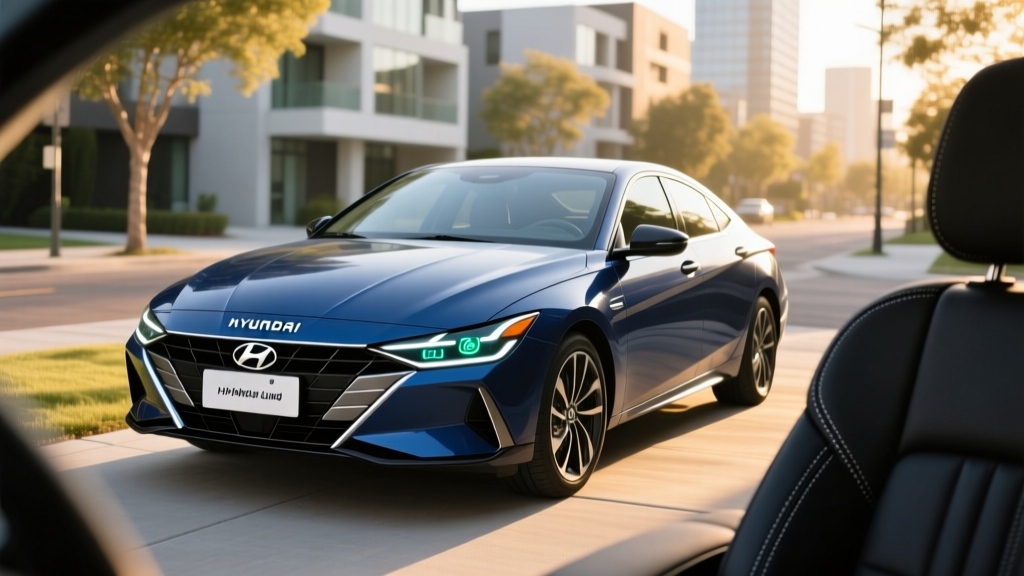
The 2024 Hyundai Elantra Hybrid Limited sits at an interesting crossroads in the electrified-car market. It's a conventional hybrid electric vehicle (HEV) — meaning it never needs to be plugged in — yet it delivers fuel economy numbers that rival some plug-in hybrids running on gasoline alone. For buyers who want maximum efficiency without the complexity of home charging infrastructure or range-planning, this top-trim Elantra Hybrid makes a compelling case.
Below, we break down every number that matters: EPA and real-world MPG, the powertrain specs, what the Limited trim actually gets you, battery longevity, warranty coverage, and whether any federal tax credits apply. If you've been cross-shopping this against the Toyota Corolla Hybrid, Honda Civic Hybrid, or considering stepping up to a full EV, this guide gives you the data to decide.
HEV vs. PHEV: Where the Elantra Hybrid Fits
Before examining the spec sheet, it's worth clarifying exactly what the 2024 Elantra Hybrid is — and what it isn't. Hyundai previously offered a plug-in hybrid (PHEV) version of the Elantra, but the 2024 Elantra Hybrid is a conventional HEV only. There is no plug, no electric-only driving mode, and no external charging port.
Quick Reference: HEV vs. PHEV
| Feature | HEV (Elantra Hybrid) | PHEV (e.g., Prius Prime) |
|---|---|---|
| Plugs in? | No | Yes (120V/240V) |
| Electric-only range | None (motor assists engine) | 25–44 mi typical |
| Battery size | ~1.3 kWh (small buffer) | 8–14 kWh usable |
| Federal tax credit (§30D) | Not eligible | Up to $7,500 (if eligible) |
| Fueling | Gasoline only | Gasoline + electricity |
The Elantra Hybrid recovers energy through regenerative braking and uses its small battery to assist the gas engine and enable brief low-speed electric creep — but it cannot drive on electricity alone for meaningful distances.
Fuel Economy: EPA Ratings and Real-World MPG
This is the Elantra Hybrid's headline act. The EPA rates the 2024 Hyundai Elantra Hybrid (Blue trim) at an outstanding 54 MPG combined (58 city / 50 highway). The Limited trim, which adds weight from larger 17-inch wheels, leather seats, and more equipment, is rated slightly lower at 50 MPG combined (53 city / 46 highway).
| Trim | City | Highway | Combined |
|---|---|---|---|
| Blue | 58 MPG | 50 MPG | 54 MPG |
| Limited | 53 MPG | 46 MPG | 50 MPG |
Real-World MPG: What Owners Actually See
Hybrids tend to outperform their EPA ratings in stop-and-go city driving, where regenerative braking is most effective and the engine shuts off frequently. On the highway, where the gas engine does most of the work, real-world numbers often land slightly below the EPA estimate.
For the 2024 Elantra Hybrid Limited, expect:
- City / suburban driving: 50–56 MPG — the hybrid system excels here, with frequent regen and engine-off coasting
- Highway (70–75 mph): 42–47 MPG — aerodynamic drag and sustained engine load reduce efficiency
- Cold weather (below 30°F): 40–46 MPG combined — the engine runs more often to generate cabin heat, and battery efficiency drops
- Overall mixed driving: 47–52 MPG for most owners
With an 11.4-gallon fuel tank, real-world total range typically falls between 520 and 590 miles per fill-up depending on driving conditions. That's a genuine road-trip advantage over most EVs, which require 20–40 minute charging stops on long routes.
Powertrain and Performance Specs
The 2024 Elantra Hybrid uses Hyundai's proven parallel-hybrid architecture: a 1.6-liter four-cylinder gasoline engine paired with a permanent-magnet synchronous electric motor, all routed through a 6-speed dual-clutch automatic transmission (DCT). Unlike the Toyota Corolla Hybrid's CVT, the Elantra's DCT gives it a more natural, stepped-shift feel that enthusiasts tend to prefer.
| Specification | Value |
|---|---|
| Gas engine | 1.6L GDI 4-cylinder (104 HP / 109 lb-ft) |
| Electric motor | 32 kW permanent-magnet synchronous (43 HP / 125 lb-ft) |
| Combined system output | 139 HP / 195 lb-ft torque |
| Transmission | 6-speed dual-clutch automatic (DCT) |
| Drivetrain | Front-wheel drive (FWD) |
| 0–60 mph | ~8.5 seconds (estimated) |
| Hybrid battery | ~1.3 kWh lithium-ion polymer |
| Curb weight | ~3,017 lbs |
| Fuel tank | 11.4 gallons |
| Towing capacity | Not rated for towing |
The 139 combined horsepower won't win any drag races, but the 195 lb-ft of torque — available low in the rev range thanks to the electric motor — makes the Elantra Hybrid feel responsive in city traffic and confident during highway merges. The DCT is a standout: it avoids the rubber-band sensation of a CVT while still delivering smooth, efficient shifts.
What the Limited Trim Adds
The 2024 Elantra Hybrid is offered in two trims: Blue and Limited. The Limited is the fully loaded variant, and it carries a meaningful equipment upgrade over the Blue:
- 17-inch alloy wheels (vs. 16-inch on Blue)
- Leather-trimmed seats with heated front seats and ventilated driver seat
- Hyundai Digital Key (NFC-based smartphone-as-key)
- Bose premium audio (8 speakers)
- Wireless phone charging pad
- Highway Drive Assist (Level 2 ADAS with lane-centering and adaptive cruise)
- LED headlights and taillights with dynamic turn signals
- 10.25-inch dual screens (instrument cluster + infotainment) with navigation
- Smart parking assist (remote smart park assist on some builds)
The tradeoff for all that equipment is roughly 100 lbs of additional weight and a 4 MPG combined penalty versus the Blue trim. For most buyers, the comfort and tech upgrades justify the slight efficiency drop.
Pricing, Tax Credits, and Total Cost
The 2024 Hyundai Elantra Hybrid Limited carried an MSRP of approximately $29,550 (including destination charge). Dealer pricing in the current market varies; expect to pay between $27,000 and $31,000 depending on regional incentives and negotiation.
Federal Tax Credit Eligibility
⚠️ No §30D Federal Tax Credit for Conventional Hybrids
The IRS §30D Clean Vehicle Credit applies only to battery electric vehicles (BEVs) and plug-in hybrids (PHEVs) that meet battery-sourcing, critical-mineral, MSRP, and buyer-income requirements. The 2024 Elantra Hybrid is a conventional HEV with no plug, so it does not qualify for the up-to-$7,500 federal tax credit.
Some states and utilities offer rebates or incentives for hybrids, but these vary widely by jurisdiction. Check your state energy office or utility provider for local programs.
Estimated 5-Year Cost of Ownership
Despite missing the federal credit, the Elantra Hybrid's fuel savings are substantial compared to a gas-only compact sedan. At 50 MPG combined and $3.40/gallon (national average), annual fuel cost for 12,000 miles is roughly $816. A comparable gas-only compact at 33 MPG combined would cost about $1,236/year — a savings of approximately $420 per year, or $2,100 over five years.
Hyundai's maintenance costs are moderate, and the hybrid system adds no routine maintenance items beyond the standard gas-engine schedule. There are no spark plug changes more frequent, no transmission fluid to worry about at short intervals, and regenerative braking extends brake pad life significantly — many hybrid owners report original brake pads lasting 80,000+ miles.
Battery Warranty, Reliability, and Replacement Cost
Hybrid battery longevity is consistently the top concern for first-time hybrid buyers. Here's what you need to know about the 2024 Elantra Hybrid's battery and warranty coverage.
Hyundai Hybrid Battery Warranty
- Hybrid battery: 10 years / 100,000 miles (whichever comes first)
- Hybrid system components (motor, inverter, etc.): 10 years / 100,000 miles
- Powertrain warranty: 10 years / 100,000 miles
- New vehicle limited warranty: 5 years / 60,000 miles
- Capacity retention threshold: Hyundai covers the hybrid battery if it fails to hold sufficient charge to operate the hybrid system normally
Source: Hyundai USA Warranty
How Long Do Hybrid Batteries Actually Last?
Modern lithium-ion hybrid batteries are engineered for the life of the vehicle. The ~1.3 kWh battery in the Elantra Hybrid is small and operates within a narrow state-of-charge window (roughly 40–80%), which dramatically reduces stress and degradation. Real-world data from Hyundai's hybrid fleet — including the Ioniq Hybrid and earlier Elantra Hybrids — shows most hybrid batteries lasting well beyond 150,000 miles without significant capacity loss.
If replacement is ever needed outside warranty, a new OEM hybrid battery for the Elantra Hybrid typically costs between $2,000 and $3,500 including labor. Refurbished units are available for $1,000–$1,800. However, given the 10-year/100,000-mile warranty and typical battery longevity, most original owners will never face this expense.
Overall Reliability
The Elantra Hybrid's powertrain is one of Hyundai's most proven setups. The 1.6L GDI engine has been in production since 2017 with minimal issues, and the 6-speed DCT has been refined through multiple generations. The IIHS rated the 2024 Elantra as a Top Safety Pick, and the hybrid variant shares the same structural safety ratings. J.D. Power and Consumer Reports have given recent Elantra Hybrid model years average to above-average reliability scores.
✓ Pros
- 50 MPG combined (Limited) — among the best in class
- No plug-in required; fuel anywhere
- 10-year/100,000-mile hybrid battery warranty
- DCT transmission feels more engaging than CVT rivals
- Limited trim is exceptionally well-equipped for ~$30K
- Strong real-world city MPG (often exceeds EPA)
- 520+ mile total range per tank
✗ Cons
- No federal §30D tax credit (HEV, not PHEV)
- FWD only — no AWD option (Corolla Hybrid offers AWD)
- ~8.5 sec 0–60 is adequate, not quick
- Road noise is noticeable at highway speeds
- Limited trim's 17-inch wheels cost 4 MPG vs. Blue trim
- Rear-seat headroom is tight for tall passengers
- No spare tire (tire repair kit only)
Who Should Choose the Elantra Hybrid vs. a PHEV or Full EV?
The decision between a conventional hybrid, a plug-in hybrid, and a battery electric vehicle comes down to your daily driving pattern, charging access, and budget.
Decision Framework: HEV, PHEV, or BEV?
Choose the Elantra Hybrid (HEV) if:
- You don't have access to home or workplace charging
- You want maximum simplicity — no plugs, no apps, no charging planning
- Your budget is under $30,000 and you want the lowest cost-per-mile from gas
- You regularly take long road trips and don't want to plan charging stops
- You live in an apartment or street-park and can't install a charger
Choose a PHEV (e.g., Toyota Prius Prime) if:
- You can charge at home (even a standard 120V outlet works overnight)
- Your daily commute is under 40 miles round-trip (you'd drive mostly on electricity)
- You want EV-like daily driving with gas-engine backup for road trips
- You want to qualify for the up-to-$7,500 federal tax credit
Choose a full EV (e.g., Chevy Bolt, Hyundai Ioniq 5) if:
- You have reliable home Level 2 charging
- You want zero tailpipe emissions and the lowest per-mile fuel cost
- Your daily driving is under 200 miles and you can plan road-trip charging
- You want the lowest long-term maintenance costs (no oil changes, fewer moving parts)
For the specific buyer who commutes 15–40 miles daily, can't charge at home, and wants a car that simply works — the Elantra Hybrid Limited is one of the strongest options on the market. You get premium features, excellent fuel economy, and Hyundai's industry-leading warranty without changing any habits.
Frequently Asked Questions
How many MPG does the 2024 Hyundai Elantra Hybrid Limited get?
The EPA rates the Limited trim at 53 city / 46 highway / 50 combined MPG. In real-world mixed driving, most owners report 47–52 MPG overall, with city driving often reaching 53–56 MPG thanks to regenerative braking. Highway-only driving at 70+ mph typically yields 42–47 MPG.
Does the Elantra Hybrid need to be plugged in?
No. The 2024 Elantra Hybrid is a conventional HEV. It charges its small battery entirely through regenerative braking and the gasoline engine. There is no charging port. You simply fill it with gasoline like any other car.
Does the 2024 Elantra Hybrid qualify for any tax credit?
It does not qualify for the federal §30D Clean Vehicle Credit, which is limited to plug-in vehicles (BEVs and PHEVs) meeting specific battery-sourcing, MSRP, and income requirements. Some states or local utilities may offer hybrid-specific rebates, but these vary by location. Check your state's energy office for current programs.
Is the hybrid battery reliable, and what does replacement cost?
Hyundai's hybrid batteries have a strong track record, with most lasting 150,000+ miles without significant degradation. The battery is covered by a 10-year/100,000-mile warranty. Out-of-warranty replacement costs $2,000–$3,500 for a new OEM unit, or $1,000–$1,800 for a refurbished battery. Most original owners will never need a replacement.
How does the Elantra Hybrid compare to the Toyota Corolla Hybrid?
The Corolla Hybrid (53 MPG combined, AWD available) edges out the Elantra Hybrid Limited on fuel economy by 3 MPG combined and offers all-wheel drive, which the Elantra does not. However, the Elantra Hybrid Limited offers more premium features (Bose audio, ventilated seats, Digital Key) and a more engaging 6-speed DCT versus the Corolla's CVT. Both carry excellent hybrid battery warranties. If AWD is essential, go Corolla. If premium features and driving feel matter more, the Elantra Limited wins.
Can the Elantra Hybrid run on electric power alone?
Only for very brief, low-speed moments (under ~15 mph, such as creeping in a parking lot). The electric motor's primary role is to assist the gasoline engine during acceleration and to recover energy during braking. It cannot sustain highway speeds or meaningful distances on electricity alone — that's what distinguishes it from a PHEV or BEV.
What is the maintenance schedule like?
The Elantra Hybrid follows Hyundai's standard maintenance schedule: oil changes every 7,500 miles or 12 months, cabin air filter every 15,000–20,000 miles, and standard inspections. The hybrid system adds no additional routine maintenance. Brake pads typically last 80,000+ miles thanks to regenerative braking doing much of the deceleration work.