When the used-car market cooled and gas prices remained volatile through 2024, hybrid SUVs surged back into the mainstream. Unlike full battery-electric vehicles, conventional hybrids require zero lifestyle changes — no home charger installation, no range planning, no cold-weather anxiety. You simply fill up with gas and let the hybrid system optimize efficiency automatically.
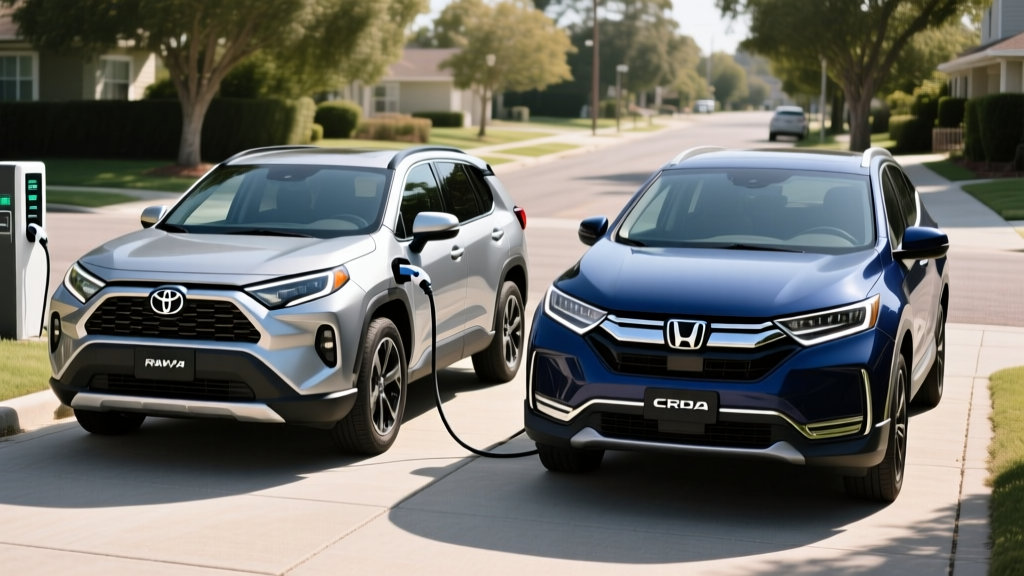
Among the 2024 hybrid SUVs dominating sales charts, two nameplates consistently battle for the top spot: the Toyota RAV4 Hybrid and the Honda CR-V Hybrid. Both pair a 2.5-liter four-cylinder engine with electric motors and all-wheel drive. Both deliver real-world fuel economy that routinely exceeds their EPA estimates in city driving. But their tuning philosophies, pricing structures, and long-term ownership profiles differ in ways that matter for buyers.
HEV vs PHEV: Which Hybrid Type Are We Comparing?
Before diving into specs, it's essential to distinguish conventional hybrids (HEVs) from plug-in hybrids (PHEVs). Both the RAV4 and CR-V discussed here are conventional hybrids — they generate electricity through regenerative braking and the gasoline engine, storing it in a small battery (roughly 1-2 kWh). You never plug them in.
| Feature | Conventional Hybrid (HEV) | Plug-in Hybrid (PHEV) |
|---|---|---|
| Plug-in charging | Not required | Required for EV-only range |
| Electric-only range | Less than 1 mile at low speeds | 25-45 miles typical |
| Battery capacity | 1-2 kWh | 12-20 kWh |
| Federal tax credit | No (eligible for used-EV credit if bought used) | Up to $7,500 under §30D (new) |
| Home charger needed | No | Yes (Level 2 recommended) |
| Best for | Drivers without home charging access | Drivers with home charging and short commutes |
If you're considering the RAV4 Prime (Toyota's PHEV variant) or the CR-V e:PHEV (available in select markets), those are separate vehicles with larger batteries, EV-only driving capability, and different pricing. This guide focuses on the conventional HEV versions that represent the volume of hybrid SUV sales in 2024.
EPA Fuel Economy: RAV4 Hybrid vs CR-V Hybrid
Fuel economy is the primary reason buyers choose a hybrid SUV. Here's how the 2024 models stack up according to EPA estimates from fueleconomy.gov:
| Metric | 2024 Toyota RAV4 Hybrid AWD | 2024 Honda CR-V Hybrid AWD |
|---|---|---|
| City MPG | 41 | 40 |
| Highway MPG | 38 | 34 |
| Combined MPG | 39 | 37 |
| Annual fuel cost (15k mi) | ~$1,650 | ~$1,750 |
The RAV4 Hybrid holds a slight 2-MPG combined advantage, driven primarily by its superior highway efficiency. Toyota's Hybrid Synergy Drive system prioritizes electric-motor assist at cruising speeds more aggressively than Honda's two-motor e:HEV system, which tends to engage the gasoline engine more readily above 65 mph.
Real-World MPG: What Owners Actually Report
EPA stickers tell part of the story. Real-world driving — particularly city routes with frequent stops — often yields higher MPG than the EPA estimate for both vehicles. Hybrids thrive in stop-and-go traffic because regenerative braking recaptures energy that a conventional car wastes as heat.
Based on aggregated owner data from Fuelly and independent testing:
- RAV4 Hybrid real-world average: 37-42 MPG combined (city drivers often report 43-46 MPG; highway-heavy commutes drop to 34-36 MPG)
- CR-V Hybrid real-world average: 34-39 MPG combined (city drivers report 40-43 MPG; sustained highway driving at 75+ mph yields 31-33 MPG)
In cold weather (below 30°F), expect a 5-10% reduction in fuel economy for both vehicles as the engine runs more frequently to provide cabin heat and maintain battery temperature. This penalty is far less severe than the 20-40% range loss a full EV experiences in winter.
Powertrain and Performance Specs
| Specification | 2024 RAV4 Hybrid AWD | 2024 CR-V Hybrid AWD |
|---|---|---|
| Engine | 2.5L inline-4 + 3 electric motors | 2.0L inline-4 + 2 electric motors |
| Combined horsepower | 219 hp | 204 hp |
| 0-60 mph | 7.4 seconds | 7.6 seconds |
| Drivetrain | Electronic AWD (rear electric motor) | Electronic AWD (rear electric motor) |
| Transmission | eCVT (planetary gearset) | eCVT (two-motor system) |
| Towing capacity | 1,750 lbs | 1,000 lbs |
| Battery type | Nickel-metal hydride (NiMH) | Lithium-ion |
The RAV4 Hybrid's 2.5-liter engine and additional rear-axle motor give it a 15-hp advantage and a meaningful 750-pound towing edge. If you're pulling a small trailer or bike rack, the RAV4 is the more capable choice.
Honda's 2.0-liter Atkinson-cycle engine paired with its two-motor hybrid system delivers smoother, more linear acceleration in city driving. The CR-V's electric motors handle most low-speed propulsion, with the gasoline engine acting primarily as a generator until highway speeds. The result is a more EV-like feel around town, though the engine drone under hard acceleration is more noticeable than in the Toyota.
Pricing and Trim Breakdown
Both vehicles are positioned as mainstream compact SUVs, but Toyota offers more hybrid trim variety:
2024 Toyota RAV4 Hybrid Pricing
- LE (base): $32,325
- XLE: $33,825
- XLE Premium: $35,725
- Woodland Edition: $36,325
- XSE: $37,525
- SE: $36,425
- Limited: $40,225
2024 Honda CR-V Hybrid Pricing
- Sport (base hybrid): $35,395
- Sport-L: $37,395
- Sport Touring: $40,895
Toyota undercuts Honda at the entry point by roughly $3,000, making the RAV4 Hybrid LE one of the most affordable AWD hybrid SUVs in the segment. However, Honda bundles more standard features at its base Sport trim (wireless Apple CarPlay/Android Auto, heated front seats, and a 9-inch touchscreen), while Toyota requires stepping up to XLE or higher for those amenities.
Tax Credit Eligibility
Neither the RAV4 Hybrid nor the CR-V Hybrid qualifies for the new-vehicle §30D federal tax credit — that credit applies only to plug-in electric vehicles (BEVs and PHEVs) with battery capacity of at least 7 kWh, per current IRS rules.
However, if you purchase either vehicle used from a dealer, you may qualify for the Used Clean Vehicle Credit (up to $4,000 or 30% of the sale price, whichever is lower) under IRC §25E, subject to income caps ($75,000 single / $150,000 joint) and a sale price cap of $25,000. This credit applies to conventional hybrids as well as BEVs and PHEVs. Always verify eligibility with a tax professional before relying on credit availability.
Reliability and Battery Warranty
Hybrid battery longevity remains a top concern for first-time hybrid buyers. The good news: modern hybrid batteries are engineered to last the life of the vehicle, and failure rates are exceptionally low.
| Warranty Coverage | 2024 RAV4 Hybrid | 2024 CR-V Hybrid |
|---|---|---|
| Hybrid battery | 10 years / 150,000 miles | 8 years / 100,000 miles (10yr/150k in CARB states) |
| Hybrid system components | 8 years / 100,000 miles | 8 years / 100,000 miles |
| Powertrain | 5 years / 60,000 miles | 5 years / 60,000 miles |
| Battery replacement cost (out of warranty) | $3,000-$4,500 | $2,500-$4,000 |
Toyota's 10-year/150,000-mile hybrid battery warranty (extended from the previous 8-year/100,000-mile standard for 2020 and later models) provides exceptional peace of mind. Honda matches this coverage in CARB-emission states (California, New York, Massachusetts, and others) but defaults to 8 years/100,000 miles in non-CARB states.
Regarding real-world reliability: Toyota's hybrid system has two decades of proven durability since the original Prius. Independent shops report hybrid battery failures in RAV4 Hybrids are rare before 180,000 miles. Honda's lithium-ion hybrid battery is newer to the market (introduced in the 2023 CR-V redesign) but benefits from lessons learned in the Accord Hybrid and Insight.
Driving Experience and Interior Quality
The RAV4 Hybrid prioritizes utility and efficiency. The cabin uses durable, hard-wearing plastics that won't win design awards but resist wear. Cargo volume stands at 37.6 cubic feet behind the rear seats — competitive for the class. The 10.5-inch touchscreen (standard on XLE and above) runs Toyota's latest infotainment system with responsive performance, though the base LE's 8-inch screen feels dated.
The CR-V Hybrid's interior is a clear step up in perceived quality. Soft-touch materials cover the dashboard and door panels, the seats are more supportive on long drives, and the cabin is noticeably quieter at highway speeds. Cargo space measures 36.3 cubic feet — slightly less than the Toyota, but the load floor is lower and wider for easier loading.
Both vehicles include comprehensive driver-assistance suites as standard equipment: Toyota Safety Sense 2.5+ (adaptive cruise, lane-keeping, automatic emergency braking) and Honda Sensing (similar feature set). Neither system offers hands-free highway driving — that remains exclusive to higher-tier systems like GM's Super Cruise or Ford's BlueCruise.
Who Should Choose Which Hybrid SUV?
Choose the RAV4 Hybrid if:
- You want the lowest entry price ($32,325 LE)
- Highway fuel economy is a priority (38 MPG vs 34)
- You need higher towing capacity (1,750 lbs)
- You prefer Toyota's 10yr/150k battery warranty nationwide
- You want maximum trim variety (7 hybrid trims)
Choose the CR-V Hybrid if:
- Interior quality and quietness matter most
- Your driving is primarily city and suburban
- You prefer Honda's smoother, more EV-like acceleration feel
- You value standard wireless smartphone integration
- You're in a CARB state (matching 10yr/150k battery warranty)
Hybrid vs PHEV vs Full EV: Which Powertrain Fits You?
The decision between a conventional hybrid, plug-in hybrid, and full electric vehicle comes down to your charging access and daily driving pattern:
- Choose a conventional hybrid (HEV) if you lack home charging, frequently drive more than 300 miles between stops, or live in an area with sparse public charging infrastructure. The RAV4 and CR-V Hybrid are ideal here.
- Choose a plug-in hybrid (PHEV) if you have home charging and a commute under 35 miles — you'll drive mostly on electricity with the gas engine as backup for road trips. Consider the RAV4 Prime (42 miles EV range) or Hyundai Tucson PHEV (33 miles).
- Choose a full EV if you have reliable home charging, your daily driving is under 250 miles, and you want to eliminate gasoline costs entirely. The Tesla Model Y, Hyundai Ioniq 5, or Ford Mustang Mach-E are strong alternatives — but require lifestyle adjustment for charging.
Frequently Asked Questions
How many MPG does the RAV4 Hybrid actually get in real driving?
The EPA rates the 2024 RAV4 Hybrid AWD at 41 city / 38 highway / 39 combined. In real-world city driving with frequent stops, many owners report 43-46 MPG thanks to regenerative braking. Highway-heavy commutes at 75+ mph typically yield 34-36 MPG. Cold weather reduces fuel economy by 5-10%.
Does either hybrid SUV qualify for a federal tax credit?
No. The §30D new-vehicle tax credit (up to $7,500) applies only to plug-in vehicles with at least 7 kWh of battery capacity. Conventional hybrids like the RAV4 Hybrid and CR-V Hybrid do not qualify. However, purchasing a used hybrid for under $25,000 may make you eligible for the Used Clean Vehicle Credit (up to $4,000) under IRC §25E, subject to income limits.
How long will the hybrid battery last, and what does replacement cost?
Both Toyota and Honda design hybrid batteries to last the vehicle's lifetime. Toyota covers the RAV4 Hybrid battery for 10 years/150,000 miles; Honda covers the CR-V Hybrid for 8 years/100,000 miles (10yr/150k in CARB states). Out-of-warranty replacement costs range from $2,500-$4,500 depending on the model and labor rates. In practice, failures before 180,000 miles are uncommon.
Is the Honda CR-V Hybrid better in the city than the Toyota RAV4 Hybrid?
They're very close. The EPA rates the RAV4 at 41 city and the CR-V at 40 city — a negligible difference. In real-world driving, both vehicles regularly exceed 40 MPG in urban stop-and-go conditions. The CR-V's two-motor system provides slightly smoother electric-only acceleration at low speeds, giving it a more refined feel, but the actual fuel savings are minimal.
Do I need to plug in a hybrid SUV?
No. Conventional hybrids (HEVs) like the RAV4 Hybrid and CR-V Hybrid generate their own electricity through regenerative braking and the gasoline engine. You never plug them in — you simply refuel with gasoline as you would any other vehicle. Only plug-in hybrids (PHEVs) require external charging to access their EV-only driving range.
Which 2024 hybrid SUV is more reliable long-term?
Both vehicles have strong reliability records, but Toyota's hybrid system has a longer track record (over 25 years since the original Prius). Independent mechanics and consumer surveys consistently rank Toyota hybrids among the most reliable vehicles in any class. Honda's hybrid system is newer to the CR-V (introduced for the 2023 redesign) but benefits from proven components in the Accord Hybrid. Either choice carries low long-term risk.