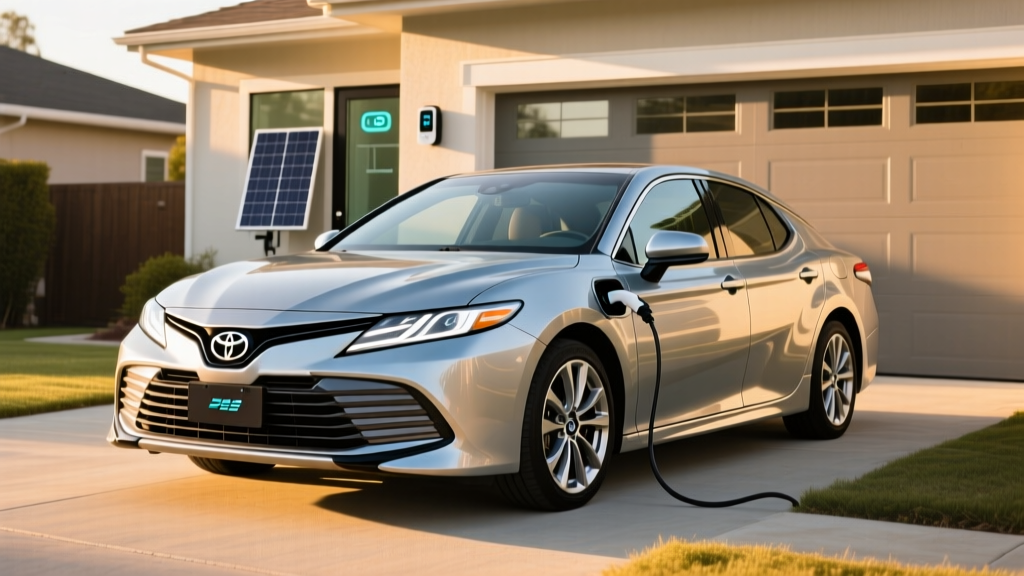
The Toyota Camry has been America's best-selling sedan for years, and its hybrid variant is the version that makes the most sense for the majority of buyers. The 2024 Hybrid Camry pairs a 2.5-liter four-cylinder engine with Toyota's proven hybrid synergy drive system to deliver exceptional fuel economy without requiring any change in driving habits — no plugs, no range anxiety, no charging infrastructure needed.
With the 2025 Camry going hybrid-only across all trims, the 2024 model year represents the last chance to choose between gas-only and hybrid Camry configurations. Here's everything you need to know about the 2024 Hybrid Camry's efficiency, powertrain, ownership costs, and how it stacks up against plug-in hybrids and full EVs.
2024 Hybrid Camry Fuel Economy: EPA Ratings vs. Real World
The headline number for the 2024 Hybrid Camry is its EPA-estimated fuel economy, which varies slightly by trim due to wheel size and equipment weight. The LE trim achieves the highest ratings, while the sportier XSE with 19-inch wheels sees a modest drop.
| Trim | City MPG | Highway MPG | Combined MPG |
|---|---|---|---|
| LE | 51 | 53 | 52 |
| SE | 44 | 47 | 46 |
| XLE | 44 | 47 | 46 |
| XSE | 44 | 47 | 46 |
Source: fueleconomy.gov
Toyota's hybrid system excels in city driving, where regenerative braking and electric-motor assist do the heavy lifting. In real-world testing, many owners report exceeding the EPA city estimate by 2–5 MPG in stop-and-go traffic. Highway driving tells a different story: sustained 75+ MPH cruising reduces the hybrid advantage, and you can expect 40–45 MPG in the LE and 38–42 MPG in the XSE on flat interstate runs. In cold weather (below 30°F), expect a 5–10% fuel economy reduction as the engine runs more frequently to maintain cabin heat and battery temperature.
Powertrain and Performance Specs
The 2024 Camry Hybrid uses Toyota's fifth-generation Hybrid Synergy Drive, pairing a 2.5-liter Dynamic Force four-cylinder engine (176 hp, 163 lb-ft) with a permanent-magnet electric motor integrated into the transaxle. Combined system output is 208 horsepower on front-wheel-drive trims. The available electronic all-wheel-drive (AWD-e) adds a rear-mounted 40 kW electric motor for a combined 218 horsepower and improved traction without a mechanical driveshaft.
| Specification | Value |
|---|---|
| Engine | 2.5L 4-cylinder Dynamic Force |
| Engine Output | 176 hp / 163 lb-ft |
| Front Motor Output | 88 kW (118 hp) |
| Combined System HP (FWD) | 208 hp |
| Combined System HP (AWD-e) | 218 hp |
| Transmission | eCVT (planetary gearset) |
| Hybrid Battery | 1.6 kWh lithium-ion (sealed NiMH on base LE) |
| 0–60 MPH | ~7.2 seconds (FWD), ~7.0 seconds (AWD-e) |
| Drivetrain | FWD standard, AWD-e available |
The eCVT is not a belt-driven CVT — it uses a planetary gearset that seamlessly blends engine and motor power with no shifting sensation. The result is smooth, linear acceleration that feels more refined than a conventional automatic, though it lacks the stepped gear changes some drivers prefer.
HEV vs. PHEV vs. EV: Which Powertrain Fits You?
The 2024 Camry Hybrid is a conventional hybrid (HEV), meaning it generates all its electricity onboard through regenerative braking and the gasoline engine. It has no plug, no electric-only range to speak of (roughly 0.5–1 mile at very low speeds), and requires zero behavioral change from a gas-car owner. This is both its greatest advantage and its limitation.
| Factor | HEV (Camry Hybrid) | PHEV (e.g., RAV4 Prime) | BEV (e.g., Tesla Model 3) |
|---|---|---|---|
| Plug-in Required? | No | Yes (for EV range) | Yes |
| Electric-Only Range | ~0.5 mi | 25–42 mi | 250–360 mi |
| Home Charging Needed? | No | Recommended | Essential |
| Federal Tax Credit | None | Up to $7,500* | Up to $7,500* |
| Best For | No home charging, long commutes | Short commutes + road trips | Home charging + daily driving |
| Fuel Cost (per mile) | ~$0.08–0.10 | ~$0.04 (EV mode) / $0.10 (gas) | ~$0.03–0.05 |
*§30D credit subject to MSRP caps, buyer income limits, and battery-sourcing requirements per IRS guidelines. Verify eligibility with a tax professional.
Choose the 2024 Camry Hybrid if: You don't have access to home or workplace charging, you drive more than 40 miles daily (exceeding most PHEV electric ranges), or you want maximum simplicity with no plug-in routine. The Camry Hybrid rewards you with 46–52 MPG whether you drive 10 miles or 1,000.
Look at a PHEV instead if: You have reliable Level 2 home charging and a commute under 35 miles — you could run almost entirely on electricity Monday through Friday and still take a gas-powered road trip on weekends without planning charging stops.
Go full EV if: You have home charging, your daily driving is under 250 miles, and you want the lowest per-mile operating cost plus access to the full $7,500 federal tax credit (if eligible).
2024 Camry Hybrid Pricing by Trim
The 2024 Camry Hybrid is offered in four trims. Pricing below reflects MSRP including destination charge. The hybrid premium over the gas-only Camry is roughly $1,500–$2,000 depending on trim — a premium you'll typically recoup within 2–4 years through fuel savings at 15,000 miles/year.
| Trim | FWD MSRP | AWD-e MSRP |
|---|---|---|
| LE | $29,490 | $30,890 |
| SE | $31,090 | $32,490 |
| XLE | $34,090 | $35,490 |
| XSE | $35,490 | $36,890 |
Tax Credit Eligibility
The 2024 Camry Hybrid is a conventional HEV and does not qualify for the federal §30D Clean Vehicle Credit, which is reserved for plug-in hybrids and battery electric vehicles with sufficient battery capacity. Some states and utilities offer rebates for conventional hybrids — check your local programs — but there is no federal incentive for this powertrain.
Battery Warranty, Reliability, and Replacement Costs
Hybrid battery longevity is the single most common concern among first-time hybrid buyers. Toyota addresses this with one of the strongest hybrid battery warranties in the industry.
- Hybrid Battery: 10 years / 150,000 miles (whichever comes first)
- Hybrid System Components: 8 years / 100,000 miles
- Powertrain: 5 years / 60,000 miles
- Basic Bumper-to-Bumper: 3 years / 36,000 miles
In California Air Resources Board (CARB) states, the hybrid battery warranty extends to 10 years / 150,000 miles under emissions warranty provisions, covering 15 states including NY, MA, NJ, CT, and OR in addition to CA.
Real-World Battery Longevity
Toyota's hybrid battery track record is among the best in the industry. The Camry Hybrid's lithium-ion pack (nickel-metal hydride on the base LE) is relatively small at 1.6 kWh and is never fully charged or fully discharged — the hybrid system keeps the battery in a 40–80% state-of-charge window, which dramatically extends cycle life. Taxi fleets running Toyota hybrids routinely exceed 200,000–300,000 miles on original batteries.
If the battery does need replacement outside of warranty, expect to pay $2,500–$4,000 for a new OEM pack installed at a dealership, or $1,500–$2,500 for a refurbished unit from a reputable independent shop. Given the 10-year/150,000-mile warranty coverage, most original owners will never face this cost.
Overall Reliability
The Camry Hybrid consistently earns top reliability ratings. The eCVT planetary gearset has fewer moving parts than a conventional automatic transmission, and the regenerative braking system reduces wear on the friction brakes — many owners report original brake pads lasting 80,000+ miles. The IIHS named the 2024 Camry a Top Safety Pick+ with acceptable headlights on higher trims.
Pros and Cons of the 2024 Camry Hybrid
- Best-in-class fuel economy: up to 52 MPG combined (LE)
- No plug-in charging required — zero lifestyle change
- 10-year/150,000-mile hybrid battery warranty
- Available AWD-e for snow-belt buyers
- Strong resale value and proven reliability
- Comfortable ride quality with a quiet cabin
- No federal tax credit (HEV, not PHEV)
- Modest 208 hp — adequate but not sporty
- Infotainment feels dated vs. competitors (8-inch screen standard)
- Trunk space slightly reduced by hybrid battery (15.1 cu ft vs. 15.4 in gas models)
- AWD-e only available on LE and SE trims (not XLE/XSE in all markets)
- Real-world highway MPG falls short of EPA estimate at 75+ MPH
Who Should Buy the 2024 Hybrid Camry?
The 2024 Camry Hybrid is the ideal sedan for buyers who want exceptional fuel economy with the simplicity of a gas-car ownership experience. It's particularly well-suited to:
- Apartment dwellers and street parkers who have no access to home or workplace charging and cannot use a PHEV or EV to its potential.
- High-mileage commuters driving 30–80 miles daily — at 52 MPG combined, annual fuel costs run approximately $900–$1,100 (at $3.50/gallon and 15,000 miles/year), saving $600–$900 annually versus a 30-MPG gas sedan.
- Rideshare drivers where fuel cost per mile directly impacts earnings. The LE trim's 52 MPG combined is among the best of any non-plug-in vehicle sold in the US.
- Conservative buyers who want electrified efficiency without battery-degradation concerns — the 1.6 kWh pack is small, simple, and backed by a decade of warranty coverage.
It is not the right choice if you want electric-only commuting, the lowest possible per-mile fuel cost, or access to federal tax credits. For those needs, look at a PHEV like the Toyota RAV4 Prime or a BEV like the Hyundai Ioniq 6.
Frequently Asked Questions
How many MPG does the 2024 Hybrid Camry get in real-world driving?
The LE trim is EPA-rated at 51 city / 53 highway / 52 combined. In real-world driving, expect 48–55 MPG in city and suburban conditions (hybrids often beat EPA in stop-and-go traffic) and 40–45 MPG on sustained highway trips at 70–80 MPH. The SE, XLE, and XSE trims are rated at 44/47/46 MPG, with real-world results typically 42–48 MPG combined.
Does the 2024 Camry Hybrid need to be plugged in?
No. The Camry Hybrid is a conventional hybrid (HEV), not a plug-in hybrid (PHEV). It charges its small battery entirely through regenerative braking and the gasoline engine. You fuel it exactly like a regular gas car — just with significantly fewer trips to the pump.
Does the 2024 Camry Hybrid qualify for a federal tax credit?
No. The federal §30D Clean Vehicle Credit requires a minimum battery capacity of 7 kWh and plug-in capability, which the Camry Hybrid's 1.6 kWh non-plug-in system does not meet. Only PHEVs and BEVs qualify. Check your state and local utility for possible hybrid rebates, which vary by jurisdiction.
How long will the Camry Hybrid battery last and what does replacement cost?
Toyota warranties the hybrid battery for 10 years / 150,000 miles. Real-world data from fleet and owner reports shows these batteries commonly lasting 200,000+ miles. If replacement is needed out of warranty, expect $2,500–$4,000 for a new OEM pack or $1,500–$2,500 for a refurbished unit.
Is the Camry Hybrid better than a PHEV or full EV?
It depends entirely on your charging access and driving pattern. If you cannot charge at home, the Camry Hybrid is superior because a PHEV driven without charging gets worse MPG than a purpose-built HEV. If you can charge at home and commute under 35 miles, a PHEV will cost less per mile on weekdays. If you can charge at home and drive under 250 miles daily, a BEV offers the lowest operating cost and strongest incentives.
What's the difference between the Camry Hybrid FWD and AWD-e?
The AWD-e system adds a 40 kW rear electric motor that engages automatically when the front wheels lose traction — there's no mechanical driveshaft. It adds roughly $1,400 to the MSRP and drops fuel economy by 1–2 MPG combined. It's worth the cost if you regularly drive on snow or ice, but unnecessary for dry-climate buyers.