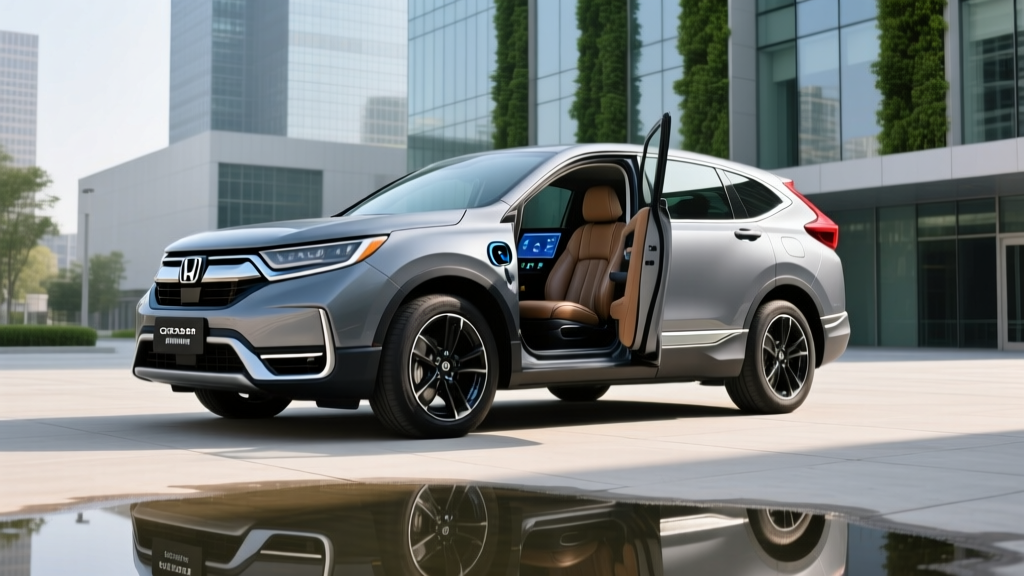
The 2024 CR-V Sport Hybrid sits in the sweet spot of Honda's compact SUV lineup: it pairs a turbocharged four-cylinder with a two-motor hybrid system for a meaningful bump in torque and fuel economy over the gas-only trims, without requiring a plug. For buyers who want hybrid efficiency without changing their fueling habits, the CR-V Sport Hybrid delivers one of the best efficiency-to-utility ratios in the segment.
Below, we break down every number that matters — EPA fuel economy, powertrain output, real-world MPG behavior, battery warranty, pricing, and how this conventional hybrid (HEV) stacks up against plug-in hybrid (PHEV) competitors and full battery-electric vehicles (BEVs).
HEV vs PHEV: What the CR-V Sport Hybrid Actually Is
Before diving into specs, it's critical to understand what the CR-V Sport Hybrid is not: it is not a plug-in hybrid. Honda does not currently sell a PHEV version of the CR-V in the United States.
| Feature | 2024 CR-V Sport Hybrid (HEV) | Typical Compact SUV PHEV (e.g., RAV4 Prime) |
|---|---|---|
| Plug-in charging required? | No — self-charging via regen + engine | Yes — Level 1/Level 2 plug-in |
| Electric-only range | ~1 mile at low speed | 35–42 miles |
| Battery size | ~1.1 kWh (small buffer) | 18.1 kWh usable |
| Federal tax credit (§30D) | Not eligible | Up to $7,500 if sourcing/income rules met |
| Combined MPG (gas mode) | 40 MPG | 38 MPG (charge-sustaining) |
| Starting MSRP | $36,295 | ~$43,695+ |
The takeaway: If you can charge at home and your commute is under 40 miles, a PHEV may save more fuel day-to-day. But if you live in an apartment, lack garage access, or simply want a no-plug experience, the CR-V Sport Hybrid's 40 MPG combined is genuinely excellent for a compact SUV.
Fuel Economy: EPA Ratings and Real-World MPG
The 2024 CR-V Sport Hybrid is rated by the EPA at 40 MPG combined. Here's the full breakdown:
| Driving Cycle | EPA Rating | Real-World Expectation |
|---|---|---|
| City | 43 MPG | 42–46 MPG (hybrids often beat EPA city) |
| Highway | 36 MPG | 33–36 MPG (sustained 75 mph reduces regen benefit) |
| Combined | 40 MPG | 37–42 MPG depending on driving mix |
Why hybrids often exceed EPA city ratings: In stop-and-go traffic, the CR-V Sport Hybrid's two-motor system recaptures kinetic energy through regenerative braking and uses electric-only propulsion at low speeds. The gasoline engine acts primarily as a generator. This means the more you brake, the more efficiently the system operates — the opposite of a conventional gas car.
Highway caveat: At sustained speeds above 70 mph, the hybrid advantage narrows. The engine must provide continuous power, and aerodynamic drag dominates. Expect 33–36 MPG on long interstate drives, especially with roof cargo or in cold weather (the engine runs more often to provide cabin heat).
Powertrain Specs: Horsepower, Torque, and How It Works
| Specification | 2024 CR-V Sport Hybrid |
|---|---|
| Engine | 2.0L Atkinson-cycle 4-cylinder |
| Hybrid system | Two-motor (traction + generator) |
| Combined system output | 204 HP |
| Combined torque | 247 lb-ft |
| Transmission type | e-CVT (no traditional gears) |
| Drivetrain (Sport Hybrid) | FWD standard; AWD available (Sport Hybrid-L) |
| 0–60 mph (est.) | ~7.6 seconds |
| Towing capacity | 1,000 lbs (not recommended for heavy towing) |
Honda's hybrid system is a series-dominant architecture. Under most conditions — particularly city driving — the gasoline engine spins a generator that feeds electricity to the traction motor, which drives the wheels. At highway cruising speeds, a lock-up clutch mechanically links the engine directly to the wheels for better efficiency. This design eliminates the "rubber band" feel of older e-CVTs and delivers smooth, linear torque from a stop.
The 204 HP figure represents a 14 HP increase over the turbocharged 1.5L gas-only CR-V trims (190 HP), and the 247 lb-ft of torque is substantially more accessible — it's available nearly instantly from the electric motor rather than waiting for turbo spool-up.
Pricing, Trims, and Tax Credit Eligibility
The 2024 Honda CR-V Sport Hybrid is available in two trims:
- Sport Hybrid (FWD): $36,295 MSRP (includes $1,395 destination)
- Sport Hybrid-L (AWD): $39,845 MSRP (includes $1,395 destination)
Federal Tax Credit: Not Eligible
The 2024 CR-V Sport Hybrid is a conventional hybrid (HEV), not a plug-in. Under IRS §30D rules, only battery-electric vehicles (BEVs) and plug-in hybrids (PHEVs) with a minimum battery capacity of 7 kWh qualify for the federal clean vehicle credit. The CR-V Sport Hybrid's ~1.1 kWh battery does not meet this threshold. No federal tax credit applies.
Some states offer rebates for conventional hybrids, but these are increasingly rare as incentive programs shift toward plug-in vehicles. Check your state's energy office or DMV website for current programs.
Hybrid Battery Warranty and Longevity
Battery longevity is the number-one concern for hybrid buyers, and Honda backs the CR-V Sport Hybrid's battery system comprehensively:
| Coverage | Term |
|---|---|
| Hybrid battery (IMA system) | 8 years / 100,000 miles (10 yr/150,000 mi in CARB states) |
| Hybrid system components | 8 years / 100,000 miles |
| Powertrain (engine + transmission) | 5 years / 60,000 miles |
| Bumper-to-bumper | 3 years / 36,000 miles |
What this means in practice: Honda's hybrid batteries are small (~1.1 kWh) and operate within a narrow state-of-charge window — typically between 40% and 70%. This shallow cycling dramatically reduces degradation. Real-world data from Honda and Toyota hybrid platforms consistently shows batteries lasting 150,000–200,000+ miles before capacity loss becomes noticeable.
Replacement cost if out of warranty: Based on current Honda parts pricing, a CR-V hybrid battery replacement runs approximately $2,000–$3,500 installed. This is far less than a BEV battery replacement ($8,000–$20,000) because the pack is small and the labor is straightforward. Third-party refurbishment options are also emerging at lower cost.
How It Compares: Hybrid vs PHEV vs Full EV
Choosing between a conventional hybrid, a plug-in hybrid, and a battery-electric vehicle depends on your charging access, driving patterns, and budget. Here's a practical decision framework:
Choose the 2024 CR-V Sport Hybrid (HEV) if:
- You don't have access to home or workplace charging
- You want 40 MPG without any behavior change
- Your budget is under $40,000
- You regularly drive more than 300 miles between fuel stops
Choose a PHEV (e.g., Toyota RAV4 Prime, Mitsubishi Outlander PHEV) if:
- You can install a Level 2 charger at home
- Your daily commute is under 40 miles round-trip
- You want electric-only daily driving with gas backup for road trips
- You may qualify for the $7,500 federal tax credit (check IRS sourcing and income requirements)
Choose a full EV (e.g., Tesla Model Y, Hyundai Ioniq 5) if:
- You have reliable home charging
- You want zero tailpipe emissions and minimal maintenance
- Your typical trips are under 250 miles, or you're comfortable with DC fast charging on road trips
- You want to qualify for the full $7,500 federal credit (eligible models vary by sourcing rules)
Pros and Cons: The Honest Scorecard
Pros
- 40 MPG combined — best-in-class for the segment alongside the RAV4 Hybrid
- 204 HP / 247 lb-ft feels noticeably quicker than the gas CR-V around town
- No plug required — fuel it like any gas car
- 8-year/100,000-mile hybrid battery warranty (10 yr in CARB states)
- Spacious cargo area: 36.3 cu ft behind rear seats, 76.5 cu ft folded
- Honda Sensing ADAS suite standard (Level 2 driver-assist, not self-driving)
Cons
- No PHEV option — can't drive on electric-only for commutes
- Not eligible for any federal tax credit
- AWD only available on the higher Sport Hybrid-L trim (+$3,550)
- 1,000-lb towing capacity limits utility for boat/trailer owners
- Highway MPG drops to ~33–36 at sustained 75+ mph
- Road noise is noticeable above 70 mph — cabin insulation is average for the class
Frequently Asked Questions
How many MPG does the 2024 CR-V Sport Hybrid get?
The EPA rates the 2024 CR-V Sport Hybrid at 43 MPG city, 36 MPG highway, and 40 MPG combined. In real-world mixed driving, most owners report 37–42 MPG. City-heavy routes tend to push the number higher due to regenerative braking; sustained highway driving at 75+ mph will pull it lower.
Does the CR-V Sport Hybrid need to be plugged in?
No. The CR-V Sport Hybrid is a conventional hybrid (HEV). It charges its small battery through regenerative braking and the gasoline engine. You never plug it in — you simply fill it with gasoline like a standard car.
Is there a plug-in hybrid CR-V?
Honda does not sell a plug-in hybrid CR-V in the United States as of the 2024 model year. The CR-V e:PHEV exists in some international markets but is not available domestically. If you need a plug-in compact SUV, competitors include the Toyota RAV4 Prime (42 miles electric-only), Mitsubishi Outlander PHEV (38 miles), and Hyundai Tucson PHEV (33 miles).
Is the CR-V Sport Hybrid reliable, and what does battery replacement cost?
Honda's hybrid system has a strong reliability track record, sharing architecture with the proven Accord Hybrid and Civic Hybrid platforms. The hybrid battery is warranted for 8 years/100,000 miles (10 years/150,000 miles in CARB states including California, New York, and Massachusetts). Out-of-warranty replacement costs approximately $2,000–$3,500 installed. Based on historical Honda hybrid data, most batteries last 150,000–200,000+ miles.
Does the 2024 CR-V Sport Hybrid qualify for any tax credit?
No. The IRS §30D federal clean vehicle credit applies only to battery-electric vehicles and plug-in hybrids with a battery capacity of at least 7 kWh. The CR-V Sport Hybrid's ~1.1 kWh battery does not qualify. Some states or local utilities may offer small rebates for hybrid purchases, but these vary by jurisdiction and are increasingly uncommon.
How does the Sport Hybrid compare to the gas-only CR-V?
The gas-only CR-V (1.5L turbo, 190 HP) is rated at 30 MPG combined (FWD). The Sport Hybrid delivers 204 HP and 40 MPG combined — a 33% improvement in fuel economy with 7% more power. The hybrid also provides smoother, more immediate torque delivery thanks to its electric motor. The trade-off is a higher starting price ($36,295 vs. ~$32,995 for the gas EX) and a slightly lower towing capacity.
Can the CR-V Sport Hybrid drive on electric power alone?
Only in very limited circumstances — typically under 1 mile at low speeds (under 25 mph) in stop-and-go traffic. This is fundamentally different from a PHEV, which can sustain 30–42 miles of electric-only driving at highway speeds. The CR-V Sport Hybrid uses its electric motor to assist the engine and improve efficiency, not to replace it.