Quick Verdict: The CR-V Hybrid Sport Touring in 2026
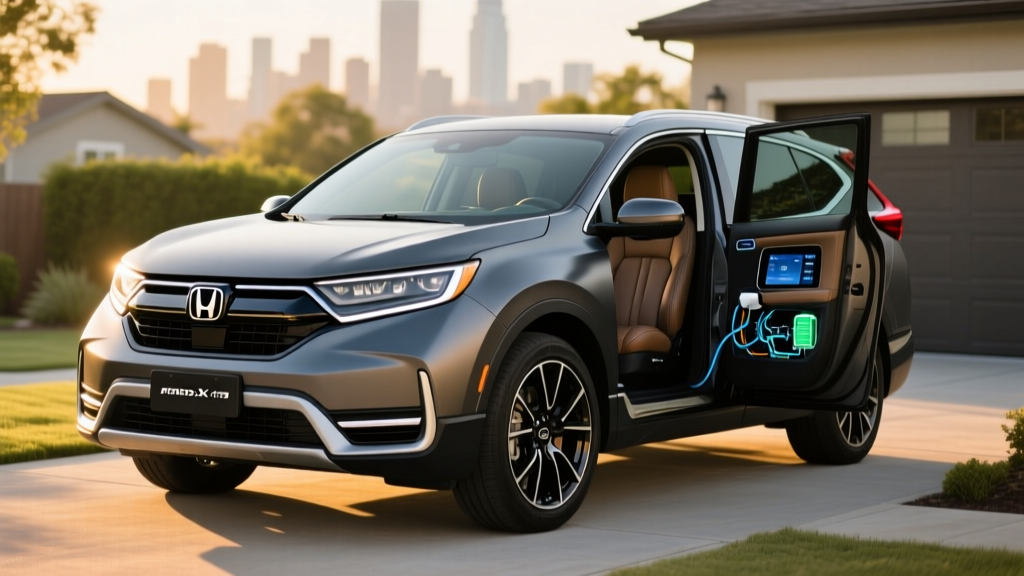
The 2024 Honda CR-V Hybrid Sport Touring remains one of the most compelling compact SUV hybrids on the used and certified-pre-owned market heading into 2026. With an EPA-estimated 40 MPG combined, standard all-wheel drive, and Honda's proven two-motor hybrid system, it bridges the gap between gas-only practicality and full EV commitment. If you can't install a home charger but still want to cut fuel costs by 30-40% versus a gas-only compact SUV, this is a strong pick.
One critical clarification up front: the CR-V Hybrid is a conventional hybrid (HEV), not a plug-in hybrid. You never plug it in. It generates and recovers all its own electricity through the engine and regenerative braking. Honda does not currently offer a PHEV version of the CR-V in the United States.
HEV vs PHEV: What the CR-V Hybrid Actually Is
Conventional Hybrid (HEV) — CR-V Hybrid
- No plug-in charging required
- Small battery (~1.06 kWh) charged by engine + regen
- Electric-only driving limited to low-speed, short-distance EV Mode
- Fuels exactly like a gas car — just less often
- No federal EV tax credit eligibility
Plug-In Hybrid (PHEV) — e.g., Toyota RAV4 Prime
- Plugs into a wall outlet or Level 2 charger
- Larger battery (18.1 kWh in RAV4 Prime) for 42 miles electric-only
- Gas engine kicks in when battery depletes or under heavy load
- May qualify for federal or state incentives
- Higher MSRP; requires charging access for full benefit
For the CR-V Hybrid Sport Touring, think of it as a gas SUV that's been made significantly more efficient through electric assist — not as a stepping stone to an EV.
Fuel Economy: EPA Numbers and Real-World MPG
| Driving Condition | EPA Estimate | Real-World Expectation |
|---|---|---|
| City | 43 MPG | 38–45 MPG (hybrids often beat EPA in stop-and-go) |
| Highway | 36 MPG | 32–37 MPG (electric assist less dominant at speed) |
| Combined | 40 MPG | 36–41 MPG depending on route mix and climate |
The EPA figures for the 2024 CR-V Hybrid Sport Touring AWD are 43 city / 36 highway / 40 combined, per fueleconomy.gov. These apply to the AWD Sport Touring and Sport-L trims. The FWD Sport and Sport-L trims rate slightly higher at 43/36/40 as well for 2024, though real-world differences are marginal.
In practice, Honda's two-motor hybrid system excels in city driving, where the electric motor handles most low-speed propulsion and the 2.0L Atkinson-cycle engine acts primarily as a generator. Owners who do heavy stop-and-go commuting often report exceeding the EPA city figure. Highway cruising, where the engine must directly drive the wheels via a clutch lockup above ~45 mph, returns lower numbers — expect 33-35 MPG at 75 mph on flat interstate, and somewhat less in mountainous terrain or with a full cargo load.
Cold weather impacts are modest compared to a full EV: expect a 3-5 MPG combined drop in sub-freezing temperatures due to cabin heating demands and reduced battery efficiency. This is a fraction of the 20-30% range loss a BEV experiences in the same conditions.
Powertrain and Performance Specs
| Specification | 2024 CR-V Hybrid Sport Touring AWD |
|---|---|
| Engine | 2.0L Atkinson-cycle 4-cylinder |
| Engine Output | 145 hp / 138 lb-ft torque |
| Electric Motors | Dual-motor hybrid system (traction + generator) |
| Traction Motor Output | 181 hp / 247 lb-ft torque |
| Combined System Output | 204 hp / 247 lb-ft torque |
| Drivetrain | Standard AWD (rear motor-driven) |
| 0–60 mph | ~7.7 seconds (est.) |
| Hybrid Battery | ~1.06 kWh lithium-ion |
| Transmission | e-CVT (no traditional gears) |
| Towing Capacity | 1,000 lbs |
| Cargo Volume | 36.3 cu ft (rear seats up) / 76.5 cu ft (folded) |
Honda's fourth-generation two-motor hybrid system is a series-parallel design. Below ~45 mph, the engine typically runs as a generator, sending electricity to the traction motor that drives the front wheels. The rear wheels are driven by a separate electric motor, providing AWD without a mechanical driveshaft — a setup that's responsive, quiet, and mechanically simpler than a traditional AWD system.
Above highway speeds, a lockup clutch engages to let the engine drive the front wheels directly, which is more efficient at sustained high speeds than converting mechanical energy to electrical and back again. This is why the CR-V Hybrid's highway MPG, while good, doesn't match its city dominance.
Battery Warranty, Lifespan, and Replacement Cost
Honda Hybrid Battery Warranty
- Coverage: 8 years / 100,000 miles (10 years / 150,000 miles in CARB states including CA, NY, MA, and others)
- What's covered: Hybrid battery capacity loss below a functional threshold, defects in the IMA/hybrid system
- Transferable: Yes, warranty transfers to subsequent owners — important for CPO and used buyers in 2026
The CR-V Hybrid's ~1.06 kWh battery is small and operates in a narrow state-of-charge window (roughly 40-80% SoC), which dramatically reduces degradation compared to a full EV battery that cycles through 0-100%. Honda's hybrid batteries have a strong longevity track record: failures before 150,000 miles are uncommon in the CR-V, Accord, and Civic Hybrid lineages.
If replacement is needed out of warranty, expect a dealer-installed hybrid battery to cost between $2,000 and $3,500 including labor for the 2024 CR-V Hybrid. Independent hybrid specialists may offer refurbished units for $1,200–$2,000. For context, this is a fraction of the $7,000–$20,000+ that a full EV traction battery replacement can cost, and the smaller battery means lower material and labor complexity.
According to Honda's warranty documentation, the hybrid system warranty covers the battery, the power control unit (PCU), and the electric motors. Routine 12V auxiliary battery replacement is not covered under this warranty and follows standard automotive intervals (~3-5 years).
Pricing, Trims, and Tax Credit Eligibility
| 2024 CR-V Hybrid Trim | MSRP (AWD) | Key Features |
|---|---|---|
| Sport | $35,395 | Black exterior accents, 18" wheels, Honda Sensing suite |
| Sport-L | $37,795 | Leather seats, power liftgate, wireless CarPlay/Android Auto |
| Sport Touring | $40,850 | Bose 12-speaker audio, navigation, heated steering wheel, wireless charging, hands-free liftgate |
The Sport Touring sits at the top of the Hybrid lineup at $40,850 MSRP (plus destination). On the used and CPO market in 2026, expect to find 2024 Sport Touring examples between $33,000 and $38,000 depending on mileage and condition.
Federal tax credit: The 2024 Honda CR-V Hybrid does not qualify for the IRS §30D Clean Vehicle Credit. That credit is reserved for battery-electric vehicles (BEVs) and plug-in hybrids (PHEVs) with a minimum battery capacity of 7 kWh — the CR-V Hybrid's ~1.06 kWh battery falls far short. There is also no federal credit for conventional hybrids. Per IRS guidelines, only plug-in vehicles meeting battery sourcing, MSRP caps, and buyer income limits are eligible.
Some states offer modest hybrid incentives — for example, certain utility companies provide rebates for hybrid purchases, and a handful of states have had hybrid-specific programs. Check your state's energy office or utility provider for current availability, as these change frequently.
Who Should Choose the CR-V Hybrid vs a PHEV or Full EV?
Choose the CR-V Hybrid (HEV) if:
- You can't charge at home (apartment, street parking, no garage outlet access)
- You want simpler ownership — no charging cables, no electrical panel upgrades
- Your daily driving is mixed city/highway with no predictable charging stops
- You want AWD capability for snow or light trails without a fuel-cost penalty
- Your budget is $35K–$41K and you need maximum cargo space
Choose a PHEV (e.g., Toyota RAV4 Prime, Hyundai Tucson PHEV) if:
- You have home Level 2 charging and a commute under 35 miles
- You want electric-only daily driving with gas backup for road trips
- You want to reduce gasoline consumption by 60-80% without range anxiety
- You can absorb the $5K–$8K price premium over a comparable HEV
Choose a Full EV (e.g., Tesla Model Y, Hyundai Ioniq 5) if:
- You have reliable home charging (Level 2 strongly recommended)
- Your daily driving is under 250 miles and you road-trip infrequently
- You want the lowest per-mile fuel cost and minimal maintenance
- You qualify for the §30D tax credit, bringing effective price closer to a hybrid
Pros and Cons
Pros
- 40 MPG combined with no charging infrastructure needed
- Standard AWD with electric rear motor — excellent in snow
- Proven hybrid system with strong reliability history
- Top-tier Sport Touring trim is well-equipped (Bose, nav, heated everything)
- Class-leading cargo volume (36.3 cu ft rear up)
- Minimal cold-weather efficiency penalty vs. full EVs
Cons
- No federal tax credit eligibility
- Highway MPG drops noticeably vs. city (36 vs 43 EPA)
- 1,000-lb towing limit — not for trailers or boat hauling
- CVT drone under hard acceleration; not a sporty driving experience
- Sport Touring at $40,850 approaches luxury-brand pricing
- No EV Mode range of consequence — electric-only is under 1 mile at low speed
Frequently Asked Questions
How many MPG does the 2024 Honda CR-V Hybrid Sport Touring get?
The EPA rates it at 43 city / 36 highway / 40 combined. In real-world mixed driving, expect 36–41 MPG combined, with city-dominant commuters sometimes exceeding 43 MPG in stop-and-go traffic.
Does the CR-V Hybrid need to be plugged in?
No. It is a conventional hybrid (HEV), not a plug-in hybrid (PHEV). The battery charges entirely through the gasoline engine and regenerative braking. You fuel it exactly like any gas car.
How far can the CR-V Hybrid drive on electric only?
Under 1 mile at very low speeds (under 25 mph) in EV Mode. The ~1.06 kWh battery is too small for meaningful electric-only range. The electric motor assists the engine constantly, but the engine is almost always running in some capacity.
Is the CR-V Hybrid reliable and what does battery replacement cost?
Honda's hybrid system is among the most proven in the industry, with decades of refinement. The hybrid battery is warrantied for 8 years/100,000 miles (10 years/150,000 miles in CARB states). Out-of-warranty replacement runs $2,000–$3,500 at a dealer, significantly less than a full EV battery.
Does the 2024 CR-V Hybrid qualify for any tax credit?
No federal tax credit applies — the IRS §30D credit requires plug-in capability and a minimum 7 kWh battery. The CR-V Hybrid has neither. Some state or utility incentives may apply for hybrid purchases; check local programs.
How does the CR-V Hybrid compare to a full EV like the Tesla Model Y?
The Model Y offers ~310 miles of EPA range, lower per-mile energy cost, and eligibility for the §30D credit (if buyer income and sourcing requirements are met), but requires home charging access and carries higher insurance premiums. The CR-V Hybrid costs less upfront, needs no charging infrastructure, and is better suited for buyers without reliable charging access or those who take frequent long road trips.
What's the difference between the Sport, Sport-L, and Sport Touring trims?
All three share the identical 204 hp hybrid AWD powertrain and 40 MPG combined rating. The Sport ($35,395) is well-equipped with Honda Sensing and 18" wheels. The Sport-L ($37,795) adds leather and a power liftgate. The Sport Touring ($40,850) tops the range with Bose audio, built-in navigation, wireless phone charging, a heated steering wheel, and a hands-free power liftgate.