Why the 2024 Accord Hybrid's 2.0L Engine Specs Matter to Buyers
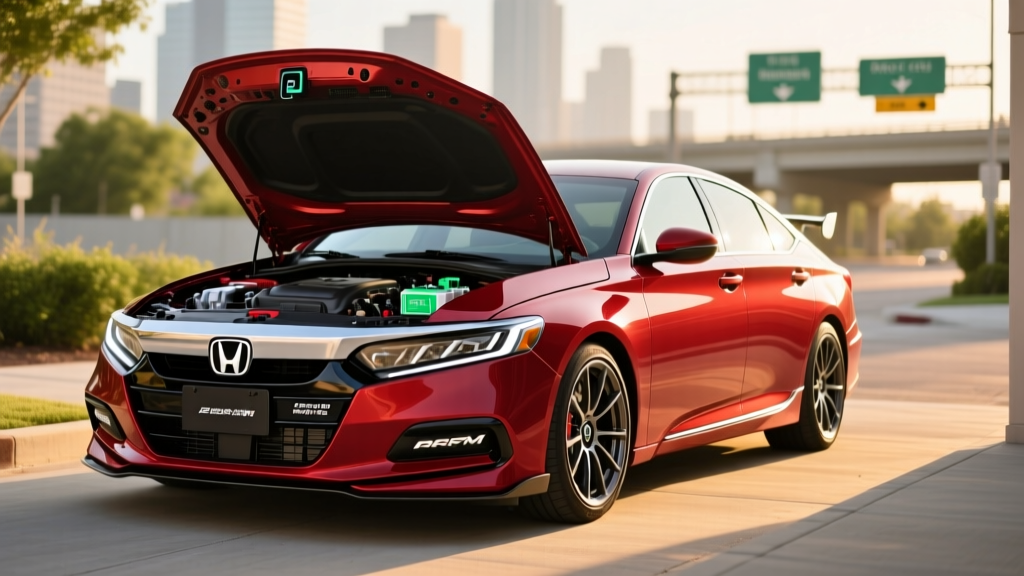
The 2024 Honda Accord Hybrid pairs a naturally aspirated 2.0-liter inline-four with a two-motor e-CVT system to deliver one of the most efficient midsize sedan powertrains on the market. For spec-driven shoppers searching for the 2024 Honda Accord Hybrid 2.0L redline RPM, the answer is 6,500 RPM — a figure that reflects Honda's emphasis on efficiency over high-revving performance in this generation's Atkinson-cycle engine. But redline is just one data point. The real story is how this engine integrates with dual electric motors to produce 204 combined horsepower and an EPA-estimated 48 MPG combined.
This guide covers every powertrain number, real-world MPG expectations, battery warranty details, and how the Accord Hybrid stacks up against plug-in hybrids and full EVs for different driving lifestyles.
Powertrain Breakdown: 2.0L Atkinson-Cycle Engine + Dual Motors
The Accord Hybrid uses Honda's fourth-generation two-motor hybrid system. Here is the full specification sheet:
| Specification | Value |
|---|---|
| Engine | 2.0L DOHC 16-valve inline-4 (Atkinson cycle) |
| Engine Redline | 6,500 RPM |
| Engine Horsepower | 146 HP @ 6,100 RPM |
| Engine Torque | 134 lb-ft @ 4,500 RPM |
| Drive Motor Output | 181 HP / 247 lb-ft |
| Combined System Output | 204 HP |
| Transmission | e-CVT (no traditional gears) |
| Drivetrain | Front-wheel drive |
| 0-60 MPH | ~7.5 seconds (est.) |
| Hybrid Battery | ~1.1 kWh lithium-ion (HEV, non-plug-in) |
Understanding the Atkinson Cycle and Redline
The Atkinson cycle keeps the intake valve open slightly longer during the compression stroke, effectively reducing pumping losses and improving thermal efficiency at the cost of peak power density. This is why the 2.0L produces 146 HP rather than the ~158 HP you might see in a conventional Otto-cycle 2.0L. The 6,500 RPM redline is the maximum safe engine speed, but the e-CVT system rarely lets the engine reach it during normal driving. Under hard acceleration, the engine will climb toward 5,500-6,000 RPM, but cruising typically holds it between 1,500-2,500 RPM where thermal efficiency peaks.
How the e-CVT Actually Works
Honda's e-CVT is not a belt-and-pulley CVT. It uses two electric motors — one primarily as a generator, one as the drive motor — with a clutch that can directly couple the engine to the wheels at steady highway speeds (roughly 45-75 MPH). Below that range, the car operates primarily as a series hybrid: the engine spins the generator, which powers the drive motor. This eliminates the "rubber-band" feel of traditional CVTs and provides linear electric-motor torque from a stop.
EPA Fuel Economy and Real-World MPG
The Accord Hybrid carries identical EPA ratings across all four hybrid trims (Sport, Sport-L, EX-L, and Touring):
| Trim | City MPG | Highway MPG | Combined MPG |
|---|---|---|---|
| Sport / Sport-L (19" wheels) | 46 | 41 | 44 |
| EX-L / Touring (17"/19" wheels) | 51 | 44 | 48 |
Source: EPA Fuel Economy
HEV vs. PHEV vs. Full EV: Which Powertrain Fits You?
The Accord Hybrid is a conventional hybrid (HEV) — it does not plug in. It has no electric-only range to speak of (roughly 1 mile at very low speeds on battery alone). If you want plug-in capability, Honda does not currently offer a PHEV Accord in the US market. Here is how the three electrified powertrain types compare:
HEV (Accord Hybrid)
- No plug-in needed
- 44-48 MPG combined
- No electric-only range
- ~$32,995-$39,395 MSRP
- No federal tax credit
- Best for: drivers without home charging access
PHEV (e.g., Toyota Prius Prime)
- Plug in for ~25-44 mi electric
- 48-52 MPG combined (gas mode)
- Requires Level 1 or 2 charging
- ~$33,000-$40,000 MSRP
- May qualify for partial §30D credit
- Best for: home chargers with short commutes
Full EV (e.g., Tesla Model 3)
- Plug in always required
- 272-363 mi EPA range
- Level 2 home + DC fast charging
- ~$38,990-$52,990 MSRP
- Up to $7,500 §30D credit (if eligible)
- Best for: home chargers, lower running costs
Decision Framework
Choose the Accord Hybrid (HEV) if: You lack reliable home or workplace charging, drive a mix of city and highway miles, want maximum simplicity with no plug-in routine, and prioritize proven long-term reliability with low maintenance costs.
Choose a PHEV if: You have a garage or driveway where you can install a Level 2 (240V) charger, your daily commute is under 30 miles round-trip, and you want to drive mostly on electricity with a gas backup for road trips.
Choose a full EV if: You have home charging, your daily driving is under 250 miles, you want the lowest per-mile fuel cost ($0.04-$0.06/mi on home electricity vs. $0.10-$0.14/mi for the Accord Hybrid at 48 MPG and $3.50/gal), and you can leverage the federal tax credit.
Pricing, Trims, and Tax Credit Eligibility
The 2024 Honda Accord Hybrid is available in four trims. All use the identical 2.0L hybrid powertrain:
| Trim | MSRP (incl. destination) | Key Features |
|---|---|---|
| Sport | $32,995 | 19" wheels, heated front seats, 7" display |
| Sport-L | $34,645 | Leather-trimmed seats, wireless CarPlay/Android Auto |
| EX-L | $36,495 | 12.3" display, power moonroof, 10-speaker audio |
| Touring | $39,395 | Bose 12-speaker audio, heated rear seats, HUD, wireless charging |
Federal Tax Credit Status
The 2024 Accord Hybrid is a conventional HEV, not a plug-in vehicle. Under IRS §30D rules, the federal clean vehicle credit applies only to battery electric vehicles (BEVs) and plug-in hybrids (PHEVs) with a minimum battery capacity of 7 kWh. The Accord Hybrid's ~1.1 kWh battery does not qualify.
- Federal §30D credit: Not eligible (HEV, insufficient battery capacity)
- Used clean vehicle credit (§25E): Not eligible (not a plug-in)
- State incentives: Some states offer small rebates for conventional hybrids, but these vary widely. Check your state's energy office or DMV for current programs.
Battery Warranty, Lifespan, and Replacement Cost
Hybrid battery longevity is the single most common concern among first-time hybrid buyers. Here is what Honda provides:
- Hybrid Battery (IMA battery): 8 years / 100,000 miles (10 years / 150,000 miles in CARB states including CA, CT, ME, MD, MA, NJ, NY, OR, RI, VT, WA)
- Hybrid System Components: 8 years / 100,000 miles (power control unit, electric motors, e-CVT)
- Capacity retention threshold: Honda does not publish a specific degradation percentage trigger, but warranty covers defects and premature failure
Real-World Battery Lifespan
Honda's lithium-ion hybrid battery in the Accord is far smaller (~1.1 kWh) than an EV battery (60-100 kWh) and operates within a narrow state-of-charge window — typically between 40% and 80%. This shallow cycling dramatically reduces degradation stress. Based on historical data from Honda's hybrid lineup (Insight, CR-V Hybrid, previous Accord Hybrid generations), the IMA battery routinely lasts 150,000-200,000+ miles before any capacity-related issues arise.
Battery Replacement Cost
If the hybrid battery does fail outside warranty, replacement costs typically range from $2,000 to $4,000 for a new OEM unit, including labor. Refurbished or aftermarket options can reduce this to $1,200-$2,500. This is significantly less than an EV battery replacement ($8,000-$20,000+) because the hybrid battery is much smaller and simpler.
Reliability, Safety Ratings, and Ownership Costs
The 2024 Accord carries strong safety credentials. The NHTSA awarded it a 5-Star Overall Safety Rating, and the IIHS named it a Top Safety Pick+, the highest designation available. Honda Sensing (standard on all trims) includes adaptive cruise control, lane-keeping assist, forward collision warning, and automatic emergency braking — all SAE Level 0-1 driver-assist features that require full driver engagement.
5-Year Estimated Cost of Ownership
At 15,000 miles/year, $3.50/gallon regular unleaded, and 46 MPG combined (real-world average):
| Category | Estimated Cost |
|---|---|
| Purchase (MSRP) | $36,495 |
| Fuel (75,000 mi total) | $5,707 |
| Insurance (avg.) | $8,400 ($1,680/yr) |
| Maintenance (5 yr) | $2,500 |
| Depreciation (est.) | $14,500 |
| Total 5-Year | ~$67,602 |
For comparison, a gasoline-only midsize sedan averaging 30 MPG combined would spend approximately $8,750 on fuel over the same period — roughly $3,000 more. The Accord Hybrid's fuel savings partially offset its higher initial purchase price versus a non-hybrid Accord (which starts at $28,990 for the 1.5T turbo).
Pros, Cons, and Final Verdict
Pros
- 48 MPG combined (EX-L) — among the best in the midsize segment
- Linear, responsive acceleration from electric motor torque
- No plug-in required — zero behavior change from a gas car
- Top Safety Pick+ with comprehensive Honda Sensing suite
- Spacious cabin with 16.7 cu-ft trunk (hybrid battery under rear seats)
- Proven hybrid system with strong long-term reliability data
- Strong resale value — Accord hybrids hold value well
Cons
- No plug-in option — cannot drive on electric-only for commutes
- No federal tax credit eligibility
- Highway MPG (41-44) less impressive than city (46-51)
- Sport trims with 19" wheels sacrifice 4 MPG vs EX-L
- Engine drone under hard acceleration (inherent to e-CVT design)
- FWD only — no AWD option for snow-belt buyers
- Touring trim approaches $40K, overlapping with PHEV/EV territory
Frequently Asked Questions
What is the 2024 Honda Accord Hybrid 2.0L redline RPM?
The 2.0-liter Atkinson-cycle engine in the Accord Hybrid has a redline of 6,500 RPM. Peak horsepower (146 HP) arrives at 6,100 RPM, and peak torque (134 lb-ft) at 4,500 RPM. During normal driving, the e-CVT system keeps the engine well below redline for optimal efficiency.
How many MPG does the Accord Hybrid actually get?
EPA ratings are 51 city / 44 highway / 48 combined for EX-L and Touring trims (17"/19" wheels), and 46/41/44 for Sport and Sport-L (19" wheels). In real-world driving, owners commonly exceed city estimates by 2-5 MPG while highway fuel economy at 75+ MPH may fall 2-4 MPG below the sticker. A realistic combined expectation is 42-50 MPG.
Does the 2024 Accord Hybrid qualify for any tax credit?
No. The Accord Hybrid is a conventional HEV, not a plug-in vehicle. The federal §30D clean vehicle credit requires a minimum 7 kWh battery and plug-in capability. The Accord's ~1.1 kWh battery does not meet these criteria. Some states may offer minor hybrid incentives — check your state energy office.
How long will the Accord Hybrid battery last?
Honda warrants the hybrid battery for 8 years/100,000 miles (10 years/150,000 miles in CARB states). In practice, Honda's lithium-ion hybrid batteries routinely last 150,000-200,000+ miles. The battery operates in a shallow charge window (roughly 40-80% SoC), which minimizes degradation. Replacement cost if needed out of warranty is approximately $2,000-$4,000.
Can the Accord Hybrid drive on electric power alone?
Only marginally. The Accord Hybrid can travel roughly 1 mile at very low speeds (under 15 MPH) on battery power alone before the engine engages. This is not a plug-in hybrid — it has no meaningful electric-only range. The electric motor primarily assists the engine and provides torque-fill, not standalone propulsion.
Is the Accord Hybrid better than a full EV for my situation?
If you cannot install a home charger, frequently drive more than 300 miles in a day, or live in an area with sparse public charging infrastructure, the Accord Hybrid is the better choice. If you have home charging, a commute under 250 miles, and want the lowest possible per-mile energy cost, a full EV like the Tesla Model 3 or Hyundai Ioniq 6 will save more over 5 years — especially with the $7,500 federal credit (if you meet income and sourcing requirements).