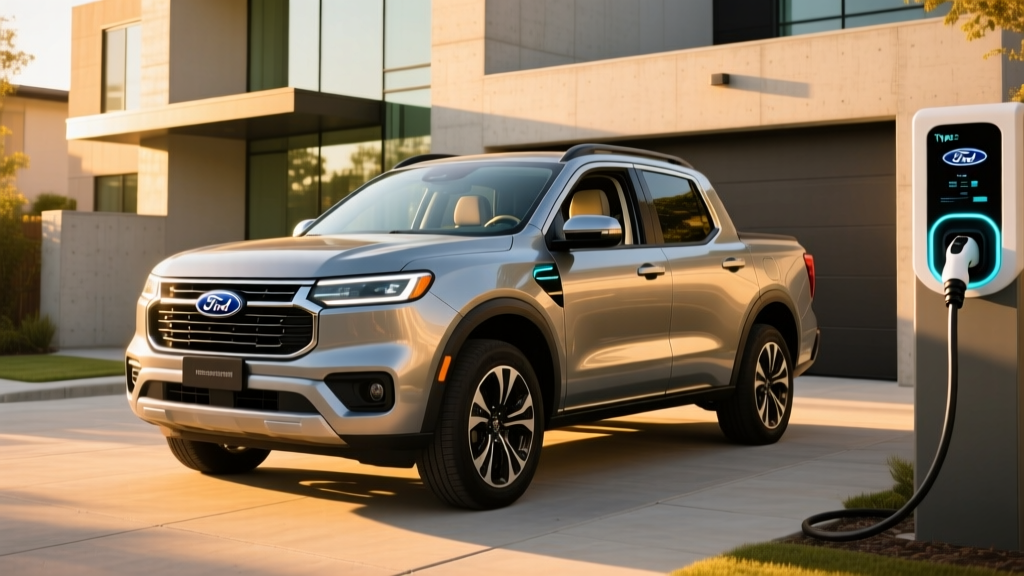
The compact pickup segment exploded in the early 2020s, and the Ford Maverick Hybrid carved out a distinct niche: a sub-$25,000 truck that sips fuel like a midsize sedan. For 2026 buyers evaluating the 2024 Ford Maverick Hybrid on the used and certified-pre-owned market—or comparing it against newer model years—this powertrain remains one of the most efficient pickups ever sold in the United States. But efficiency is only part of the ownership equation. This guide breaks down the real-world MPG, battery longevity, hybrid architecture, pricing, and tax-credit eligibility so you can decide whether this HEV fits your garage.
HEV vs PHEV vs EV: Where the Maverick Hybrid Fits
Conventional Hybrid (HEV): The Maverick Hybrid is a self-charging hybrid. It has no plug, no electric-only driving mode, and no external charging port. A small battery (1.1 kWh) recovers energy through regenerative braking and assists the gas engine during acceleration. You fuel it exclusively at the pump.
Plug-in Hybrid (PHEV): PHEVs carry larger batteries (typically 12–25 kWh) that enable 25–50 miles of electric-only driving before the gas engine engages. They require plugging in at home or at public chargers to realize their efficiency advantage. The Maverick is not a PHEV—Ford does not offer a plug-in variant.
Battery Electric (BEV): Full EVs like the Ford F-150 Lightning run entirely on electricity with 230–320+ miles of EPA range. They require consistent home or public charging access and carry significantly higher upfront costs.
If you lack access to a home charger or apartment-level charging infrastructure, the Maverick Hybrid's HEV architecture is a major advantage: zero behavior change from a conventional gas truck, with 30–40% better city fuel economy.
Powertrain Specs: Engine, Motor, and Combined Output
| Specification | 2024 Ford Maverick Hybrid |
|---|---|
| Engine | 2.5L Atkinson-cycle inline-4 |
| Electric Motor | Permanent-magnet AC synchronous (integrated into eCVT) |
| Combined System Horsepower | 191 hp |
| Engine Horsepower (standalone) | 162 hp @ 5,600 rpm |
| Engine Torque | 155 lb-ft @ 4,000 rpm |
| Transmission | Electronic CVT (eCVT, planetary gearset) |
| Drivetrain | Front-wheel drive (FWD) standard; AWD available (2024+) |
| Hybrid Battery | 1.1 kWh lithium-ion (NMC chemistry) |
| 0–60 mph | ~8.5 seconds (est.) |
| Max Towing Capacity | 2,000 lbs (standard); 4,000 lbs with 4K Tow package (gas only, not hybrid) |
| Payload Capacity | 1,500 lbs |
The 2024 model year was notable because Ford finally introduced all-wheel drive (AWD) for the Maverick Hybrid—previously limited to FWD only. The AWD system adds a rear-mounted electric motor that engages the rear axle when traction is needed, without a mechanical driveshaft connecting the engine to the rear wheels. This is a torque-vectoring eAWD system, similar in concept to the Toyota RAV4 Hybrid AWD setup.
One important limitation: the Maverick Hybrid cannot be equipped with the 4K Tow package. That 4,000-lb towing rating is exclusive to the 2.0L EcoBoost gas engine. If you need to tow a boat or travel trailer beyond 2,000 lbs, the hybrid is not the right powertrain for you.
Fuel Economy: EPA Ratings and Real-World MPG
| Drivetrain | City MPG | Highway MPG | Combined MPG |
|---|---|---|---|
| FWD Hybrid | 42 | 33 | 37 |
| AWD Hybrid | 40 | 33 | 37 |
Source: EPA / fueleconomy.gov
Real-World MPG Expectations: The Maverick Hybrid's 42 MPG city rating is one of the highest in any pickup, and hybrid city driving often exceeds EPA estimates because stop-and-go traffic maximizes regenerative braking. On highway-only trips at 75 mph, expect 29–32 MPG—the Atkinson-cycle engine is less efficient at sustained high loads. In mixed suburban driving, owners consistently report 35–40 MPG. In cold weather (below 30°F), expect a 5–10% efficiency drop as the engine runs more frequently to provide cabin heat.
The city-biased efficiency profile is a hallmark of Toyota-derived hybrid architectures (Ford's 2.5L hybrid system shares engineering lineage with the Toyota Hybrid System). The eCVT keeps the engine in its most efficient RPM band, and the electric motor handles low-speed acceleration where gas engines are least efficient. If your daily commute is stop-and-go suburban or urban driving, the Maverick Hybrid will likely deliver 38–44 MPG in practice.
For context, the non-hybrid 2.0L EcoBoost Maverick AWD achieves 23 city / 30 highway / 26 combined—making the hybrid roughly 42% more efficient in city driving and 30% better combined.
Pricing, Trims, and Tax Credit Eligibility
The 2024 Ford Maverick Hybrid was available across all three trim levels, with the hybrid powertrain offered as a no-cost or low-cost option versus the 2.0L EcoBoost:
- XL Hybrid (FWD): ~$23,945 MSRP (base, before destination)
- XLT Hybrid (FWD/AWD): ~$26,740–$28,240 MSRP
- Lariat Hybrid (FWD/AWD): ~$30,555–$32,055 MSRP
Adding AWD to the hybrid cost approximately $1,500 across trims. The 4K Tow package was not available on hybrid trims.
Federal Tax Credit: Does the Maverick Hybrid Qualify?
No. The Maverick Hybrid is a conventional HEV, not a plug-in vehicle. Under IRS §30D rules, the federal clean vehicle credit applies only to battery electric vehicles (BEVs) and plug-in hybrids (PHEVs) that meet battery-capacity thresholds, critical-mineral sourcing requirements, MSRP caps, and buyer income limits. Conventional hybrids like the Maverick Hybrid do not qualify for the §30D credit or its point-of-sale transfer option.
Some states and local utilities offer rebates or reduced registration fees for hybrid vehicles, but these vary significantly by jurisdiction. Check your state energy office or utility provider for current programs. For federal rules, consult the IRS clean vehicle credit page.
Used Maverick Hybrid Pricing (2026 Market)
As of early 2026, certified pre-owned and well-maintained 2024 Maverick Hybrids typically trade between $22,000 and $30,000 depending on trim, mileage, and options. The Maverick's strong resale value—driven by persistent demand and limited hybrid-pickup competition—keeps used prices elevated. A used-EV tax credit (§25E, up to $4,000) does not apply to conventional hybrids either.
Battery Warranty, Longevity, and Replacement Cost
Ford Hybrid Battery Warranty: 8 years / 100,000 miles (whichever comes first), covering defects and capacity loss below a defined threshold. In states that follow California Air Resources Board (CARB) standards—California, Colorado, Connecticut, Maine, Maryland, Massachusetts, New Jersey, New York, Oregon, Rhode Island, Vermont, Virginia, and Washington—the hybrid battery warranty extends to 10 years / 150,000 miles.
The Maverick Hybrid's 1.1 kWh lithium-ion pack is small by EV standards, and that works in its favor for longevity. Because the battery never deep-cycles (it operates within a narrow state-of-charge window, typically 40–80% SoC), degradation is minimal. Ford's hybrid system—derived from engineering shared with Toyota's hybrid architecture—has a demonstrated track record of battery packs lasting 150,000–200,000+ miles without significant capacity loss in vehicles like the Ford Escape Hybrid and Fusion Hybrid.
What Does Replacement Cost?
If the hybrid battery fails outside of warranty, replacement costs for the Maverick Hybrid's 1.1 kWh pack typically range from $2,000 to $3,500 including parts and labor at a Ford dealership. This is substantially less than EV battery replacements ($8,000–$20,000+) because the pack is small and modular. Independent hybrid specialists may offer refurbished packs for $1,200–$2,000.
The hybrid system also includes an electric motor integrated into the eCVT transaxle. This unit is covered under the powertrain warranty (5 years / 60,000 miles) and has proven highly reliable—electric motors have far fewer failure points than conventional automatic transmissions.
Reliability: What Owners and Testers Report
The 2024 Maverick Hybrid benefits from Ford's third-generation hybrid system, which has been in production since the 2021 model year in the Escape Hybrid and Maverick. By 2024, most early-production software and hardware issues had been resolved through running changes.
Key reliability considerations:
- eCVT durability: The planetary-gearset eCVT has no traditional clutch packs, bands, or torque converter—components that commonly fail in conventional automatics. Toyota's version of this design has demonstrated 200,000+ mile longevity, and Ford's implementation follows the same mechanical principles.
- AWD system (2024+): The rear electric motor and inverter are additional components that add complexity. Early data suggests strong reliability, but long-term (100,000+ mile) data on the hybrid AWD system is still accumulating as of 2026.
- 12V battery: Like many modern Fords, the Maverick Hybrid uses a 12V lithium-ion auxiliary battery rather than a lead-acid unit. Replacement cost is higher (~$300–$400 vs. ~$150 for lead-acid), but lifespan is typically longer (5–7 years vs. 3–5 years).
- Brakes: Regenerative braking significantly reduces wear on the friction brakes. Many hybrid owners report original brake pads lasting 80,000–100,000 miles.
The IIHS gave the 2024 Maverick crew cab strong crash-test scores, and NHTSA awarded it a 5-star overall safety rating. The hybrid variant shares the same structural safety performance as the gas model.
Who Should Buy the Maverick Hybrid (and Who Shouldn't)
Choose the 2024 Maverick Hybrid if:
- Your commute is primarily city or suburban stop-and-go driving (where it achieves 38–44 MPG real-world)
- You want a truck bed for weekend projects, hauling, or a small trailer (under 2,000 lbs) but don't need full-size truck capability
- You have no access to home or workplace EV charging and don't want to change your fueling behavior
- You want the lowest possible fuel cost in a pickup without the $40,000+ price tag of an EV truck
- You prioritize low cost of ownership: minimal maintenance, no plug-in requirement, proven hybrid reliability
Look elsewhere if:
- You need to tow more than 2,000 lbs (the EcoBoost gas Maverick or an F-150 is required)
- You want electric-only driving for short commutes (consider a PHEV like the Toyota RAV4 Prime or a BEV)
- You need a full-size bed or crew-cab rear seat that fits three adults comfortably (the Maverick's rear seat is compact)
- You frequently drive highway-only routes over 70 mph—the hybrid's advantage shrinks to single-digit MPG gains over the EcoBoost in that scenario
Pros
- 42 MPG city EPA—best-in-class for any pickup
- AWD availability (starting 2024) expands usability in snow and rain
- No plug-in required; zero behavior change from a gas vehicle
- Low starting MSRP (~$24K base) keeps monthly payments manageable
- Proven hybrid architecture with 8-yr/100K-mi battery warranty
- Strong payload (1,500 lbs) for a compact truck
- Regenerative braking extends brake life significantly
Cons
- Towing capped at 2,000 lbs (4K Tow package unavailable on hybrid)
- Highway MPG (33 EPA) is only marginally better than the EcoBoost AWD
- Rear seat is tight for taller passengers
- No federal tax credit eligibility
- AWD hybrid adds ~$1,500 and slightly reduces city MPG (40 vs 42)
- No spare tire from factory (tire-inflator kit included)
Maverick Hybrid vs. the Alternatives
The Maverick Hybrid occupies a unique position in 2026—there are very few direct competitors that combine a pickup bed with hybrid efficiency at this price point:
- Hyundai Santa Cruz: No hybrid option. The turbocharged AWD model achieves ~22 MPG combined. More refined interior, but significantly thirstier.
- Ford F-150 Lightning (BEV): 230–320 miles EPA range, 78 MPGe combined, $55,000+ starting price. Ideal if you have home charging and want zero tailpipe emissions, but over twice the cost.
- Toyota Tacoma i-FORCE MAX (Hybrid): Midsize truck with a hybrid turbocharged powertrain producing 326 hp. Gets ~24 MPG combined. Much more capable off-road and for towing (6,000 lbs), but starts above $40,000.
- Chevrolet Colorado / GMC Canyon: No hybrid variants available. The turbo-4 achieves ~21 MPG combined.
For buyers who want a compact truck with maximum fuel efficiency and minimum purchase cost, the Maverick Hybrid has no direct rival as of 2026.
Frequently Asked Questions
How many MPG does the 2024 Ford Maverick Hybrid get?
The FWD Maverick Hybrid achieves 42 city / 33 highway / 37 combined MPG per the EPA. The AWD variant rates at 40 city / 33 highway / 37 combined. In real-world city driving, many owners report 38–44 MPG thanks to regenerative braking. Highway-only driving at 75 mph typically yields 29–32 MPG.
Does the Maverick Hybrid need to be plugged in?
No. The Maverick Hybrid is a conventional hybrid (HEV), not a plug-in hybrid (PHEV). It has no charging port. The 1.1 kWh battery charges exclusively through regenerative braking and engine-generated power. You fuel it at a gas station like any other vehicle.
Can the 2024 Maverick Hybrid tow a trailer?
Yes, but with limitations. The hybrid is rated for 2,000 lbs of towing capacity. The optional 4K Tow package (which raises capacity to 4,000 lbs) is only available on the 2.0L EcoBoost gas engine, not the hybrid. For light-duty towing—small utility trailers, a pair of jet skis, or a lightweight pop-up camper—the hybrid's 2,000-lb rating is sufficient.
Is the Maverick Hybrid reliable? What about the battery?
Ford's hybrid system has proven reliable across the Escape Hybrid and Maverick Hybrid lineups. The eCVT transmission has fewer wear components than a conventional automatic, and the hybrid battery operates within a narrow charge window that minimizes degradation. The battery is warranted for 8 years/100,000 miles (10 years/150,000 miles in CARB states). Out-of-warranty replacement costs $2,000–$3,500.
Does the Maverick Hybrid qualify for a federal tax credit?
No. The federal §30D clean vehicle credit applies only to plug-in electric vehicles (BEVs and PHEVs). As a conventional hybrid with no plug, the Maverick Hybrid does not qualify. Check your state and local utility programs for possible hybrid-specific incentives, which vary by jurisdiction.
How does the Maverick Hybrid compare to a full EV truck?
The Maverick Hybrid costs roughly $24,000–$32,000 and achieves 37 MPG combined (~$0.10–$0.14/mile at $3.50/gal). The Ford F-150 Lightning starts above $55,000 and achieves ~2.0 kWh/mile (~$0.07–$0.10/mile at national-average electricity rates). The Lightning is larger, more powerful, and emits zero tailpipe emissions, but costs nearly double and requires reliable charging access. The Maverick Hybrid is the pragmatic choice for budget-conscious buyers who want truck utility without charging infrastructure.
Is the AWD system on the 2024 Maverick Hybrid good in snow?
The hybrid AWD uses a rear electric motor that engages on demand—there's no mechanical driveshaft. It provides confident traction in rain, light snow, and gravel. It is not a dedicated off-road system like the Tremor or FX4 packages on the gas Maverick, and ground clearance remains the same as FWD (~8.3 inches). For moderate winter conditions, the hybrid AWD is effective, especially paired with all-weather or winter tires.