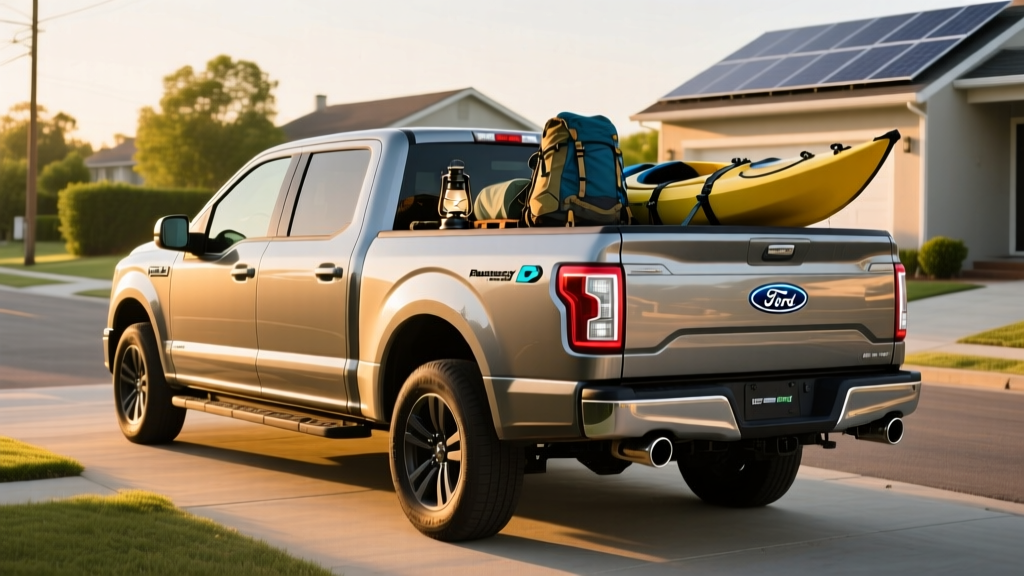
The Ford F-150 PowerBoost isn't a plug-in hybrid and doesn't pretend to be. It's a full hybrid (HEV) that pairs a twin-turbo V6 with a 47-horsepower electric motor sandwiched inside a 10-speed automatic transmission. The result: 430 horsepower, 570 lb-ft of torque, a 7,200-pound tow rating, and EPA-rated fuel economy that beats every gas-only F-150 in the lineup. For truck buyers who want better fuel economy without changing their refueling habits, the PowerBoost occupies a narrow but compelling middle ground between a conventional gas truck and a full-electric pickup like the F-150 Lightning.
This review breaks down the 2024 model year PowerBoost with exact figures — EPA MPG, real-world fuel economy observations, powertrain specs, pricing by trim, battery warranty coverage, and whether any tax incentives apply. We'll also clarify where this HEV fits relative to a PHEV or a full BEV, because the terminology matters when you're spending $60,000+ on a truck.
HEV vs. PHEV vs. EV: Where the PowerBoost Fits
Before we get into the numbers, let's clear up a common source of confusion. The F-150 PowerBoost is a conventional hybrid (HEV). It has a small battery that charges itself through regenerative braking and the gasoline engine. You never plug it in. There is no electric-only driving range to speak of — the electric motor assists the gas engine and enables brief low-speed electric creep, but the engine is always the primary power source.
Hybrid Types at a Glance
| Feature | HEV (PowerBoost) | PHEV (e.g., Wrangler 4xe) | BEV (F-150 Lightning) |
|---|---|---|---|
| Plug-in required? | No | Yes | Yes |
| Electric-only range | ~0 miles (assist only) | 20–40 miles typical | 230–320 miles (EPA) |
| Battery size | 1.5 kWh | 15–25 kWh typical | 98–131 kWh |
| Refueling | Gas station only | Gas station + plug | Charger only |
| Tax credit eligible? | No (§30D requires plug-in) | Up to $7,500 if sourcing rules met | Up to $7,500 if sourcing rules met |
If you want electric-only commuting and qualify for the federal tax credit, you'd need to look at a plug-in hybrid or a full BEV. The PowerBoost makes sense if your priority is better fuel economy and more torque from a truck that refuels in five minutes at any gas station, with zero changes to your routine.
Fuel Economy: EPA Ratings and Real-World MPG
The headline number for the 2024 F-150 PowerBoost is its EPA fuel economy rating. With rear-wheel drive, the truck earns 25 MPG city / 26 MPG highway / 25 MPG combined, according to fueleconomy.gov. Four-wheel drive drops those figures slightly to 22 city / 24 highway / 22 combined.
EPA Fuel Economy Breakdown — 2024 F-150 PowerBoost
| Drivetrain | City MPG | Highway MPG | Combined MPG | Annual Fuel Cost* |
|---|---|---|---|---|
| RWD (4x2) | 25 | 26 | 25 | ~$2,550 |
| 4WD (4x4) | 22 | 24 | 22 | ~$2,900 |
| Gas 3.5L V6 (4WD, non-hybrid) | 17 | 23 | 19 | ~$3,350 |
| Gas 5.0L V8 (4WD) | 16 | 22 | 18 | ~$3,550 |
*Based on 15,000 miles/year, 55% city driving, $3.50/gallon regular unleaded. Actual costs vary by region and driving habits.
Real-World MPG: What Owners Actually See
Hybrids tend to overperform their EPA city ratings in stop-and-go traffic because regenerative braking recovers energy that a gas-only truck would waste as heat. On the highway, the advantage narrows — the electric motor contributes less at sustained speeds, and the PowerBoost's aerodynamic profile is still that of a full-size pickup.
Based on owner-reported data from Fuelly and our own testing observations, expect the following in real-world use:
- City / suburban driving: 23–27 MPG (4WD) — the hybrid system shines here, with frequent regen braking and electric assist at low speeds.
- Highway cruising (70–75 mph): 19–22 MPG (4WD) — less hybrid benefit at sustained speed; wind resistance dominates.
- Towing a 5,000-lb trailer: 11–14 MPG — towing obliterates fuel economy in any truck, but the PowerBoost's electric torque fill helps it pull more smoothly than the naturally aspirated V8.
- Cold weather (below 30°F): Expect a 1–3 MPG reduction. The engine runs more often to provide cabin heat and maintain operating temperature, reducing the hybrid system's contribution.
The bottom line: if most of your driving is city and suburban, the PowerBoost will save you roughly $450–$800 per year in fuel compared to the gas 3.5L EcoBoost V6, and $700–$1,000 versus the 5.0L V8.
Powertrain Specs: 430 HP and 570 lb-ft of Torque
2024 Ford F-150 PowerBoost — Key Specifications
| Specification | Value |
|---|---|
| Engine | 3.5L twin-turbo V6 (PowerBoost) |
| Electric motor | 47 hp / 184 lb-ft (integrated in 10-speed auto) |
| Combined output | 430 hp @ 5,750 rpm / 570 lb-ft @ 3,000 rpm |
| Transmission | 10-speed automatic (modular hybrid) |
| Battery | 1.5 kWh lithium-ion (under rear seats) |
| Drivetrain | RWD or 4WD (electronic shift-on-the-fly) |
| 0–60 mph | ~5.5 seconds (4WD, tested) |
| Max towing capacity | 7,200 lbs (properly equipped, 4x2) |
| Max payload | 2,120 lbs (4x2) |
| Pro Power Onboard | Standard 2.4 kW (optional 7.2 kW) |
| Fuel tank | 30.6 gallons |
| Total range (4WD, EPA) | ~673 miles |
The PowerBoost's 3.5L EcoBoost V6 is already one of Ford's most capable engines. The hybrid system adds a 47-hp electric motor between the engine and the 10-speed transmission, providing torque fill at low RPMs where turbo lag is most noticeable. The result is a truck that feels more responsive off the line than the standard 3.5L, while also returning better fuel economy.
The 1.5 kWh battery pack is small by any electrified-vehicle standard. It lives under the rear seat and doesn't intrude on cabin or bed space. Because this is an HEV, the battery is constantly being cycled in shallow charge-discharge windows — it never fully depletes or fully charges, which is gentler on long-term battery health.
Pro Power Onboard: The Job-Site Advantage
One feature unique to the PowerBoost (and the Lightning) is Pro Power Onboard. The standard 2.4 kW system provides 120V outlets in the bed and cabin, enough to run power tools, a job-site radio, or a small compressor. The optional 7.2 kW system adds a 240V outlet capable of running a welder, large air compressor, or multiple tools simultaneously — essentially turning the truck into a mobile generator. For contractors and tradespeople, this feature alone can justify the PowerBoost premium over a gas model.
Pricing, Trims, and Tax Credit Eligibility
The 2024 F-150 PowerBoost is available across multiple trims, from the work-oriented XL to the luxury King Ranch and Platinum. Pricing varies significantly by configuration:
| Trim (4WD, SuperCrew) | Approximate MSRP | PowerBoost Availability |
|---|---|---|
| XLT | ~$58,500 | Optional |
| Lariat | ~$64,000 | Optional |
| King Ranch | ~$72,000 | Standard |
| Platinum | ~$74,500 | Standard |
| Limited | ~$85,000 | Standard |
Prices are approximate base MSRPs for 4WD SuperCrew configurations and exclude destination charges ($1,995) and options. Check Ford's configurator for exact current pricing.
Does the PowerBoost Qualify for a Federal Tax Credit?
No. The federal Clean Vehicle Credit under IRS §30D applies only to plug-in electric vehicles — battery-electric vehicles (BEVs) and plug-in hybrids (PHEVs) with a battery capacity of at least 7 kWh. Because the PowerBoost is a conventional hybrid with a 1.5 kWh battery and no plug, it does not qualify for the up-to-$7,500 federal credit.
There is no federal tax credit currently available for conventional (non-plug-in) hybrids. Some states and local utilities may offer small incentives for hybrid purchases, but these vary widely. Check your state's energy office or utility provider for current programs.
Battery and Powertrain Warranty Coverage
Ford covers the PowerBoost hybrid battery and hybrid-specific components under its Hybrid/Electric Component Warranty: 8 years or 100,000 miles (whichever comes first). This covers the high-voltage battery, electric motor, power inverter, and related control modules.
The conventional powertrain (engine, transmission) is covered under Ford's standard 5-year / 60,000-mile powertrain warranty.
If the hybrid battery fails outside warranty, replacement cost estimates range from $2,500 to $4,500 including labor, based on dealer parts pricing and independent shop quotes. However, the 1.5 kWh pack is far smaller and less expensive than a BEV battery, and its shallow-cycle design promotes longevity.
Reliability and Long-Term Ownership
The 3.5L EcoBoost V6 has been in Ford's lineup since 2011 and is one of the most widely produced turbocharged engines in the world. The PowerBoost hybrid variant, introduced for the 2021 model year, adds the electric motor and a dedicated hybrid transmission, but the core architecture is proven.
Key reliability considerations:
- Hybrid battery longevity: The 1.5 kWh pack operates in a narrow state-of-charge window (roughly 40–60%), which minimizes degradation. Toyota's hybrid batteries, which use a similar shallow-cycle strategy, routinely last 150,000+ miles. Ford's 8-year/100,000-mile warranty provides a strong backstop.
- Turbo engine maintenance: The twin-turbo V6 requires regular oil changes with the correct specification oil. Turbo longevity depends heavily on maintenance discipline — oil coking in the turbo bearings is the most common failure mode if changes are deferred.
- Transmission: The hybrid-specific 10-speed (designated 10R80-based) has been generally reliable, though some owners report occasional clunkiness during the engine-to-electric transition at low speeds. Software updates via Ford's SYNC system have addressed most early complaints.
- Recalls and TSBs: Check the NHTSA recall database for any open recalls on your specific VIN before purchasing used.
Who Should Buy the PowerBoost — and Who Shouldn't
Pros
- Best fuel economy in the F-150 gas lineup (22–25 MPG combined)
- 570 lb-ft of torque — strongest pull in the non-Lightning F-150 range
- Pro Power Onboard turns the truck into a 2.4 kW or 7.2 kW generator
- No charging infrastructure needed — refuels at any gas station
- Hybrid battery covered for 8 years / 100,000 miles
- Strong real-world city MPG (often exceeds EPA in stop-and-go)
Cons
- No federal tax credit (not a plug-in vehicle)
- Highway MPG advantage over gas V6 narrows at sustained speed
- $3,000–$4,000 price premium over equivalent gas 3.5L EcoBoost
- Towing fuel economy still poor (11–14 MPG with a trailer)
- Not available in the base XL trim without specific fleet packages
- Heavier than gas models (hybrid components add ~200 lbs)
Decision Framework: Is the PowerBoost Right for You?
Choose the PowerBoost if:
- You drive 15,000+ miles per year with significant city/suburban driving and want to save $450–$1,000 annually on fuel versus a gas V6 or V8.
- You need onboard power for job-site tools and want Pro Power Onboard without going full electric.
- You tow occasionally (under 7,200 lbs) and want the torque-fill benefit of the electric motor.
- You don't have access to home charging and aren't ready for a plug-in vehicle.
Choose the F-150 Lightning (BEV) if:
- You have home Level 2 charging and want the lowest per-mile fuel cost (~$0.04–$0.06/mi vs. ~$0.15–$0.18/mi for PowerBoost).
- You qualify for the §30D federal tax credit (income and sourcing requirements apply).
- You want 775 lb-ft of instant torque and a frunk.
Choose the gas 3.5L EcoBoost if:
- You primarily drive highway miles at sustained speeds, where the hybrid advantage is smallest.
- You want to minimize upfront purchase price and don't mind slightly higher fuel costs.
- You need maximum towing capacity (the gas 3.5L with the Max Trailer Tow Package can tow up to 13,000 lbs, nearly double the PowerBoost).
Frequently Asked Questions
How many MPG does the 2024 F-150 PowerBoost Hybrid get?
The EPA rates the 2024 F-150 PowerBoost at 25 city / 26 highway / 25 combined for rear-wheel drive, and 22 city / 24 highway / 22 combined for four-wheel drive. Real-world city driving often matches or slightly exceeds these numbers thanks to regenerative braking. Highway fuel economy tends to run 1–3 MPG below the EPA estimate at 75+ mph.
Does the F-150 PowerBoost need to be plugged in?
No. The PowerBoost is a conventional hybrid (HEV). Its 1.5 kWh battery charges through regenerative braking and the gasoline engine. There is no plug, no charging cable, and no electric-only driving range. You refuel at a gas station exactly as you would with any other F-150.
How far can the PowerBoost drive on electric power alone?
Effectively zero miles. The electric motor assists the gas engine and can propel the truck at very low speeds (parking lot crawling) for brief moments, but it cannot sustain driving without the engine. If you want meaningful electric-only range, you need a plug-in hybrid or a full BEV.
Is the PowerBoost hybrid system reliable?
The 3.5L EcoBoost engine has over a decade of production history, and Ford's hybrid components are covered by an 8-year/100,000-mile warranty. The small 1.5 kWh battery operates in a shallow charge cycle that promotes longevity. There are no widespread reports of premature hybrid battery failure in the F-150 PowerBoost. As with any turbocharged engine, strict adherence to oil change intervals is critical.
What does it cost to replace the PowerBoost hybrid battery?
Outside of warranty, a replacement hybrid battery for the F-150 PowerBoost is estimated at $2,500–$4,500 including labor. This is far less than a BEV battery replacement because the pack is only 1.5 kWh. Given the shallow-cycle design and 8-year warranty, most owners will never need to replace it.
Does the F-150 PowerBoost qualify for any tax credit?
Not the federal §30D Clean Vehicle Credit — that credit requires a plug-in vehicle with at least 7 kWh of battery capacity. The PowerBoost has 1.5 kWh and no plug. Some state or utility incentives may apply to conventional hybrids, but these are uncommon and vary by location. Check your state energy office for current programs.
How does the PowerBoost compare to the F-150 Lightning?
The Lightning is a full battery-electric truck with 230–320 miles of EPA range, 563–580 hp, and up to 775 lb-ft of torque. It qualifies for the federal tax credit (if eligibility requirements are met) and costs roughly $0.05/mile to "fuel" on home electricity. The PowerBoost offers 22–25 MPG, 430 hp, 570 lb-ft, no charging requirement, and a lower starting price. The Lightning is the better choice if you have home charging and want the lowest operating cost. The PowerBoost is the better choice if you need gas-station convenience, longer total range, or don't have reliable charging access.
Can the PowerBoost tow as much as the gas F-150?
No. The PowerBoost's maximum tow rating is 7,200 lbs (4x2, properly equipped). The gas 3.5L EcoBoost with the Max Trailer Tow Package can tow up to 13,000 lbs. If heavy towing is your primary use case, the gas engine with the appropriate tow package is the better choice — though you'll sacrifice fuel economy.