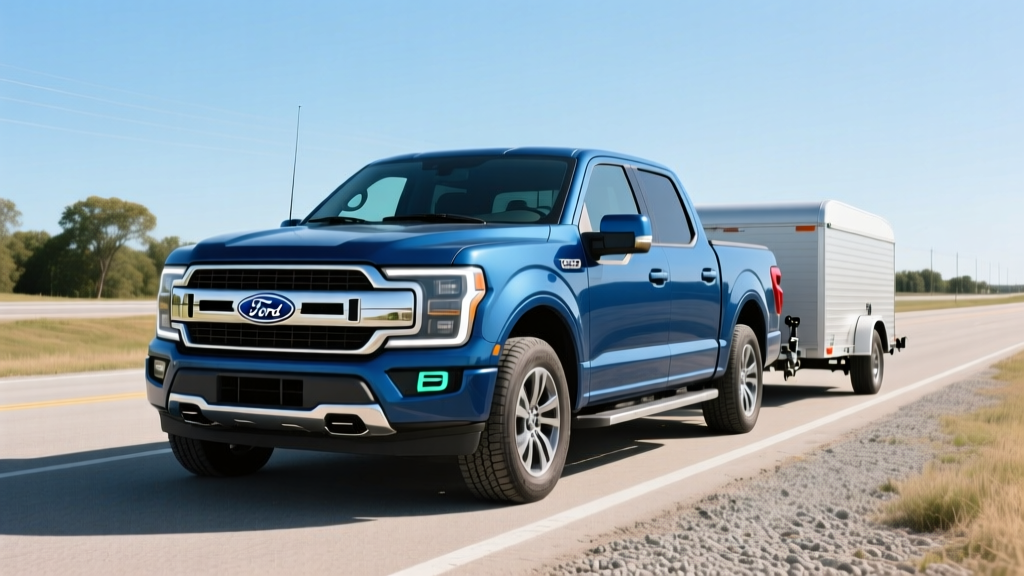
The full-size pickup segment isn't known for fuel efficiency, but the 2024 Ford F-150 Hybrid — officially badged as the PowerBoost — proves you don't have to sacrifice capability to cut fuel costs. Pairing a twin-turbo V6 with an electric motor and a self-charging battery pack, this conventional hybrid (HEV) delivers genuine MPG gains in the city while retaining the towing, payload, and bed utility that truck buyers demand. No plug required.
In this guide, we break down the PowerBoost's real-world fuel economy, powertrain specs, pricing, battery reliability, and how it stacks up against both full-electric trucks and gas-only F-150 variants. Whether you're cross-shopping the F-150 Lightning, the Chevy Silverado Hybrid, or a standard EcoBoost, the data below will clarify whether the PowerBoost is the right powertrain for your drive cycle.
HEV vs PHEV vs EV: What the F-150 PowerBoost Actually Is
Before diving into specs, it's critical to understand what you're buying. The 2024 F-150 PowerBoost is a conventional hybrid (HEV) — it cannot be plugged in. Its 1.5 kWh lithium-ion battery recharges exclusively through regenerative braking and the gasoline engine. You will never see an electric-only range figure for this truck because it doesn't have one in any meaningful sense (Ford rates it at roughly 1–2 miles at very low speeds, which is functionally negligible).
Hybrid Powertrain Types at a Glance
| Feature | HEV (PowerBoost) | PHEV (e.g., Wrangler 4xe) | BEV (e.g., F-150 Lightning) |
|---|---|---|---|
| Plugs in? | No | Yes | Yes |
| Electric-only range | ~0 mi | 20–40 mi typical | 230–400+ mi |
| Battery size | 1.5 kWh | 12–20 kWh | 90–131 kWh |
| Federal tax credit (§30D) | No | $3,750–$7,500* | Up to $7,500* |
| Gas engine | Yes | Yes | No |
* §30D credit eligibility depends on MSRP caps, buyer income limits, and battery critical-mineral sourcing per current IRS rules. Verify before purchase.
The PowerBoost sits between the gas-only 3.5L EcoBoost V6 (which shares its engine block) and the all-electric F-150 Lightning. It's designed for buyers who want fuel savings without changing their fueling habits — no home charger installation, no range planning, no public charging dependency.
Fuel Economy: EPA Ratings vs Real-World MPG
The headline number for the 2024 F-150 PowerBoost is its EPA-rated fuel economy. With rear-wheel drive (RWD), the truck achieves 25 MPG city / 26 MPG highway / 25 MPG combined. Opting for four-wheel drive (4WD) drops those figures to 23 city / 23 highway / 23 combined, according to fueleconomy.gov.
| Configuration | City | Highway | Combined |
|---|---|---|---|
| PowerBoost RWD | 25 MPG | 26 MPG | 25 MPG |
| PowerBoost 4WD | 23 MPG | 23 MPG | 23 MPG |
| 3.5L EcoBoost 4WD (gas) | 18 MPG | 23 MPG | 20 MPG |
| F-150 Lightning 4WD | 70 MPGe combined (2.0 kWh/mi) | ||
Real-world expectations: Hybrid trucks, like all hybrids, tend to outperform their EPA city ratings in stop-and-go driving because regenerative braking recaptures energy that a gas truck wastes as heat. Owners who do heavy city and suburban driving (delivery routes, job-site commutes, school runs) frequently report 24–27 MPG in the 4WD PowerBoost. Highway-only driving at 75+ MPH, however, often drops to 20–22 MPG because the electric motor contributes less at sustained high speeds and the truck's aerodynamic profile works against it. Towing a 5,000–7,000 lb trailer will reduce fuel economy to roughly 12–15 MPG depending on terrain and wind — the hybrid system helps modestly but cannot overcome physics.
Powertrain Specs: 430 HP and 7,700-lb Towing
The PowerBoost pairs Ford's 3.5L twin-turbocharged V6 with a 35 kW (47 hp) electric motor integrated into the 10-speed automatic transmission. Combined system output is 430 horsepower and 570 lb-ft of torque — figures that match or exceed many V8 competitors. The electric motor fills in torque at low RPM before the turbos spool, giving the PowerBoost a notably responsive launch from a stop.
| Specification | 2024 F-150 PowerBoost |
|---|---|
| Engine | 3.5L twin-turbo V6 + 35 kW electric motor |
| Combined output | 430 hp / 570 lb-ft |
| Transmission | 10-speed automatic |
| Hybrid battery | 1.5 kWh lithium-ion (NMC) |
| 0–60 MPH | ~5.4 seconds (4WD) |
| Max towing capacity | 7,700 lbs (properly equipped) |
| Max payload | ~2,120 lbs |
| Fuel tank | 30.6 gallons |
| Total range (4WD) | ~700 miles |
| Pro Power Onboard | Up to 7.2 kW (optional) |
The available 7.2 kW Pro Power Onboard system is a standout feature. It turns the PowerBoost into a mobile generator, providing up to 7,200 watts of 120V/240V power through bed-mounted outlets. This is enough to run power tools at a job site, power a small camper, or serve as emergency home backup during an outage — running a refrigerator, sump pump, and several circuits simultaneously for days on a tank of gas.
Pricing, Trims, and Tax Credit Eligibility
The PowerBoost is available on XLT (higher trim packages), Lariat, King Ranch, Platinum, and Limited trims. The hybrid powertrain is a $3,300 option over the standard 3.5L EcoBoost on most trims where both are offered. As of the 2024 model year, base pricing starts around $54,000 for an XLT with the PowerBoost and climbs past $85,000 for a fully loaded Limited.
Federal Tax Credit: Not Eligible
Because the F-150 PowerBoost is a conventional hybrid (HEV) that cannot be plugged in, it does not qualify for the IRS §30D Clean Vehicle Credit. That credit — worth up to $7,500 — is reserved for battery-electric vehicles (BEVs) and plug-in hybrids (PHEVs) that meet battery sourcing, MSRP, and buyer income requirements.
However, some states and local utilities offer rebates or reduced registration fees for hybrid vehicles. Check your state energy office or utility provider for current programs.
Compared to the F-150 Lightning (which starts around $55,000 and may qualify for the full $7,500 federal credit at point of sale, bringing effective pricing near $47,500), the PowerBoost's lack of a federal incentive narrows the price gap. The Lightning also eliminates fuel costs entirely if you charge at home, though it sacrifices the unlimited range and rapid refueling convenience that a hybrid provides.
Battery Reliability, Warranty, and Replacement Cost
Hybrid battery longevity is consistently the top concern for first-time hybrid buyers. The F-150 PowerBoost's 1.5 kWh battery is small compared to a full EV's pack, and because it never fully charges or fully depletes (Ford manages a buffer on both ends), the cells experience relatively mild cycling stress.
Battery & Hybrid Component Warranty
- Hybrid battery: 8 years / 100,000 miles (whichever comes first)
- Hybrid system components (electric motor, inverter, etc.): 8 years / 100,000 miles
- Powertrain warranty (engine, transmission): 5 years / 60,000 miles
- Bumper-to-bumper: 3 years / 36,000 miles
The battery warranty covers capacity loss below 60% of original capacity, per Ford's warranty guide.
Real-world reliability: The PowerBoost debuted for the 2021 model year, giving the system roughly four years of real-world data. Ford's hybrid technology is well-established — the company has produced hybrid Escape, Fusion, and Maverick models for over a decade with strong battery longevity records. Most hybrid batteries from this era last 150,000–200,000 miles before notable degradation, and the F-150's larger thermal management system should support similar or better longevity.
Replacement cost: If the hybrid battery does require replacement outside warranty, expect $2,500–$4,500 for a new OEM pack, plus labor. Given the small 1.5 kWh size, this is far less expensive than an EV battery replacement (which can exceed $15,000). Third-party refurbishment options may lower this cost further as the platform ages.
Who Should Choose the F-150 PowerBoost?
Choose the PowerBoost If:
- You drive 15,000+ miles/year with significant city/suburban driving
- You need towing capacity but want to reduce fuel spend
- You can't install a home charger or lack reliable public charging
- You value Pro Power Onboard for job-site or emergency use
- You want an EV-like torque feel without range planning
Look at a Full EV (Lightning) Instead If:
- You can charge at home and drive under 250 miles/day
- You want to eliminate gas expenses entirely
- You qualify for the $7,500 federal tax credit
- You want zero tailpipe emissions and minimal maintenance
- You rarely tow over 5,000 lbs
The PowerBoost is also the clear choice over the gas-only 3.5L EcoBoost for any buyer whose driving includes a meaningful share of city or stop-and-go miles. The 3–5 MPG improvement (23 vs 20 combined for 4WD) translates to roughly $400–$600 in annual fuel savings for a driver covering 15,000 miles per year at $3.50/gallon — enough to recoup the $3,300 powertrain premium in about 6–8 years. If gas prices rise or your city driving share is higher, payback comes faster.
Frequently Asked Questions
How many MPG does the 2024 F-150 Hybrid get?
The EPA rates the 2024 F-150 PowerBoost at 25/26/25 MPG (city/highway/combined) for RWD and 23/23/23 for 4WD. Real-world city driving often yields 1–2 MPG above the EPA rating thanks to regenerative braking, while sustained highway driving at 75+ MPH may drop 1–3 MPG below.
Does the F-150 Hybrid need to be plugged in?
No. The PowerBoost is a conventional hybrid (HEV). Its small battery charges through regenerative braking and the gasoline engine. You fuel it exactly like a standard F-150 — at a gas station.
Can the F-150 Hybrid run on electric power alone?
Only at very low speeds (under ~25 MPH) for roughly 1 mile in ideal conditions. This is not a meaningful electric-only range — the truck is designed to blend electric and gas power continuously for efficiency, not to drive on electricity alone.
Does the 2024 F-150 Hybrid qualify for a federal tax credit?
No. The IRS §30D Clean Vehicle Credit applies only to plug-in vehicles (BEVs and PHEVs). The PowerBoost, as a conventional hybrid, is not eligible. Some state or utility programs may offer hybrid incentives — check local resources.
How much does it cost to tow with the F-150 Hybrid?
Expect fuel economy to drop to 12–15 MPG when towing a 5,000–7,000 lb trailer, depending on weight, terrain, and wind. The hybrid system provides a modest efficiency improvement over the gas-only EcoBoost while towing, but the gains are smaller than in unloaded city driving.
Is the F-150 PowerBoost reliable long-term?
The PowerBoost system has been in production since 2021 and builds on Ford's two decades of hybrid engineering (Escape Hybrid debuted in 2004). The hybrid battery carries an 8-year/100,000-mile warranty, and the small pack size means replacement costs ($2,500–$4,500 out of warranty) are manageable compared to full EV batteries.
PowerBoost vs F-150 Lightning: which should I buy?
Choose the PowerBoost if you frequently drive long distances, tow heavy loads, lack home charging, or need the 7.2 kW Pro Power Onboard for extended off-grid use. Choose the Lightning if you charge at home, drive under 250 miles daily, want to eliminate fuel and oil-change costs, and qualify for the federal tax credit — which can make the Lightning cheaper to own over five years despite a similar sticker price.