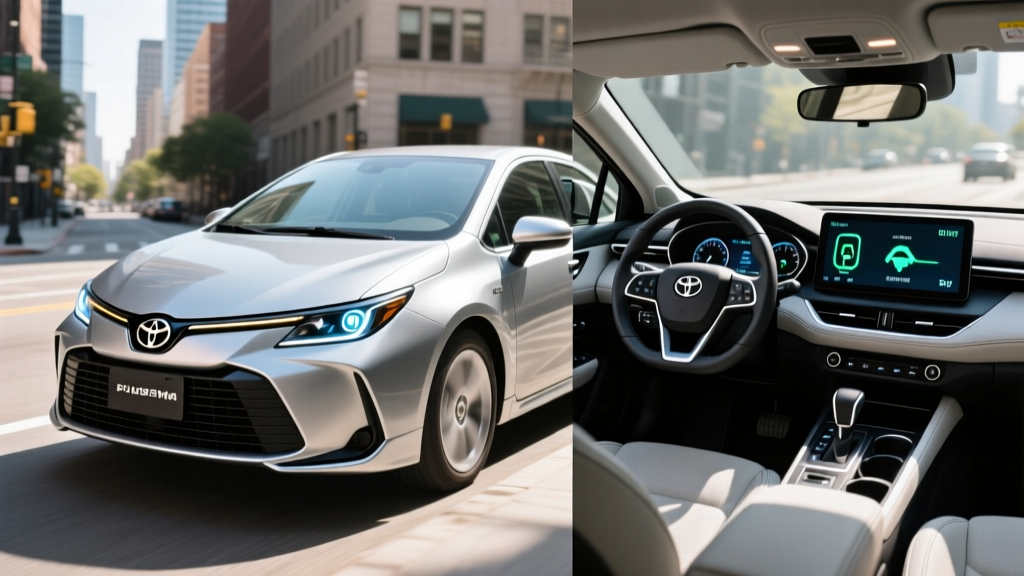
The 2024 Toyota Corolla Hybrid occupies a specific niche in an increasingly electrified market: it is a conventional hybrid (HEV) that requires no plug, no charging app, and no lifestyle adjustment — just significantly better fuel economy than its gas-only counterpart. For buyers researching the 2024 Corolla Hybrid, the appeal is straightforward. You get EPA-estimated fuel economy as high as 50 MPG combined in a compact sedan starting under $24,000, with Toyota's long-proven hybrid synergy drive system and a 10-year/150,000-mile hybrid battery warranty.
But how does that EPA sticker translate to real-world driving? Is the Corolla Hybrid actually a better buy than a plug-in hybrid like the Toyota Prius Prime or a full battery-electric vehicle (BEV)? And what does long-term ownership look like when the hybrid battery eventually ages? This guide covers exact specs, real-world MPG observations, trim-level pricing, and a practical decision framework to help you decide.
2024 Corolla Hybrid Fuel Economy: EPA Estimates vs. Real-World MPG
The 2024 Corolla Hybrid is offered in three trims — LE, SE, and XLE — with front-wheel drive (FWD) or available electronic all-wheel drive (eAWD). Fuel economy varies by drivetrain:
| Trim / Drivetrain | City MPG | Highway MPG | Combined MPG |
|---|---|---|---|
| LE FWD | 53 | 46 | 50 |
| SE FWD | 50 | 43 | 47 |
| XLE FWD | 50 | 43 | 47 |
| LE AWD | 51 | 44 | 48 |
| SE AWD | 47 | 41 | 44 |
Source: EPA fueleconomy.gov
The key takeaway: the Corolla Hybrid LE FWD at 50 MPG combined is one of the most fuel-efficient non-plug-in vehicles sold in the United States. The SE and AWD variants trade 3–6 MPG for sportier tuning and all-weather traction, which is a reasonable exchange depending on your climate.
Powertrain and Performance Specs
The 2024 Corolla Hybrid uses Toyota's fifth-generation Hybrid Synergy Drive, pairing a 1.8-liter Atkinson-cycle four-cylinder engine with electric motor-generators. Here are the exact numbers:
| Engine | 1.8L 4-cylinder Atkinson-cycle |
| Engine Output | 96 hp / 105 lb-ft torque |
| Electric Motor (FWD) | 94 hp / 131 lb-ft torque |
| Combined Net Horsepower | 138 hp |
| Transmission | Electronic Continuously Variable (eCVT) |
| AWD System | Separate rear-mounted electric motor (eAWD, LE/SE only) |
| 0–60 mph (est.) | ~9.0 seconds (FWD) |
| Hybrid Battery | Lithium-ion, ~0.9 kWh (not plug-in) |
| Fuel Tank | 11.4 gallons |
| Total Driving Range (est.) | ~570 miles (LE FWD at 50 MPG) |
The 138 combined horsepower is a meaningful bump over the gas-only Corolla's 169 hp from its 2.0L engine — wait, it's actually less. The gas Corolla makes 169 hp; the hybrid makes 138 hp. The trade-off is fuel economy: 50 MPG combined versus 35 MPG combined for the gas model. The hybrid's electric motor provides immediate low-end torque, making it feel responsive around town despite the lower peak horsepower figure. The eCVT is smooth and drone-free under normal acceleration, though it exhibits the expected rubber-band effect under hard throttle.
The electronic AWD system is worth noting: unlike mechanical AWD, there is no driveshaft. A small rear electric motor engages automatically when front-wheel slip is detected, providing traction in rain and light snow. It does not provide meaningful performance benefit in dry conditions and costs you roughly 2–6 MPG depending on trim.
HEV vs. PHEV vs. EV: Which Powertrain Fits You?
The Corolla Hybrid is a conventional hybrid (HEV), meaning it generates all its electricity onboard through regenerative braking and engine-driven generation. There is no plug, no electric-only driving mode, and no external charging required. This is fundamentally different from a plug-in hybrid (PHEV) like the Toyota Prius Prime or a full BEV like the Tesla Model 3.
| Factor | HEV (Corolla Hybrid) | PHEV (Prius Prime) | BEV (Model 3 / Bolt) |
|---|---|---|---|
| Plug-in Required? | No | Yes (Level 1/2) | Yes (Level 2 / DC fast) |
| Electric-Only Range | 0 miles | 39–44 miles | 250–360 miles |
| Total Range | ~570 miles | ~440+ miles | 250–360 miles |
| Home Charging Needed? | No | Recommended | Essential |
| Federal Tax Credit (§30D) | Not eligible | Up to $7,500 (if eligible) | Up to $7,500 (if eligible) |
| Starting MSRP (2024) | ~$23,500 | ~$33,445 | ~$38,990+ |
| Best For | No home charging access, budget-first buyers | Short commute + home charging, road-trip flexibility | Home charging + daily driving under 300 mi |
- You live in an apartment or lack access to home/workplace charging
- Your budget is under $28,000 out-the-door
- You want maximum range with zero charging logistics
- You drive in a region with expensive or unreliable public charging
- You prioritize low total cost of ownership without lifestyle changes
- You have home Level 2 charging and a commute under 40 miles (PHEV covers it electrically)
- You qualify for the §30D federal tax credit, effectively reducing a PHEV/BEV's price
- You want zero tailpipe emissions on daily driving
- You want access to HOV lane perks (state-dependent)
2024 Corolla Hybrid Pricing by Trim
Toyota positions the Corolla Hybrid as an accessible entry point into electrified driving. Here is the 2024 MSRP breakdown (destination charge included):
| Trim | Drivetrain | MSRP (incl. destination) |
|---|---|---|
| LE | FWD | $23,525 |
| LE | AWD | $24,925 |
| SE | FWD | $25,965 |
| SE | AWD | $27,365 |
| XLE | FWD | $28,465 |
Source: Toyota.com 2024 Corolla Hybrid
Federal and State Tax Credit Eligibility
The 2024 Corolla Hybrid does not qualify for the IRS §30D Clean Vehicle Credit. Under current IRS rules, the §30D credit (up to $7,500) is available only for plug-in electric vehicles — BEVs and PHEVs with a minimum battery capacity of 7 kWh. Conventional hybrids like the Corolla Hybrid, which use a sub-1 kWh battery charged only by the engine and regenerative braking, are excluded.
Some states offer their own incentives for hybrids, though these are increasingly rare and typically target PHEVs and BEVs. Check your state's energy office or DMV for current programs. The Corolla Hybrid's value proposition is purely operational: lower fuel cost, not purchase incentives.
Hybrid Battery Warranty, Lifespan, and Replacement Cost
Toyota's hybrid battery longevity is among the best-documented in the industry. The Corolla Hybrid uses a relatively small lithium-ion pack (~0.9 kWh usable), which operates in a narrow state-of-charge window — typically between 40% and 80% — managed by the hybrid system's battery management computer. This shallow cycling is the primary reason Toyota hybrid batteries routinely last 150,000–200,000+ miles before meaningful degradation occurs.
How Long Will the Battery Actually Last?
Based on fleet data from the Prius (which shares the same hybrid architecture), most Toyota hybrid batteries retain functional capacity well past 150,000 miles. Degradation manifests as slightly reduced fuel economy (1–3 MPG loss) and more frequent engine engagement, not sudden failure. Complete battery failure before 100,000 miles is uncommon and would typically be covered under warranty.
Hybrid Battery Replacement Cost
If replacement is needed out of warranty (typically at 150,000+ miles):
- New OEM battery from Toyota: $2,000–$3,500 (parts + labor at a dealership)
- Refurbished/remanufactured battery: $1,000–$2,000 from independent hybrid specialists
- Individual module replacement: $500–$1,000 if only specific cells have failed (a service some hybrid specialists offer)
For context, a $2,500 battery replacement at 180,000 miles — after saving an estimated $4,000–$6,000 in fuel versus a gas-only Corolla over that distance — still nets positive economics. The hybrid battery is a maintenance item, not a catastrophic cost.
Reliability, Safety, and Ownership Costs
The 2024 Corolla Hybrid benefits from one of the most mature hybrid platforms in production. Toyota has manufactured millions of hybrid vehicles since 1997, and the fifth-generation Hybrid Synergy Drive in the Corolla represents iterative refinement rather than unproven technology.
Reliability
Toyota consistently ranks at or near the top of J.D. Power and Consumer Reports reliability surveys, and the Corolla nameplate specifically is among the most dependable compact cars sold. The hybrid system adds complexity (electric motor-generators, inverter, hybrid battery) but eliminates other wear items — there is no traditional starter motor, no alternator, and the eCVT has no belts or clutch packs to replace. Regenerative braking significantly extends brake pad life, with many owners reporting original brake pads at 60,000+ miles.
Safety
The 2024 Corolla Hybrid comes standard with Toyota Safety Sense 3.0, which includes:
- Pre-Collision System with Pedestrian Detection
- Lane Departure Alert with Steering Assist
- Lane Tracing Assist
- Dynamic Radar Cruise Control (full-speed)
- Road Sign Assist
- Automatic High Beams
The Corolla (including hybrid variants) earned the IIHS Top Safety Pick designation when tested with acceptable-rated headlights. IIHS ratings show Good scores across all crashworthiness categories.
Note: Toyota Safety Sense is a Level 2 driver-assistance system under SAE classification. The driver must remain fully engaged, hands on or near the wheel, at all times. This is not autonomous driving.
Estimated 5-Year Ownership Cost
| Cost Factor | Corolla Hybrid LE FWD | Corolla Gas LE (2.0L) |
|---|---|---|
| MSRP (approx.) | $23,525 | $22,175 |
| Fuel (75,000 mi at $3.50/gal) | ~$5,250 | ~$7,500 |
| Estimated Maintenance | ~$2,200 | ~$2,500 |
| Insurance (avg.) | ~$5,500 | ~$5,200 |
| 5-Year Total (est.) | ~$36,475 | ~$37,375 |
The hybrid's ~$1,350 MSRP premium over the gas Corolla is typically recovered in fuel savings within 3–4 years at average mileage and current gas prices. Over 10 years and 150,000 miles, the fuel savings widen to $3,500–$5,000 depending on gas prices, making the hybrid the more economical choice for long-term owners.
Pros, Cons, and Final Verdict
Pros
- 50 MPG combined (LE FWD) — among the highest of any non-plug-in vehicle
- No plug, no charging infrastructure needed — works for apartment dwellers
- Starting MSRP under $24,000 — one of the cheapest electrified vehicles available
- 10-year/150,000-mile hybrid battery warranty
- Standard AWD availability across LE and SE trims
- Toyota Safety Sense 3.0 standard on all trims
- Proven long-term reliability with extensive real-world track record
- ~570 miles of total range — no range anxiety on road trips
Cons
- 138 hp — noticeably slower than the 169 hp gas Corolla on highway merges
- No federal tax credit eligibility (HEV, not a PHEV/BEV)
- Modest 11.4-gallon fuel tank limits range despite excellent MPG
- XLE trim not available with AWD
- Interior materials and infotainment are functional but unremarkable
- No DC fast charging capability (not applicable — this is an HEV)
- eCVT drone under hard acceleration
The verdict: The 2024 Corolla Hybrid is the pragmatic electrified-vehicle choice for buyers who cannot or do not want to plug in. It delivers genuine 50 MPG in daily driving, costs less than most gas compact sedans over a 5-year ownership cycle, and carries the reliability backing of Toyota's decades-long hybrid program. If you have home charging and qualify for the §30D credit, a PHEV like the Prius Prime offers a more compelling daily-electric experience. If you want zero emissions and have charging access, a BEV is the longer-term play. But for buyers who need a dependable, ultra-efficient sedan with zero infrastructure dependency, the Corolla Hybrid LE is difficult to beat on pure economics.
Frequently Asked Questions
How many MPG does the 2024 Corolla Hybrid get?
The EPA rates the Corolla Hybrid LE FWD at 53 city / 46 highway / 50 combined MPG. The SE and XLE trims are rated at 50/43/47 MPG (FWD). AWD models lose 2–6 MPG depending on trim. In real-world mixed driving, most owners report lifetime averages between 46–51 MPG for the LE FWD, closely matching or slightly exceeding the EPA combined figure.
Does the Corolla Hybrid need to be plugged in?
No. The Corolla Hybrid is a conventional hybrid (HEV). Its small lithium-ion battery is charged entirely by the gasoline engine and regenerative braking. You simply fill it with gasoline like any other car. There is no plug, no charging cable, and no electric-only driving range.
How far can the Corolla Hybrid go on electric only?
The Corolla Hybrid cannot drive on electric power alone for any meaningful distance. The electric motor assists the gasoline engine and can power the car at very low speeds for brief moments (e.g., creeping in a parking lot), but it is not a plug-in hybrid and has no rated electric-only range. If electric-only commuting is your goal, look at the Toyota Prius Prime (39–44 miles electric-only) or a full BEV.
Does the 2024 Corolla Hybrid qualify for a federal tax credit?
No. Under IRS §30D rules, the Clean Vehicle Credit applies only to plug-in electric vehicles (BEVs and qualifying PHEVs) with battery capacities of at least 7 kWh. The Corolla Hybrid's ~0.9 kWh battery and conventional hybrid architecture make it ineligible. Some states may offer minor incentives for hybrids — check your state energy office for current programs.
Is the Corolla Hybrid reliable and what does a battery replacement cost?
Yes. Toyota's hybrid system is among the most proven in the industry, with millions of units on the road since 1997. The hybrid battery carries a 10-year/150,000-mile warranty. Based on Prius fleet data, most Toyota hybrid batteries last 150,000–200,000+ miles. Out-of-warranty replacement costs $2,000–$3,500 for a new OEM battery, or $1,000–$2,000 for a refurbished unit from a hybrid specialist.
Is the Corolla Hybrid slower than the gas Corolla?
Yes, measurably. The hybrid makes 138 combined horsepower versus 169 hp for the gas Corolla's 2.0L engine. The 0–60 mph time is approximately 9.0 seconds for the hybrid versus roughly 7.5 seconds for the gas model. In daily driving, the hybrid feels responsive around town thanks to electric motor torque, but it lacks passing power for aggressive highway merging.
Should I get the Corolla Hybrid or the Prius?
The Prius (redesigned for 2023) offers 57 MPG combined in its LE trim, 196 hp, and a more modern interior — but starts around $28,545, roughly $5,000 more than the Corolla Hybrid LE. If budget is the priority, the Corolla Hybrid delivers nearly identical real-world efficiency at a lower price. If you want more power, a more premium feel, and optional PHEV capability (Prius Prime), the Prius platform is the upgrade pick.