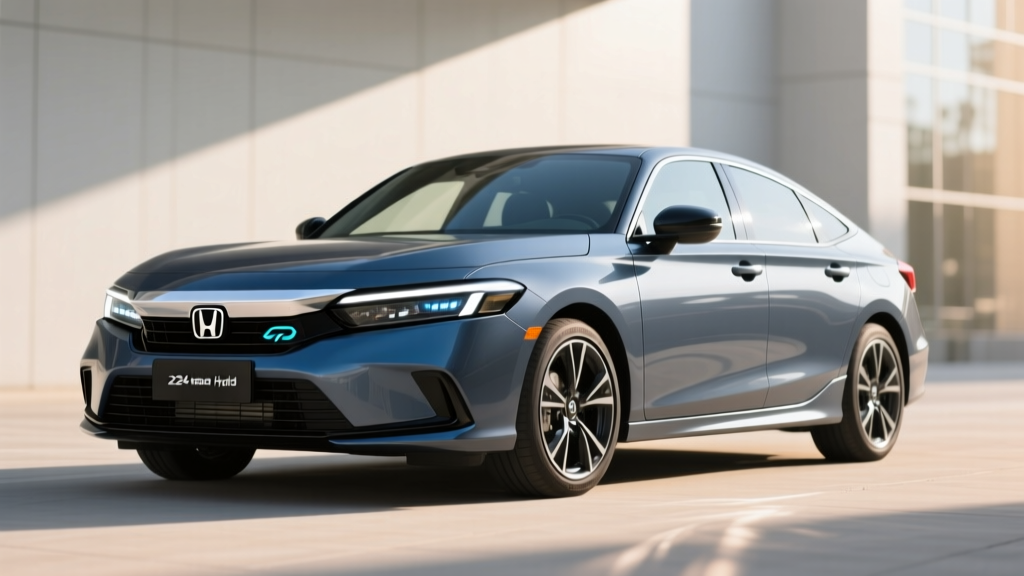
The 2024 Honda Civic Hybrid arrived as a trim-level addition to the 11th-generation Civic lineup, slotting between the standard gas-powered Civic and the fully electric Honda Prologue in Honda's electrified portfolio. Unlike plug-in hybrids or battery-electric vehicles, the Civic Hybrid is a conventional self-charging hybrid (HEV) — it requires no plug, no charging cable, and no behavior change from the driver. You fill it with gas, and the hybrid system handles the rest, delivering an EPA-estimated 50 MPG combined that puts it among the most efficient compact sedans on the market.
This guide breaks down the exact fuel economy figures, powertrain specifications, real-world efficiency observations, battery longevity expectations, pricing, and tax credit eligibility for the 2024 Civic Hybrid — and helps you decide whether it's the right fit versus a PHEV or full EV.
2024 Civic Hybrid Fuel Economy: EPA Ratings and Real-World MPG
The headline number for the 2024 Civic Hybrid is its EPA-rated fuel economy. Honda offers the hybrid powertrain in both sedan and hatchback body styles, with slight efficiency differences between them. Here is the official EPA data from fueleconomy.gov:
| Body Style | City MPG | Highway MPG | Combined MPG |
|---|---|---|---|
| Sedan (Sport Hybrid / Sport Touring Hybrid) | 50 | 47 | 49 |
| Hatchback (Sport Hybrid / Sport Touring Hybrid) | 50 | 45 | 48 |
A few notes on interpreting these numbers:
- City driving favors hybrids. The Civic Hybrid's two-motor system allows it to operate as a series hybrid at low speeds, meaning the gasoline engine acts as a generator while the electric motor drives the wheels. This is where hybrids shine — frequent stops and low-speed driving maximize regenerative braking and electric-only operation.
- Highway efficiency drops slightly. At sustained highway speeds, the engine takes over direct drive, and the aerodynamic and weight penalties of the hybrid system reduce the advantage over a conventional Civic. Expect 45–47 MPG highway in real-world driving at 70–75 mph.
- Real-world observations. Owner reports and independent testing frequently show the Civic Hybrid sedan matching or slightly exceeding its EPA combined rating in mixed suburban driving. In predominantly city conditions, some drivers report 52–55 MPG. In sustained cold weather (below 32°F) or on all-highway road trips, expect the combined figure to dip to 43–46 MPG.
Hybrid Powertrain: Engine, Motors, and Combined Horsepower
The 2024 Civic Hybrid uses Honda's fourth-generation two-motor hybrid system, a setup that shares DNA with the Accord Hybrid and CR-V Hybrid but is tuned for the lighter Civic platform. Here are the exact specifications:
| Specification | Detail |
|---|---|
| Engine | 2.0L 4-cylinder Atkinson-cycle (146 hp, 134 lb-ft) |
| Electric Motors | Dual-motor system (drive motor + generator motor) |
| Drive Motor Output | 184 hp, 232 lb-ft torque |
| Combined System Output | 200 hp, 232 lb-ft torque |
| Transmission | e-CVT (no traditional gears — fixed-ratio direct drive at highway speed) |
| Drivetrain | Front-wheel drive |
| 0–60 mph | ~7.2 seconds (independent testing) |
| Hybrid Battery | ~1.0 kWh lithium-ion (not plug-in capable) |
The combined 200 horsepower represents a significant step up from the standard 2.0L Civic (158 hp) and even the 1.5L turbo Civic (180 hp). The electric motor's instant 232 lb-ft of torque gives the Civic Hybrid strong off-the-line acceleration that feels quicker than the 0–60 time suggests. The system seamlessly switches between three modes:
- EV Drive: Battery powers the drive motor alone (low speeds, light loads, short distances)
- Hybrid Drive: Engine generates electricity to power the drive motor (most city and suburban driving)
- Engine Drive: Engine directly drives the wheels via a lock-up clutch (steady highway cruising)
HEV vs PHEV vs EV: Where Does the Civic Hybrid Fit?
A common question from shoppers is whether the Civic Hybrid is a plug-in hybrid. It is not. The 2024 Civic Hybrid is a conventional hybrid electric vehicle (HEV), meaning it charges its small battery entirely through regenerative braking and the onboard gasoline engine. There is no plug, no charging port, and no electric-only range to manage.
| Factor | HEV (Civic Hybrid) | PHEV (e.g., Toyota Prius Prime) | BEV (e.g., Tesla Model 3) |
|---|---|---|---|
| Plug-in charging required? | No | Yes (for EV range benefit) | Yes (exclusive fuel source) |
| Electric-only range | Less than 1 mile at low speed | 25–44 miles typical | 250–360+ miles |
| Home charging needed? | No | Recommended (120V or 240V) | Essential (240V Level 2) |
| Gasoline required? | Yes (primary fuel) | Yes (backup/long trips) | No |
| Best for | No home charging access, simple ownership, maximum MPG | Short commutes + home charging + road-trip flexibility | Home charging access, daily commutes, lowest operating cost |
| Federal tax credit | Not eligible | Up to $7,500 (if eligible) | Up to $7,500 (if eligible) |
- You rent or live in an apartment without charging access
- You want maximum MPG without changing your fueling habits
- You regularly take long road trips and don't want to plan around charging stops
- You want a lower purchase price than a comparable EV
- You have reliable home or workplace Level 2 charging
- Your daily commute is under 40 miles round-trip (PHEV covers it on electricity alone)
- You want to qualify for the federal §30D tax credit (up to $7,500)
- You want zero tailpipe emissions for daily driving
Pricing, Trims, and Tax Credit Eligibility
The 2024 Civic Hybrid is available in Sport Hybrid and Sport Touring Hybrid trims for both the sedan and hatchback. Pricing at launch (MSRP, excluding destination):
| Trim | Body Style | MSRP |
|---|---|---|
| Sport Hybrid | Sedan | $29,845 |
| Sport Touring Hybrid | Sedan | $32,845 |
| Sport Hybrid | Hatchback | $30,845 |
| Sport Touring Hybrid | Hatchback | $33,845 |
Federal tax credit: The 2024 Civic Hybrid does not qualify for the federal §30D Clean Vehicle Credit. Under current IRS rules, the §30D credit applies only to plug-in electric vehicles (PHEVs and BEVs) with sufficient battery capacity and meeting critical-mineral and battery-component sourcing requirements. Conventional hybrids like the Civic Hybrid are excluded regardless of price or buyer income.
State incentives: A small number of states offer rebates or HOV-lane access for conventional hybrids, but these programs are increasingly rare and tend to focus on PHEVs and BEVs. Check your state's energy or environmental agency website for current availability.
Battery Warranty, Lifespan, and Replacement Cost
Hybrid battery longevity is consistently one of the top concerns for hybrid buyers. The 2024 Civic Hybrid's lithium-ion hybrid battery is substantially smaller than an EV battery (~1.0 kWh vs 60–80+ kWh in a BEV) and operates within a narrow state-of-charge window, which reduces stress and extends lifespan.
- Hybrid battery: 8 years / 100,000 miles (10 years / 150,000 miles in CARB states including California, New York, Massachusetts, and others that follow California emissions standards)
- Hybrid system components: 8 years / 100,000 miles (covers inverter, electric motors, control electronics)
- Standard powertrain warranty: 5 years / 60,000 miles
Real-world lifespan data: Honda's hybrid systems have been in production since the early 2000s (Insight, Civic Hybrid first generation). Fleet data and owner reports suggest modern Honda hybrid batteries typically last 150,000–200,000+ miles before significant degradation. The smaller battery and conservative charge management in the 2024 model reduce the failure risk compared to earlier generations.
Replacement cost: If a hybrid battery replacement is needed out of warranty, expect a cost in the range of $2,000–$4,000 for the battery pack itself, plus labor. This is significantly less than EV battery replacement ($8,000–$20,000+) because the hybrid battery is far smaller. Refurbished and aftermarket options may reduce this cost further.
Driving Impressions and Practical Ownership Notes
The 2024 Civic Hybrid drives like a Civic — composed, responsive, and well-damped — with the added benefit of electric motor torque filling in the low end. The e-CVT operates without the rubber-band effect that plagued earlier CVTs; Honda's system uses a fixed gear ratio for highway cruising, which eliminates the droning sensation common in Toyota's planetary-gear e-CVTs.
Regenerative braking is adjustable via steering-wheel paddles, allowing you to increase regen for stop-and-go traffic or reduce it for a more natural coasting feel. It does not offer true one-pedal driving to a full stop like a BEV, but the strongest regen setting handles most deceleration in city driving.
On the practical side:
- Cargo space: The hybrid battery is packaged under the rear seats, preserving the Civic's full trunk volume (14.8 cu ft sedan, 24.4 cu ft hatchback with rear seats up).
- Weight penalty: The hybrid system adds approximately 150–200 lbs vs the gas Civic, barely perceptible in daily driving.
- Maintenance: No plug, no charging equipment, no home electrical work. Maintenance is identical to a gas Civic — oil changes, brake fluid, tire rotations — with the added benefit of reduced brake wear thanks to regenerative braking.
- Insurance: Hybrid insurance premiums are typically within $50–$100/year of the gas equivalent, far less than the EV insurance premium gap.
Pros and Cons: 2024 Civic Hybrid
Pros
- 49 MPG combined EPA (sedan) — among the best in the compact segment
- 200 hp combined — quicker than the gas Civic 2.0L and 1.5T
- No plug, no charging infrastructure needed — zero behavior change
- 8-year/100,000-mile hybrid battery warranty (10/150k in CARB states)
- Preserves full cargo space with under-seat battery packaging
- Strong low-end torque from electric motor for confident city driving
- Lower purchase price than comparable PHEVs and EVs
Cons
- No federal tax credit eligibility (§30D is plug-in only)
- No meaningful electric-only range — always burning gasoline
- Highway MPG advantage over gas Civic is modest (3–5 MPG)
- Only available in Sport and Sport Touring trims (no base LX Hybrid)
- Not available with all-wheel drive (AWD is not offered on Civic)
- Regenerative braking does not bring the car to a full stop
Who Should Buy the 2024 Civic Hybrid?
The 2024 Civic Hybrid occupies a specific niche: it's the highest-efficiency option for drivers who cannot or do not want to plug in. If you live in an apartment, park on the street, take frequent road trips, or simply want a car that works exactly like a gas car but uses 35% less fuel, the Civic Hybrid is one of the strongest choices in the compact segment.
It is not the right choice if your goal is to drive on electricity for your daily commute — for that, a PHEV like the Toyota Prius Prime (44 miles EV range) or a full EV like the Chevrolet Equinox EV (315+ miles range) will eliminate most or all of your gasoline use. But if plug-in infrastructure isn't part of your life, the Civic Hybrid delivers exceptional efficiency with zero compromise.
Frequently Asked Questions
How many MPG does the 2024 Civic Hybrid get?
The 2024 Civic Hybrid sedan is EPA-rated at 50 MPG city, 47 MPG highway, and 49 MPG combined. The hatchback is rated at 50 city, 45 highway, and 48 combined. In real-world mixed driving, owners typically see 47–52 MPG, with cold weather and all-highway driving reducing that to the low-to-mid 40s.
Does the 2024 Civic Hybrid need to be plugged in?
No. The Civic Hybrid is a conventional hybrid (HEV), not a plug-in hybrid (PHEV). Its small battery is charged entirely through regenerative braking and the gasoline engine. There is no charging port and no plug-in capability.
How far can the Civic Hybrid drive on electric power alone?
Less than one mile at very low speeds. The hybrid battery (~1.0 kWh) is too small to provide meaningful electric-only range. The electric motor assists the gasoline engine continuously, but the car is always consuming some gasoline.
Is the 2024 Civic Hybrid reliable?
Honda's hybrid systems have a strong reliability track record spanning two decades. The 2024 Civic Hybrid carries an 8-year/100,000-mile hybrid battery warranty (extended to 10 years/150,000 miles in CARB states). Independent reliability data from sources like Consumer Reports has rated Honda's hybrid powertrains favorably. The smaller battery and conservative charge management reduce long-term degradation risk.
What does it cost to replace the Civic Hybrid battery?
Out-of-warranty hybrid battery replacement typically costs $2,000–$4,000 including labor. This is substantially less than EV battery replacement due to the smaller battery size. Most hybrid batteries last 150,000–200,000+ miles, and failures within the warranty period are covered.
Does the 2024 Civic Hybrid qualify for any tax credit?
No. The federal §30D Clean Vehicle Credit applies only to plug-in electric vehicles (PHEVs and BEVs). The Civic Hybrid, as a conventional HEV, does not qualify for the federal credit regardless of buyer income or vehicle price. Some states may offer minor incentives for hybrids, but these are uncommon. Check IRS.gov for current federal credit rules.
How does the Civic Hybrid compare to the Toyota Prius?
The 2024 Toyota Prius (conventional hybrid) is EPA-rated at 57 MPG combined (LE trim, FWD), giving it an 8 MPG advantage over the Civic Hybrid sedan. However, the Civic Hybrid offers 200 combined horsepower vs the Prius's 194 hp, a more conventional driving feel, and Honda's interior quality. The Prius wins on pure efficiency; the Civic Hybrid wins on driving engagement and interior space.