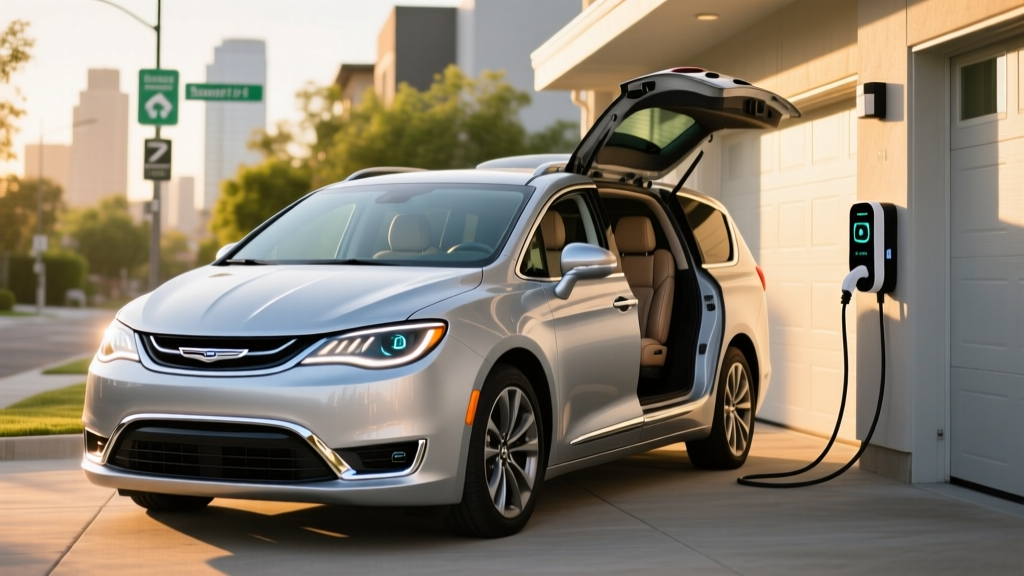
The Chrysler Pacifica Hybrid remains the only plug-in hybrid minivan on the U.S. market, and for 2024 it carries forward a formula that works well for families who want electric school-run commuting without sacrificing road-trip flexibility. With 32 miles of EPA-rated electric-only range and a combined 82 MPGe when blending battery and gasoline, the Pacifica PHEV occupies a unique niche: full-size family hauler that can genuinely run on electrons for daily errands, then burn gas on a 500-mile highway run without a single charging stop.
But the plug-in hybrid proposition only works if your daily driving fits inside that battery envelope — and if the math on pricing, tax credits, and long-term battery reliability checks out. This guide breaks down every number you need to make that call.
HEV vs PHEV: Which Pacifica Are We Talking About?
Chrysler sells the Pacifica in two electrified flavors, and confusing them is the most common buyer mistake:
Conventional Hybrid (HEV)
The standard Pacifica Hybrid uses a smaller battery that recharges through regenerative braking and the engine. You never plug it in. It delivers consistent fuel savings across all driving conditions but cannot run on electricity alone for meaningful distances.
Plug-In Hybrid (PHEV)
The Pacifica Plug-In Hybrid carries a larger 16 kWh battery pack that you charge from a wall outlet or public charger. It can drive up to 32 miles on electricity alone before the gas engine takes over. This is the model reviewed here.
If your daily round-trip commute is under 30 miles and you have access to a standard 120V outlet or a Level 2 home charger, the PHEV version will let you burn almost zero gasoline on weekdays. If you lack charging access, the conventional hybrid is the better choice — it still saves fuel without requiring any behavioral change.
2024 Chrysler Pacifica PHEV: Core Specs at a Glance
| Specification | 2024 Pacifica Plug-In Hybrid |
|---|---|
| Powertrain | 3.6L V6 Atkinson-cycle + 2 electric motors (eCVT) |
| Combined System Horsepower | 260 hp |
| Battery Capacity | 16 kWh (lithium-ion, NMC chemistry) |
| EPA Electric-Only Range | 32 miles |
| EPA Combined MPGe (electric + gas) | 82 MPGe |
| EPA Gas-Only MPG (combined) | 30 MPG |
| Total Combined Range | ~520 miles |
| Level 1 Charging (120V) | ~14 hours (full charge) |
| Level 2 Charging (240V, 32A) | ~2 hours (full charge) |
| DC Fast Charging | Not supported |
| 0–60 mph | ~7.1 seconds |
| Cargo Volume (behind 3rd row) | 32.3 cu ft |
| Base MSRP (Pinnacle trim) | $51,095 |
| Battery Warranty | 8 years / 100,000 miles (10 yr / 150,000 mi in CARB states) |
Real-World MPG and Electric Range: What to Actually Expect
The EPA rates the Pacifica PHEV at 82 MPGe when operating in blended electric-gasoline mode and 30 MPG combined once the battery is depleted. But real-world results depend heavily on how you use it.
EPA Electric Range: 32 miles
Real-world expectation: Expect 26–30 miles in mild weather with mixed city/highway driving. In winter (below 35°F), cabin heating and battery thermal losses can reduce electric-only range to 20–24 miles. Highway-speed driving at 70+ mph also depletes the battery faster than the EPA cycle suggests — plan on roughly 22–25 miles of electric range at sustained interstate speeds.
In gas-only operation after the battery is depleted, the 30 MPG combined figure is reasonably accurate for mixed driving. City driving may push slightly higher (31–33 MPG) thanks to regenerative braking assistance, while sustained highway cruising at 75 mph typically nets 27–29 MPG. These are strong numbers for a 5,000-pound minivan — for comparison, the non-hybrid Pacifica AWD manages about 22 MPG combined.
The key insight: if you charge nightly and your daily driving stays under 30 miles, you may visit a gas station only a handful of times per year. Owners who report the best results treat the Pacifica PHEV like an EV during the week and a hybrid on weekends.
Charging the Pacifica PHEV: What You Need at Home
The Pacifica Plug-In Hybrid does not support DC fast charging — there is no CCS or NACS port. All charging happens via the J1772 AC connector, which is standard and compatible with every Level 2 home charger and public AC station in the U.S.
| Charging Level | Power | Time to Full Charge | Practical Notes |
|---|---|---|---|
| Level 1 (120V household outlet) | ~1.4 kW | ~14 hours | Sufficient if you drive <20 mi/day and plug in nightly |
| Level 2 (240V, 32-amp circuit) | ~7.2 kW | ~2 hours | Recommended; full recharge during a workday or overnight |
For most PHEV owners, a Level 2 home charger is the sweet spot. A 240V / 32-amp hardwired unit (such as a ChargePoint Home Flex or Emporia Level 2) costs $300–$700 for equipment, plus $500–$1,500 for professional installation depending on your electrical panel's capacity and the run distance. If your panel is already near capacity, a 200-amp service upgrade can add $1,500–$3,000 — factor this into your purchase decision.
Public Level 2 charging is widely available at shopping centers, workplaces, and municipal lots. Since the battery is only 16 kWh, even a brief 30-minute stop at a 7.2 kW public charger can restore roughly 10–12 miles of electric range — enough to cover a short errand loop.
Pricing, Trims, and Federal Tax Credit Eligibility
For 2024, the Chrysler Pacifica Plug-In Hybrid is offered exclusively in the top-tier Pinnacle trim at an MSRP of $51,095 (including destination). This is a significant premium over the non-hybrid Pacifica, which starts in the mid-$38,000s.
The federal tax credit picture requires careful attention. Under current IRS §30D rules, the Pacifica PHEV previously qualified for up to $7,500 in federal tax credits. However, battery component and critical mineral sourcing requirements introduced in 2023 and tightened in subsequent years have affected eligibility for many PHEVs. Before counting on the credit, verify current eligibility on the fueleconomy.gov tax credit database and consult a tax professional. Key §30D requirements include:
- Vehicle MSRP cap: Vans and SUVs must have an MSRP at or below $80,000 (Pacifica qualifies)
- Buyer income cap: Modified AGI must not exceed $150,000 (single) or $300,000 (joint)
- Battery sourcing: Minimum percentages of battery components and critical minerals must be sourced from the U.S. or free-trade-agreement partners — these thresholds tighten annually
- Point-of-sale transfer: Eligible buyers can transfer the credit to the dealer at purchase for an immediate price reduction rather than waiting for a tax refund
Even without the full federal credit, many states offer additional incentives for PHEVs. Check your state energy office or the Alternative Fuels Data Center for local rebates that may stack with federal benefits.
Reliability, Battery Longevity, and Warranty Coverage
High-Voltage Battery Warranty: Chrysler covers the Pacifica PHEV battery for 8 years or 100,000 miles (whichever comes first) in most states. In California Air Resources Board (CARB) states — which include CA, CO, CT, ME, MD, MA, NJ, NY, OR, RI, VT, and WA — the warranty extends to 10 years or 150,000 miles.
Capacity retention threshold: The warranty covers the battery if it falls below approximately 70% of original capacity during the warranty period.
The Pacifica PHEV's 16 kWh lithium-ion pack uses NMC (nickel-manganese-cobalt) chemistry, which offers good energy density but is somewhat more susceptible to calendar degradation than LFP chemistry. That said, PHEV batteries experience shallower charge cycles than full EVs — you're typically cycling between 20% and 100% rather than doing deep 0–100% drains — which reduces stress on the cells.
Based on data from Pacifica PHEVs now reaching 6–8 years of age, most owners report battery degradation in the range of 8–15%, meaning electric-only range drops from 32 miles to roughly 27–29 miles over that period. This is within normal expectations and rarely triggers a warranty claim.
If the battery does need replacement outside of warranty coverage, expect a cost between $5,000 and $8,000 for the pack plus labor, based on current dealer pricing. Third-party hybrid battery rebuilders may offer lower-cost options as the vehicle ages further.
For overall vehicle reliability, the Pacifica PHEV carries average ratings. The eCVT transmission is proven and simple (no traditional gear shifts), but the complex integration of the V6 with two electric motors means more potential service points than a conventional hybrid. According to NHTSA records, there have been no major safety recalls specific to the PHEV powertrain for the 2024 model year.
Who Should Buy the Pacifica PHEV — And Who Shouldn't
Pros
- Only PHEV minivan available — no direct competitor
- 32 miles electric covers most school/activity/errand loops
- 520+ miles total range eliminates road-trip charging anxiety
- Stow 'n Go second-row seating (on gas models, but PHEV retains third-row stow)
- Strong 260 hp for confident highway merging
- Level 2 charges in just 2 hours — no need for DC fast charging
Cons
- Premium pricing at $51,095 (Pinnacle trim only)
- No DC fast charging capability
- Second-row Stow 'n Go eliminated due to battery placement (captain's chairs only)
- Federal tax credit eligibility uncertain under current sourcing rules
- Electric range drops to ~20–24 miles in cold weather
- Average long-term reliability ratings
The Decision Framework
Choose the Pacifica PHEV if: You need minivan space and seating for 7, your daily driving is under 30 miles, you can install a Level 2 charger at home, and you want the flexibility to take gas-powered road trips without route-planning for chargers.
Choose a full EV (like the Kia EV9 or Tesla Model X) if: You want zero gasoline costs, have reliable charging at home and work, your trips rarely exceed 250 miles, and you want lower long-term maintenance.
Choose the conventional Pacifica Hybrid (HEV) if: You want better fuel economy than a gas-only minivan but cannot charge at home. The HEV delivers ~30 MPG combined without ever plugging in, at a lower purchase price.
Stick with a gas minivan if: Your budget is under $40,000, you drive very low annual miles (making fuel savings negligible), or you prioritize second-row Stow 'n Go cargo flexibility over fuel economy.
Frequently Asked Questions
How many MPG does the 2024 Chrysler Pacifica Plug-In Hybrid get?
The EPA rates it at 82 MPGe when blending electric and gas operation, and 30 MPG combined (city/highway) once the battery is depleted. Real-world gas-only MPG typically falls between 27–33 depending on driving conditions — city driving with regen braking assistance tends toward the higher end, while sustained 75 mph highway driving pushes toward 27–28 MPG.
How far can the Pacifica PHEV go on electric power alone?
The EPA rates it at 32 miles of electric-only range. In practice, expect 26–30 miles in moderate temperatures with mixed driving. Cold weather (below 35°F) and sustained highway speeds can reduce this to 20–25 miles. For most families, this covers a full day of school drop-off, errands, and activities without using gasoline.
Does the Pacifica PHEV qualify for the federal $7,500 tax credit?
Eligibility depends on current IRS §30D battery sourcing and critical mineral requirements, which have tightened significantly. The Pacifica PHEV's MSRP is below the $80,000 van cap, but battery component sourcing may disqualify it in the current tax year. Always check fueleconomy.gov and consult a tax professional before counting on the credit.
Is the Pacifica Plug-In Hybrid reliable, and what does a battery replacement cost?
The PHEV powertrain carries average reliability ratings. The eCVT is proven technology, but the dual-motor integration adds complexity. The battery is warranted for 8 years / 100,000 miles (10 years / 150,000 miles in CARB states). Out-of-warranty battery replacement runs approximately $5,000–$8,000 including labor. Most owners report 8–15% battery degradation over 6–8 years, which rarely triggers a warranty claim.
Can the Pacifica PHEV charge at a DC fast charger?
No. The Pacifica PHEV only supports AC charging via a J1772 connector — Level 1 (120V) or Level 2 (240V). There is no CCS or NACS DC fast-charge port. This is typical for PHEVs, whose smaller batteries don't require DC fast charging; a full charge on Level 2 takes just 2 hours.
Hybrid vs PHEV vs EV — which is right for my family?
A conventional hybrid (HEV) is best if you can't charge at home and want simple fuel savings. A PHEV is ideal if you have home charging and want electric daily driving with gas flexibility for longer trips. A full EV makes sense if you want the lowest operating costs, have reliable charging access, and your trips rarely exceed 250 miles. For a family that needs minivan space and takes 2–3 road trips per year, the PHEV offers the best of both worlds.
What is the total cost of ownership compared to a gas Pacifica?
Over 5 years and 75,000 miles, the Pacifica PHEV can save $3,000–$5,000 in fuel costs compared to the gas-only Pacifica (assuming regular home charging and electricity at $0.14/kWh). However, the PHEV's ~$12,000 price premium over a base gas Pacifica means the breakeven point may exceed the typical ownership period unless you qualify for tax credits. The PHEV makes strongest financial sense for high-mileage families who maximize electric-only driving.