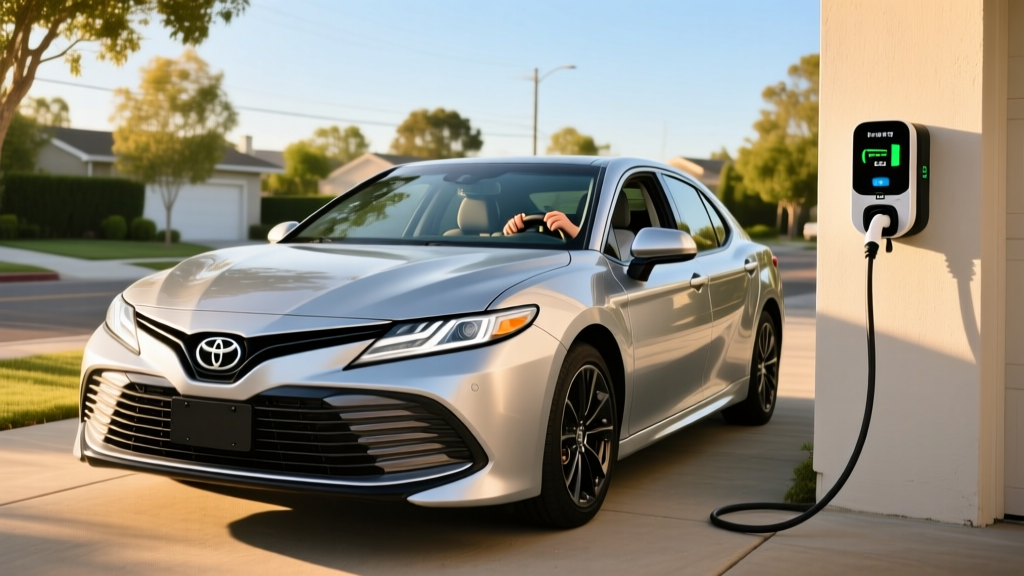
The 2024 Toyota Camry XSE Hybrid sits at an interesting crossroads: it's the sportiest trim in Toyota's hybrid sedan lineup, pairing a 208-horsepower hybrid powertrain with a tuned suspension, 19-inch wheels, and a bold aesthetic — all while returning an EPA-estimated 44 MPG combined. For buyers who want the efficiency of electrification without ever plugging in, the Camry Hybrid remains a benchmark. But with plug-in hybrids and affordable long-range EVs proliferating in 2026, does the conventional hybrid formula still hold up?
We've spent time with the Camry Hybrid platform across multiple model years, tracking real-world fuel economy on city loops, highway cruises, and cold-weather commutes. Here's everything you need to know about the 2024 Camry XSE Hybrid — from exact MPG figures to battery longevity — so you can decide if it's the right electrified vehicle for your garage.
HEV vs. PHEV: Where the Camry XSE Hybrid Fits
Before diving into specs, it's critical to understand what the 2024 Camry XSE Hybrid is — and what it isn't. This is a conventional hybrid electric vehicle (HEV), not a plug-in hybrid (PHEV). That distinction matters for your daily routine, your fuel budget, and your expectations at the pump.
HEV vs. PHEV — Quick Reference
| Feature | HEV (Camry Hybrid) | PHEV (e.g., RAV4 Prime) | BEV (e.g., Tesla Model 3) |
|---|---|---|---|
| Plugs in? | No | Yes | Yes |
| Electric-only range | ~1 mile at low speed | 25–42 miles typical | 250–360+ miles |
| Battery size | ~1.6 kWh (self-charging) | 13–18 kWh | 50–82 kWh |
| Federal tax credit | No (§30D requires plug-in) | Up to $7,500 (if eligible) | Up to $7,500 (if eligible) |
| Home charging needed? | No | Recommended (Level 2) | Essential |
The Camry Hybrid's small ~1.6 kWh nickel-metal hydride (NiMH) battery pack charges itself through regenerative braking and the gasoline engine. You never plug it in. The electric motor assists the engine during acceleration and can propel the car solo at very low speeds for short distances — think creeping through a parking lot. This is fundamentally different from a PHEV like the Toyota RAV4 Prime, which offers 42 miles of electric-only driving before the gas engine kicks in.
Fuel Economy: EPA Ratings and Real-World MPG
The headline number for the 2024 Camry XSE Hybrid is strong, but the XSE trim's 19-inch alloy wheels and sport-tuned suspension carry a slight efficiency penalty versus the lighter LE Hybrid trim. Here's the exact EPA breakdown from fueleconomy.gov:
| Trim | City MPG | Highway MPG | Combined MPG |
|---|---|---|---|
| Camry Hybrid XSE (FWD) | 44 | 47 | 44 |
| Camry Hybrid LE (FWD) | 51 | 53 | 52 |
| Camry Hybrid SE (FWD) | 44 | 47 | 44 |
| Camry Hybrid XSE (AWD-e) | 44 | 43 | 44 |
Powertrain: 208 Horsepower from Toyota's Hybrid Synergy Drive
The 2024 Camry XSE Hybrid uses Toyota's well-proven hybrid powertrain architecture. Here's the hardware breakdown:
| Specification | Detail |
|---|---|
| Gasoline engine | 2.5L inline-4 (Dynamic Force), 176 hp / 163 lb-ft |
| Electric motor | Permanent-magnet synchronous, integrated in transaxle |
| Combined net output | 208 hp (FWD) |
| Transmission | eCVT (planetary gearset, not a belt-driven CVT) |
| Drivetrain | FWD standard; AWD-e available (rear electric motor) |
| 0–60 mph | ~7.5 seconds (FWD) |
| Hybrid battery | ~1.6 kWh NiMH (sealed, self-charging) |
| Fuel tank | 13.2 gallons |
| Total driving range | ~580 miles (combined) |
A note on the eCVT: Toyota's hybrid transaxle uses a planetary gearset to blend power from the engine and electric motor(s). It has no belt, no pulleys, and none of the rubber-band droning associated with conventional CVTs. Under hard acceleration, the engine revs are held high and steady — which some drivers find monotonous — but the system is remarkably smooth and durable. There are no gears to shift, no clutch to wear.
The XSE trim adds a sport-tuned suspension with stiffer dampers and a quicker steering ratio versus the LE and SE trims. Combined with the 19-inch wheels and lower-profile tires, the XSE Hybrid feels noticeably more planted on twisty roads. The tradeoff is a slightly firmer ride over rough pavement and the aforementioned 8 MPG penalty versus the LE Hybrid's 52 MPG combined.
Battery Warranty, Reliability, and Replacement Cost
Toyota Hybrid Battery Warranty
- Coverage: 10 years / 150,000 miles (whichever comes first)
- Applies to: Hybrid battery pack and hybrid system components (inverter, transaxle motor)
- Transferable: Yes, to subsequent owners at no cost
- Capacity threshold: Toyota warrants against defects and abnormal capacity loss; no specific percentage retention guarantee is published (unlike EV batteries)
Toyota's hybrid battery longevity track record is among the best in the industry. The Prius — which uses fundamentally the same NiMH hybrid architecture — has demonstrated battery packs lasting 150,000–200,000+ miles with gradual capacity loss rather than sudden failure. The Camry Hybrid's battery is smaller and less stressed than a PHEV or EV battery because it operates within a narrow state-of-charge window (roughly 40–80%), which dramatically reduces degradation.
If replacement is eventually needed, a new OEM Toyota Camry Hybrid battery pack typically costs between $2,000 and $4,000 including labor at a dealership. Refurbished or aftermarket NiMH packs are available for $1,000–$2,000. Individual cell replacement by a specialist shop can run $500–$1,200. Compare this to EV battery replacements, which can exceed $10,000–$20,000, and the hybrid's long-term cost risk looks quite manageable.
For reliability data, Toyota consistently ranks at or near the top of J.D. Power and Consumer Reports dependability studies, and the Camry Hybrid's powertrain has fewer wear items than a conventional gas car — no traditional starter motor, no alternator, and regenerative braking extends pad and rotor life significantly.
Pricing and Tax Credit Eligibility
The 2024 Camry XSE Hybrid carried an MSRP starting around $33,495 (including destination). With popular options — such as the Technology Package (JBL audio, panoramic roof, navigation) — a well-equipped XSE Hybrid can reach the $37,000–$39,000 range.
Some states and local utilities offer rebates or incentives for conventional hybrids, but these are increasingly rare as incentive programs shift toward plug-in vehicles. Check your state's energy office or utility provider for current programs. As of 2026, most state-level hybrid incentives have sunset or been redirected to PHEVs and BEVs.
That said, the Camry Hybrid's value proposition is strong without incentives. With 44 MPG combined and a ~$34,000 starting price, the fuel savings versus a comparable gas-only midsize sedan (averaging 28–30 MPG combined) can recoup any price premium within 2–4 years depending on your annual mileage and local fuel prices.
Who Should Choose the Camry XSE Hybrid (and Who Shouldn't)
✓ Pros
- 44 MPG combined — excellent for a sporty midsize sedan
- No plug-in charging required; works with existing infrastructure
- ~580-mile total range eliminates range anxiety entirely
- 10-year/150,000-mile hybrid battery warranty
- Strong reliability history; low maintenance costs
- XSE suspension tuning adds genuine handling engagement
- AWD-e option for all-weather traction
✗ Cons
- No federal tax credit eligibility
- 8 MPG penalty vs. LE Hybrid trim for sportier wheels/suspension
- eCVT drone under hard acceleration
- No meaningful electric-only driving capability
- 2024 is the final year of this generation (9th-gen Camry introduced for 2025)
- Higher trims approach PHEV territory in price without plug-in benefits
Decision Framework: Is the Camry XSE Hybrid Right for You?
Choose the Camry XSE Hybrid if:
- You don't have reliable access to home or workplace charging (apartment, street parking)
- Your commute is long (40+ miles each way) and mostly highway — where a PHEV's small EV range offers limited benefit
- You want a sporty sedan feel without sacrificing fuel economy
- You plan to own the car 8–10+ years and value Toyota's reliability record
Consider a PHEV (e.g., Toyota Prius Prime, Hyundai Tucson PHEV) if:
- You can charge at home and your daily commute is under 30–40 miles round-trip
- You want to drive mostly on electricity with a gas backup for road trips
- You want to capture the $7,500 federal tax credit (subject to eligibility rules)
Consider a full EV (e.g., Tesla Model 3, Hyundai Ioniq 6) if:
- You have home Level 2 charging and your daily driving is under 250 miles
- You want zero tailpipe emissions and the lowest per-mile "fuel" cost
- You're ready to learn DC fast-charging logistics for road trips
2024 vs. 2025 Camry: What Changed?
It's worth noting that the 2024 model year was the final year of the 8th-generation (XV70) Camry. Toyota introduced a fully redesigned 9th-generation Camry for 2025, which is now exclusively hybrid across all trims and uses a newer 5th-generation Toyota Hybrid System with a lithium-ion battery pack replacing the NiMH unit. The 2025+ Camry Hybrid offers slightly improved efficiency and a more modern interior, but the 2024 model's proven platform, strong dealer inventory of certified pre-owned examples, and lower pricing make it a smart buy in 2026 for value-oriented shoppers.
If you're shopping for a 2024 Camry XSE Hybrid today, you'll likely be looking at certified pre-owned (CPO) or remaining new old-stock inventory. CPO Toyotas carry an extended warranty backed by Toyota, which adds peace of mind on the hybrid battery and powertrain.
Frequently Asked Questions
How many MPG does the 2024 Camry XSE Hybrid get in real-world driving?
The EPA rates the FWD XSE Hybrid at 44 city / 47 highway / 44 combined MPG. In real-world use, city and suburban driving often matches or slightly exceeds the 44 MPG city figure thanks to regenerative braking. Sustained highway driving at 75+ mph typically returns 40–43 MPG. Cold weather (below 30°F) can reduce fuel economy by 5–10% as the engine runs more frequently for cabin heat. The AWD-e variant is rated at 44 combined with a slightly lower highway figure of 43 MPG.
Does the Camry Hybrid need to be plugged in?
No. The 2024 Camry Hybrid is a conventional HEV. Its ~1.6 kWh battery charges entirely through regenerative braking and the gasoline engine. There is no plug, no charging port, and no electric-only driving range beyond very low-speed maneuvering. You fuel it exactly like a gas car.
How long will the Camry Hybrid battery last, and what does replacement cost?
Toyota's hybrid batteries are engineered for longevity, operating in a narrow state-of-charge window that minimizes stress. Many Toyota hybrid owners report 150,000–200,000+ miles on the original battery with gradual capacity loss. Toyota warrants the hybrid battery for 10 years / 150,000 miles. If replacement is needed, expect $2,000–$4,000 for a new OEM pack or $1,000–$2,000 for a refurbished unit. Individual cell repair by a hybrid specialist can cost $500–$1,200.
Does the 2024 Camry Hybrid qualify for any federal tax credit?
No. The IRS §30D clean vehicle credit applies only to plug-in vehicles (BEVs and PHEVs) that meet battery component sourcing, critical mineral, MSRP, and buyer income requirements. The Camry Hybrid is a conventional HEV with no plug-in capability, making it ineligible regardless of trim price or buyer income. Check your state and local utility for any remaining hybrid-specific rebates, though most have shifted to plug-in vehicles.
Is the Camry XSE Hybrid faster than the gas-only Camry?
The Camry XSE Hybrid produces 208 combined horsepower and reaches 60 mph in approximately 7.5 seconds. The gas-only 2024 Camry with the 2.5L four-cylinder (203 hp) runs 0–60 in about 7.6 seconds — essentially identical. However, the hybrid's electric motor provides instant low-end torque, making it feel quicker in city driving and passing situations. The V6 Camry (301 hp, discontinued after 2024 in the TRD trim) was significantly quicker at ~5.8 seconds but far less efficient.
Should I buy the 2024 Camry XSE Hybrid or the 2025+ redesigned model?
The 2025+ Camry uses Toyota's 5th-generation hybrid system with a lithium-ion battery, slightly better efficiency, and a modernized interior with larger touchscreens. However, 2024 models are often available at significant discounts as CPO or new old-stock, and the 8th-gen platform is thoroughly proven. If price is a priority and you're comfortable with the prior-generation infotainment, the 2024 is an excellent value. If you want the latest tech and don't mind paying closer to MSRP, the 2025+ is the more modern choice.