Quick Verdict: The 2024 BMW X5 xDrive50e PHEV at a Glance
The 2024 BMW X5 xDrive50e is a luxury midsize SUV that bridges the gap between full electrification and conventional gasoline driving. With 38 miles of EPA-rated electric-only range, a combined 56 MPGe, and 483 horsepower, it targets buyers who want daily zero-tailpipe-emission commuting without sacrificing the 550+ mile total range that eliminates road-trip anxiety. But at a starting MSRP of $73,795, its value proposition hinges on whether you can charge at home and whether its battery and powertrain justify the premium over the standard X5.
| Specification | 2024 BMW X5 xDrive50e |
|---|---|
| Powertrain | 3.0L turbocharged I6 + electric motor (PHEV) |
| Combined Output | 483 hp / 516 lb-ft torque |
| Battery (usable) | 25.7 kWh (NMC lithium-ion) |
| EPA Electric-Only Range | 38 miles |
| EPA Total Combined Range | ~560 miles |
| MPGe (electric + gas) | 56 MPGe combined |
| Gas-Only MPG | 27 city / 28 hwy / 27 combined |
| 0–60 mph | 4.6 seconds |
| Max AC Charging (Level 2) | 7.4 kW |
| DC Fast Charging | Not available |
| Level 2 Charge Time (0–100%) | ~3.75 hours |
| Drivetrain | xDrive AWD |
| Cargo Volume (rear seats up) | 33.9 cu ft |
| Starting MSRP | $73,795 |
| Battery Warranty | 8 years / 80,000 miles |
HEV vs. PHEV: What the 2024 BMW X5 xDrive50e Actually Is
BMW offers the X5 in two electrified forms for the 2024 model year, and confusing them is a common buyer mistake:
- Conventional Hybrid (HEV): The X5 xDrive45e (discontinued after 2023) used a smaller battery and could not be plugged in. It regenerated energy through braking and the engine, offering no meaningful electric-only range. You simply fueled it like a gas car.
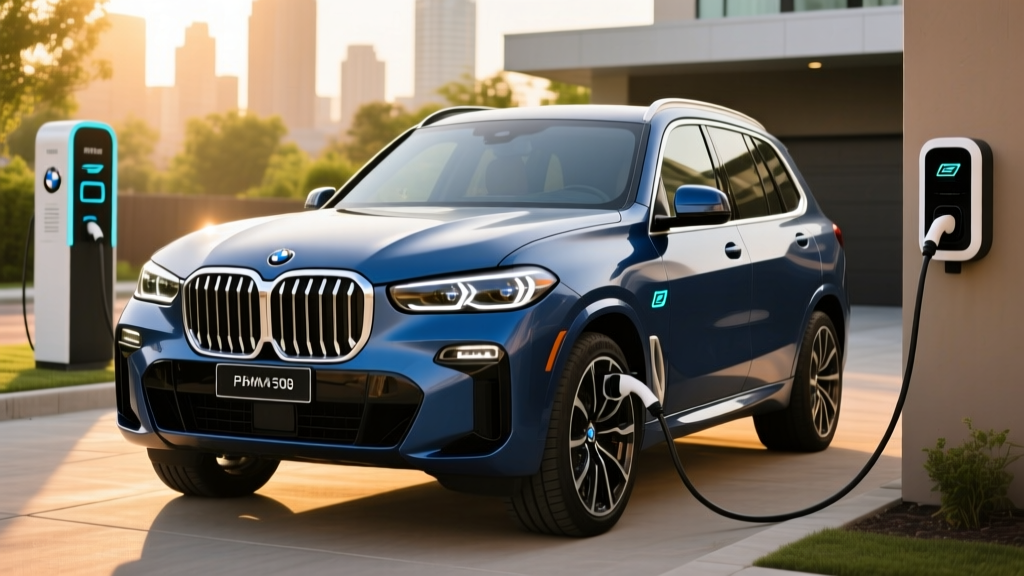
- Plug-In Hybrid (PHEV): The 2024 X5 xDrive50e has a 25.7 kWh battery you plug in to charge. It delivers 38 miles of pure electric driving before the gasoline inline-six seamlessly takes over. You can also drive it without ever plugging in — it functions as a conventional hybrid in that case, but you forfeit most of the efficiency benefit.
The xDrive50e replaces the older xDrive45e with a larger battery, more electric motor output, and a revised powertrain that bumps total system output from 389 hp to 483 hp. The jump is significant: this PHEV outperforms the gas-only X5 xDrive40i (375 hp) while offering substantially better city efficiency when charged regularly.
Fuel Economy: EPA Numbers vs. Real-World MPG
| Driving Mode | City | Highway | Combined |
|---|---|---|---|
| Electric + Gas (MPGe) | — | — | 56 MPGe |
| Gas Only (charge-depleted) | 27 MPG | 28 MPG | 27 MPG |
According to fueleconomy.gov, the 2024 X5 xDrive50e earns 56 MPGe combined when operating with a charged battery, blending electric and gasoline driving. Once the battery depletes to its buffer threshold (approximately 10–12% state of charge reserved for hybrid assist), the vehicle reverts to conventional hybrid mode at 27 MPG combined.
Real-world expectations: PHEVs are uniquely sensitive to how often you charge. If you plug in nightly and your commute falls within the 38-mile electric window, your actual gasoline consumption may approach zero for months at a time — owners report 80–100+ MPGe equivalent in this pattern. Conversely, if you never plug in, expect 25–27 MPG combined in mixed driving, which is only marginally better than the gas-only X5 xDrive40i's 25 MPG combined. Cold weather (below 30°F) reduces electric-only range by roughly 15–25%, bringing the usable EV range down to approximately 28–32 miles.
Highway driving at 75+ mph also compresses efficiency. Expect 24–26 MPG gas-only on sustained interstate trips, and electric-only range drops to roughly 30–33 miles at highway speeds due to higher aerodynamic drag and the absence of regenerative braking opportunities.
Electric-Only Range and Total Driving Range
The 2024 X5 xDrive50e's EPA-rated electric-only range is 38 miles. This is a meaningful improvement over the outgoing xDrive45e's 31-mile rating, thanks to the larger 25.7 kWh usable battery pack (up from 21.5 kWh).
EPA Electric Range: 38 miles
Real-World Expectation: 32–38 miles in mild weather (mixed city/suburban); 28–32 miles in cold weather or at sustained highway speeds. Expect 34–36 miles in typical 60°F commuter driving with moderate HVAC use.
Total combined range — electric plus the 18.5-gallon fuel tank — reaches approximately 560 miles. This dual-energy architecture is the core PHEV advantage: daily commutes run on cheap electricity, while cross-country road trips rely on gasoline infrastructure with zero range anxiety.
Powertrain Performance: 483 Horsepower in a 5,400-lb SUV
The xDrive50e pairs BMW's B58 3.0-liter turbocharged inline-six (producing 312 hp and 332 lb-ft on its own) with an electric motor integrated into the 8-speed automatic transmission housing (197 hp / 207 lb-ft). Combined system output is 483 hp and 516 lb-ft of torque, routed through BMW's xDrive all-wheel-drive system.
The result is a 0–60 mph time of 4.6 seconds — quicker than the gas-only xDrive40i (5.2 seconds) and approaching the territory of BMW's M-lite performance models. The electric motor fills the torque curve below 2,000 RPM where the turbo is still spooling, delivering immediate off-the-line thrust that makes the X5 feel lighter than its ~5,400-pound curb weight suggests.
Three driving modes manage the powertrain:
- Electric mode: Pure EV driving up to 87 mph, using only battery energy.
- Hybrid mode: The car's default — it blends electric and gas intelligently based on speed, load, and navigation data (if a route is set, it optimizes battery usage across the trip).
- Sport mode: Both power sources deliver maximum output simultaneously; the engine stays running for aggressive throttle response.
Charging: Level 2 Only, No DC Fast Charging
The 2024 X5 xDrive50e accepts AC charging only — there is no DC fast charging capability, which is typical for PHEVs in this class (the Toyota RAV4 Prime, Jeep Wrangler 4xe, and Volvo XC60 Recharge similarly lack DC fast charging).
| Charging Level | Power (kW) | Time (0–100%) | Miles of EV Range per Hour |
|---|---|---|---|
| Level 1 (120V household outlet) | ~1.4 kW | ~18–20 hours | ~2 miles/hr |
| Level 2 (240V, 32A home/public) | 7.4 kW (max) | ~3.75 hours | ~10 miles/hr |
| DC Fast Charging | N/A | N/A | N/A |
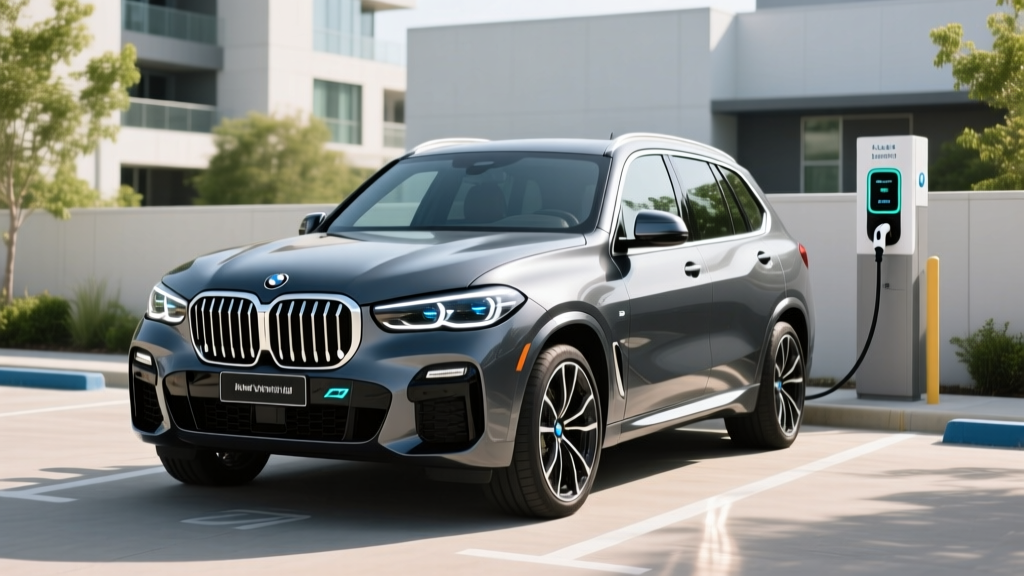
At the maximum 7.4 kW Level 2 rate, a full charge takes approximately 3 hours and 45 minutes. A standard 48-amp Level 2 home charger (like a ChargePoint Home Flex or BMW's own Wallbox) delivers the full 7.4 kW the vehicle can accept. Level 1 trickle charging from a standard 120V outlet is technically possible but impractical for daily use — it would require nearly 20 hours for a full charge, meaning you'd only recover roughly 20 miles of EV range overnight.
Practical charging advice: Most PHEV owners charge nightly on Level 2. Since the battery is relatively small (25.7 kWh), a 3.75-hour charge window means plugging in at 8 PM gives you a full battery by midnight. For daily commuting within the 38-mile window, you rarely need a "full" charge — even a 2-hour top-up adds ~20 miles of electric range.
Pricing, Tax Credits, and Total Cost of Ownership
The 2024 BMW X5 xDrive50e starts at $73,795 (including $995 destination). That's approximately $7,800 more than the gas-only X5 xDrive40i ($65,995). Popular options — the Premium Package, Driving Assistance Professional, and larger wheels — can push a well-equipped example past $85,000.
Federal §30D Tax Credit Eligibility (2024–2026 rules):
- Maximum credit: Up to $3,750 (partial — critical minerals requirement may not be fully met; verify current sourcing status on IRS.gov qualified vehicle list).
- MSRP cap: SUVs must be under $80,000 — the base xDrive50e qualifies, but options can push it above the cap.
- Buyer income cap: Modified AGI ≤ $150,000 (single) / $300,000 (joint).
- Battery sourcing: Critical minerals and battery component requirements phase in annually. The X5's battery supply chain may only partially satisfy 2024–2026 rules, reducing the credit to $3,750 or potentially $0 depending on the purchase date and current IRS guidance.
- Point-of-sale transfer: Eligible buyers can transfer the credit to the dealer at purchase, reducing the upfront price rather than waiting for a tax refund.
5-year ownership cost estimate: Assuming 15,000 miles/year, $0.14/kWh electricity, $3.70/gallon gasoline, and 70% of driving done on electric power (with nightly home charging), the xDrive50e uses approximately 350 gallons of gas annually (~$1,295/year) versus the gas-only xDrive40i at roughly 600 gallons (~$2,220/year). Annual fuel savings of ~$925 partially offset the $7,800 price premium over 5 years ($4,625 in fuel savings), leaving a net cost premium of ~$3,175 — before accounting for the federal tax credit, which could narrow or close that gap entirely.
Battery Warranty, Reliability, and Replacement Cost
BMW High-Voltage Battery Warranty: 8 years / 80,000 miles (whichever comes first), covering defects and capacity loss below 70% of original capacity. This is federally mandated minimum coverage for PHEV/EV batteries under EPA/CARB rules.
BMW's NMC (nickel-manganese-cobalt) battery chemistry in the xDrive50e is proven in the brand's PHEV lineup since 2019 (with the xDrive45e). Long-term degradation data for the 2024-specific pack is limited given its recent introduction, but the predecessor xDrive45e showed approximately 5–8% capacity loss over 3 years / 45,000 miles in owner-reported data — well within the 70% warranty threshold.
Battery replacement cost: If the high-voltage battery requires replacement outside warranty, expect a cost in the range of $12,000–$18,000 (parts and labor) at a BMW dealer. However, catastrophic battery failure in modern BMW PHEVs is rare; more commonly, individual cell modules can be serviced rather than replacing the entire pack.
General reliability: The B58 inline-six is widely regarded as one of BMW's most reliable modern engines, with timing chain and cooling system improvements over earlier N55 designs. The ZF 8-speed automatic is similarly well-proven. The primary reliability risk for PHEVs is the added complexity of dual powertrains — more components (electric motor, power electronics, charge port, high-voltage wiring) mean more potential failure points than a conventional gas vehicle, though BMW's 4-year/50,000-mile bumper-to-bumper warranty and 8-year powertrain coverage mitigate early-ownership risk.
Who Should Choose the X5 xDrive50e — and Who Shouldn't
Choose the 2024 BMW X5 xDrive50e if:
- Your daily round-trip commute is under 35 miles and you can install a Level 2 charger at home.
- You want luxury SUV performance (483 hp, AWD, premium interior) with reduced fuel costs.
- You take 3+ road trips per year and need 500+ mile total range without charging stops.
- You're not ready to commit to a full EV due to apartment living, unreliable public charging, or frequent long-distance travel.
Choose a full EV (like the BMW iX) instead if:
- You can charge at home AND your daily driving rarely exceeds 250 miles.
- You want to eliminate gasoline entirely — no oil changes, no fuel-system maintenance, no tailpipe emissions.
- You qualify for the full $7,500 federal credit on an eligible EV, making the total cost competitive.
Choose the gas-only X5 xDrive40i instead if:
- You cannot charge at home (no garage, no landlord permission, no electrical capacity).
- Your annual mileage is low (<8,000 miles) — the fuel savings won't offset the PHEV price premium.
- You prefer a lower purchase price and simpler mechanical package.
Pros
- 38-mile electric range covers most daily commutes
- 483 hp with smooth gas-electric blending
- 560+ mile total range eliminates road-trip anxiety
- Quiet, refined EV mode for city driving
- Strong B58 engine reliability track record
- 8-year/80,000-mile battery warranty
Cons
- No DC fast charging — Level 2 only
- $73,795 starting price; options push past $80K (MSRP cap risk)
- Partial or no federal tax credit depending on battery sourcing
- Cargo space reduced vs. gas X5 (battery under floor)
- Level 1 charging is too slow for daily use — Level 2 install required
- Electric range drops to ~28–32 miles in cold weather
Frequently Asked Questions
How many MPG does the 2024 BMW X5 plug-in hybrid get?
The 2024 BMW X5 xDrive50e earns an EPA-rated 56 MPGe combined when using both electric and gasoline power. Once the battery is depleted, it operates as a conventional hybrid at 27 MPG combined (27 city / 28 highway). Real-world fuel economy depends heavily on how often you charge — daily charging with a short commute can yield effective economy well above 80 MPGe, while never charging results in approximately 25–27 MPG.
How far can the 2024 BMW X5 xDrive50e go on electric only?
The EPA rates the xDrive50e at 38 miles of electric-only range. In real-world conditions, expect 32–38 miles in mild weather and 28–32 miles in cold weather or at sustained highway speeds. The electric motor can propel the vehicle up to 87 mph in EV mode.
Does the 2024 BMW X5 PHEV qualify for a federal tax credit?
It may qualify for a partial federal tax credit of up to $3,750 under IRS §30D rules, depending on battery component and critical minerals sourcing at the time of purchase. The full $7,500 credit is unlikely due to partial sourcing compliance. The vehicle must also remain under the $80,000 MSRP cap for SUVs, and the buyer's modified AGI must not exceed $150,000 (single) or $300,000 (joint). Always verify current eligibility on the IRS qualified vehicles page before purchasing.
Is the BMW X5 plug-in hybrid reliable, and what does battery replacement cost?
The xDrive50e's powertrain combines BMW's well-regarded B58 inline-six with proven PHEV components. The high-voltage battery is covered by an 8-year/80,000-mile warranty against defects and capacity loss below 70%. Out-of-warranty battery replacement is estimated at $12,000–$18,000, though full pack replacement is rare — individual module service is more common. Overall reliability is expected to be good, though PHEV complexity adds more potential service points than a conventional gas vehicle.
Can I charge the BMW X5 xDrive50e at a public DC fast charger?
No. The 2024 X5 xDrive50e does not support DC fast charging. It accepts AC charging only, up to 7.4 kW on Level 2. This is standard for most PHEVs — the battery is small enough that Level 2 charging replenishes it fully in under 4 hours, making DC fast charging less necessary. You can charge at any public Level 2 station (J1772 connector) or at home with a 240V Level 2 charger.
Hybrid vs. PHEV vs. full EV — which is right for me?
A conventional hybrid (HEV) requires no plug-in charging and improves fuel economy by 20–35% over a gas car — ideal if you can't charge at home. A PHEV like the X5 xDrive50e offers 30–40 miles of electric range for daily commuting plus gasoline range for long trips — the best compromise if you have home charging but take regular road trips. A full EV (like the BMW iX) offers 250–350 miles of range, zero tailpipe emissions, and the lowest operating costs — best if you can charge at home, have reliable public charging access, and rarely drive more than 250 miles in a single day.