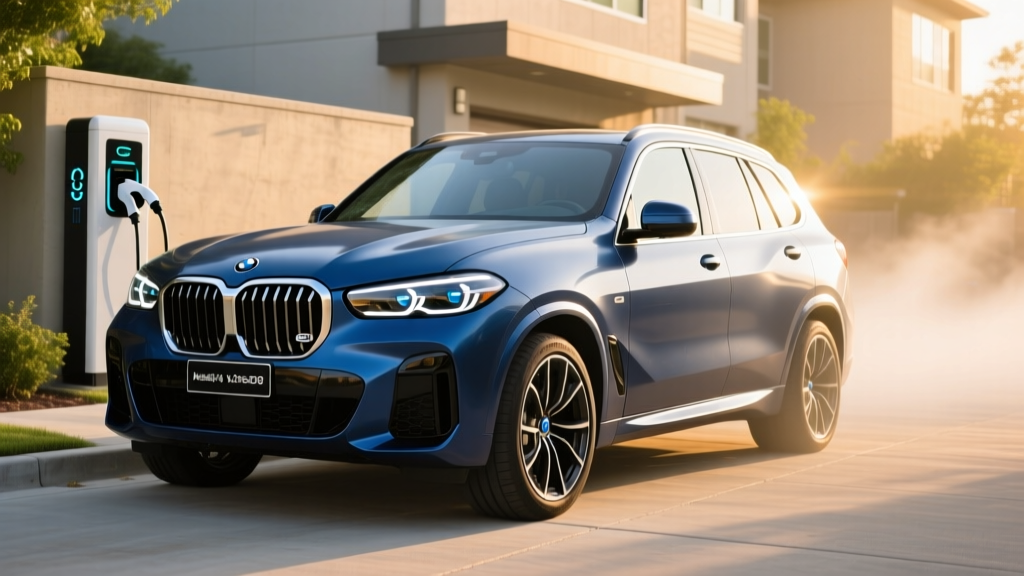
The 2024 BMW X5 xDrive50e represents a significant generational leap for BMW's plug-in hybrid SUV. Replacing the outgoing xDrive45e, the 50e packs a larger battery, more electric-only range, and substantially more combined power — all while maintaining the X5's reputation as one of the best-driving midsize luxury SUVs on the road. For buyers not yet ready to commit to a full battery-electric vehicle but who want meaningful electric daily driving, this PHEV deserves serious consideration.
In this guide, we break down every spec that matters: EPA range and MPGe figures, the real-world efficiency you can actually expect, charging logistics, powertrain output, battery longevity, federal tax credit eligibility under current IRS §30D rules, and whether the X5 PHEV is the right bridge vehicle for your specific driving patterns.
HEV vs. PHEV: What the 2024 BMW X5 Hybrid Actually Is
Let's clear up a common source of confusion immediately. The term "hybrid" covers two very different powertrain architectures, and the 2024 BMW X5 is firmly in the plug-in hybrid (PHEV) camp.
| Feature | Conventional Hybrid (HEV) | Plug-In Hybrid (PHEV) — X5 xDrive50e |
|---|---|---|
| Battery Size | 1–2 kWh | 25.7 kWh (usable: ~22 kWh) |
| Plug In to Charge? | No — self-charging via regen and engine | Yes — Level 1 or Level 2 AC charging |
| Electric-Only Driving | Minimal (low-speed, short bursts) | EPA-rated 38 miles at highway-capable speeds |
| DC Fast Charging | N/A | Not supported (AC only) |
| Fuel Economy When Battery Depleted | Consistently high MPG | Good, but heavier — MPG drops vs. dedicated HEV |
| Federal Tax Credit (§30D) | Not eligible | Potentially eligible — see details below |
The X5 xDrive50e is a PHEV: it has a substantial lithium-ion battery you plug in to charge, an electric motor capable of propelling the vehicle at full highway speeds without the gasoline engine, and a turbocharged inline-six for extended range. BMW does not currently offer a conventional (non-plug-in) HEV version of the X5 in the US market. If you see "2024 BMW X5 hybrid" in search results, it's referring to this plug-in model.
Powertrain and Performance Specs
The xDrive50e pairs a 3.0-liter turbocharged inline-six gasoline engine with a more powerful electric motor integrated into the eight-speed automatic transmission. Combined output is dramatically higher than the previous 45e.
| Specification | 2024 BMW X5 xDrive50e |
|---|---|
| Gasoline Engine | 3.0L turbocharged inline-6 (312 hp / 332 lb-ft) |
| Electric Motor | 184 hp / 207 lb-ft (integrated into transmission) |
| Combined System Output | 483 hp / 516 lb-ft |
| 0–60 mph | 4.6 seconds |
| Drivetrain | xDrive all-wheel drive |
| Transmission | 8-speed automatic (Steptronic) |
| Battery (Gross / Usable) | 25.7 kWh / ~22 kWh |
| Battery Chemistry | NMC (nickel manganese cobalt) |
| Electric-Only Top Speed | 87 mph |
| Towing Capacity | 5,000 lbs (with factory hitch) |
| Cargo Volume (behind 2nd row) | 33.9 cu ft |
That 483-horsepower combined figure puts the xDrive50e in the same performance territory as the previous-generation X5 M50i. The instant torque from the electric motor makes the SUV feel genuinely quick off the line, and the transition between electric and gasoline power is one of the smoothest in the PHEV segment. BMW's eDrive modes — Electric, Hybrid, and Sport — let you choose how aggressively to deploy battery energy or preserve it for later.
EPA Range, MPGe, and Fuel Economy Breakdown
Fuel economy in a PHEV requires two separate measurements: efficiency when running primarily on electricity (expressed as MPGe), and fuel economy once the battery is depleted and the gasoline engine takes over.
| Metric | EPA Rating |
|---|---|
| Combined MPGe (electric + gas) | 56 MPGe |
| Electric-Only Range | 38 miles |
| Total Combined Range (electric + gas) | ~440 miles |
| Gas-Only MPG (battery depleted) — Combined | 25 MPG |
| Gas-Only MPG — City | 23 MPG |
| Gas-Only MPG — Highway | 27 MPG |
| Fuel Tank Capacity | 18.2 gallons |
Source: fueleconomy.gov — 2024 BMW X5 xDrive50e
The EPA's 38-mile electric-only estimate is achievable under moderate conditions — suburban driving at 35–55 mph in mild temperatures. Expect 30–34 miles in cold weather (below 40°F) due to battery chemistry limitations and cabin heating demands. At sustained highway speeds of 70+ mph, plan for roughly 28–32 electric miles before the inline-six fires up. The gas-only 25 MPG combined figure is realistic for mixed driving; highway-only runs can push 27–28 MPG, while heavy city traffic with a depleted battery may dip to 21–22 MPG. The X5's weight (~5,400 lbs) is the primary efficiency penalty when running on gasoline alone.
Charging: How to Replenish the Battery
The xDrive50e supports AC charging only — there is no DC fast-charging capability, which is typical for PHEVs in this class. The onboard charger has been upgraded to 7.4 kW (up from 3.7 kW on the previous 45e), which significantly reduces Level 2 charge times.
| Charging Level | Power | 0–100% Time (approx.) | Practical Use |
|---|---|---|---|
| Level 1 (120V household outlet) | ~1.4 kW | ~16–17 hours | Emergency/top-up only |
| Level 2 (240V, 32A) | 7.4 kW (max onboard) | ~3.25 hours | Home or workplace charging |
| DC Fast Charging | Not supported | N/A | N/A |
For most owners, a Level 2 home wallbox (such as the BMW Wallbox Professional or a third-party unit like the ChargePoint Home Flex) is the practical solution. Plug in overnight and the battery will be fully replenished well before morning — even if you arrive home nearly depleted. The 7.4 kW onboard charger means you don't need a 48-amp circuit; a 40-amp circuit (delivering 32 amps continuous) is sufficient to max out the car's acceptance rate.
Preconditioning tip: Use the BMW Connected app to precondition the cabin while the car is still plugged in. This warms or cools the interior using grid power rather than battery energy, preserving your full 38-mile electric range when you depart.
Battery Longevity, Warranty, and Replacement Cost
- Coverage: 8 years / 80,000 miles (whichever comes first)
- Capacity retention threshold: BMW warrants the battery against defects and excessive capacity loss — typically defined as dropping below ~70% of original capacity
- What's covered: Battery cell defects, module failures, battery management system faults
- What's not covered: Normal gradual degradation within acceptable thresholds, damage from accidents or improper charging equipment
The 25.7 kWh NMC battery in the xDrive50e is larger and more robust than the previous generation's pack. PHEV batteries generally experience less stress than full BEV batteries because they operate within a narrower state-of-charge window — BMW's battery management system maintains buffers at the top and bottom to protect long-term health.
Is the 2024 BMW X5 hybrid reliable? BMW's PHEV powertrains have proven reasonably dependable in real-world ownership. The inline-six (B58 engine family) is widely regarded as one of BMW's most reliable modern engines. The electric motor, having far fewer moving parts than the combustion side, rarely causes issues. The primary long-term concern is high-voltage battery degradation, but the 8-year/80,000-mile warranty provides substantial coverage.
Battery replacement cost: If the battery requires full replacement outside of warranty, expect a range of $12,000–$18,000 including parts and labor at a BMW dealership. However, module-level repairs (replacing individual cell modules rather than the entire pack) can reduce this to $3,000–$6,000 depending on the failure. Most PHEV batteries from established manufacturers last well beyond their warranty period with 15–20% capacity loss over 10–12 years of typical use.
Pricing, Trims, and Federal Tax Credit Eligibility
The 2024 BMW X5 xDrive50e comes in a single well-equipped trim, with options packages available for additional features.
| Item | Amount |
|---|---|
| Base MSRP | $73,475 (including $995 destination) |
| Typical Options (Premium Package, Driving Assistance, etc.) | +$5,000–$10,000 |
| As-Tested Price Range | $78,000–$85,000 |
Does the 2024 BMW X5 xDrive50e Qualify for a Federal Tax Credit?
Under the IRS §30D Clean Vehicle Credit, the X5 xDrive50e is potentially eligible for up to $3,750 — not the full $7,500. Here's why the credit is limited and conditional:
- MSRP cap: SUVs must have an MSRP at or below $80,000. The X5 xDrive50e base price qualifies, but heavily optioned units can exceed this cap — check your specific window sticker.
- Battery sourcing requirements: The $7,500 credit is split into two halves — $3,750 for critical minerals sourcing and $3,750 for battery component manufacturing. As of 2024, the X5 xDrive50e's battery supply chain meets the critical minerals threshold but not the full component manufacturing requirement, resulting in $3,750 eligibility.
- Buyer income limits: Modified adjusted gross income (MAGI) must not exceed $300,000 (married filing jointly), $225,000 (head of household), or $150,000 (single).
- Point-of-sale transfer: You can transfer the credit to the dealer at purchase for an immediate price reduction rather than claiming it on your tax return.
- Battery capacity minimum: The 25.7 kWh pack exceeds the 7 kWh minimum for full credit consideration.
Source: IRS.gov — Clean Vehicle Credits
Important caveat: Battery sourcing requirements tighten annually. A vehicle eligible for $3,750 in 2024 may have different eligibility in subsequent model years. Always verify current eligibility on the IRS clean vehicle credit page and consult a tax professional before making a purchase decision based on credit assumptions.
Who Should Choose the X5 xDrive50e vs. a Full EV or Gas SUV?
Choose the X5 xDrive50e if:
- Your daily commute is under 35 miles round-trip and you can charge at home — you'll drive electric most weekdays and use gas only for longer trips
- You want a luxury midsize SUV with genuine performance (483 hp, 4.6-second 0–60) and can't yet commit to a full EV due to road-trip charging concerns
- You live in an area with limited DC fast-charging infrastructure but still want to reduce fuel consumption
- You need 5,000-lb towing capacity — something most electric SUVs in this price range struggle to match efficiently
- You want to "test the waters" of electric driving before a future full BEV purchase
Choose a full EV (e.g., BMW iX, Tesla Model X, Rivian R1S) if:
- You have reliable home Level 2 charging and your daily driving is under 250 miles
- You want zero tailpipe emissions and minimal drivetrain maintenance (no oil changes, no transmission fluid)
- You can access DC fast charging for road trips and accept 20–30 minute charge stops
- You want the lowest per-mile energy cost — electricity is typically 3–5 cents per mile vs. 12–18 cents for gasoline
Choose the gas-only X5 xDrive40i if:
- You cannot install a Level 2 charger at home (apartment, street parking, no garage)
- Your driving is predominantly highway and long-distance — the PHEV's weight penalty hurts gas-only highway MPG
- You want the lowest purchase price and aren't motivated by electric driving
Pros and Cons
- 38 miles of electric-only range covers most daily commutes
- 483 hp combined output — genuinely fast for a 5,400-lb SUV
- Seamless electric-to-gas power transitions
- 7.4 kW onboard charger (fast for a PHEV)
- Retains X5's excellent driving dynamics and ride quality
- 5,000-lb towing capacity
- Potentially eligible for $3,750 federal tax credit
- No range anxiety — gas engine provides ~440 total miles
- No DC fast-charging capability
- $73,475 starting price is steep — options push it past $80K MSRP cap
- Gas-only MPG (25 combined) is unremarkable for the class when battery is depleted
- Cargo space slightly reduced vs. gas X5 due to battery placement
- Heavy — 5,400+ lbs impacts tire wear and braking distances
- $3,750 tax credit is less than many competing PHEVs and all eligible BEVs
- Requires home Level 2 charging to realize full value — without it, you're driving an expensive, heavy gas SUV
Frequently Asked Questions
How many MPG does the 2024 BMW X5 hybrid get?
The EPA rates the X5 xDrive50e at 56 MPGe when combining electric and gasoline operation. Once the battery is depleted, it returns 25 MPG combined (23 city / 27 highway) on gasoline alone. In real-world driving, if you charge nightly and commute under 35 miles, you may go weeks without visiting a gas station.
How far can the 2024 BMW X5 xDrive50e go on electric only?
The EPA rates it at 38 miles of electric-only range. Real-world results vary: expect 30–34 miles in cold weather and 28–32 miles at sustained highway speeds. In mild conditions with moderate suburban driving, 38 miles is achievable.
Does the BMW X5 hybrid need to be plugged in?
Yes — the X5 xDrive50e is a plug-in hybrid (PHEV), not a conventional self-charging hybrid. To take advantage of the 38-mile electric range, you need access to a Level 1 (120V) or Level 2 (240V) charging source. You can drive it without ever plugging in, but you'll operate solely as a gasoline vehicle with 25 MPG combined — negating most of the PHEV's value.
Is the 2024 BMW X5 hybrid reliable?
BMW's B58 inline-six engine is well-regarded for reliability, and the PHEV system has proven durable in the previous-generation xDrive45e. The high-voltage battery is covered by an 8-year/80,000-mile warranty. Long-term data specific to the 50e is still accumulating, but the powertrain architecture is a proven evolution rather than an all-new design. Out-of-warranty battery replacement would cost $12,000–$18,000, though module-level repairs are significantly cheaper.
Does the 2024 BMW X5 xDrive50e qualify for a federal tax credit?
It is potentially eligible for up to $3,750 under the IRS §30D Clean Vehicle Credit — not the full $7,500. Eligibility depends on the vehicle's MSRP staying at or below $80,000 (SUV cap), the buyer's income not exceeding IRS thresholds, and battery sourcing compliance. The credit can be transferred to the dealer at point of sale for an immediate price reduction. Always verify current eligibility at IRS.gov and consult a tax professional.
Can the BMW X5 xDrive50e DC fast charge?
No. The X5 xDrive50e supports AC charging only, up to 7.4 kW on a Level 2 station. A full charge takes approximately 3.25 hours. This is standard for PHEVs — the smaller battery doesn't require (and the vehicle doesn't include) DC fast-charging hardware.
What is the total driving range of the X5 xDrive50e?
Combining the 38-mile electric range with the 18.2-gallon fuel tank (yielding roughly 400+ miles on gasoline), total range is approximately 440 miles. This eliminates range anxiety entirely for road trips — you refuel at any gas station in minutes.