Quick Verdict: The 2024 Audi Q5 TFSI e in Three Sentences
The 2024 Audi Q5 plug-in hybrid (badged Q5 55 TFSI e) is a luxury compact SUV that pairs a turbocharged 2.0-liter four-cylinder with a 17.9 kWh battery and an integrated electric motor for a combined 362 horsepower. With an EPA-estimated 23 miles of electric-only driving and 61 MPGe when blending electricity and gasoline, it targets commuters who want silent, zero-tailpipe-emission daily trips without sacrificing the flexibility of a gasoline engine for longer road trips. However, its modest electric range and lack of DC fast charging mean it works best for drivers with reliable home Level 2 charging and round-trip commutes under 25 miles.
HEV vs. PHEV: Understanding What the Q5 TFSI e Actually Is
Before diving into specs, it's critical to distinguish between a conventional hybrid (HEV) and a plug-in hybrid (PHEV), because Audi sells the Q5 in multiple configurations:
Conventional Hybrid (HEV)
- Small battery (~1–2 kWh), recharged only by regenerative braking and the engine
- Never plugs in — no charging equipment needed
- Electric motor assists the gas engine but cannot drive the car alone for meaningful distances
- Typical efficiency gain: 15–30% over a gas-only equivalent
Plug-In Hybrid (PHEV) — The Q5 55 TFSI e
- Larger battery (17.9 kWh gross / ~14.1 kWh usable), charges via plug
- Can drive on electricity alone for 23 EPA-estimated miles
- Once the battery depletes, operates like a conventional hybrid using the gas engine
- Requires home or workplace charging infrastructure to realize full efficiency benefits
If you cannot install a Level 2 home charger or lack workplace charging access, the PHEV premium over a standard Q5 45 TFSI (mild-hybrid gas model) is difficult to justify. You'd be carrying extra battery weight without using its electric capability.
Range, MPGe, and Fuel Economy: The Numbers That Matter
| Metric | EPA Estimate | Real-World Expectation |
|---|---|---|
| Electric-only range | 23 miles | 18–22 mi (highway/cold); 23–25 mi (city/mild weather) |
| MPGe (electric + gas combined) | 61 MPGe | 50–60 MPGe with regular charging; drops sharply without plug-in use |
| Gas-only MPG (battery depleted, combined) | 26 MPG | 24–27 MPG combined; 22–24 highway at 75+ mph |
| Gas-only city MPG | 25 MPG | 24–28 MPG (regen helps in stop-and-go) |
| Gas-only highway MPG | 27 MPG | 23–26 MPG at sustained speeds above 70 mph |
| Total combined range (full tank + full battery) | ~440 miles | 380–430 miles depending on driving style and conditions |
According to fueleconomy.gov, the 2024 Q5 55 TFSI e achieves 61 MPGe combined when operating in blended electric-gasoline mode and 26 MPG combined once the battery is depleted. For comparison, the non-plug-in Q5 45 TFSI (mild hybrid) returns 25 MPG combined — meaning the PHEV only delivers meaningful efficiency gains if you actually plug it in regularly.
Powertrain, Battery, and Charging Specifications
| Specification | 2024 Audi Q5 55 TFSI e |
|---|---|
| Engine | 2.0L turbocharged inline-4 (261 hp / 273 lb-ft) |
| Electric motor | Permanent-magnet synchronous (141 hp / 258 lb-ft) |
| Combined system output | 362 hp / 369 lb-ft torque |
| Transmission | 7-speed S tronic dual-clutch automatic |
| Drivetrain | quattro all-wheel drive |
| Battery gross capacity | 17.9 kWh |
| Battery usable capacity | ~14.1 kWh |
| Battery chemistry | NMC (nickel manganese cobalt) |
| Level 1 charging (120V, 12A) | ~1.4 kW — full charge in ~10 hours |
| Level 2 charging (240V, 32A) | 7.2 kW — full charge in ~2.5 hours |
| DC fast charging | Not available |
| Charge port / connector | J1772 (Level 1/2) |
| 0–60 mph | 5.0 seconds (Audi-estimated) |
| Fuel tank capacity | 14.3 gallons (premium required) |
| Cargo volume (behind 2nd row) | 24.7 cu ft (slightly reduced vs. gas Q5 due to battery) |
Charging Reality: What 7.2 kW Means in Practice
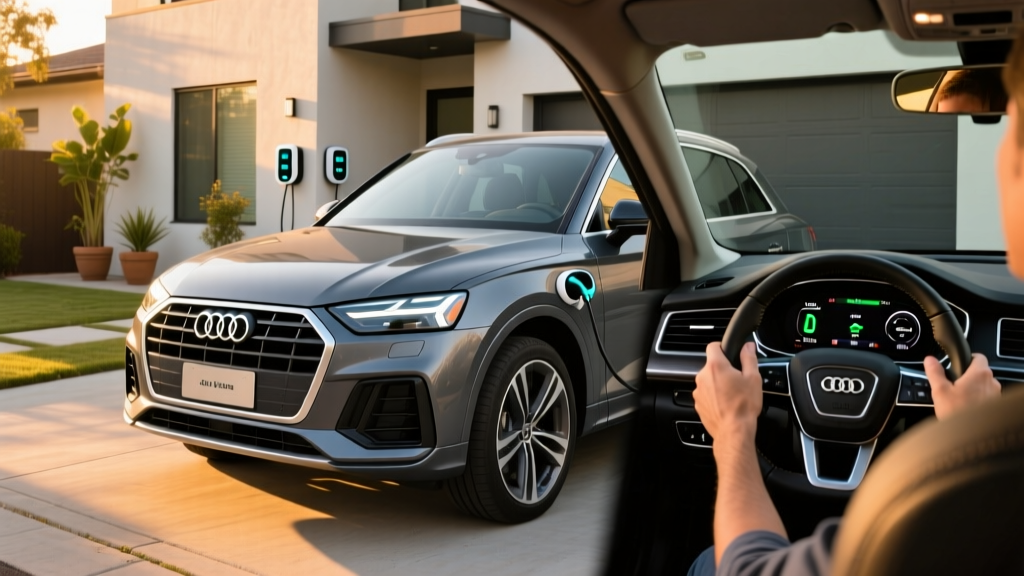
The Q5 TFSI e's 7.2 kW onboard charger is adequate for overnight replenishment but means you cannot take advantage of faster public Level 2 stations that deliver 11–19 kW. A full 0–100% charge on a home Level 2 charger (240V, 32A or higher) takes approximately 2.5 hours. On a standard 120V household outlet (Level 1), expect roughly 10 hours for a full charge — workable if you park in a garage overnight but too slow for midday top-ups.
The absence of DC fast charging is typical for PHEVs in this segment. The BMW X3 xDrive30e and Volvo XC60 Recharge also lack DC fast-charge capability. For a PHEV with a 14.1 kWh usable battery, DC fast charging would add cost and weight for minimal practical benefit — most PHEV owners charge exclusively at home.
Pricing, Trims, and Federal Tax Credit Eligibility
The 2024 Audi Q5 55 TFSI e is offered in three trims, with pricing that reflects its position as a premium compact PHEV SUV:
| Trim | MSRP (incl. destination) |
|---|---|
| Premium | $58,995 |
| Premium Plus | $62,395 |
| Prestige | $66,595 |
Does the 2024 Q5 TFSI e Qualify for the Federal §30D Tax Credit?
Current §30D rules (IRS): The Q5 55 TFSI e's eligibility for the up-to-$3,750 federal plug-in hybrid tax credit depends on several factors that change frequently:
- Battery sourcing & critical minerals: Under the Inflation Reduction Act, the credit is split into two halves — $3,750 for battery component sourcing and $3,750 for critical minerals. The Q5 TFSI e's eligibility for each half depends on where its NMC battery cells and raw materials are sourced. Audi has not publicly confirmed full compliance for the 2024 model year.
- MSRP cap: The Q5 TFSI e is classified as an SUV under IRS rules, with an $80,000 MSRP cap. All trims fall well under this limit.
- Buyer income cap: Modified adjusted gross income must not exceed $150,000 (single), $225,000 (head of household), or $300,000 (married filing jointly).
- Point-of-sale transfer: If eligible, the credit can be transferred to the dealer at purchase, reducing your out-of-pocket cost immediately rather than waiting for tax filing.
Always verify current eligibility on IRS.gov or consult a tax professional before relying on credit amounts in your purchase decision. Rules and eligible vehicle lists are updated periodically by the Treasury Department.
Battery Warranty, Reliability, and Long-Term Ownership Costs
Audi PHEV Battery Warranty
- High-voltage battery: 8 years / 100,000 miles (whichever comes first)
- Capacity retention threshold: Audi warrants the battery against defects and excessive capacity loss — typically defined as dropping below 70% of original capacity during the warranty period
- Powertrain warranty: 4 years / 50,000 miles (covers engine, transmission, electric motor)
- Limited vehicle warranty: 4 years / 50,000 miles bumper-to-bumper
How Long Will the PHEV Battery Last?
Audi's NMC battery in the Q5 TFSI e is engineered for longevity, but like all lithium-ion packs, it will gradually lose capacity over time and charge cycles. Based on industry data from similar PHEV platforms (BMW, Volvo, VW Group), owners can expect approximately 10–15% capacity degradation over 8–10 years of typical use. Because the Q5 TFSI e has a ~14.1 kWh usable capacity, a 15% loss would reduce electric-only range from 23 miles to roughly 19–20 miles — still functional for short commutes.
The thermal management system (liquid cooling) helps mitigate degradation by keeping the battery within an optimal temperature range during charging and discharging. This is a significant advantage over passively cooled PHEV batteries in older or less sophisticated designs.
Battery Replacement Cost
Out-of-warranty high-voltage battery replacement for the Q5 TFSI e is estimated at $8,000–$12,000 including parts and labor, based on VW Group PHEV platform pricing. This is a significant expense, though most owners will never face it — the battery is designed to outlast the vehicle's typical ownership cycle, and the 8-year/100,000-mile warranty provides substantial coverage.
Reliability Considerations
The Q5 TFSI e adds complexity over the gas-only Q5 — there's an electric motor, power electronics, onboard charger, and high-voltage battery in addition to the turbocharged engine and dual-clutch transmission. Audi's PHEV powertrain has been in production since the 2020 model year, and while major failures are uncommon, the added components do represent additional potential service points. The IIHS has rated the Q5 highly for crashworthiness, which speaks to overall build quality.
Who Should Choose the Q5 PHEV vs. a Full EV or Gas SUV?
Choose the 2024 Q5 TFSI e (PHEV) if:
- Your daily round-trip commute is 20 miles or less and you can charge at home every night
- You regularly take road trips exceeding 200 miles and don't want to plan around DC fast-charging stops
- You want a luxury compact SUV with strong acceleration (362 hp, 5.0s 0–60) and quattro AWD
- You live in an apartment or area with limited public charging infrastructure
- You want to reduce fuel consumption without fully committing to an EV
Choose a full EV (e.g., Audi Q4 e-tron, Tesla Model Y) if:
- You have reliable home Level 2 charging and your daily driving is under 250 miles
- You want to eliminate gasoline costs and engine maintenance entirely
- You want a longer electric range (200–300+ miles) and DC fast charging for road trips
- You want to maximize federal tax credit eligibility (many EVs qualify for the full $7,500)
Choose the gas Q5 45 TFSI (mild hybrid) if:
- You cannot install a home charger and lack workplace charging
- You want a lower purchase price (the gas Q5 starts ~$14,000 less than the PHEV)
- Your driving is predominantly highway/long-distance where PHEV electric range offers minimal benefit
- You prefer simpler mechanicals with fewer components that could require service
Pros and Cons at a Glance
Pros
- 362 hp and 5.0s 0–60 make it genuinely quick for a PHEV SUV
- 23 miles of electric-only range covers most daily commutes
- quattro AWD and refined ride quality expected of Audi
- No range anxiety — gas engine provides 440+ total miles
- Premium interior with 10.1-inch MMI touchscreen, virtual cockpit
- 7.2 kW Level 2 charging fully replenishes battery in ~2.5 hours
Cons
- 23 miles electric range is modest — rivals like the Toyota RAV4 Prime offer 42 miles
- No DC fast charging capability
- MSRP starting near $59K; PHEV premium over gas Q5 is ~$14,000
- Federal tax credit eligibility uncertain and likely partial ($3,750 max)
- Cargo space reduced to 24.7 cu ft vs. 25.8 cu ft in gas Q5
- Fuel tank reduced to 14.3 gallons to accommodate battery, limiting gas-only range
Frequently Asked Questions
How many MPG does the 2024 Audi Q5 plug-in hybrid get?
The EPA rates the 2024 Q5 55 TFSI e at 61 MPGe combined when blending electric and gasoline power, and 26 MPG combined (25 city / 27 highway) once the battery is depleted and it operates as a conventional hybrid. Real-world gas-only MPG typically ranges from 24–27 combined depending on driving style, terrain, and temperature.
How far can the 2024 Q5 TFSI e go on electric power alone?
The EPA estimates 23 miles of electric-only range. In real-world conditions, expect 18–22 miles in cold weather or at highway speeds, and up to 25 miles in mild city driving. Once the battery is depleted, the 2.0L turbo engine takes over seamlessly.
Does the 2024 Audi Q5 plug-in hybrid qualify for a federal tax credit?
It may qualify for a partial credit of up to $3,750 under the IRS §30D clean vehicle credit, depending on battery sourcing compliance, your income, and current Treasury guidance. The MSRP falls under the $80,000 SUV cap. Verify eligibility on fueleconomy.gov and IRS.gov before purchasing, as eligible vehicle lists are updated regularly.
Can I charge the Q5 TFSI e at a DC fast charger?
No. The Q5 55 TFSI e does not support DC fast charging. It charges exclusively via Level 1 (120V) or Level 2 (240V) using a J1772 connector. At 7.2 kW on Level 2, a full charge takes approximately 2.5 hours.
Is the Q5 PHEV battery reliable and what does replacement cost?
Audi warrants the high-voltage battery for 8 years / 100,000 miles against defects and excessive capacity loss (typically below 70% retention). Out-of-warranty replacement is estimated at $8,000–$12,000. With liquid-cooled thermal management, real-world degradation is typically 10–15% over a decade, which is manageable given the relatively small battery.
How does the Q5 PHEV compare to the BMW X3 xDrive30e and Volvo XC60 Recharge?
The Q5 TFSI e (362 hp, 23 mi range, ~$59K) sits between the BMW X3 xDrive30e (288 hp, 22 mi range, ~$54K) and the Volvo XC60 Recharge (455 hp, 35 mi range, ~$58K) in the luxury PHEV SUV segment. The Volvo offers the longest electric range and most power; the BMW is the most affordable; the Audi balances performance with refinement and quattro AWD.
Should I buy the PHEV or wait for a fully electric Audi SUV?
If you can charge at home and your daily driving is under 200 miles, the Audi Q4 e-tron (265 mi EPA range, starting ~$50K) may be a better long-term choice with lower running costs and full $7,500 tax credit eligibility (subject to current rules). Choose the Q5 PHEV if you need the Q5's size, frequently drive long distances, or lack reliable access to DC fast charging on your typical routes.