Quick Verdict: A Torque-Heavy Hybrid Workhorse
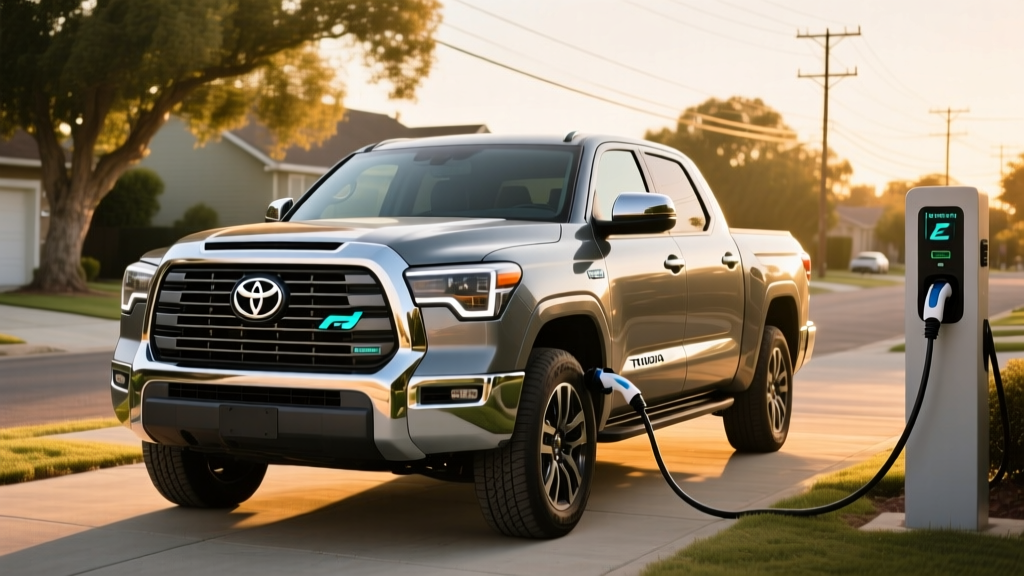
The 2023 Toyota Tundra Hybrid (badged i-FORCE MAX) pairs a twin-turbo V6 with an electric motor sandwiched between the engine and transmission, delivering 437 horsepower and 583 lb-ft of torque — figures that rival much larger V8s while sipping fuel at an EPA-rated 22 MPG combined. This is a conventional hybrid (HEV), not a plug-in. You never plug it in; the 1.87 kWh battery recharges through regenerative braking and the gasoline engine. For full-size truck buyers who need serious towing and payload but want to cut fuel costs without changing their refueling habits, the Tundra Hybrid occupies a rare middle ground.
| Spec | Value |
|---|---|
| Powertrain | 3.5L Twin-Turbo V6 + Electric Motor (i-FORCE MAX) |
| Combined Horsepower | 437 hp |
| Combined Torque | 583 lb-ft |
| Transmission | 10-speed automatic |
| Battery Capacity | 1.87 kWh (NiMH, sealed) |
| Drivetrain | RWD or 4WD (part-time) |
| EPA Fuel Economy (4WD) | 20 city / 24 highway / 22 combined MPG |
| EPA Fuel Economy (RWD) | 20 city / 26 highway / 22 combined MPG |
| Max Towing Capacity | 12,000 lbs (properly equipped) |
| Max Payload | 1,940 lbs |
| 0-60 mph | ~5.7 seconds (MotorTrend tested) |
| Base MSRP (SR5 Hybrid) | ~$53,505 |
| Hybrid Battery Warranty | 10 years / 150,000 miles |
Fuel Economy: EPA Ratings vs. Real-World MPG
According to fueleconomy.gov, the 2023 Tundra Hybrid 4WD returns 20 MPG city, 24 MPG highway, and 22 MPG combined. The rear-wheel-drive variant bumps highway to 26 MPG while holding 22 combined. These numbers are a meaningful improvement over the non-hybrid i-FORCE V6, which manages 17/22/19 (city/highway/combined) with 4WD — a 3 MPG combined advantage for the hybrid.
| Truck | City MPG | Highway MPG | Combined MPG |
|---|---|---|---|
| 2023 Tundra Hybrid i-FORCE MAX (4WD) | 20 | 24 | 22 |
| 2023 Tundra i-FORCE (non-hybrid, 4WD) | 17 | 22 | 19 |
| 2023 Ford F-150 PowerBoost Hybrid (4WD) | 18 | 23 | 20 |
| 2023 Ram 1500 eTorque V8 (4WD) | 15 | 21 | 17 |
| 2023 Chevy Silverado 1500 2.7T (4WD) | 18 | 21 | 19 |
Real-World MPG: What to Actually Expect
Toyota's hybrid system excels in stop-and-go city driving, where the electric motor handles low-speed propulsion and regenerative braking recovers energy. In mixed suburban driving, owners commonly report 21-23 MPG — close to or slightly above the EPA combined figure. On sustained highway trips at 75 mph, expect the number to settle around 20-22 MPG for 4WD models. Towing a 6,000-lb trailer drops economy to roughly 12-14 MPG, which is typical for the segment under load but worth budgeting for if you tow frequently.
Cold weather reduces fuel economy by roughly 5-10% in hybrids, as the engine runs more often to maintain cabin heat and the battery operates less efficiently below freezing. If you live in northern climates, plan for 19-20 MPG combined in winter months.
Hybrid vs. Plug-In Hybrid vs. Full EV: Which Truck Fits You?
The Tundra Hybrid is a conventional HEV. It has no plug, no electric-only range, and no external charging requirement. This distinction matters because several competitors and upcoming trucks blur the lines. Here's how the three electrified truck categories break down:
| Factor | HEV (Tundra Hybrid) | PHEV (e.g., F-150 PHEV concepts) | BEV (e.g., F-150 Lightning, R1T) |
|---|---|---|---|
| Plug in to charge? | No | Yes | Yes |
| Electric-only range | 0 miles | 20-40 miles (typical) | 230-400 miles |
| Fuel/energy source | Gasoline only | Gasoline + electricity | Electricity only |
| Home charging needed? | No | Recommended (Level 2) | Required (Level 2) |
| Federal tax credit | Not eligible (§30D) | Up to $7,500 (if eligible) | Up to $7,500 (if eligible) |
| Refueling time | ~5 minutes | ~5 min gas / 2-4 hr charge | 20-45 min DC fast / 8-10 hr L2 |
| Best for | No home charging, heavy towing | Short commutes + long trips | Home charging access, daily driving |
Choose the Tundra Hybrid (HEV) if: You don't have access to home or workplace charging, you tow heavy loads regularly (where battery weight in BEVs reduces payload), you want lower fuel costs without changing your routine, or you operate in areas with sparse DC fast-charging infrastructure.
Consider a full EV truck if: You have Level 2 home charging, your daily driving stays under 250 miles, you want near-zero maintenance costs, and you can plan road trips around charging stops.
Powertrain Deep Dive: How the i-FORCE MAX Works
The i-FORCE MAX powertrain uses Toyota's 3.5-liter twin-turbocharged V6 (the V35A-FTS engine) paired with a 48-horsepower electric motor-generator positioned between the engine and the 10-speed automatic transmission. This is a parallel hybrid architecture — both the gas engine and electric motor can drive the wheels simultaneously, or the motor can assist during acceleration and low-speed maneuvers.
The system produces a combined 437 hp and 583 lb-ft of torque, with peak torque arriving at just 2,000 RPM thanks to the electric motor's instant response. This gives the Tundra Hybrid a notably responsive feel from a stop and strong mid-range pull when merging or climbing grades — areas where the non-hybrid V6 (389 hp, 479 lb-ft) feels noticeably softer.
The 1.87 kWh nickel-metal hydride (NiMH) battery pack is compact, mounted under the rear seats. It's intentionally small because the system doesn't need to store energy for electric-only driving — it simply buffers regenerative braking energy and smooths power delivery. Toyota has used NiMH chemistry in its hybrids for decades, and the trade-off versus lithium-ion is slightly lower energy density but proven long-term reliability and thermal stability.
Pricing, Trims, and Tax Credit Eligibility
The 2023 Tundra Hybrid is available across multiple trims, starting at the SR5 level. Here's the approximate MSRP breakdown (destination charge included):
- SR5 i-FORCE MAX: ~$53,505
- Limited i-FORCE MAX: ~$58,960
- Platinum i-FORCE MAX: ~$63,505
- 1794 Edition i-FORCE MAX: ~$64,010
- TRD Pro i-FORCE MAX: ~$68,995
- Capstone i-FORCE MAX: ~$75,025
Does the Tundra Hybrid Qualify for a Federal Tax Credit?
No. Under the IRS §30D Clean Vehicle Credit, only plug-in electric vehicles (BEVs and PHEVs with at least 7 kWh of battery capacity) qualify. The Tundra Hybrid's 1.87 kWh battery and conventional HEV architecture make it ineligible for the federal EV tax credit. There is currently no federal tax credit specifically for conventional hybrids.
Some states offer their own incentives for fuel-efficient vehicles, but these vary widely by jurisdiction and change frequently. Check your state's energy or environmental agency website, or consult a tax professional, to determine whether any local incentives apply. For federal rules, the IRS Clean Vehicle Credits page is the authoritative source.
Battery Warranty, Reliability, and Replacement Cost
Toyota Hybrid Battery Warranty: 10 years or 150,000 miles (whichever comes first), covering defects and capacity loss below a specified threshold. This applies to all 2023 Toyota hybrids, including the Tundra i-FORCE MAX. The warranty is transferable to subsequent owners.
How Long Will the Hybrid Battery Last?
Toyota's hybrid battery track record is among the best in the industry. NiMH packs in models like the Prius and Highlander Hybrid routinely exceed 200,000 miles with minimal degradation. The Tundra's relatively small 1.87 kWh pack undergoes shallow charge-discharge cycles (it rarely depletes fully or charges to absolute maximum), which is the gentlest possible usage pattern for battery longevity.
Based on Toyota's history with similar systems, expect the Tundra Hybrid battery to last the life of the truck in most cases. If replacement becomes necessary outside warranty, current estimates for a Toyota hybrid battery swap range from $2,000 to $4,000 including labor — significantly less than a full EV battery replacement, which can exceed $10,000-$20,000.
General Reliability
The 2023 Tundra is part of the third-generation platform introduced for 2022. Early models had some reported issues with paint quality and minor electrical gremlins, but the i-FORCE MAX powertrain itself has been robust. The 10-speed automatic transmission, shared with the non-hybrid, has proven durable. NHTSA lists no major powertrain recalls specific to the hybrid system as of early 2025. Toyota's hybrid components — the motor-generator, inverter, and battery management system — benefit from over 25 years of continuous refinement since the original Prius.
Towing, Payload, and Practical Ownership
The Tundra Hybrid's maximum towing capacity of 12,000 lbs (on properly equipped 4x2 models with the tow package) is competitive within the half-ton segment. The 4WD hybrid tops out around 11,175 lbs. The electric motor's instant torque actually improves low-speed trailer maneuvering and initial pull-away from a stop, which is where you feel the hybrid advantage most acutely when loaded.
Payload ranges from approximately 1,535 to 1,940 lbs depending on trim and configuration. The hybrid system adds roughly 200 lbs of weight over the non-hybrid V6, which slightly reduces maximum payload on equivalent trims — a trade-off worth noting if you regularly max out your bed.
Fuel cost savings are tangible. At $3.50/gallon and 15,000 miles per year, the hybrid's 3 MPG advantage over the non-hybrid V6 saves approximately $400-$500 annually. Over a five-year ownership period, that's $2,000-$2,500 in fuel savings — enough to partially offset the hybrid's higher MSRP, which runs approximately $3,000-$4,000 more than an equivalently trimmed non-hybrid.
Pros, Cons, and Who Should Buy
Pros
- 437 hp / 583 lb-ft from a V6 — V8-rivaling performance with better fuel economy
- 22 MPG combined is best-in-class for a body-on-frame full-size truck
- No plug-in charging required — zero lifestyle change from a gas truck
- 10-year / 150,000-mile hybrid battery warranty
- Instant electric torque improves towing feel and low-speed response
- Toyota's proven hybrid reliability track record
Cons
- ~$3,000-$4,000 premium over non-hybrid V6 trims
- No federal tax credit eligibility (HEV, not PHEV/BEV)
- Only 1.87 kWh battery — no electric-only driving capability
- Hybrid system adds ~200 lbs, slightly reducing max payload
- Real-world highway MPG doesn't dramatically exceed EPA sticker
- Fuel savings take 5+ years to offset the hybrid premium at current gas prices
Decision Framework: Is the Tundra Hybrid Right for You?
Buy the 2023 Tundra Hybrid if:
- You drive 15,000+ miles per year and want to reduce fuel costs without plugging in
- You tow regularly and want the low-RPM torque advantage of the electric motor
- You lack access to home or workplace charging (apartment, street parking)
- You plan to keep the truck 8+ years (warranty coverage, long-term reliability)
- You want full-size truck capability without the fuel penalty of a traditional V8
Skip the hybrid and choose the non-hybrid i-FORCE if:
- You drive under 10,000 miles per year (fuel savings won't offset the premium)
- You need absolute maximum payload and want every pound of capacity
- You're on a tight budget and the $3,000-$4,000 premium matters
Look at a full EV truck (F-150 Lightning, Silverado EV, Rivian R1T) if:
- You have Level 2 home charging and daily drives under 250 miles
- You want the lowest possible operating costs and near-zero drivetrain maintenance
- You qualify for the $7,500 federal tax credit under current §30D rules
Frequently Asked Questions
How many MPG does the 2023 Toyota Tundra Hybrid get?
The EPA rates the 2023 Tundra Hybrid 4WD at 20 city / 24 highway / 22 combined MPG. The RWD version achieves 20 city / 26 highway / 22 combined. In real-world mixed driving, most owners report 21-23 MPG. Highway-only trips at 75 mph yield around 20-22 MPG, and towing drops economy to 12-14 MPG depending on trailer weight.
Do I need to plug in the Tundra Hybrid to charge it?
No. The 2023 Tundra Hybrid is a conventional hybrid (HEV), not a plug-in hybrid (PHEV). The small 1.87 kWh battery charges itself through regenerative braking and the gasoline engine. You refuel it exactly like a standard gas truck — at the pump.
Can the Tundra Hybrid drive on electric power alone?
Only for very brief, low-speed moments (such as coasting to a stop or creeping in traffic). The 1.87 kWh battery is too small to sustain electric-only driving for any meaningful distance. This is by design — the system uses the electric motor to assist the gas engine, not replace it.
Does the 2023 Tundra Hybrid qualify for any federal tax credit?
No. The IRS §30D Clean Vehicle Credit applies only to plug-in vehicles (BEVs and PHEVs) with battery capacities of at least 7 kWh. The Tundra Hybrid's 1.87 kWh pack and conventional HEV architecture make it ineligible. Check your state's incentive programs for possible local benefits, and consult a tax professional for personalized guidance.
Is the Tundra Hybrid battery reliable, and what does replacement cost?
Toyota covers the hybrid battery with a 10-year / 150,000-mile warranty. Based on Toyota's extensive hybrid history (the Prius platform has been in production since 1997), NiMH hybrid batteries commonly last 200,000+ miles with proper maintenance. If replacement is needed out of warranty, expect $2,000-$4,000 for parts and labor — far less than a full EV battery replacement.
How does the Tundra Hybrid compare to the Ford F-150 PowerBoost?
The F-150 PowerBoost Hybrid (3.5L V6 + electric motor) produces 430 hp and 570 lb-ft, slightly less than the Tundra's 437 hp and 583 lb-ft. The Ford achieves 20 MPG combined (4WD) versus the Tundra's 22 MPG combined. The F-150 PowerBoost does offer a built-in onboard generator (Pro Power Onboard up to 7.2 kW), which is useful for job sites and tailgating — a feature the Tundra lacks. Both are strong choices; the Tundra edges ahead on fuel economy and torque, while the Ford offers more onboard power capability.
What's the difference between the Tundra Hybrid and a plug-in hybrid truck?
A conventional hybrid (HEV) like the Tundra cannot plug in and has no meaningful electric-only range. A plug-in hybrid (PHEV) truck — such as upcoming models from various manufacturers — would have a larger battery (typically 15-30 kWh), an external charging port, and 20-40 miles of electric-only range for daily commuting before the gas engine engages. As of 2025, no mainstream full-size PHEV pickup is widely available in the US market, making the Tundra Hybrid and F-150 PowerBoost the primary electrified truck options short of going full EV.