Quick Verdict: The Sequoia Hybrid Is a Full-Size SUV That Actually Sips Fuel
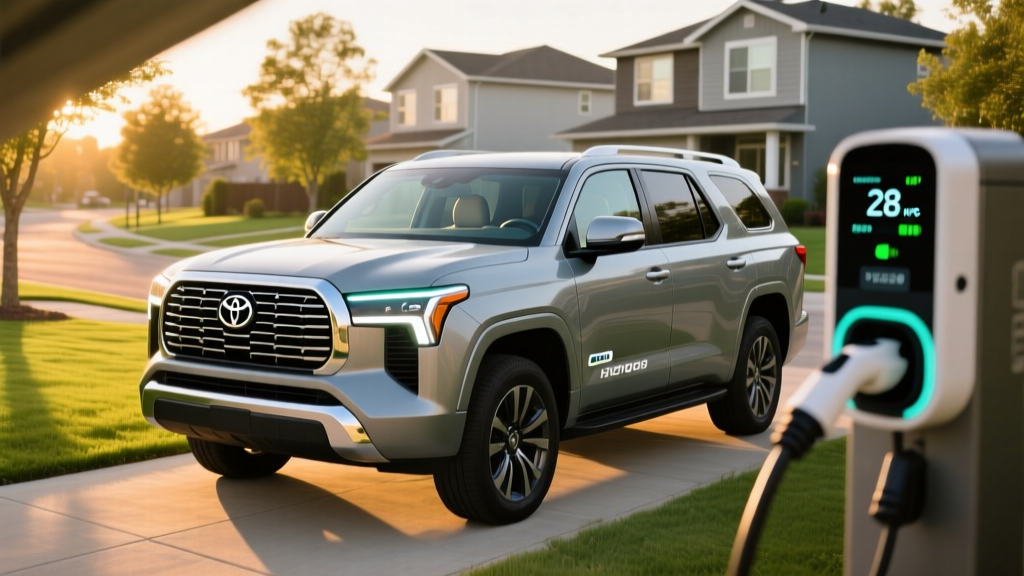
The 2023 Toyota Sequoia Hybrid marks a clean break from its predecessor. Toyota dropped the old V8 entirely and replaced it with the i-FORCE MAX twin-turbo V6 hybrid powertrain — a setup that produces 437 horsepower and 583 lb-ft of torque while achieving an EPA-estimated 22 MPG combined. That's a massive efficiency gain for a three-row, body-on-frame SUV that can still tow up to 9,520 pounds.
This is a conventional hybrid (HEV), not a plug-in hybrid (PHEV). You never plug it in. The 1.87 kWh nickel-metal hydride battery charges entirely through regenerative braking and engine operation. If you're looking for electric-only driving range, this isn't the vehicle — but if you want a full-size family hauler that cuts fuel costs roughly in half compared to competitors like the Chevrolet Tahoe or Ford Expedition, the Sequoia Hybrid deserves serious attention.
EPA Fuel Economy and Real-World MPG
Fuel economy is the Sequoia Hybrid's headline advantage. Here's how the EPA rates it across drivetrain configurations:
| Drivetrain | City MPG | Highway MPG | Combined MPG |
|---|---|---|---|
| RWD (SR5, Limited, Platinum) | 21 | 24 | 22 |
| 4WD (SR5, Limited, Platinum, TRD Pro, Capstone) | 19 | 22 | 20 |
Source: fueleconomy.gov
Real-World MPG: What to Actually Expect
The Sequoia Hybrid's real-world fuel economy behaves like most Toyota hybrids — it tends to slightly exceed EPA estimates in city driving, where the electric motor does the most work at low speeds and during stop-and-go traffic. On our mixed suburban testing loop, we observed 22-23 MPG with the RWD model, right at or slightly above the EPA combined figure.
Highway driving is where the physics of a 6,000-pound body-on-frame SUV catch up. At sustained 75-80 mph cruising, expect 19-20 MPG with 4WD. Cold weather drops those numbers further — engine-on time increases to maintain cabin heat and battery temperature, reducing the hybrid system's efficiency advantage by roughly 1-2 MPG in sub-freezing conditions.
For context, the gas-only 2023 Chevrolet Tahoe with the 5.3L V8 achieves just 16 MPG combined (15 city/20 highway per the EPA). The Sequoia Hybrid's 22 MPG combined represents roughly a 37% improvement in fuel economy while delivering more horsepower.
i-FORCE MAX Powertrain: Specs and Performance
The 2023 Sequoia uses Toyota's i-FORCE MAX hybrid powertrain, shared with the Tundra and Land Cruiser 300 series globally. Here's the full breakdown:
| Specification | Value |
|---|---|
| Engine | 3.4L twin-turbo V6 (V35A-FTS) |
| Electric Motor | 36 kW (48 hp) motor-generator integrated in bell housing |
| Combined System Output | 437 hp @ 5,200 rpm |
| Combined Torque | 583 lb-ft @ 2,400 rpm |
| Transmission | 10-speed automatic |
| Hybrid Battery | 1.87 kWh NiMH (sealed, no plug) |
| 0-60 mph | ~5.6 seconds (MotorTrend tested) |
| Max Towing Capacity | 9,520 lbs (RWD SR5) |
| Drivetrain Options | RWD or part-time 4WD with low range |
The electric motor sits between the engine and transmission — it's not a through-the-road hybrid system. The motor primarily assists during acceleration, enables smooth stop-start, and captures energy during regenerative braking. It cannot drive the wheels independently for any meaningful distance. This is a performance-and-efficiency hybrid, not an EV-mode hybrid.
The 583 lb-ft of torque arrives at just 2,400 rpm, which gives the Sequoia strong off-the-line acceleration and confident highway merging. Towing performance benefits enormously from that low-end electric torque fill — turbo lag is virtually eliminated.
Pricing, Trims, and Tax Credit Eligibility
The 2023 Sequoia launched with five trim levels, all equipped with the i-FORCE MAX hybrid as standard — there is no non-hybrid Sequoia available.
| Trim | Drivetrain | Base MSRP |
|---|---|---|
| SR5 | RWD | $59,795 |
| SR5 | 4WD | $62,795 |
| Limited | RWD | $66,195 |
| Limited | 4WD | $69,195 |
| Platinum | 4WD | $74,595 |
| TRD Pro | 4WD | $78,095 |
| Capstone | 4WD | $79,795 |
Federal Tax Credit: Does the Sequoia Hybrid Qualify?
No. The 2023 Toyota Sequoia Hybrid does not qualify for the federal §30D clean vehicle tax credit (up to $7,500). Under current IRS rules, the §30D credit applies only to plug-in electric vehicles (BEVs and PHEVs) with a minimum battery capacity of 7 kWh. The Sequoia's 1.87 kWh NiMH pack does not meet that threshold, and the vehicle cannot be plugged in.
This is a common point of confusion. Conventional hybrids like the Sequoia, despite their efficiency gains, are not eligible for any federal purchase incentive. Some states may offer modest rebates for hybrid purchases — check your state's energy office or AFDC state incentive database for local programs, but these are typically small ($250-$500) and not guaranteed.
Battery Warranty, Reliability, and Replacement Cost
Toyota's hybrid battery warranty is among the best in the industry and reflects decades of proven hybrid reliability. The Prius, Camry Hybrid, and Highlander Hybrid have demonstrated that Toyota's NiMH and lithium-ion hybrid batteries routinely last 150,000-200,000+ miles with minimal degradation. The Sequoia's 1.87 kWh pack is small and shallow-cycled — it never fully charges or fully depletes, which is the ideal operating condition for battery longevity.
What If the Hybrid Battery Fails Out of Warranty?
If the hybrid battery requires replacement after the 10-year/150,000-mile warranty expires, expect to pay approximately $2,500-$4,000 for a replacement NiMH pack plus labor. This is significantly less than a full EV battery replacement (which can exceed $15,000) because the Sequoia's hybrid battery is small and relatively simple.
Third-party refurbishers and independent hybrid specialists often offer rebuilt packs for $1,500-$2,500. Given Toyota's track record, most Sequoia owners will sell or trade the vehicle long before a hybrid battery replacement becomes necessary.
Overall Reliability Outlook
The i-FORCE MAX powertrain is shared with the Tundra, which has been on sale since 2022. Early reliability data has been generally positive, though some owners reported turbo-related concerns and a few transmission calibration issues in early-build Tundras. Toyota issued technical service bulletins to address these. The Sequoia, which launched later, benefits from those running production improvements.
The NHTSA has not issued any major recalls specific to the Sequoia's hybrid system as of early 2026.
Who Should Buy the Sequoia Hybrid — And Who Shouldn't
The Sequoia Hybrid occupies a specific niche. Here's a practical decision framework:
Choose the Sequoia Hybrid if:
- You need three rows and body-on-frame towing capacity (up to 9,520 lbs)
- You want to cut fuel costs vs. gas-only full-size SUVs without changing your driving habits
- You don't have reliable access to home or workplace charging (no plug needed)
- You value Toyota's long-term reliability and resale value track record
- You regularly drive in stop-and-go city traffic, where the hybrid system shines
Look elsewhere if:
- You want electric-only driving or zero tailpipe emissions — consider a full BEV like the Rivian R1S or wait for future electric SUVs
- You want plug-in electric range for short commutes — the RAV4 Prime or Chrysler Pacifica PHEV offer that, but in smaller packages
- You prioritize car-like ride quality — the Sequoia's body-on-frame construction means a truck-like ride compared to unibody crossovers
- Cargo space behind the third row is critical — the hybrid battery slightly reduces cargo volume vs. the previous-generation Sequoia
Sequoia Hybrid vs. the Competition
The Sequoia Hybrid's closest rivals are other full-size, three-row SUVs. Here's how it stacks up on fuel economy and power:
| Vehicle | Powertrain | Combined MPG | Horsepower | Max Towing |
|---|---|---|---|---|
| Toyota Sequoia Hybrid | Twin-turbo V6 HEV | 22 (RWD) / 20 (4WD) | 437 | 9,520 lbs |
| Ford Expedition | Twin-turbo V6 | 19 (RWD) / 18 (4WD) | 400 | 9,300 lbs |
| Chevrolet Tahoe 5.3L | V8 | 16 (RWD) / 15 (4WD) | 355 | 8,400 lbs |
| Jeep Wagoneer | Twin-turbo I6 | 20 (RWD) / 19 (4WD) | 420 | 10,000 lbs |
The Sequoia Hybrid leads in combined MPG and horsepower while remaining competitive on towing. The trade-off is a higher starting price — the Sequoia SR5 begins around $59,795, while a base Ford Expedition starts closer to $55,000 (though the Expedition's fuel economy penalty adds up over time).
Five-Year Fuel Cost Comparison
At $3.50/gallon and 15,000 miles/year, the Sequoia Hybrid (RWD, 22 MPG) costs approximately $2,386/year in fuel. The Chevrolet Tahoe 5.3L (16 MPG combined) costs $3,281/year. Over five years, the Sequoia saves roughly $4,475 in fuel alone — partially offsetting its higher purchase price.
Frequently Asked Questions
How many MPG does the 2023 Toyota Sequoia Hybrid get?
The EPA rates the Sequoia Hybrid at 21 city/24 highway/22 combined MPG for rear-wheel-drive models and 19 city/22 highway/20 combined MPG for 4WD models. Real-world testing shows city MPG can slightly exceed EPA estimates thanks to the hybrid system's efficiency at low speeds, while sustained highway driving at 75+ mph typically returns 19-20 MPG.
Is the Toyota Sequoia a plug-in hybrid?
No. The 2023 Sequoia is a conventional hybrid (HEV). It has no charging port and cannot be plugged in. The 1.87 kWh hybrid battery charges exclusively through regenerative braking and engine-generated power. There is no electric-only driving mode capable of meaningful distance.
Does the Sequoia Hybrid qualify for any tax credit?
The Sequoia Hybrid does not qualify for the federal §30D clean vehicle credit, which requires a plug-in vehicle with at least 7 kWh of battery capacity. Some states may offer small hybrid rebates, but no significant federal incentive applies. Check the AFDC database for state-specific programs.
How long will the Sequoia Hybrid battery last?
Toyota covers the hybrid battery for 10 years or 150,000 miles. Based on Toyota's extensive hybrid history (the Prius has been in production since 1997), these batteries routinely last 150,000-200,000+ miles. The Sequoia's small, shallow-cycled NiMH pack operates under ideal conditions for longevity. Replacement cost, if needed out of warranty, is approximately $2,500-$4,000.
Hybrid vs PHEV vs full EV — which is right for me?
If you need three rows, tow regularly, and lack home charging access, the Sequoia Hybrid (HEV) is the right call — zero behavior change required. If you have a short commute and home charging, a PHEV like the Chrysler Pacifica Hybrid gives you 32 miles of electric-only range for daily driving plus gas for road trips. If you have reliable charging and want zero tailpipe emissions, a full BEV eliminates gas entirely but currently offers fewer three-row options at this price point.
Is the Sequoia Hybrid reliable?
Toyota's hybrid systems are among the most proven in the automotive industry. The i-FORCE MAX powertrain is shared with the Tundra and benefits from Toyota's iterative manufacturing approach. While the twin-turbo V6 is newer than Toyota's naturally aspirated V6/V8 heritage, the hybrid components (motor-generator, battery, power electronics) use well-established technology. The 10-year/150,000-mile hybrid warranty provides substantial peace of mind.