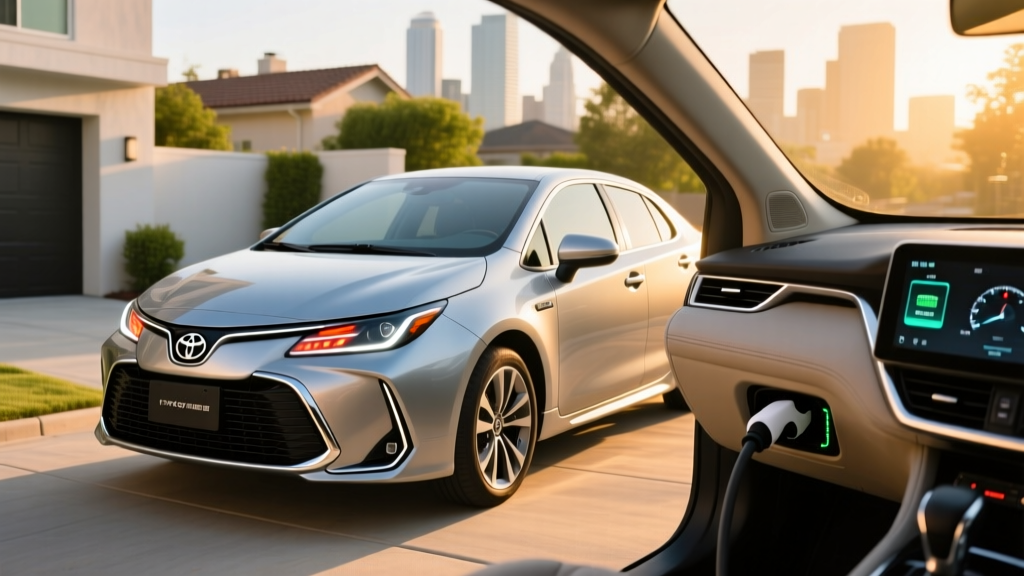
The 2023 Toyota Corolla Hybrid occupies a narrow but compelling lane in the electrified-vehicle market: it's a conventional hybrid (HEV) that requires no plug, no behavior change, and no range anxiety, yet delivers fuel economy that rivals or beats many plug-in hybrids operating in charge-sustaining mode. For buyers who want maximum efficiency without the infrastructure demands of a full EV or the price premium of a PHEV, the Corolla Hybrid remains one of the most data-backed choices available on the used and remaining-new market in 2026.
This guide covers the 2023 model year specifically—the year Toyota expanded the Corolla Hybrid lineup with an SE trim and an available electronic all-wheel-drive (AWD-e) system. We'll walk through exact EPA figures, real-world fuel economy observations, powertrain specs, battery longevity, warranty coverage, and whether any federal tax credits apply.
HEV vs PHEV: What the Corolla Hybrid Actually Is
Before examining the numbers, it's critical to establish what the 2023 Corolla Hybrid is—and isn't. It is a conventional hybrid electric vehicle (HEV), sometimes called a "self-charging" hybrid. It has no plug, no charging port, and no meaningful electric-only driving range. Instead, a small traction battery captures energy from regenerative braking and the gasoline engine, then deploys that energy to assist acceleration and enable brief low-speed electric operation.
| Feature | HEV (Corolla Hybrid) | PHEV (e.g., Prius Prime) | BEV (e.g., bZ4X) |
|---|---|---|---|
| Plug-in charging | No | Yes (Level 1/2) | Yes (Level 1/2/DC) |
| Electric-only range | ~1 mile at low speed | 25–44 miles | 220–300+ miles |
| Gasoline engine | Yes (primary) | Yes (backup) | No |
| Federal tax credit (§30D) | Not eligible | Up to $7,500* | Up to $7,500* |
| Home charging install | Not needed | Recommended ($500–$2,000) | Often required ($1,000–$3,000+) |
| Typical starting MSRP | $22,000–$26,000 | $32,000–$40,000 | $35,000–$55,000+ |
*§30D eligibility depends on MSRP caps, buyer income limits, battery sourcing requirements, and point-of-sale transfer rules. See IRS.gov for current-year rules.
The distinction matters because buyers sometimes search for "Corolla Hybrid" expecting a plug-in option. Toyota does not offer a Corolla PHEV in the US market. If you need electric-only commuting, you'll need to look at the Toyota Prius Prime or another PHEV/BEV.
EPA Fuel Economy: City, Highway, and Combined MPG
The 2023 Corolla Hybrid is available in two main configurations: front-wheel drive (FWD) and electronic all-wheel drive (AWD-e). EPA ratings differ between them.
| Trim / Drivetrain | City MPG | Highway MPG | Combined MPG |
|---|---|---|---|
| LE (FWD) | 53 | 46 | 50 |
| LE (AWD-e) | 47 | 41 | 44 |
| SE (FWD) | 50 | 43 | 47 |
| SE (AWD-e) | 47 | 41 | 44 |
Source: fueleconomy.gov
The FWD LE's 50 MPG combined is the headline figure, placing it among the most efficient non-plug-in vehicles sold in the US for the 2023 model year. The SE trim drops slightly due to larger 18-inch wheels and sport-tuned suspension tuning that increases rolling resistance. The AWD-e system adds a rear-mounted electric motor for traction in slippery conditions but costs you 6 MPG combined across both trims.
Real-World MPG: What Owners Actually Report
Toyota's hybrid system excels in stop-and-go city driving, where regenerative braking recaptures energy and the engine can shut off frequently. This is why the city MPG rating exceeds the highway rating—a reversal of what gas-only cars show.
In real-world driving, many Corolla Hybrid owners report exceeding the EPA city estimate in warm-weather urban conditions, with figures of 54–58 MPG not uncommon on routes with frequent stops and speeds under 35 mph. Highway driving at 70–75 mph tends to land closer to 42–44 MPG for the FWD LE, slightly below the EPA highway estimate, because aerodynamic drag dominates at higher speeds and the hybrid system has less opportunity to recapture energy.
Cold weather (below 35°F) reduces fuel economy by roughly 5–12% in hybrids, as the engine runs more frequently to provide cabin heat and maintain battery temperature. Expect 43–47 MPG combined in winter for the FWD LE, recovering as temperatures rise.
Powertrain Specs: Engine, Motors, and Horsepower
The 2023 Corolla Hybrid uses Toyota's fifth-generation hybrid system, pairing a 1.8-liter Atkinson-cycle four-cylinder engine with electric motors. Here's the exact breakdown:
| Specification | Detail |
|---|---|
| Engine | 1.8L 4-cyl Atkinson-cycle |
| Engine horsepower | 96 hp @ 5,200 rpm |
| Front electric motor | 94 hp (70 kW) |
| Net combined system horsepower | 138 hp |
| AWD-e rear motor (if equipped) | 40 hp (30 kW) |
| Transmission | Continuously Variable (eCVT) |
| 0–60 mph (est.) | ~9.0 seconds (FWD) |
| Traction battery | Lithium-ion, ~1.3 kWh (total) |
| Fuel tank | 11.4 gallons |
| Total driving range (FWD LE) | ~570 miles |
The 138 net combined horsepower is a meaningful jump over the previous-generation Corolla Hybrid's 121 hp. It puts the 2023 model within striking distance of the gas-only Corolla's 139 hp (2.0L engine), eliminating the "hybrid feels slow" objection that plagued earlier models. The AWD-e system's rear motor engages automatically under acceleration from a stop and in low-traction conditions, disengaging above ~43 mph to avoid efficiency losses.
The eCVT is not a belt-and-pulley CVT like those in some competitors. It's a planetary gearset that blends engine and motor output seamlessly. There are no fixed gear ratios, no rubber-band effect, and no shift shock. Toyota's hybrid synergy drive remains one of the most refined powertrain implementations in the segment.
Hybrid Battery: Size, Chemistry, Warranty, and Lifespan
The 2023 Corolla Hybrid uses a compact lithium-ion traction battery with approximately 1.3 kWh of total capacity. This is not the same as a plug-in hybrid's 10–18 kWh pack or a full EV's 60–100 kWh pack. In an HEV, the battery acts as a buffer—absorbing regenerative braking energy and releasing it in short bursts to assist acceleration. The system typically uses only a narrow band of the battery's state of charge (roughly 40–80% SoC), which significantly reduces stress on the cells.
Battery & Hybrid System Warranty
- Hybrid battery: 10 years / 150,000 miles (whichever comes first)
- Hybrid system components: 8 years / 100,000 miles
- Powertrain (engine, transaxle): 5 years / 60,000 miles
- Basic (bumper-to-bumper): 3 years / 36,000 miles
Toyota extended hybrid battery coverage from 8 years/100,000 miles to 10 years/150,000 miles starting with 2020 model-year vehicles. The 2023 Corolla Hybrid benefits from this enhanced coverage.
How Long Will the Battery Last?
Toyota's hybrid battery track record is among the strongest in the industry. The Prius, which uses a similar system, routinely sees original batteries lasting 150,000–200,000+ miles in real-world use. The Corolla Hybrid's lithium-ion pack (earlier Prius models used NiMH) is expected to match or exceed this longevity because the narrow SoC window minimizes degradation.
If replacement is needed out of warranty, a new OEM hybrid battery for the Corolla Hybrid typically costs between $2,000 and $3,500 including labor at a dealership. Refurbished or aftermarket options may be available for $1,000–$2,000. This is a fraction of the cost of a full EV battery replacement ($8,000–$20,000+) because the pack is so much smaller.
Pricing, Trims, and Tax Credit Eligibility
When new, the 2023 Corolla Hybrid was offered in the following configurations with these MSRP figures (destination charge included):
| Trim | Drivetrain | MSRP (2023) |
|---|---|---|
| LE | FWD | $23,095 |
| LE | AWD-e | $24,495 |
| SE | FWD | $25,595 |
| SE | AWD-e | $26,995 |
Source: Toyota USA pressroom specifications.
Does the 2023 Corolla Hybrid Qualify for a Federal Tax Credit?
No. The federal §30D Clean Vehicle Credit applies only to plug-in electric vehicles—battery electric vehicles (BEVs) and plug-in hybrids (PHEVs) with a minimum battery capacity of 7 kWh. The Corolla Hybrid's ~1.3 kWh battery and lack of a charging port make it ineligible for the federal purchase credit.
A few states offer modest incentives for conventional hybrids, but these are uncommon and vary widely by jurisdiction. Check your state's energy office or department of environmental quality for current programs. Some states previously offered hybrid rebates but have shifted incentive budgets exclusively toward plug-in vehicles.
On the used market, the §25E used clean vehicle credit also requires a plug-in vehicle. The Corolla Hybrid does not qualify there either. However, its low purchase price—typically $18,000–$23,000 on the used market in 2026 depending on mileage and condition—means the total cost of ownership remains competitive even without incentives, especially when fuel savings are factored in.
Who Should Choose the Corolla Hybrid vs. a PHEV or Full EV?
The Right Buyer Profile
Choose the 2023 Corolla Hybrid (HEV) if:
- You don't have access to home or workplace charging (apartment, street parking, no garage outlet)
- Your budget is under $25,000 and you want maximum MPG without a plug
- You drive 12,000–15,000 miles/year in mixed city/highway conditions
- You want zero behavior change—just fill up at any gas station
- You live in a region with limited public charging infrastructure
- You want Toyota's long-proven hybrid reliability with a 10-year battery warranty
Consider a PHEV (Prius Prime, RAV4 Prime) if:
- You can charge at home (even a standard 120V outlet works for overnight PHEV charging)
- Your daily commute is under 40 miles round-trip and you want electric-only driving most days
- You want eligibility for the §30D federal tax credit (up to $7,500, subject to income/MSRP/sourcing rules)
Consider a full EV (Tesla Model 3, Hyundai Ioniq 6, Chevy Equinox EV) if:
- You have reliable Level 2 home charging
- Your daily driving is under 250 miles and you take occasional road trips
- You want to eliminate gasoline purchases entirely
- You qualify for the full §30D credit, which can bring EV pricing close to hybrid territory
Total Cost of Ownership Snapshot
At 50 MPG combined and $3.25/gallon (2026 national average for regular unleaded), the Corolla Hybrid FWD LE costs approximately $0.065 per mile in fuel. A comparable gas-only Corolla at 33 MPG combined costs about $0.098 per mile. Over 15,000 miles per year, that's roughly $500 in annual fuel savings for the hybrid, or $2,500 over five years. The hybrid's typically $1,500–$2,500 price premium over a gas-only equivalent pays for itself within 3–5 years at average mileage.
Pros, Cons, and the Bottom Line
Pros
- 50 MPG combined (FWD LE) — among the highest of any non-plug-in vehicle
- No charging infrastructure required
- 138 hp eliminates the "slow hybrid" stereotype
- 10-year / 150,000-mile hybrid battery warranty
- AWD-e available for snow-belt buyers
- Low starting price (~$23K MSRP when new)
- Toyota Safety Sense 3.0 standard (PCS, LDA, DRCC, LTA, AHB)
- Strong resale value; Toyota hybrid demand remains high
Cons
- No federal or state tax credit eligibility
- AWD-e reduces fuel economy to 44 MPG combined
- Modest 138 hp — adequate, not quick (0–60 in ~9 seconds)
- Trunk space slightly reduced vs. gas Corolla (13.1 cu ft vs. 13.1 cu ft — comparable, but battery packaging limits under-floor storage)
- No plug-in variant available — electric-only driving limited to low-speed parking maneuvers
- SE trim's 18-inch wheels sacrifice 3 MPG combined
- Rear seat space is tight for taller passengers (38.0" legroom)
Frequently Asked Questions
How many MPG does the 2023 Toyota Corolla Hybrid get?
The FWD LE achieves an EPA-estimated 53 city / 46 highway / 50 combined MPG. The SE trim drops to 50/43/47. AWD-e models are rated at 47/41/44 across both trims. Real-world city driving in warm weather often exceeds EPA estimates by 4–8 MPG, while sustained highway driving at 75+ mph may fall 2–4 MPG below the sticker.
Does the Corolla Hybrid need to be plugged in?
No. The 2023 Corolla Hybrid is a conventional HEV with no charging port. The battery charges exclusively through regenerative braking and the gasoline engine. You fuel it like any other car at a gas station.
Is the Corolla Hybrid reliable, and what does battery replacement cost?
Toyota's hybrid system has an extensive reliability record spanning over two decades (since the 2001 Prius). The 2023 model carries a 10-year/150,000-mile hybrid battery warranty. Out-of-warranty replacement runs $2,000–$3,500 for a new OEM pack. Many Toyota hybrid batteries last 150,000–200,000+ miles before significant capacity loss.
Does the 2023 Corolla Hybrid qualify for any tax credit?
No federal tax credit applies. The §30D Clean Vehicle Credit requires a plug-in vehicle with at least 7 kWh of battery capacity. The Corolla Hybrid has ~1.3 kWh and no charging port. Some state-level hybrid incentives exist but are uncommon—check your state's energy office for current programs.
How does the Corolla Hybrid compare to the Prius?
The 2023 Prius (redesigned for 2023) is rated at 57 MPG combined (LE FWD) and produces 194 hp—more efficient and more powerful than the Corolla Hybrid, but with a higher starting price (~$27,450). The Corolla Hybrid trades a few MPG and some horsepower for a lower entry price and a more traditional sedan design. Both use Toyota's fifth-generation hybrid architecture.
Can I get AWD on the Corolla Hybrid?
Yes. The AWD-e system is available on both LE and SE trims. It adds a 40-hp rear electric motor that engages automatically for improved traction from a stop and in slippery conditions. The trade-off is a 6 MPG combined reduction (from 50 to 44 on the LE).
What's the total driving range on a full tank?
With an 11.4-gallon fuel tank and 50 MPG combined, the FWD LE can travel approximately 570 miles between fill-ups. Highway-heavy driving at lower efficiency may yield 480–520 miles; city-heavy driving in warm weather can push past 600 miles.