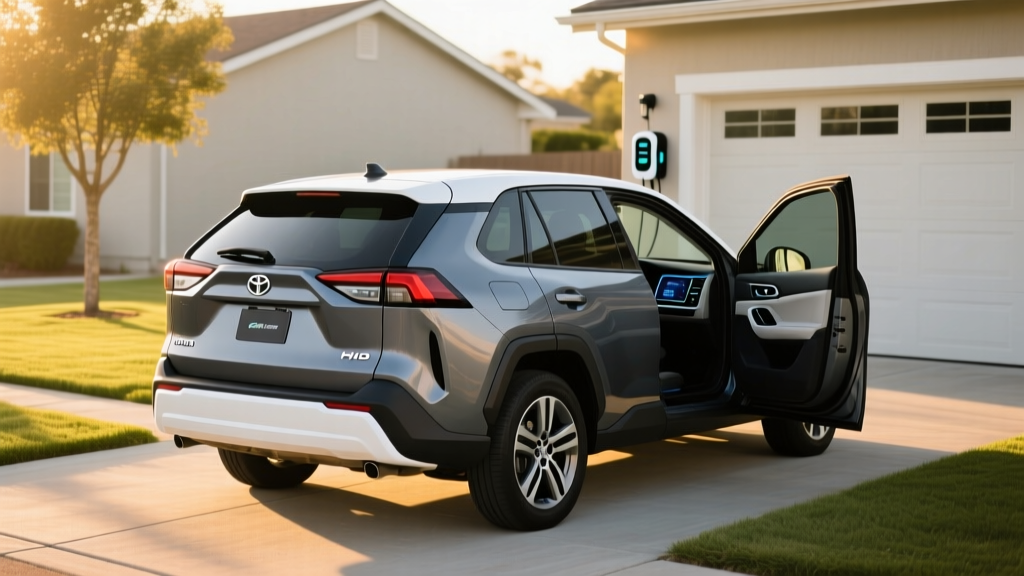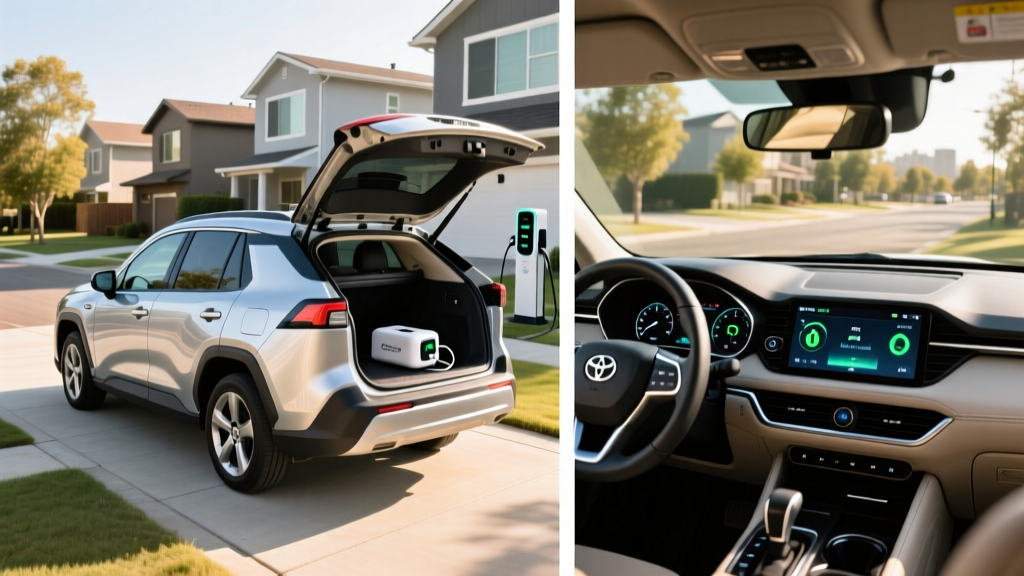
The 2023 Toyota RAV4 Hybrid XLE sits in a sweet spot for buyers who want SUV practicality and genuine fuel savings without plugging in. As a conventional hybrid (HEV), it never needs a charger — yet it still delivers EPA-estimated fuel economy that embarrasses most gas-only compact SUVs. But with the RAV4 Prime (PHEV) and full battery-electric rivals also on the table, does the Hybrid XLE still make sense in 2026? We break down every number that matters.
2023 RAV4 Hybrid XLE: Key Specifications at a Glance
| Spec | Value |
|---|---|
| Powertrain | 2.5L 4-cyl + 3 electric motors (AWD-i) |
| Combined Horsepower | 219 hp (net system) |
| EPA Fuel Economy | 41 city / 38 hwy / 40 combined MPG |
| Fuel Tank | 14.5 gallons |
| EPA Total Range | ~580 miles |
| 0–60 mph | ~7.4 seconds |
| Drivetrain | Electronic AWD (rear motor) |
| Hybrid Battery | 1.6 kWh (sealed NiMH), not plug-in |
| Cargo Volume | 37.6 cu ft (rear seats up) / 69.8 cu ft (folded) |
| Original MSRP (2023) | $32,345 (including destination) |
| Hybrid Battery Warranty | 10 years / 150,000 miles |
How Many MPG Does the 2023 RAV4 Hybrid XLE Actually Get?
The EPA rates the 2023 RAV4 Hybrid XLE at 41 MPG city, 38 MPG highway, and 40 MPG combined, according to fueleconomy.gov. That's a substantial improvement over the gas-only RAV4 LE AWD, which returns 27 city / 35 hwy / 30 combined.
| Driving Scenario | EPA Rating | Real-World Expectation |
|---|---|---|
| City / Stop-and-Go | 41 MPG | 40–44 MPG (regenerative braking excels here) |
| Highway (70–75 mph) | 38 MPG | 34–37 MPG (aero drag, less regen benefit) |
| Combined (mixed) | 40 MPG | 37–41 MPG depending on route and climate |
| Cold Weather (below 30°F) | N/A | 34–38 MPG (engine runs more for cabin heat) |
The real-world story: Toyota's hybrid system is one of the few powertrains that routinely exceeds its EPA city estimate in daily driving. Short commutes with frequent stops let the electric motor do most of the work. Highway-only road trips will dip below the sticker, but even at 75 mph on a flat interstate, expect 35+ MPG — numbers most gas SUVs can't touch in the city, let alone on the freeway.
HEV vs. PHEV vs. Full EV: Which RAV4 Fits Your Life?
Toyota sells three electrified RAV4 variants, and the differences matter far more than most buyers realize. Here's how the 2023 lineup breaks down:
| Attribute | RAV4 Hybrid (HEV) | RAV4 Prime (PHEV) | bZ4X (Full EV) |
|---|---|---|---|
| Needs Plugging In? | No | Yes (optional) | Yes (required) |
| EPA MPG / MPGe | 40 MPG combined | 94 MPGe (elec) / 38 MPG (gas) | 119 MPGe combined |
| Electric-Only Range | None (motor assists only) | 42 miles (EV mode) | 222–252 miles |
| Total Range | ~580 miles | ~600 miles (EV + gas) | 222–252 miles |
| Battery Size | 1.6 kWh (NiMH) | 18.1 kWh (Li-ion) | 71.4 kWh (Li-ion) |
| Combined HP | 219 hp | 302 hp | 201–214 hp |
| 0–60 mph | ~7.4 sec | ~5.7 sec | ~6.5–7.1 sec |
| DC Fast Charging | N/A | No (Level 2 only, ~2.5 hrs) | Yes (~150 kW peak) |
| Original MSRP (2023) | From ~$32,345 | From ~$43,095 | From ~$42,000 |
| Federal Tax Credit | Not eligible | Up to $7,500 (§30D, subject to eligibility) | Up to $7,500 (§30D, subject to eligibility) |
The HEV (Hybrid XLE) is right for you if: You don't have reliable home or workplace charging, you drive a mix of city and highway, and you want fuel savings without changing your refueling habits at all.
The PHEV (Prime) is right for you if: You can charge at home nightly, your daily commute is under 42 miles (covering most trips on electricity), but you still want unlimited road-trip range with zero range anxiety.
A full EV (bZ4X or rival) is right for you if: You have home Level 2 charging, your daily driving stays under ~200 miles, and you want zero tailpipe emissions with the lowest per-mile fuel cost.
Powertrain Deep Dive: What's Under the Hood
The 2023 RAV4 Hybrid XLE uses Toyota's fourth-generation hybrid synergy drive. A 2.5-liter Atkinson-cycle four-cylinder engine produces 176 hp on its own, paired with three electric motor-generators: two at the front axle and one powering the rear wheels. The net system output is 219 horsepower.
The rear electric motor gives the Hybrid XLE standard electronic AWD (AWD-i). Unlike mechanical AWD systems, there's no driveshaft connecting front to rear — the rear motor engages in milliseconds when slip is detected or during hard acceleration. This also means the rear motor contributes to regenerative braking, which is partly why the Hybrid's city MPG is so strong.
The 1.6 kWh nickel-metal hydride (NiMH) battery pack is small by EV standards, but it doesn't need to store energy for long electric-only driving. It serves as a buffer: capturing braking energy and feeding it back to the motors during acceleration. Toyota has decades of data on NiMH longevity in this application, which directly informs the generous warranty.
Hybrid Battery Warranty, Lifespan, and Replacement Cost
Battery longevity is the single most common concern among first-time hybrid buyers. Here's the reality for the 2023 RAV4 Hybrid:
Toyota Hybrid Battery Warranty (2023 Model Year)
- Coverage: 10 years or 150,000 miles (whichever comes first)
- Applies to: Hybrid battery pack, hybrid control module, inverter
- Transferable: Yes — transfers to subsequent owners automatically
- Capacity threshold: Toyota covers defects and significant capacity loss affecting function
Real-world data from Toyota's hybrid fleet (Prius, Camry Hybrid, RAV4 Hybrid) consistently shows NiMH packs lasting 150,000–200,000+ miles before any meaningful degradation. The RAV4 Hybrid's battery is small and rarely cycled deeply, which reduces stress. Failures before 100,000 miles are uncommon.
If replacement is eventually needed out of warranty, a new OEM hybrid battery for the RAV4 Hybrid runs approximately $3,000–$4,500 including labor at a dealership. Independent hybrid specialists often offer refurbished packs for $1,500–$2,500. Compare that to a full EV battery replacement at $10,000–$20,000+, and the HEV's smaller battery becomes a long-term cost advantage.
Pricing, Value, and Tax Credit Reality for 2026 Buyers
The 2023 RAV4 Hybrid XLE originally carried an MSRP of approximately $32,345 (including destination). On the used market in 2026, expect to pay roughly $26,000–$31,000 depending on mileage and condition, as RAV4 Hybrids hold value well.
Federal Tax Credit Status
The conventional RAV4 Hybrid does not qualify for the federal §30D clean vehicle tax credit. That credit applies only to plug-in electric vehicles (PHEVs and BEVs) meeting battery-sourcing, MSRP cap, and buyer income requirements as outlined by the IRS. The Hybrid XLE is a self-charging HEV — no plug, no federal credit.
Some states offer separate incentives for hybrids, though most have shifted their incentive budgets toward PHEVs and BEVs. Check your state's energy office or department of environmental quality for current programs.
Total Cost of Ownership Snapshot (5 Years / 75,000 Miles)
| Cost Category | RAV4 Hybrid XLE (HEV) | RAV4 Gas AWD LE | RAV4 Prime (PHEV)* |
|---|---|---|---|
| Purchase Price (approx.) | $32,345 | $29,625 | $43,095 |
| Fuel Cost (75k mi, $3.50/gal avg) | ~$6,560 | ~$8,750 | ~$4,200 (mix of elec + gas) |
| Federal Tax Credit | $0 | $0 | Up to $7,500 (if eligible) |
| Estimated 5-Yr Maintenance | ~$2,800 | ~$3,200 | ~$2,600 |
| Net 5-Yr Cost (before credit) | ~$41,705 | ~$41,575 | ~$49,895 |
| Net 5-Yr Cost (after credit) | ~$41,705 | ~$41,575 | ~$42,395 |
*Prime figures assume ~70% of miles driven on electricity with home charging at $0.14/kWh. Actual costs vary by electricity rate and driving mix. Tax credit eligibility depends on income, MSRP caps, and battery-sourcing rules per IRS §30D guidelines.
The Hybrid XLE essentially pays for its price premium over the gas model through fuel savings within 4–5 years of average driving, and it does so without any charging infrastructure or credit-eligibility hurdles.
Who Should Buy the 2023 RAV4 Hybrid XLE — And Who Shouldn't
Choose the RAV4 Hybrid XLE If…
- You want 40 MPG without installing a charger or changing habits
- You live in an apartment or lack reliable home/workplace charging
- You take frequent road trips and don't want range or charging logistics
- You value Toyota's long-term reliability track record and 10-year hybrid warranty
- You want AWD capability with minimal fuel-economy penalty
Look Elsewhere If…
- You have home charging and a short commute — the RAV4 Prime (PHEV) would eliminate most gas use
- You want zero tailpipe emissions — consider a full EV like the Ioniq 5 or Model Y
- You need the $7,500 federal tax credit to make the math work (HEVs don't qualify)
- You prioritize acceleration thrills — the Prime's 302 hp and 5.7-sec 0–60 is significantly quicker
- You drive mostly highway miles at high speed — the hybrid advantage shrinks on open interstates
Frequently Asked Questions
Does the 2023 RAV4 Hybrid XLE need to be plugged in?
No. It is a conventional hybrid (HEV), meaning it charges its small battery through regenerative braking and the gasoline engine. You refuel it exactly like a gas car — at any gas station. There is no plug, no charging cable, and no home charger required.
How far can the RAV4 Hybrid XLE go on a full tank?
With a 14.5-gallon fuel tank and an EPA combined rating of 40 MPG, the real-world total range is approximately 540–580 miles. Drivers who do mostly city driving with frequent stops may see 600+ miles between fill-ups thanks to the hybrid system's city efficiency advantage.
Is the hybrid battery expensive to replace?
Out-of-warranty replacement runs roughly $3,000–$4,500 for a new OEM pack, or $1,500–$2,500 for a refurbished unit. However, Toyota's hybrid battery warranty covers 10 years / 150,000 miles, and real-world data shows these NiMH packs routinely exceeding 150,000 miles. Most original owners will never need a replacement.
Does the 2023 RAV4 Hybrid qualify for any tax credits?
The conventional Hybrid does not qualify for the federal §30D clean vehicle credit, which is reserved for plug-in vehicles (PHEVs and BEVs). Some states may offer modest hybrid incentives, but availability varies. If a federal tax credit is important to your purchase decision, the RAV4 Prime (PHEV) or a full EV would be the path to eligibility.
How does the Hybrid XLE compare to the RAV4 Prime for daily commuting?
If your commute is under 42 miles round-trip and you can charge at home, the RAV4 Prime covers most daily driving on electricity alone, using zero gasoline on typical weekdays. The Hybrid XLE can't drive on electric power alone at meaningful speeds — it always uses some gasoline. However, the Hybrid costs roughly $10,000 less upfront and doesn't require any charging setup, making it the simpler, more affordable choice for drivers without home charging access.
What's the real-world highway MPG at 75 mph?
In sustained 75-mph highway driving, expect approximately 34–37 MPG, below the EPA highway rating of 38 MPG. Hybrid systems gain their biggest advantage in city driving where regenerative braking recovers energy at every stop. At constant high speed, the engine does most of the work, and aerodynamic drag is the dominant force. This is true of all hybrids, not just the RAV4.
Is the 2023 RAV4 Hybrid XLE reliable?
Toyota's hybrid powertrain is among the most proven in the industry, with over two decades of real-world data from millions of vehicles. The RAV4 Hybrid specifically has earned strong reliability ratings from major evaluators. The IIHS gave the 2023 RAV4 top safety marks. Combined with the 10-year / 150,000-mile hybrid component warranty, long-term ownership risk is low.
The 2023 RAV4 Hybrid XLE isn't the most exciting electrified SUV on the market, and it won't earn you a federal tax credit. What it does deliver is 40 MPG in a practical, reliable, AWD-equipped compact SUV that requires zero lifestyle changes. For buyers who want the efficiency upside of electrification without the complexity of plugs, chargers, or credit-eligibility paperwork, it remains one of the most rational choices available — in 2023, and well into 2026.