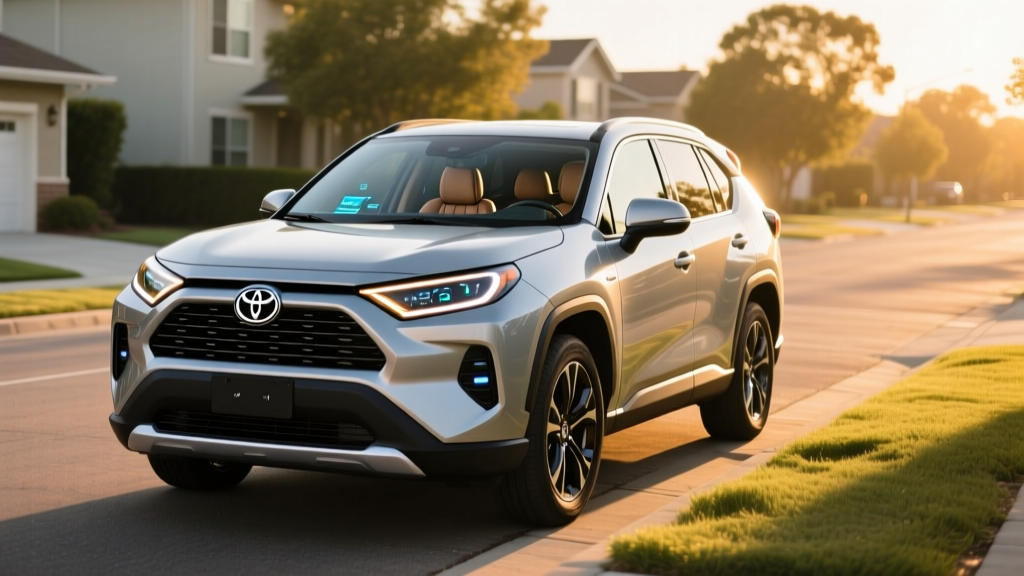
The Toyota RAV4 Hybrid has been the best-selling hybrid SUV in America for years, and the 2023 RAV4 Hybrid Limited sits at the top of that lineup. With standard all-wheel drive, a spacious cabin, and Toyota's proven hybrid synergy drive, it targets buyers who want fuel savings without plugging in. But with the RAV4 Prime (the plug-in version) and a wave of new EVs on the market, is the conventional hybrid Limited still the smartest buy in 2026? We break down every number that matters.
Quick Verdict: Who the 2023 RAV4 Hybrid Limited Is For
The 2023 RAV4 Hybrid Limited delivers 41 MPG combined with zero lifestyle change — no plug, no range anxiety, no charging apps. It's the right pick for apartment dwellers without home charging, high-mileage commuters, and buyers in regions with sparse public charging infrastructure. If you can charge at home and your daily commute is under 42 miles, the RAV4 Prime PHEV offers more savings. If you want zero tailpipe emissions and have reliable charging access, a full EV like the Tesla Model Y or Hyundai Ioniq 5 may serve you better. But for effortless fuel economy with go-anywhere practicality, the Hybrid Limited remains a benchmark.
HEV vs. PHEV: What's the Difference on the RAV4?
Toyota sells two electrified RAV4 models, and confusing them is the single most common buyer mistake. Here's the distinction:
| Attribute | RAV4 Hybrid (HEV) | RAV4 Prime (PHEV) |
|---|---|---|
| Plug-in required? | No — charges via engine & regen | Yes — plug in for electric-only miles |
| Electric-only range | 0 miles (motor assists engine) | 42 miles EPA |
| Battery capacity | 1.6 kWh (NiMH) | 18.1 kWh (lithium-ion) |
| Combined horsepower | 219 hp | 302 hp |
| EPA combined fuel economy | 41 MPG (gas) | 94 MPGe (electric) / 38 MPG (gas) |
| 0-60 mph | 7.4 seconds | 5.7 seconds |
| DC fast charging | N/A | No — Level 2 AC only |
| Federal tax credit (§30D) | Not eligible | Not eligible (credit exhausted) |
The HEV captures energy from braking and the gasoline engine to charge its small battery. You never plug it in. The PHEV (Prime) has a much larger battery you charge via a wall outlet or Level 2 station, giving you 42 miles of pure electric driving before the gas engine engages. Both are excellent — they just serve different driving patterns.
Fuel Economy: EPA Ratings vs. Real-World MPG
| Driving Cycle | EPA Rating | Real-World Expectation |
|---|---|---|
| City | 41 MPG | 43–47 MPG (hybrids excel in stop-and-go) |
| Highway | 38 MPG | 35–38 MPG (aerodynamic drag reduces hybrid advantage) |
| Combined | 41 MPG | 39–43 MPG depending on driving mix |
According to fueleconomy.gov, the 2023 RAV4 Hybrid AWD earns 41 MPG city, 38 MPG highway, and 41 MPG combined. In practice, Toyota's hybrid system rewards city driving. The electric motor handles low-speed propulsion while the 2.5-liter Atkinson-cycle four-cylinder shuts off at stops. Owners consistently report exceeding the EPA city figure in suburban and urban commutes.
Highway driving tells a different story. Above 65 mph, the gasoline engine does most of the work, and the SUV's boxy profile creates aerodynamic drag. Expect 35–37 MPG on sustained interstate trips at 75 mph, especially with roof rails or a cargo box. In cold weather (below 30°F), the engine runs more frequently to provide cabin heat, dropping observed economy by 3–5 MPG until the powertrain reaches operating temperature.
Powertrain and Performance Specs
| Specification | 2023 RAV4 Hybrid Limited |
|---|---|
| Engine | 2.5L 4-cylinder Atkinson cycle |
| Electric motors | Front (134 hp) + Rear (54 hp) |
| Combined system output | 219 hp |
| 0-60 mph | 7.4 seconds |
| Drivetrain | Electronic AWD (eAWD) |
| Transmission | eCVT (planetary gearset) |
| Hybrid battery | 1.6 kWh Nickel-Metal Hydride (NiMH) |
| Towing capacity | 1,750 lbs |
| Cargo volume (rear seats up) | 37.6 cu ft |
| Cargo volume (rear seats folded) | 69.8 cu ft |
The Hybrid Limited's eAWD system uses a dedicated rear electric motor rather than a mechanical driveshaft. This means the rear axle engages only when the system detects slip or under hard acceleration — it's not a full-time AWD system like a Subaru Outback's, but it handles rain, light snow, and gravel roads with confidence. The 219 hp output delivers adequate passing power, and the eCVT eliminates shift shock entirely. It won't thrill you on a canyon road, but it's smooth, predictable, and efficient.
Pricing, Trims, and Tax Credit Eligibility
The 2023 RAV4 Hybrid Limited carried an MSRP of approximately $39,445 (including destination). On the used market in 2026, expect to pay between $30,000 and $35,000 depending on mileage and condition.
Federal Tax Credit: Not Eligible
Conventional hybrids like the RAV4 Hybrid do not qualify for the federal §30D clean vehicle tax credit (up to $7,500). That credit applies only to plug-in electric vehicles (BEVs and PHEVs) meeting battery-sourcing and MSRP caps. Even the RAV4 Prime PHEV is no longer eligible — Toyota's credit allocation was exhausted. Always verify current rules at IRS.gov. Some states offer separate hybrid rebates; check your state energy office for local programs.
Despite the lack of a federal credit, the Hybrid Limited's value proposition rests on fuel savings. At $3.40/gallon and 15,000 miles/year, a 41 MPG hybrid saves roughly $620 annually versus a comparable 28 MPG gas-only SUV — that's over $3,100 across five years of ownership.
Battery Reliability, Warranty, and Replacement Cost
Hybrid battery anxiety is the top concern for first-time hybrid buyers, and it's largely unfounded based on two decades of Toyota data. The 2023 RAV4 Hybrid uses a 1.6 kWh NiMH pack — a chemistry Toyota has deployed in millions of vehicles since the original 1997 Prius. NiMH is less energy-dense than lithium-ion but extremely durable and thermally stable.
| Coverage | Term |
|---|---|
| Hybrid battery warranty | 10 years / 150,000 miles (whichever comes first) |
| Hybrid system components | 8 years / 100,000 miles |
| Basic vehicle warranty | 3 years / 36,000 miles |
| Powertrain warranty | 5 years / 60,000 miles |
Toyota's 10-year/150,000-mile hybrid battery warranty (applicable in all 50 states for 2020+ models) is among the best in the industry. Real-world failure data from Consumer Reports and high-mileage fleet usage shows that Toyota hybrid batteries routinely last 150,000–200,000+ miles before significant degradation. The NiMH chemistry degrades more gracefully than early lithium-ion packs — you'll see a gradual MPG decline rather than a sudden failure.
If replacement is needed out of warranty, a new OEM hybrid battery runs approximately $2,500–$3,500 installed at a Toyota dealer. Third-party reconditioned packs are available for $1,500–$2,000. Individual module replacement (only the degraded cells) can drop the cost to $500–$1,000 at a hybrid-specialist shop. Compare this to a full EV battery replacement ($8,000–$20,000+), and the hybrid's long-term risk profile looks very manageable.
How It Stacks Up: Hybrid vs. PHEV vs. Full EV
Choosing between a conventional hybrid, a plug-in hybrid, and a battery-electric vehicle depends on three factors: your charging access, your daily mileage, and your budget tolerance.
Choose the RAV4 Hybrid (HEV) if:
- You live in an apartment or lack home/workplace charging access
- You take frequent long road trips (300+ miles) and don't want to plan charging stops
- You want fuel savings with zero behavior change
- You live in a region with extreme cold or limited charging infrastructure
Choose the RAV4 Prime (PHEV) if:
- You can install a Level 2 charger at home (240V outlet)
- Your daily commute is under 42 miles round-trip (you'll rarely use gas)
- You want EV-like daily driving with a gas engine for road trips
- You value the 302 hp performance boost
Choose a full EV (e.g., Tesla Model Y, Hyundai Ioniq 5) if:
- You have reliable home Level 2 charging
- You want zero tailpipe emissions and minimal maintenance
- Your daily driving is under 250 miles and you're comfortable with DC fast charging on road trips
- You want the lowest per-mile fuel cost (electricity vs. gasoline)
The Hybrid Limited costs less upfront than the Prime or a comparable EV, carries no charging dependency, and still cuts fuel costs by 35–40% versus a gas-only RAV4. It's the lowest-friction path to better fuel economy.
Pros, Cons, and the Bottom Line
Pros
- 41 MPG combined — exceeds EPA city rating in real-world stop-and-go driving
- No plug-in required — zero lifestyle change from a gas car
- Standard eAWD with dedicated rear motor
- 10-year/150,000-mile hybrid battery warranty
- Strong resale value — RAV4 Hybrids hold value better than most competitors
- Limited trim adds SofTex seats, 9-inch touchscreen, wireless CarPlay/Android Auto
Cons
- Highway MPG drops to 35–37 at sustained 75+ mph speeds
- No federal tax credit eligibility
- 1,750-lb towing capacity trails turbocharged competitors
- Rear motor AWD is not a full-time system — not for serious off-roading
- Cabin noise under hard acceleration (eCVT drone)
- Used pricing remains elevated due to high demand
The 2023 RAV4 Hybrid Limited isn't the most exciting SUV you can buy, but it may be the most rational. It sips fuel, carries a family and their gear, and asks nothing of you except the occasional fill-up. For buyers in 2026 who aren't ready for plug-in life — whether due to housing situation, road-trip habits, or charging-infrastructure gaps — it remains the default recommendation.
Frequently Asked Questions
How many MPG does the 2023 RAV4 Hybrid Limited actually get?
The EPA rates it at 41 city / 38 highway / 41 combined. In real-world driving, expect 43–47 MPG in city and suburban conditions, and 35–38 MPG on the highway. Cold weather reduces economy by roughly 3–5 MPG due to increased engine operation for cabin heating.
Does the RAV4 Hybrid need to be plugged in?
No. The RAV4 Hybrid is a conventional (self-charging) hybrid. It charges its 1.6 kWh battery through regenerative braking and the gasoline engine. You simply refuel at any gas station. Only the RAV4 Prime (PHEV) requires plug-in charging.
Is the 2023 RAV4 Hybrid reliable?
Toyota's hybrid powertrain is one of the most proven in the automotive industry, with over 25 years of production data. The RAV4 Hybrid earns top reliability scores from Consumer Reports and carries a 10-year/150,000-mile hybrid battery warranty. The NiMH battery chemistry is known for longevity, with many Toyota hybrids exceeding 200,000 miles on the original battery.
How much does a RAV4 Hybrid battery replacement cost?
An OEM replacement battery costs approximately $2,500–$3,500 installed at a Toyota dealership. Reconditioned third-party packs run $1,500–$2,000, and individual module replacement at a hybrid specialist can cost as little as $500–$1,000. Most owners never need a replacement within typical ownership periods.
Does the 2023 RAV4 Hybrid qualify for any tax credit?
The conventional RAV4 Hybrid does not qualify for the federal §30D clean vehicle credit, which is reserved for plug-in vehicles (BEVs and PHEVs). The RAV4 Prime PHEV previously qualified but its credit allocation has been exhausted. Some states or utilities may offer separate hybrid incentives — check your state energy office or the Alternative Fuels Data Center for local programs.
Should I buy the RAV4 Hybrid or the RAV4 Prime?
If you have home charging and a commute under 42 miles, the Prime saves more fuel and offers 302 hp. If you lack charging access or regularly drive 300+ miles between fill-ups, the Hybrid is simpler and less expensive. The Prime also carries a $7,000–$9,000 price premium (when new), which takes years of fuel savings to recoup.