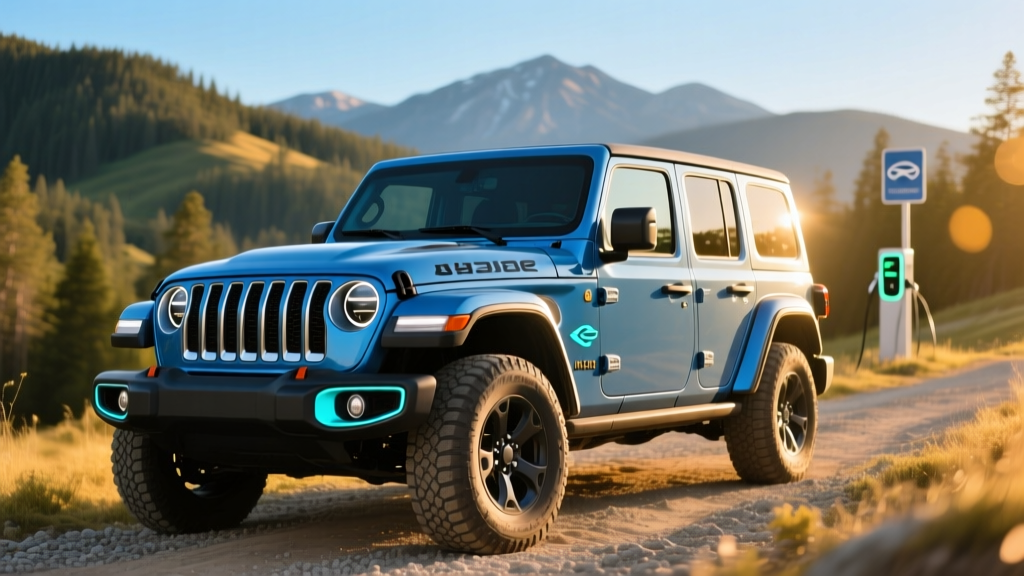
The 2023 Jeep Wrangler 4xe (pronounced "four-by-e") remains one of the most unusual vehicles in the plug-in hybrid segment: a solid-axle, body-on-frame off-roader that can commute on electric power alone. As of the 2026 model year, Jeep continues to sell the Wrangler 4xe alongside updated trims, but the 2023 model established the powertrain template that still defines the lineup. For buyers searching for a 2023 Jeep Wrangler hybrid, this guide covers every number that matters — from EPA-rated efficiency to real-world range, charging logistics, battery longevity, and whether the 4xe actually saves money versus the gas-only Wrangler or a full EV.
HEV vs PHEV: What the Wrangler 4xe Actually Is
Before examining specs, it is essential to distinguish the two hybrid categories. The Wrangler 4xe is a plug-in hybrid electric vehicle (PHEV), not a conventional hybrid (HEV).
- Conventional Hybrid (HEV): Charges its small battery exclusively through regenerative braking and the engine. No plug. Examples: Toyota RAV4 Hybrid, Honda CR-V Hybrid. Cannot drive on electric power alone for meaningful distances.
- Plug-in Hybrid (PHEV): Has a larger battery you charge via a plug (Level 1 or Level 2). Offers a dedicated electric-only range before the gas engine engages. Examples: Jeep Wrangler 4xe, Toyota RAV4 Prime, Chrysler Pacifica Hybrid.
The 2023 Wrangler is only available as a PHEV in its electrified form. There is no conventional HEV Wrangler. If you see "Wrangler hybrid" in listings, it refers to the 4xe plug-in variant.
Powertrain Specs: Engine, Motors, and Combined Output
The 2023 Wrangler 4xe pairs a 2.0-liter turbocharged inline-four engine with two electric motor-generators integrated into the TorqueFlite 8-speed automatic transmission. Here is the full powertrain breakdown:
| Specification | 2023 Jeep Wrangler 4xe |
|---|---|
| Engine | 2.0L turbo I-4 (270 hp / 295 lb-ft) |
| Electric Motors | Two motor-generators (134 hp combined electric contribution) |
| Combined System Output | 375 hp / 470 lb-ft torque |
| Transmission | 8-speed automatic (TorqueFlite) |
| Drivetrain | 4WD (Selec-Trac or Rock-Trac depending on trim) |
| Battery Pack | 17.3 kWh usable (NMC lithium-ion) |
| Onboard Charger | 7.2 kW (Level 2 AC only — no DC fast charging) |
| 0-60 mph | ~6.0 seconds |
| Towing Capacity | 3,500 lbs |
| Ground Clearance | 10.8 inches (Rubicon trim) |
The 470 lb-ft of torque — available at low RPM thanks to the electric motors — gives the 4xe a distinct low-speed crawling advantage over the gas V6 Wrangler. The combined 375 hp also makes it the quickest Wrangler in the lineup, though the added battery mass (~700 lbs of extra weight versus the gas model) shows up in braking distances and highway fuel consumption once the battery is depleted.
Fuel Economy: EPA Ratings and Real-World MPG
| Mode | City | Highway | Combined |
|---|---|---|---|
| Charge-Depleting (EV + Hybrid) | 49 MPGe (EPA) | ||
| Charge-Sustaining (Gas Only, Battery Depleted) | 20 mpg | 20 mpg | 20 mpg |
Source: EPA Fuel Economy Guide — 2023 Jeep Wrangler 4xe
The MPGe figure (miles per gallon equivalent) applies when the battery is charged and you are using a mix of electric and gas power. Once the battery depletes — after roughly 21 miles of electric driving — the 4xe operates as a heavy, boxy gas vehicle and returns about 20 mpg combined.
Real-World MPG vs. EPA:
- City commuting with daily charging: Many owners report 30-40+ mpg equivalent because short trips stay within the 21-mile electric envelope. If your commute is under 20 miles round-trip and you charge nightly, you may use almost no gasoline on weekdays.
- Highway driving (battery depleted): Expect 18-20 mpg at 70-75 mph. The Wrangler's aerodynamics — flat windshield, solid axles, aggressive tires — are brutal at speed. The gas-only Wrangler 2.0L turbo returns a similar 20-22 mpg highway, so the 4xe offers no highway advantage once the battery is empty.
- Cold weather: Electric-only range drops 20-30% in freezing temperatures. A 21-mile EPA electric range becomes roughly 15-17 miles in sub-30°F conditions.
- Off-road / low-range use: Electric torque is excellent for rock crawling, but battery depletion happens faster under heavy load. Plan for gas-engine operation on longer trails.
Electric-Only Range and Charging Details
The EPA rates the 2023 Wrangler 4xe at 21 miles of electric-only range. Combined electric-plus-gas total range is approximately 370 miles (based on the 17.2-gallon fuel tank and blended operation).
| Charging Level | Power | Time (0-100%) | Notes |
|---|---|---|---|
| Level 1 (120V household) | ~1.4 kW | ~12 hours | Trickle charge; suitable for overnight if you drive very little |
| Level 2 (240V) | 7.2 kW | ~2 hours | Recommended for daily use; full charge before bed |
| DC Fast Charging | N/A | N/A | Not supported — no CCS or CHAdeMO port |
The 7.2 kW onboard charger is adequate for a 17.3 kWh battery, meaning a standard Level 2 home charger (like a ChargePoint Home Flex or Wallbox Pulsar Plus) replenishes the pack in roughly two hours. The 4xe uses a standard J1772 connector for AC charging. There is no DC fast-charge capability — this is a PHEV designed for home and destination charging, not highway corridor fast-charging.
Practical charging tip: The 4xe's charge port is located on the driver's side front fender. If you install a Level 2 charger at home, plan your parking orientation accordingly — the cable needs to reach the front-left corner of the vehicle.
Pricing, Trims, and Tax Credit Eligibility
The 2023 Wrangler 4xe launched with a base MSRP starting around $54,990 (including destination) for the Willys trim and climbing to approximately $61,000-$65,000 for the Rubicon and High Altitude trims. As a used vehicle in 2026, pricing varies widely based on mileage, condition, and trim — expect $35,000-$50,000 in the pre-owned market.
Federal Tax Credit — §30D New Vehicle Credit (for original 2023 purchasers):
The 2023 Wrangler 4xe qualified for a partial federal tax credit (up to $3,750) for original buyers who met income and MSRP caps. Key 2023 rules included:
- Buyer AGI cap: $150,000 single / $300,000 married filing jointly
- MSRP cap: $80,000 for SUVs (Wrangler 4xe fell well under this)
- Battery component and critical mineral sourcing requirements phased in starting 2023, reducing many vehicles from $7,500 to $3,750
- Credit was non-refundable (could only offset tax liability)
Used EV Credit (§25E) — for 2026 buyers purchasing pre-owned:
If you are buying a used 2023 Wrangler 4xe in 2026, you may qualify for the Used Clean Vehicle Credit of up to $4,000 (or 30% of the sale price, whichever is less). Requirements include:
- Sale price at or below $25,000 (this is a challenge — most used 4xe models sell above this threshold)
- Buyer AGI cap: $75,000 single / $150,000 married filing jointly
- Vehicle must be at least 2 model years old (2023 models qualify in 2025+)
- Must purchase from a licensed dealer
Source: IRS Used Clean Vehicle Credit. Consult a tax professional for your specific eligibility.
Battery Warranty, Reliability, and Replacement Cost
2023 Wrangler 4xe High-Voltage Battery Warranty:
- Coverage: 8 years / 100,000 miles (whichever comes first)
- Capacity retention threshold: Stellantis warrants the battery against failure to hold a charge below a specified capacity (typically 70% of original capacity, though exact threshold varies by model year documentation)
- What's covered: Battery cell defects, battery management system (BMS) failures, and related high-voltage components
- Transferability: The hybrid battery warranty transfers to subsequent owners, which supports used-vehicle resale value
Reliability: The 2.0L turbo engine has been in the Stellantis lineup since 2018 and is generally well-regarded, though early models had some turbo-related complaints. The hybrid system — motor-generators, inverter, and battery — has proven robust in fleet data. Jeep/Stellantis has deployed the 4xe powertrain globally, and large-scale battery failure rates remain low.
Battery replacement cost: If the high-voltage battery fails out of warranty, replacement cost is estimated at $12,000-$16,000 (parts and labor). This is a significant expense, though it is comparable to other PHEV battery replacements in the industry. The 8-year/100,000-mile warranty provides substantial coverage, and most PHEV batteries outlast their warranty period with manageable degradation (typically 10-15% capacity loss over 8-10 years based on industry data).
The 12V auxiliary battery (a standard lead-accent or AGM unit) is a separate maintenance item and typically costs $200-$400 to replace — unrelated to the high-voltage traction battery.
Who Should Choose the Wrangler 4xe vs. a Full EV or Gas Wrangler?
Choose the 2023 Wrangler 4xe (PHEV) if:
- You want serious off-road capability (solid axles, locking diffs, sway-bar disconnect on Rubicon) but also want to commute partially on electric power
- You have access to Level 2 charging at home and a daily commute under ~20 miles
- You tow occasionally (3,500 lbs) and need a rugged SUV that can handle trails on weekends
- You want to reduce fuel costs on daily driving without range anxiety on road trips
- You value the instant low-end electric torque for rock crawling and technical terrain
Choose the gas-only Wrangler (3.6L V6 or 2.0L turbo) if:
- You cannot charge at home (no garage, no driveway outlet, apartment living)
- Your budget is tighter — gas Wranglers start several thousand dollars less
- You primarily drive highway miles where the 4xe's electric advantage disappears
- You want lower vehicle weight and simpler mechanicals for remote-area reliability
Choose a full EV (e.g., Ford F-150 Lightning, Rivian R1S, or upcoming electric Jeep Recon) if:
- You want zero tailpipe emissions and have reliable charging access
- Your daily driving is under 250 miles and you can plan road trips around DC fast-charging
- You prioritize lower per-mile "fuel" costs and reduced maintenance (no oil changes, no transmission fluid)
- You do not need extreme off-road articulation (solid axles) — independent-suspension EVs handle trails moderately but not at Rubicon level
Pros and Cons of the 2023 Wrangler 4xe
Pros
- 21 miles of electric-only range covers many commutes gas-free
- 470 lb-ft of instant torque — best low-speed crawling in the Wrangler lineup
- 375 hp makes it the quickest Wrangler available (0-60 in ~6 seconds)
- Full off-road hardware retained (Rubicon locking diffs, sway-bar disconnect, 10.8" clearance)
- 3,500-lb towing capacity matches gas Wrangler
- 8-year/100,000-mile battery warranty transfers to used buyers
- No range anxiety — 370+ total miles with gas tank as backup
Cons
- Only 20 mpg combined once the battery depletes — no highway efficiency gain
- ~700 lbs heavier than gas Wrangler — affects braking and handling
- No DC fast charging — limited to 7.2 kW Level 2
- Electric-only range drops to ~15 miles in freezing weather
- High base MSRP ($54,990+); used prices still elevated
- Used EV tax credit ($4,000) has a $25,000 sale-price cap most 4xes exceed
- Cargo space reduced slightly due to battery pack under rear seat
Frequently Asked Questions
How many MPG does the 2023 Jeep Wrangler 4xe hybrid get?
The EPA rates the Wrangler 4xe at 49 MPGe when operating in blended electric-gas mode with a charged battery. Once the battery depletes (after ~21 miles), it returns 20 mpg combined (20 city / 20 highway) on gasoline alone. Real-world results vary: daily charging with a short commute can push effective economy well above 30 mpg, while highway road trips with a depleted battery hover around 18-20 mpg.
How far can the Wrangler 4xe go on electric only?
The EPA-rated electric-only range is 21 miles. In real-world conditions — particularly cold weather (below 30°F) or aggressive driving — expect 15-18 miles. Gentle city driving in mild weather may stretch it to 22-24 miles thanks to regenerative braking.
Does the 2023 Wrangler 4xe qualify for a tax credit in 2026?
For original purchasers in 2023, the 4xe qualified for up to $3,750 in federal tax credits (not the full $7,500, due to battery sourcing rules). For used buyers in 2026, the §25E Used Clean Vehicle Credit offers up to $4,000 — but only if the sale price is at or below $25,000. Most used 2023 Wrangler 4xe models sell above that threshold, making the used credit difficult to claim. Always verify eligibility with a tax professional and check current IRS guidelines.
Is the Wrangler 4xe reliable, and what does a battery replacement cost?
The 4xe powertrain has proven reliable in fleet and owner data. The high-voltage battery is covered by an 8-year/100,000-mile warranty. Out-of-warranty battery replacement is estimated at $12,000-$16,000, though large-scale failure rates are low. Most PHEV batteries experience gradual degradation (10-15% over 8-10 years) rather than sudden failure.
Can I charge the Wrangler 4xe at a DC fast charger?
No. The Wrangler 4xe supports only AC charging: Level 1 (120V, ~1.4 kW) and Level 2 (240V, up to 7.2 kW). There is no DC fast-charge port. A full Level 2 charge takes approximately 2 hours. This is standard for PHEVs — only full battery-electric vehicles (BEVs) support DC fast charging at 50+ kW.
Hybrid vs. PHEV vs. EV — which is right for me?
If you have no home charging access, a conventional hybrid (HEV) like a Toyota RAV4 Hybrid requires no plug and delivers consistent MPG gains. If you have Level 2 home charging and a short commute, a PHEV like the Wrangler 4xe lets you drive partially on electricity while keeping a gas engine for road trips. If you have reliable charging, drive under 250 miles daily, and want the lowest per-mile operating cost, a full EV eliminates gasoline entirely. The Wrangler 4xe occupies a niche: it is the PHEV choice for buyers who need genuine off-road hardware that no current EV can match.
Editorial note: Specifications and pricing reflect the 2023 model year as originally published by Stellantis. Used-market pricing and federal tax credit rules reflect conditions as of early 2026 and are subject to change. Always verify current IRS credit eligibility at irs.gov and consult a licensed tax professional before purchasing.