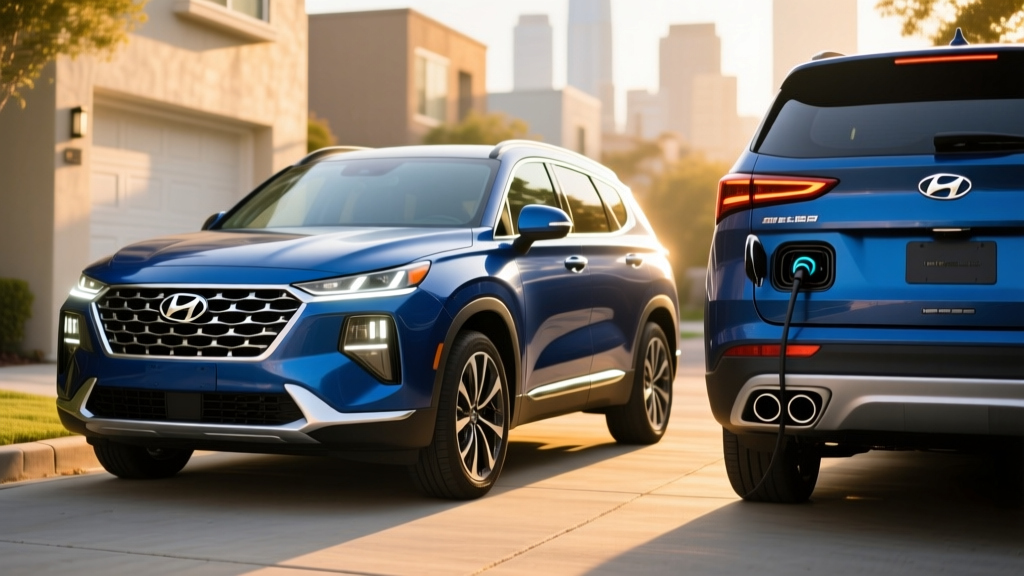
The 2023 Hyundai Santa Fe Plug-In Hybrid occupies a specific niche: a midsize crossover that can handle daily commutes on electricity alone while retaining a gas engine for longer road trips. With 31 miles of EPA-rated electric-only range and a combined 261 horsepower, it targets buyers who want EV-like driving around town without committing to a full battery-electric vehicle. But does the math work in 2026, as used models hit dealer lots and newer PHEVs push the segment forward?
This guide covers the real-world efficiency, charging practicalities, powertrain details, battery longevity, and tax-credit eligibility you need to evaluate the 2023 Santa Fe PHEV as a new leftover or certified pre-owned purchase.
HEV vs PHEV: Which Santa Fe Hybrid Is Which?
Hyundai sells two hybrid flavors of the Santa Fe, and confusing them is the most common buyer mistake. Here's the fundamental difference:
Conventional Hybrid (HEV)
The Santa Fe Hybrid uses a small battery (around 1.49 kWh) that charges exclusively through regenerative braking and the gas engine. You never plug it in. It delivers strong city MPG but zero electric-only driving range. Think of it as a more efficient gas car.
Plug-In Hybrid (PHEV)
The Santa Fe Plug-In Hybrid carries a much larger 13.8 kWh battery pack that you charge by plugging into a wall outlet or Level 2 charger. It can drive up to 31 miles on electricity alone before the 1.6L turbo engine kicks in. It operates as a short-range EV for commutes and a hybrid for longer trips.
If your daily round-trip commute is under 30 miles and you have access to home charging, the PHEV effectively becomes an EV on weekdays and a road-trip-capable SUV on weekends. If you can't charge at home or at work, the PHEV premium over the HEV is harder to justify.
Fuel Economy and Electric-Only Range
The EPA rates the 2023 Hyundai Santa Fe Plug-In Hybrid at 79 MPGe combined when operating in electric mode and 33 MPG combined once the battery is depleted and the vehicle runs as a conventional hybrid. Here's the full breakdown per fueleconomy.gov:
| Mode | City | Highway | Combined |
|---|---|---|---|
| Electric + Gas (MPGe) | 81 | 77 | 79 |
| Gas Only (MPG, battery depleted) | 33 | 33 | 33 |
EPA Electric-Only Range: 31 miles
Real-World Expectation: 24–28 miles in mixed driving with moderate climate control use. Expect 20–23 miles in cold weather (below 40°F) due to cabin heating demands and reduced battery efficiency. Highway-speed electric-only driving at 70+ mph will also reduce range to the low-to-mid 20s.
Total Combined Range (Electric + Gas): Approximately 440 miles with a full tank and full battery.
Real-world MPG vs EPA: In our experience, the 33 MPG gas-only figure is achievable in mixed suburban driving. City-heavy routes with frequent stops can push it to 35–36 MPG thanks to aggressive regenerative braking. Sustained highway driving at 75+ mph drops gas-only economy to roughly 29–31 MPG. The PHEV's advantage is front-loaded: the more often you charge and stay within 31 miles, the less gas you burn. Owners with short commutes and nightly charging report using 1–2 gallons per week.
Powertrain: 261 Horsepower from Turbo + Electric
The 2023 Santa Fe PHEV pairs a 1.6-liter turbocharged four-cylinder engine with a 66.9 kW (90 hp) electric motor integrated into a six-speed automatic transmission. Combined output is 261 horsepower and 258 lb-ft of torque, routed through HTRAC all-wheel drive as standard.
| Specification | Value |
|---|---|
| Engine | 1.6L Turbo GDI 4-cylinder |
| Engine Output | 178 hp / 195 lb-ft |
| Electric Motor | 66.9 kW (90 hp) / 195 lb-ft |
| Combined System Output | 261 hp / 258 lb-ft |
| Transmission | 6-speed automatic |
| Drivetrain | HTRAC AWD (standard) |
| Battery Capacity | 13.8 kWh (gross) |
| Battery Chemistry | NMC (Nickel Manganese Cobalt) |
| EPA Electric Range | 31 miles |
| EPA MPGe (combined) | 79 MPGe |
| Gas-Only MPG (combined) | 33 MPG |
| 0–60 mph | ~7.6 seconds (est.) |
| Max DC Fast Charge | Not available (AC only) |
| Level 2 Charge Time (0–100%) | ~3 hours 15 min at 7.2 kW |
| Level 1 Charge Time (120V) | ~11–12 hours |
| Towing Capacity | 2,000 lbs |
| Cargo Volume (behind 2nd row) | 36.4 cu ft |
The powertrain delivers confident acceleration, especially from a stop where the electric motor's instant torque fills in before the turbo spools. The six-speed automatic is a welcome departure from the CVT or e-CVT found in some competitors — shifts are perceptible but smooth, and highway passing power is strong.
Charging: Level 2 Only, No DC Fast Charging
The 2023 Santa Fe PHEV charges exclusively via AC power. There is no DC fast-charging capability — a limitation shared with most PHEVs in this class but worth stating plainly for buyers coming from full-EV expectations.
| Charging Level | Power Source | Max kW | Estimated Time (0–100%) | Miles of Range Added/Hour |
|---|---|---|---|---|
| Level 1 | 120V household outlet | ~1.4 kW | 11–12 hours | ~3 mi/hr |
| Level 2 | 240V (home or public) | 7.2 kW | ~3 hours 15 min | ~10 mi/hr |
| DC Fast Charge | N/A | N/A | N/A | N/A |
Practical charging reality: With a 13.8 kWh battery, a dedicated Level 2 home charger (240V, 32A or higher) will fully replenish the pack in roughly 3 hours and 15 minutes. Most PHEV owners charge overnight, and even a standard 120V outlet can recover 15–20 miles of electric range during an 8-hour sleep cycle — enough for many commutes. A Level 2 installation typically costs $500–$1,500 depending on electrical panel proximity; consult a licensed electrician for your specific setup.
The charge port uses a standard J1772 connector, compatible with virtually every public Level 2 station in the US. You will not need an adapter for public AC charging.
Pricing, Trims, and Tax Credit Eligibility
The 2023 Hyundai Santa Fe Plug-In Hybrid was offered in two trims at launch:
| Trim | Original MSRP | Key Features |
|---|---|---|
| SEL Convenience | $40,290 | Leatherette seats, 10.25" nav, wireless CarPlay/Android Auto, SmartSense safety suite, heated front seats, power liftgate |
| Limited | $47,240 | Nappa leather, ventilated front seats, heated rear seats, head-up display, 12-speaker Harman Kardon audio, Highway Driving Assist |
As of 2026, the 2023 model year is available only as dealer leftover inventory or on the used/CPO market. Used pricing typically ranges from $28,000–$38,000 depending on mileage and trim.
Federal Tax Credit (§30D) — Key Rules
- New-vehicle credit: The 2023 Santa Fe PHEV qualified for a partial federal tax credit (up to $6,574 depending on battery sourcing) when purchased new, subject to Hyundai's North American assembly status and critical-mineral requirements.
- Used EV credit (§25E): Buying a used 2023 Santa Fe PHEV from a dealer in 2026 may qualify you for up to $4,000 or 30% of the sale price (whichever is less), provided the sale price is $25,000 or less, your income falls below IRS thresholds ($75,000 single / $150,000 joint), and you purchase from a licensed dealer.
- Income caps apply: Modified AGI must not exceed $75,000 (single), $112,500 (head of household), or $150,000 (married filing jointly) for the used credit.
- Point-of-sale transfer: Both the new and used credits can be transferred to the dealer at purchase to reduce your out-of-pocket cost immediately.
- Verify current rules: Tax credit eligibility changes frequently. Check the IRS clean vehicle credits page and consult a tax professional before relying on any credit amount.
Battery Longevity, Warranty, and Replacement Cost
Hybrid/PHEV Battery Warranty: Hyundai covers the 13.8 kWh lithium-ion battery pack for 10 years or 100,000 miles (whichever comes first) under its powertrain warranty. In states that follow California Air Resources Board (CARB) standards — including California, New York, Massachusetts, and others — the emissions-related warranty extends to 10 years/150,000 miles.
Capacity retention threshold: Hyundai's warranty covers the battery if it falls below approximately 70% of original capacity during the warranty period.
Degradation reality: NMC batteries in PHEV applications experience moderate degradation. Based on fleet data from similar Hyundai/Kia PHEV platforms, expect roughly 8–12% capacity loss over 5 years and 60,000 miles under normal use. Because the battery is relatively small (13.8 kWh) and the vehicle has robust thermal management, degradation tends to be gradual rather than cliff-like. Many owners report negligible range loss in the first 3–4 years.
Battery replacement cost: If the battery fails outside warranty, a full pack replacement runs approximately $5,000–$7,500 including parts and labor at a Hyundai dealership. Individual module replacement may be possible at lower cost depending on the failure mode. Third-party hybrid battery specialists may offer refurbished packs at lower prices, though warranty coverage varies.
The conventional hybrid components — regenerative braking system, electric motor, power control unit — are also covered under the 10-year/100,000-mile powertrain warranty. The 1.6L turbo engine follows the standard 5-year/60,000-mile new-vehicle warranty for 2023 models.
Who Should Buy the Santa Fe PHEV vs a Full EV or Gas Car?
Choose the 2023 Santa Fe Plug-In Hybrid if:
- Your daily commute is 25 miles or less round-trip and you can charge at home
- You take 4+ road trips per year exceeding 150 miles and don't want to plan around charging infrastructure
- You need AWD and midsize SUV cargo space (36.4 cu ft behind the second row)
- You want to reduce gas consumption significantly without the upfront cost of a long-range EV
- You live in an area with limited DC fast-charging infrastructure
Choose a full EV (like the Hyundai Ioniq 5 or Kia EV6) instead if:
- You have reliable home Level 2 charging and your daily driving rarely exceeds 200 miles
- You want zero tailpipe emissions and minimal maintenance (no oil changes, no gas engine)
- You value DC fast charging at 200+ kW for road trips
- You want access to the full $7,500 federal tax credit on a new vehicle
Choose the conventional Santa Fe Hybrid (HEV) instead if:
- You cannot charge at home or at work (apartment, street parking)
- Your budget is tighter — the HEV starts several thousand dollars lower
- Your driving is mostly highway, where the PHEV's electric-only advantage diminishes
- You prefer a simpler ownership experience with no charging cables or routines
Pros and Cons
Pros
- 31 miles of electric-only range covers most daily commutes
- 261 hp provides confident acceleration and highway merging
- Standard AWD — no FWD-only base model compromise
- 10-year/100,000-mile battery and powertrain warranty
- Comfortable, well-equipped cabin with strong safety tech (SmartSense)
- Used-market pricing now makes it accessible under $35K
- Smooth six-speed automatic — no CVT drone
Cons
- No DC fast charging — AC only, limiting road-trip electric driving
- 31-mile electric range is modest vs newer PHEVs (e.g., Toyota RAV4 Prime at 42 mi)
- 33 MPG gas-only is good but not class-leading (RAV4 Hybrid achieves ~39 MPG)
- 13.8 kWh battery is small — cold weather cuts electric range noticeably
- 2023 model year no longer qualifies for the new-vehicle §30D credit
- Third row is cramped (best suited for children)
Frequently Asked Questions
How many MPG does the 2023 Hyundai Santa Fe Plug-In Hybrid get?
The EPA rates it at 79 MPGe combined when using both electric and gas power, and 33 MPG combined in gas-only mode (after the battery is depleted). Real-world gas-only MPG ranges from 29–31 MPG on the highway to 35–36 MPG in stop-and-go city driving with regenerative braking.
How far can the Santa Fe PHEV go on electric only?
The EPA rates it at 31 miles of electric-only range. In real-world conditions, expect 24–28 miles in moderate weather and 20–23 miles in cold weather (below 40°F). Aggressive acceleration and sustained highway speeds above 65 mph will also reduce electric range.
Does the 2023 Santa Fe PHEV qualify for a tax credit?
As a new vehicle, the 2023 Santa Fe PHEV was eligible for a partial federal credit (up to $6,574 depending on battery sourcing) when purchased new, though Hyundai's US assembly status and IRS sourcing rules affected the exact amount. In 2026, only the used-vehicle credit (§25E) applies — up to $4,000 if the sale price is $25,000 or less and you meet income requirements. Always verify current eligibility on IRS.gov.
Is the Santa Fe PHEV reliable, and what does battery replacement cost?
Hyundai's hybrid/PHEV powertrains have proven reliable in industry surveys, and the 10-year/100,000-mile battery warranty provides strong coverage. NMC battery degradation in PHEV use is typically 8–12% over five years. Out-of-warranty battery replacement costs approximately $5,000–$7,500 at a dealership.
Can I charge the Santa Fe PHEV at a regular household outlet?
Yes. A standard 120V Level 1 outlet will fully charge the 13.8 kWh battery in approximately 11–12 hours, adding about 3 miles of range per hour. Most owners find that overnight Level 1 charging recovers enough electric range for a daily commute. A 240V Level 2 charger reduces charge time to roughly 3 hours and 15 minutes.
How does the Santa Fe PHEV compare to the Toyota RAV4 Prime?
The RAV4 Prime offers 42 miles of electric range (vs 31), 302 hp (vs 261), and roughly 38 MPG gas-only (vs 33). It also costs significantly more on the used market and has faced availability constraints. The Santa Fe PHEV trades some efficiency and range for a lower price point, a more refined interior, and Hyundai's longer warranty coverage.
Do I need to plug in the Santa Fe PHEV, or does it charge itself?
To get the electric-only range and MPGe benefits, you must plug it in. The vehicle recovers some energy through regenerative braking, but this alone will not meaningfully recharge the 13.8 kWh pack. If you never plug in, the PHEV operates as a conventional hybrid at approximately 33 MPG — essentially paying a premium for electric capability you're not using.
Sources: EPA fueleconomy.gov, IRS Clean Vehicle Credits, Hyundai Motor America specifications.