Quick Verdict: A Practical Hybrid SUV Without the Plug
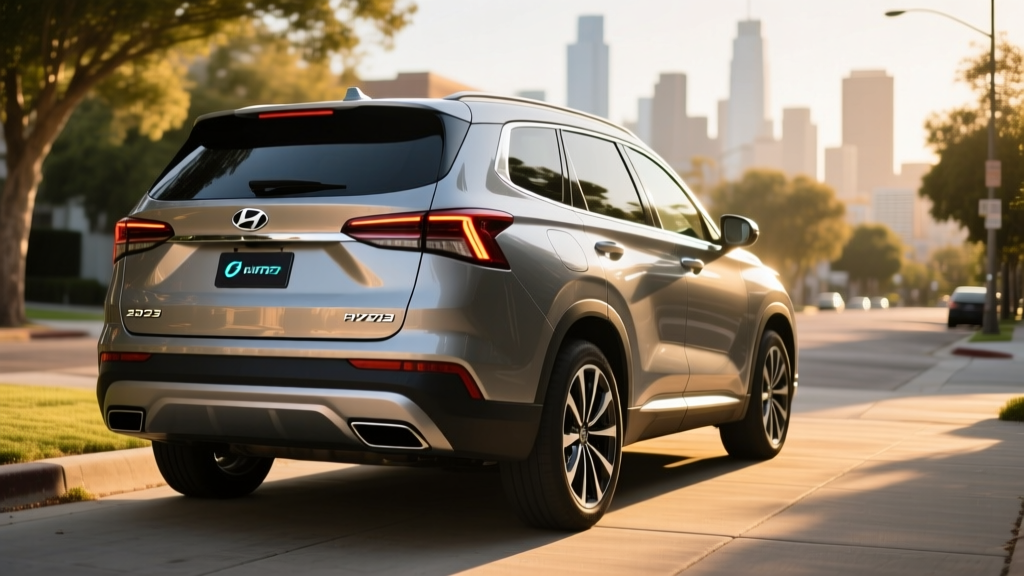
If you're shopping the used market in 2026 and want a three-row midsize SUV that sips fuel without requiring a home charger, the 2023 Hyundai Santa Fe Hybrid remains a compelling option. This is a conventional hybrid electric vehicle (HEV) — meaning it charges itself through regenerative braking and its gasoline engine. You never plug it in. For buyers who can't install a Level 2 charger at home or who frequently take long road trips through charging deserts, the Santa Fe Hybrid offers a pragmatic middle ground between a gas-only SUV and a full battery-electric vehicle.
With 226 combined horsepower, an EPA-estimated 34 MPG combined, and Hyundai's 10-year/100,000-mile hybrid battery warranty, the Santa Fe Hybrid delivers practicality and peace of mind. But it's important to understand what it is — and what it isn't — before you buy.
HEV vs PHEV: Which Santa Fe Are You Looking At?
Hyundai sold two electrified versions of the 2023 Santa Fe, and confusing them is one of the most common mistakes shoppers make:
| Feature | 2023 Santa Fe Hybrid (HEV) | 2023 Santa Fe Plug-In Hybrid (PHEV) |
|---|---|---|
| Powertrain Type | Conventional Hybrid (no plug) | Plug-In Hybrid (charges via outlet) |
| Combined Horsepower | 226 hp | 261 hp |
| Battery Capacity | 1.49 kWh (small buffer) | 12.4 kWh usable |
| Electric-Only Range | Less than 1 mile at low speed | EPA-est. 31 miles |
| EPA Combined Fuel Economy | 34 MPG (36 city / 31 hwy) | 79 MPGe (elec+gas) / 33 MPG (gas only) |
| Needs to Plug In? | No — self-charging | Yes — for electric range benefit |
| DC Fast Charging | N/A | No — Level 2 AC only |
| Federal Tax Credit (§30D) | Not eligible | Up to $7,500 (subject to eligibility) |
This article focuses on the conventional HEV model. If you have access to home charging and a commute under 30 miles, the PHEV variant is worth exploring separately — its 31 miles of electric-only range can cover most daily driving without burning a drop of gasoline.
Fuel Economy: EPA Numbers and Real-World MPG
The EPA rates the 2023 Hyundai Santa Fe Hybrid at:
| Driving Condition | EPA Estimate | Real-World Expectation |
|---|---|---|
| City | 36 MPG | 35–38 MPG (hybrids excel in stop-and-go) |
| Highway | 31 MPG | 28–32 MPG (aerodynamic drag limits regen benefit) |
| Combined | 34 MPG | 32–36 MPG depending on driving mix |
Like most hybrids, the Santa Fe HEV tends to exceed its EPA city rating in real-world stop-and-go driving. That's because regenerative braking recaptures energy that a gas-only vehicle wastes as heat. On the highway, where regenerative braking plays a smaller role and aerodynamic drag dominates, expect fuel economy to dip closer to 28–30 MPG at sustained 75+ mph speeds.
According to fueleconomy.gov, the Blue Hybrid trim with front-wheel drive achieves 36/31/34 MPG city/highway/combined. The all-wheel-drive variant carries the same EPA rating thanks to Hyundai's efficient hybrid AWD system, though real-world testing suggests a 1–2 MPG penalty in mixed driving with AWD engaged frequently.
Real-World Fuel Cost Context: At 34 MPG combined and $3.50/gallon regular unleaded, you'd spend roughly $1,544 per year on fuel driving 15,000 miles. A comparable gas-only midsize SUV at 24 MPG combined would cost about $2,188 annually — a savings of approximately $644/year with the hybrid.
Powertrain: 226 Horsepower from Turbo Four + Electric Motor
The 2023 Santa Fe Hybrid pairs a 1.6-liter turbocharged four-cylinder engine (178 hp, 195 lb-ft) with a 44.2 kW electric motor integrated into the six-speed automatic transmission. Combined system output is 226 horsepower and 258 lb-ft of torque.
| Specification | 2023 Santa Fe Hybrid (HEV) |
|---|---|
| Engine | 1.6L Turbocharged I-4 |
| Engine Output | 178 hp / 195 lb-ft |
| Electric Motor | 44.2 kW (59 hp) / 195 lb-ft |
| Combined System Output | 226 hp / 258 lb-ft |
| Transmission | 6-speed automatic |
| Drivetrain | FWD standard, HTRAC AWD available |
| 0-60 mph | ~7.4 seconds (FWD) |
| Towing Capacity | 2,000 lbs (with trailer brakes) |
| Battery Type | Lithium-ion polymer, 1.49 kWh |
| Cargo Volume (behind 3rd row) | 12.9 cu ft |
| Cargo Volume (2nd row folded) | 41.2 cu ft |
The six-speed automatic is a deliberate choice over the continuously variable transmissions (CVTs) used in competitors like the Toyota Highlander Hybrid. The result is more natural-feeling acceleration without the "rubber band" drone associated with CVTs, though the trade-off is marginally lower efficiency at steady-state cruising.
Acceleration is adequate for merging and passing — 0-60 mph in roughly 7.4 seconds puts it in the middle of the hybrid SUV pack. The electric motor fills in the turbo lag at low RPMs, giving the Santa Fe Hybrid a responsive feel from a stoplight that the gas-only 2.5T model doesn't quite match in city driving.
Battery Warranty, Reliability, and Replacement Cost
Hybrid battery longevity is the number-one concern for used hybrid buyers, and Hyundai addresses this with one of the strongest warranties in the industry:
Hyundai Hybrid Battery Warranty: 10 years / 100,000 miles (whichever comes first) for the original owner. For subsequent owners (relevant on the used market in 2026), coverage transfers as 10 years / 100,000 miles from the original in-service date in most states, though California-emissions states may offer enhanced coverage. Always verify with a Hyundai dealer using the VIN.
The 1.49 kWh lithium-ion polymer battery in the Santa Fe HEV is relatively small and operates within a narrow state-of-charge window (typically 40–60% SoC). This shallow cycling dramatically reduces degradation compared to full EV batteries that routinely cycle between 10–90% SoC. In practice, Hyundai's hybrid batteries rarely require replacement within the warranty period.
If replacement is needed out of warranty, expect a cost of $2,000–$3,500 for the hybrid battery pack — significantly less than a full EV battery replacement, which can exceed $10,000. The smaller capacity and simpler thermal management of an HEV battery keep costs manageable.
According to IIHS ratings, the 2023 Santa Fe earned a Top Safety Pick+ designation when equipped with specific headlights, reflecting strong crashworthiness. Hyundai's SmartSense suite (forward collision-avoidance, lane-keeping assist, blind-spot monitoring) comes standard on all trims, including the hybrid.
Pricing on the Used Market and Tax Credit Reality
When new, the 2023 Santa Fe Hybrid started at $35,310 MSRP for the Blue (FWD) trim, climbing to approximately $40,960 for the Limited (AWD). On the used market in 2026, expect to find examples in the $24,000–$33,000 range depending on mileage, condition, and trim level.
| Trim | Original MSRP | Estimated Used Price (2026) |
|---|---|---|
| Blue (FWD) | $35,310 | $24,000–$27,000 |
| SEL Premium (AWD) | $38,310 | $26,500–$29,500 |
| Limited (AWD) | $40,960 | $29,000–$33,000 |
Tax Credit Reality Check: The conventional Santa Fe Hybrid (HEV) does not qualify for the federal §30D Clean Vehicle Credit. That credit applies only to plug-in electric vehicles (BEVs and PHEVs) with sufficient battery capacity and meeting critical-mineral and battery-component sourcing requirements per IRS guidelines. The HEV's 1.49 kWh battery falls far below the 7 kWh minimum threshold.
If you purchased the Santa Fe Plug-In Hybrid new in 2023, it could have qualified for up to $7,500 in federal credits (subject to income caps of $150,000 single / $300,000 joint, MSRP cap of $80,000 for SUVs, and battery sourcing requirements). On the used market, the used clean vehicle credit (up to $4,000 or 30% of sale price, whichever is lower) may apply to a used Santa Fe PHEV purchased from a dealer — but not the conventional HEV.
Who Should Choose the Santa Fe Hybrid vs. a PHEV or Full EV?
Choose the 2023 Santa Fe Hybrid (HEV) if:
- You cannot install a Level 2 home charger (apartment, street parking, no garage)
- Your typical drive is a mix of city and highway with no predictable short commute
- You take frequent long road trips and don't want to plan around DC fast-charging stops
- You want a three-row SUV under $30,000 on the used market with low fuel costs
- You prefer zero behavior change — just drive it like a gas car and save at the pump
Choose the Santa Fe Plug-In Hybrid (PHEV) instead if:
- You can charge at home (even a standard 120V outlet adds ~4 miles of range per hour)
- Your daily commute is under 30 miles round-trip (you'll rarely burn gas on weekdays)
- You want to reduce tailpipe emissions for daily driving while keeping gas for road trips
- You qualify for the used EV tax credit (up to $4,000 on a dealer purchase)
Choose a full EV (like the Hyundai Ioniq 5 or Tesla Model Y) if:
- You have reliable home Level 2 charging and access to DC fast chargers on your routes
- You want the lowest per-mile energy cost (electricity at $0.12/kWh ≈ $0.04/mile vs. $0.10/mile for this hybrid)
- You want to eliminate oil changes, spark plugs, and transmission fluid forever
- You qualify for the full §30D $7,500 federal credit on a new EV purchase
Pros and Cons at a Glance
Pros
- 34 MPG combined — no plug-in required
- 226 hp provides confident highway merging
- 10-year/100,000-mile hybrid battery warranty
- Three-row seating in a midsize footprint
- Standard Hyundai SmartSense safety suite
- Natural 6-speed automatic (no CVT drone)
- Real-world city MPG often exceeds EPA estimate
Cons
- Third row is tight for adults (best for children)
- No federal tax credit eligibility (HEV)
- Highway MPG drops at sustained 75+ mph speeds
- Cargo space behind third row is just 12.9 cu ft
- Infotainment system can lag compared to 2025+ models
- No DC fast charging (PHEV variant)
- Redesigned 2024+ Santa Fe makes 2023 look dated
Frequently Asked Questions
How many MPG does the 2023 Hyundai Santa Fe Hybrid get?
The EPA rates the Santa Fe Hybrid at 36 MPG city, 31 MPG highway, and 34 MPG combined. In real-world driving, owners often see 35–38 MPG in city conditions thanks to regenerative braking, while sustained highway driving at 75+ mph may yield 28–30 MPG.
Does the 2023 Santa Fe Hybrid need to be plugged in?
No. The conventional Santa Fe Hybrid (HEV) is a self-charging vehicle. Its small 1.49 kWh battery recharges through regenerative braking and the gasoline engine. You fuel it at a gas station like any other car. Only the Santa Fe Plug-In Hybrid (PHEV) variant requires plugging in.
How far can the Santa Fe Plug-In Hybrid go on electric only?
The 2023 Santa Fe PHEV has an EPA-estimated 31 miles of electric-only range from its 12.4 kWh battery. In mild weather at city speeds, some owners report 33–35 miles. In cold weather (below 32°F), expect that to drop to 22–26 miles due to reduced battery efficiency and cabin heating demand. The PHEV's total combined range (electric + gas) exceeds 400 miles.
Is the 2023 Santa Fe Hybrid reliable?
Hyundai's hybrid powertrain has proven reliable across the Tucson and Santa Fe lineups. The 1.6L turbo engine and electric motor combination has been in production since 2021 with no widespread failure patterns. Hyundai's 10-year/100,000-mile hybrid battery warranty provides long-term protection, and the small HEV battery's shallow charge cycles minimize degradation. Out-of-warranty battery replacement runs $2,000–$3,500 if ever needed.
Does the 2023 Santa Fe Hybrid qualify for any tax credit?
The conventional HEV does not qualify for the federal §30D Clean Vehicle Credit, which requires a minimum 7 kWh battery and plug-in capability. The Santa Fe PHEV variant could qualify for up to $7,500 (new) or up to $4,000 (used, from a dealer) depending on income, MSRP, and battery sourcing requirements. Check current IRS guidelines for eligibility details, and consult a tax professional for your specific situation.
How does the Santa Fe Hybrid compare to the Toyota Highlander Hybrid?
The Toyota Highlander Hybrid achieves 35–36 MPG combined (slightly better) and offers more third-row space, but starts at a higher used price and uses a CVT that some drivers find less engaging. The Santa Fe Hybrid offers more horsepower (226 vs. 243 for Toyota, though Toyota's is heavier), a longer hybrid battery warranty (10yr/100k vs. Toyota's 10yr/150k), and a more premium interior at the SEL Premium and Limited trims. Both are strong choices — test-drive both to compare ride quality and seating comfort.
What is the maintenance cost difference vs. a gas-only SUV?
The Santa Fe Hybrid requires the same maintenance as a gas vehicle (oil changes, air filters, brake pads) but with one advantage: regenerative braking significantly reduces brake pad wear. Many hybrid owners report brake pads lasting 80,000–100,000 miles. There is no additional hybrid-specific maintenance — the electric motor is sealed and requires no service. Over five years and 75,000 miles, expect to save $3,000–$3,500 in fuel compared to a 24 MPG gas-only midsize SUV, partially offset by slightly higher insurance premiums in some states.