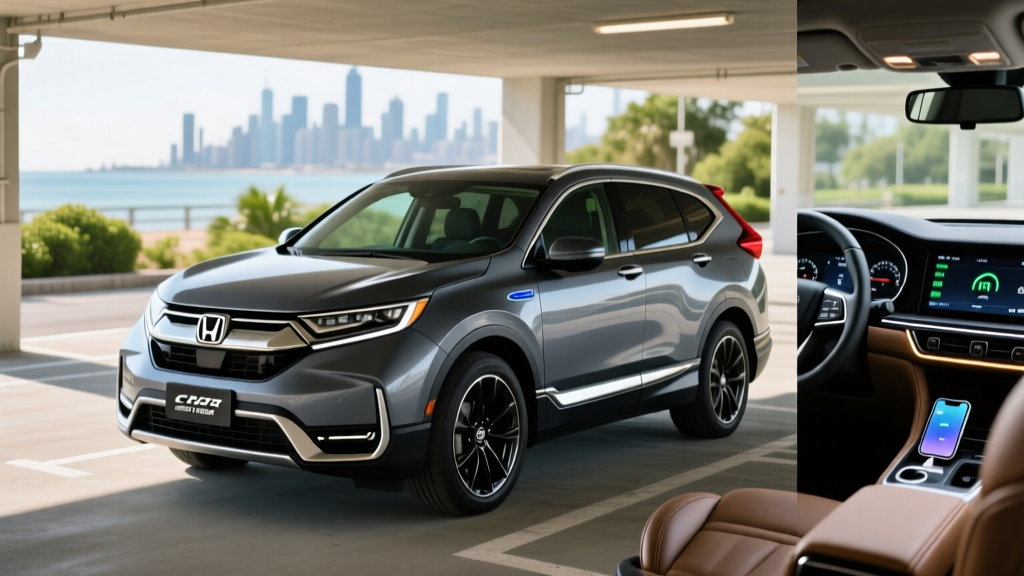
The 2023 Honda CR-V Sport Hybrid arrived as part of the sixth-generation CR-V redesign, slotting a two-motor hybrid powertrain into Honda's best-selling compact SUV. For buyers who want the fuel-economy upside of electrification without plugging in, the Sport Hybrid trim offers a practical middle ground: 40 MPG combined on the EPA cycle, 204 combined horsepower, and no change to daily driving habits. This review breaks down the real-world efficiency, powertrain specs, battery longevity, and total ownership picture so you can decide whether this HEV fits your garage — or whether a PHEV or full EV makes more sense.
HEV vs PHEV: What the CR-V Sport Hybrid Actually Is
Before diving into specs, it's worth clarifying what the 2023 CR-V Sport Hybrid is — and what it isn't. Honda offers the CR-V in three powertrain flavors for the 2023 model year:
Conventional Hybrid (HEV) — CR-V Sport Hybrid
- No plug; charges itself via regenerative braking and the gas engine
- Small battery (~1.06 kWh usable) — not designed for electric-only driving beyond very low speeds
- Primary benefit: significantly improved MPG over the gas-only model
- No home charging equipment needed
Plug-In Hybrid (PHEV) — Not Offered in 2023 CR-V
- Larger battery (typically 15-20 kWh) that charges via a plug
- 30-50 miles of electric-only range before the gas engine engages
- Requires Level 1 or Level 2 home charging to realize full benefit
- May qualify for federal §30D tax credit (up to $7,500) depending on sourcing and income
The 2023 CR-V Sport Hybrid is strictly an HEV. Honda did not offer a plug-in hybrid variant of the CR-V in the U.S. market for 2023. If you need electric-only commuting range, you'd need to look at competitors like the Toyota RAV4 Prime (PHEV) or consider a full battery-electric vehicle.
Fuel Economy: EPA Ratings and Real-World MPG
The headline number for the 2023 Honda CR-V Sport Hybrid is its EPA-estimated fuel economy. Here's the full breakdown for the front-wheel-drive (FWD) and all-wheel-drive (AWD) configurations:
| Configuration | City MPG | Highway MPG | Combined MPG |
|---|---|---|---|
| Sport Hybrid FWD | 43 | 36 | 40 |
| Sport Hybrid AWD | 40 | 34 | 37 |
| Gas-only CR-V (AWD, for comparison) | 27 | 32 | 29 |
Source: EPA / fueleconomy.gov
Real-World MPG: What Owners Actually See
Honda's two-motor hybrid system excels in city driving, where regenerative braking and electric-motor assist do the heavy lifting. Real-world owners and independent testers have reported the following patterns:
- City and suburban driving: 40-45 MPG is common, with some drivers exceeding the EPA city estimate of 43 MPG in warm weather on flat terrain. The hybrid system recaptures energy at every stop light.
- Highway cruising at 70-80 mph: Expect 32-36 MPG. The gas engine runs more continuously at sustained speeds, reducing the hybrid advantage. This is typical for all compact hybrid SUVs.
- Cold weather (below 30°F): Fuel economy can drop 5-10% as the engine runs more frequently to heat the cabin and maintain battery temperature. Expect 35-38 MPG combined in winter for the FWD model.
- Combined real-world average: Most owners report 37-41 MPG in mixed driving, tracking closely with the EPA combined estimate.
The hybrid's advantage over the gas-only CR-V is most pronounced in stop-and-go traffic, where the 43 MPG city rating represents a 59% improvement over the gas model's 27 MPG city. If your commute is primarily highway miles, the efficiency gap narrows but remains meaningful.
Powertrain Specs: Two-Motor Hybrid System
The 2023 CR-V Sport Hybrid uses Honda's fourth-generation two-motor hybrid system, pairing a 2.0-liter Atkinson-cycle four-cylinder engine with two electric motors. Here's the complete powertrain breakdown:
| Specification | Value |
|---|---|
| Engine | 2.0L Atkinson-cycle DOHC i-VTEC 4-cylinder |
| Engine Output | 146 hp @ 6,100 rpm / 134 lb-ft torque @ 4,500 rpm |
| Electric Motors | Two-motor system (one drive motor, one generator/starter) |
| Drive Motor Output | 184 hp / 247 lb-ft torque |
| Combined System Output | 204 hp / 247 lb-ft torque |
| Transmission | Electronic Continuously Variable (e-CVT) — no traditional gears |
| Hybrid Battery | Lithium-ion, ~1.06 kWh usable capacity |
| 0-60 mph | ~7.6 seconds (independent testing) |
| Drivetrain | FWD standard; AWD available (mechanical rear axle coupling) |
| Towing Capacity | 1,000 lbs (all trims) |
The e-CVT in this system is not a belt-and-pulley CVT like those found in some competitors. Honda's system uses the two motors and a clutch to create a direct-drive feel at highway speeds, avoiding the rubber-band sensation common to older CVTs. Off the line, the drive motor provides instant torque (247 lb-ft from zero RPM), making the Sport Hybrid feel notably quicker in city driving than its 7.6-second 0-60 time suggests.
The AWD system on hybrid trims uses a mechanical connection to the rear axle rather than a dedicated rear electric motor. This means AWD engagement is not as instantaneous as the electric AWD systems in some competitors (like the Toyota RAV4 Hybrid), but it's effective in rain and light snow.
Pricing, Trims, and Tax Credit Eligibility
The 2023 CR-V Sport Hybrid was offered in two trim levels at launch:
| Trim | Drivetrain | MSRP (at launch) |
|---|---|---|
| Sport Hybrid | FWD | $33,695 |
| Sport Hybrid | AWD | $35,195 |
| Sport Touring Hybrid | AWD (standard) | $39,845 |
Note: These are original 2023 MSRP figures. Used and certified pre-owned pricing in 2026 varies by market, mileage, and condition.
Does the CR-V Sport Hybrid Qualify for a Federal Tax Credit?
No. The 2023 Honda CR-V Sport Hybrid does not qualify for the federal §30D Clean Vehicle Credit. Under current IRS rules, the §30D credit (up to $7,500) applies only to plug-in electric vehicles — battery-electric vehicles (BEVs) and plug-in hybrids (PHEVs) with a battery capacity of at least 7 kWh. Conventional hybrids like the CR-V Sport Hybrid, which cannot be plugged in and have a battery well under 7 kWh, are ineligible.
Some states offer their own incentives for hybrid vehicles, but these vary widely by jurisdiction and change frequently. Check your state's energy office or department of revenue for current programs.
Battery Warranty, Lifespan, and Replacement Cost
Hybrid battery longevity is consistently the top concern among first-time hybrid buyers. Here's what Honda provides and what long-term data shows:
Honda Hybrid Battery Warranty
- Coverage: 8 years / 100,000 miles (10 years / 150,000 miles in CARB states including CA, NY, MA, and others that follow California emissions standards)
- What's covered: Defects in materials and workmanship; capacity loss below a defined threshold (typically ~70% of original capacity)
- Transferable: Yes — the warranty follows the vehicle, not the original owner
How Long Do Honda Hybrid Batteries Last?
Honda's lithium-ion hybrid batteries in the CR-V are small (~1.06 kWh usable) and are managed conservatively by the powertrain control system. The battery never fully charges or fully discharges in normal operation — it operates within a narrow state-of-charge window (roughly 30-70% SoC) that dramatically reduces degradation stress.
Based on long-term data from Honda's earlier hybrid systems (Insight, Accord Hybrid, previous-gen CR-V Hybrid), these batteries routinely last 150,000-200,000+ miles without significant capacity loss. The small battery size means there's less total energy cycling through the cells compared to a PHEV or BEV, further extending lifespan.
Battery Replacement Cost
If a hybrid battery does fail outside of warranty, replacement costs for the CR-V Hybrid battery pack typically range from $2,000 to $4,000 (parts and labor) at a Honda dealership. Third-party hybrid battery specialists may offer refurbished packs for $1,500-$2,500. This is significantly less than BEV battery replacements ($8,000-$20,000+) because the hybrid battery pack is small and relatively simple.
For context, the 12V auxiliary battery (a separate, conventional lead-agid or lithium 12V battery that powers electronics) will need replacement every 4-6 years at a cost of $150-$300 — the same as any other vehicle.
Reliability and Safety Ratings
The 2023 CR-V Sport Hybrid benefits from Honda's extensive hybrid experience and the proven reliability of the two-motor system, which has fewer moving parts than a conventional automatic transmission (no torque converter, no gear sets, no clutch packs that wear).
- NHTSA: The 2023 CR-V earned a 5-Star Overall Safety Rating from the National Highway Traffic Safety Administration.
- IIHS: The 2023 CR-V was named an IIHS Top Safety Pick when equipped with specific headlights.
- Honda Sensing: Standard on all trims — includes adaptive cruise control, lane-keeping assist, forward collision warning with automatic emergency braking, and traffic sign recognition. This is a Level 1/Level 2 driver-assistance suite; the driver must remain fully engaged at all times.
Common owner-reported issues for the 2023 model year are minor and mostly related to infotainment software glitches rather than powertrain concerns. Honda's hybrid system has been one of the most reliable in the industry over the past decade.
CR-V Sport Hybrid vs. Alternatives: Which Should You Choose?
The right electrified vehicle depends on your driving pattern, charging access, and budget. Here's a decision framework:
Choose the CR-V Sport Hybrid (HEV) if:
- You don't have access to home or workplace charging (apartment, street parking)
- You want better fuel economy without changing any habits — no plugging in, no route planning
- Your driving is a mix of city and highway, and you value the city MPG advantage
- You want a lower purchase price than a PHEV or BEV
- You drive 10,000-15,000 miles per year and want to reduce fuel costs by ~$500-$800 annually vs. the gas CR-V
Choose a PHEV (e.g., Toyota RAV4 Prime) if:
- You have reliable home Level 2 charging and a commute under 40 miles round-trip
- You want to drive mostly on electricity for daily trips but need a gas engine for road trips
- You may qualify for the §30D federal tax credit (up to $7,500) — check IRS eligibility rules for income caps, MSRP limits, and battery sourcing requirements
Choose a Full EV (e.g., Tesla Model Y, Hyundai Ioniq 5) if:
- You have home charging and your daily driving is under 250 miles
- You want zero tailpipe emissions and the lowest per-mile fuel cost (~$0.04-$0.06/mile on residential electricity vs. ~$0.12-$0.15/mile for the hybrid)
- You qualify for the full $7,500 federal credit and want the lowest total cost of ownership over 5 years
- You're willing to plan around DC fast charging on road trips
Pros and Cons at a Glance
Pros
- 40 MPG combined (FWD) — a 38% improvement over the gas CR-V
- 204 hp with instant electric torque makes it feel quicker than the gas model in daily driving
- No plugging in — zero lifestyle change required
- Proven, reliable Honda two-motor hybrid system
- Strong safety ratings (NHTSA 5-Star, IIHS Top Safety Pick)
- Generous cargo space (36.3 cu ft behind rear seats, 76.5 cu ft with seats folded)
- 8-year/100,000-mile hybrid battery warranty (10/150k in CARB states)
Cons
- No federal tax credit — HEVs are ineligible for §30D
- AWD system is mechanical, not electric — slightly less responsive in low-traction scenarios
- Highway MPG (34-36) is less impressive than city MPG — the hybrid advantage shrinks at sustained speed
- No PHEV variant available — no electric-only driving range
- Towing limited to 1,000 lbs (same as gas model)
- Premium trim (Sport Touring Hybrid) pushes $40K with no luxury badge
Frequently Asked Questions
How many MPG does the 2023 Honda CR-V Sport Hybrid get?
The EPA rates the FWD Sport Hybrid at 43 city / 36 highway / 40 combined MPG. The AWD version is rated at 40 city / 34 highway / 37 combined. Real-world owners typically see 37-41 MPG in mixed driving, with city-heavy commutes sometimes exceeding the EPA city estimate.
Does the CR-V Sport Hybrid need to be plugged in?
No. The CR-V Sport Hybrid is a conventional hybrid (HEV). It charges its small lithium-ion battery through regenerative braking and the gasoline engine. You simply fill it with gas like any other vehicle — the hybrid system operates entirely automatically.
How far can the CR-V Sport Hybrid drive on electric only?
Essentially zero miles at meaningful speeds. The hybrid battery is ~1.06 kWh, and the electric motor can propel the vehicle at very low speeds (parking lots, creeping in traffic) for short distances, but the gas engine engages almost immediately for normal driving. If you need electric-only range, you need a PHEV or BEV.
Is the 2023 CR-V Sport Hybrid reliable?
Yes. Honda's two-motor hybrid system has an excellent reliability track record over multiple generations. The e-CVT has fewer wear components than a traditional automatic transmission, and the hybrid battery is managed conservatively to maximize lifespan. Honda backs the hybrid battery with an 8-year/100,000-mile warranty (10 years/150,000 miles in CARB states).
What does it cost to replace the hybrid battery?
If replacement is needed outside of warranty, expect $2,000-$4,000 at a Honda dealer for a new battery pack, or $1,500-$2,500 for a refurbished unit from a hybrid specialist. However, Honda hybrid batteries routinely last 150,000-200,000+ miles, making out-of-pocket replacement uncommon during typical ownership.
Does the CR-V Sport Hybrid qualify for any tax credit?
Not the federal §30D Clean Vehicle Credit — that's limited to plug-in vehicles (BEVs and PHEVs with 7+ kWh batteries). Some states offer separate incentives for hybrids, but these vary by jurisdiction. Check your state's energy or revenue department for current programs.
How does the CR-V Sport Hybrid compare to the Toyota RAV4 Hybrid?
The Toyota RAV4 Hybrid (AWD standard) is EPA-rated at 41 city / 38 highway / 40 combined MPG and starts at a similar price point. The RAV4 Hybrid uses an electric rear motor for AWD (more responsive in snow), while the CR-V uses a mechanical rear axle. Both are excellent choices; the RAV4 has a slight highway MPG edge and standard AWD, while the CR-V offers a more refined interior and slightly more cargo space.
Should I buy the Sport Hybrid or the Sport Touring Hybrid?
The Sport Touring Hybrid ($39,845 MSRP at launch) adds AWD as standard, a Bose premium audio system, wireless Apple CarPlay/Android Auto, a hands-free power tailgate, heated rear seats, and a larger 9-inch touchscreen. If you need AWD and want the premium features, the Touring is well-equipped. If you're budget-conscious and don't need AWD, the Sport Hybrid FWD at $33,695 delivers the same powertrain and best-in-class 40 MPG combined for significantly less.