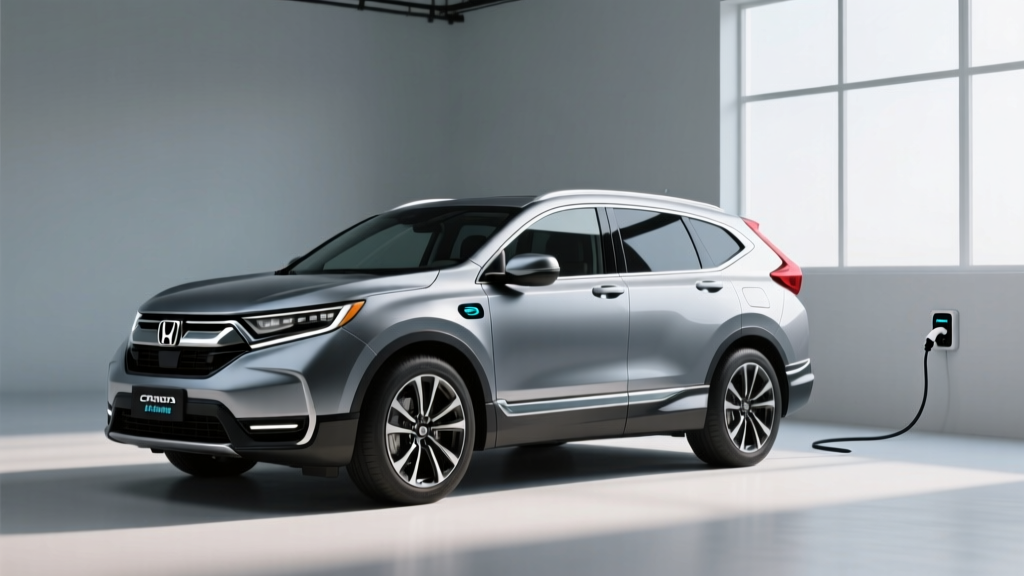
The 2023 Honda CR-V Hybrid arrived as part of the sixth-generation CR-V redesign, bringing a more refined two-motor hybrid system, a larger cabin, and a significant efficiency bump over its predecessor. For buyers researching the 2023 CR-V Hybrid as a used or certified-pre-owned option in 2026, it remains one of the most compelling compact hybrid SUVs on the market — no plug required, no range anxiety, and fuel economy that routinely beats its EPA sticker in city driving.
This guide covers every spec that matters: real-world MPG, powertrain details, battery longevity, warranty coverage, tax-credit eligibility, and how the CR-V Hybrid stacks up against plug-in hybrids and full EVs.
2023 CR-V Hybrid Fuel Economy: EPA vs. Real-World MPG
The 2023 CR-V Hybrid is rated by the EPA at 43 MPG city / 36 MPG highway / 40 MPG combined for front-wheel-drive (FWD) trims, and 40 city / 34 highway / 37 combined for all-wheel-drive (AWD) trims. These are strong numbers for a compact SUV, but the real-world story is even better for city drivers.
| Drivetrain | City MPG | Highway MPG | Combined MPG |
|---|---|---|---|
| FWD (Sport, Sport Touring) | 43 | 36 | 40 |
| AWD (Sport, Sport Touring) | 40 | 34 | 37 |
The CR-V Hybrid's two-motor system excels in stop-and-go traffic, where the gasoline engine acts primarily as a generator while the electric motor handles propulsion. This is why city MPG exceeds highway MPG — the opposite of a conventional gas car. If most of your driving is urban or suburban, expect to beat the combined EPA figure.
Powertrain Specs: Engine, Motors, and Horsepower
The 2023 CR-V Hybrid pairs a 2.0-liter Atkinson-cycle four-cylinder engine with Honda's fourth-generation two-motor hybrid system. Unlike traditional transmissions, this setup uses an e-CVT (electronic continuously variable transmission) that manages power delivery seamlessly between the gas engine and electric motors.
| Specification | Value |
|---|---|
| Engine | 2.0L Atkinson-cycle 4-cylinder |
| Engine Output | 145 hp @ 6,100 rpm / 134 lb-ft torque |
| Drive Motor Output | 184 hp / 247 lb-ft torque |
| Combined System Output | 204 hp / 247 lb-ft torque |
| Transmission | e-CVT (two-motor hybrid system) |
| 0–60 MPH (est.) | ~7.5 seconds |
| Drivetrain Options | FWD or AWD (torque-vectoring rear motor) |
| Towing Capacity | 1,000 lbs |
The combined 204 horsepower represents a meaningful upgrade over the previous-generation CR-V Hybrid's 212 hp rating (which was measured under a different SAE protocol). In practice, the 2023 model feels more responsive due to improved electric motor calibration and a stiffer chassis. The AWD system uses a dedicated rear electric motor rather than a mechanical driveshaft, providing torque vectoring that aids cornering stability.
HEV vs. PHEV vs. EV: Which Is Right for You?
A common question from CR-V shoppers is whether to choose the standard hybrid (HEV), seek out a plug-in hybrid (PHEV), or go full electric. The 2023 CR-V is offered only as a conventional hybrid (HEV) — Honda does not sell a CR-V plug-in hybrid in the United States. Here's how the three powertrain types compare:
HEV vs. PHEV vs. EV — Decision Framework
| Factor | HEV (CR-V Hybrid) | PHEV (e.g., Toyota RAV4 Prime) | BEV (e.g., Tesla Model Y) |
|---|---|---|---|
| Plug-in Charging? | No — gas only | Yes (Level 1/2) | Yes (Level 1/2/DC) |
| Electric-Only Range | N/A (EV assist only) | 25–42 miles typical | 250–330 miles |
| Total Range | ~430–520 miles | ~400–500 miles | 250–330 miles |
| Fuel Cost (per mile) | ~$0.10–$0.12 | ~$0.04–$0.10 | ~$0.03–$0.06 |
| Home Charging Needed? | No | Recommended | Essential |
| Federal Tax Credit (§30D) | Not eligible | Up to $7,500* | Up to $7,500* |
| Upfront Price (typical) | $33k–$40k | $40k–$48k | $40k–$55k |
* §30D credit subject to MSRP caps, buyer income limits, and battery-sourcing requirements. See IRS.gov for current eligibility rules.
Choose a PHEV if: You have home charging and a short commute (under 35 miles) but want gas-engine flexibility for road trips. The RAV4 Prime or Hyundai Tucson PHEV are strong alternatives.
Choose a full EV if: You have reliable home charging, want the lowest per-mile fuel cost, and your daily driving plus typical road trips fall within DC fast-charging infrastructure coverage.
Does the 2023 CR-V Hybrid Qualify for Any Tax Credit?
No. The 2023 Honda CR-V Hybrid is a conventional hybrid (HEV), not a plug-in vehicle. Federal tax credits under IRS §30D apply only to plug-in electric vehicles (PHEVs and BEVs) with a minimum battery capacity of 7 kWh. The CR-V Hybrid's small battery pack (approximately 1.06 kWh) does not meet this threshold.
Additionally, the federal hybrid vehicle tax credit that existed prior to 2011 has been discontinued. Some states may offer minor incentives for hybrid purchases — check your state energy office or AFDC incentive database for local programs. However, no major federal incentive applies to the CR-V Hybrid as of 2026.
Battery Warranty, Longevity, and Replacement Cost
Hybrid battery longevity is the top concern for used-hybrid buyers, and Honda's coverage is competitive with the segment standard.
- Hybrid Battery (IPU): 8 years / 100,000 miles (10 years / 150,000 miles in CARB states including CA, NY, MA, and others)
- Hybrid System Components: 8 years / 100,000 miles
- Powertrain Warranty: 5 years / 60,000 miles
- Limited Vehicle Warranty: 3 years / 36,000 miles
How Long Will the CR-V Hybrid Battery Last?
Honda's hybrid batteries use lithium-ion chemistry and are designed to last the life of the vehicle under normal use. Real-world data from Honda's earlier hybrid models (Accord Hybrid, Insight) shows that IPU (Intelligent Power Unit) failures before 150,000 miles are uncommon. The battery in the 2023 CR-V Hybrid is relatively small (~1.06 kWh usable) and operates within a narrow state-of-charge window — typically between 20% and 80% — which significantly reduces degradation stress compared to a full EV battery.
Battery Replacement Cost
If the hybrid battery does fail out of warranty, replacement costs typically range from $2,000 to $4,000 including parts and labor at a Honda dealership. Third-party and refurbished options can reduce this to $1,200–$2,500. This is far less than an EV traction battery replacement ($8,000–$20,000+) because the CR-V Hybrid's battery pack is small and simpler in construction.
For context, Toyota and Honda hybrid batteries have demonstrated strong longevity records. Many Prius and Accord Hybrid owners report 200,000+ miles on the original battery. The 2023 CR-V Hybrid's fourth-generation system benefits from improved thermal management over earlier designs.
2023 CR-V Hybrid Pricing and Trims (2026 Used Market)
The 2023 CR-V Hybrid was sold in two trims: Sport and Sport Touring. Here is the original MSRP and typical 2026 certified-pre-owned (CPO) pricing:
| Trim | Drivetrain | Original MSRP | Est. 2026 CPO Price |
|---|---|---|---|
| Sport | FWD | $33,695 | $27,000–$30,000 |
| Sport | AWD | $35,195 | $28,500–$31,500 |
| Sport Touring | AWD (standard) | $39,845 | $32,000–$36,000 |
The Sport Touring trim adds leather seats, a Bose 12-speaker audio system, wireless Apple CarPlay/Android Auto, a heated steering wheel, navigation, and Honda's full Honda Sensing suite with low-speed braking control. The Sport trim includes a 7-inch touchscreen, wireless CarPlay (on Sport Touring only for 2023), heated front seats, and adaptive cruise control across all trims.
Reliability Ratings and Safety
The 2023 CR-V Hybrid has strong reliability projections based on Honda's hybrid system track record and the model's overall build quality.
- NHTSA Overall Safety Rating: 5 stars (2023 model year). Source: NHTSA.gov
- IIHS Rating: Top Safety Pick (with specific headlight equipment). Source: IIHS.org
- Honda Sensing (standard on all trims): Adaptive cruise control, lane-keeping assist, collision mitigation braking, road departure mitigation, traffic sign recognition
Honda's hybrid components have proven reliable across multiple model lines. The e-CVT system has no traditional transmission bands or clutches to wear out — it's a gearset-based system with fewer moving parts than a conventional automatic. Routine maintenance is limited to oil changes (every 7,500–10,000 miles), brake fluid, and cabin air filters. Regenerative braking extends pad life significantly; many hybrid owners report original brake pads lasting 80,000+ miles.
Pros, Cons, and Final Verdict
Pros
- 40 MPG combined (FWD) — beats EPA in city driving
- No charging infrastructure needed
- Spacious cabin: 39.3 cu ft cargo behind rear seats
- Standard Honda Sensing ADAS on all trims
- Strong resale value and CPO availability
- Competitive 8-year/100k-mile hybrid battery warranty
- Smooth, quiet hybrid operation with good low-speed torque
Cons
- No PHEV option available — cannot drive on electric only
- No federal tax credit eligibility
- AWD reduces combined MPG to 37
- Towing capacity limited to 1,000 lbs
- Sport Touring approaches $40k MSRP — near PHEV territory
- 7-inch infotainment screen feels dated for the price
- Road noise noticeable at highway speeds
Frequently Asked Questions
How many MPG does the 2023 CR-V Hybrid get?
The EPA rates the FWD model at 43 city / 36 highway / 40 combined MPG, and the AWD model at 40 city / 34 highway / 37 combined MPG. Real-world city driving often yields 41–45 MPG for FWD models.
Does the 2023 CR-V Hybrid need to be plugged in?
No. The CR-V Hybrid is a conventional hybrid (HEV). It charges its small battery pack through regenerative braking and the gasoline engine. You never plug it in — just fill up at any gas station.
Is there a plug-in hybrid (PHEV) version of the CR-V?
Not in the United States. Honda has sold a CR-V e:PHEV in China and Europe, but as of 2026, no plug-in CR-V is offered in the US market. If you need a compact PHEV SUV, consider the Toyota RAV4 Prime (42 miles electric range), Hyundai Tucson PHEV (33 miles), or Ford Escape PHEV (37 miles).
How much does it cost to replace the hybrid battery?
Out-of-warranty replacement typically costs $2,000–$4,000 at a dealership, or $1,200–$2,500 with refurbished or third-party options. However, Honda hybrid batteries rarely fail before 150,000+ miles, and the 8-year/100,000-mile warranty (10 years/150,000 miles in CARB states) provides strong coverage.
Is the 2023 CR-V Hybrid reliable?
Yes. Honda's two-motor hybrid system has a proven track record across the Accord Hybrid and Insight. The NHTSA awarded the 2023 CR-V a 5-star overall safety rating, and IIHS named it a Top Safety Pick. The e-CVT system has fewer wear components than a traditional automatic transmission.
Does the 2023 CR-V Hybrid qualify for a federal tax credit?
No. Federal §30D clean vehicle credits apply only to plug-in vehicles (PHEVs and BEVs). Conventional hybrids like the CR-V Hybrid are not eligible. Check your state for any local hybrid incentives.
Hybrid vs. full EV — which should I choose?
Choose the CR-V Hybrid if you lack home charging access, frequently drive long distances in areas with sparse charging infrastructure, or want zero change to your refueling routine. Choose a full EV (like the Tesla Model Y or Hyundai Ioniq 5) if you can charge at home, want the lowest per-mile fuel cost (~$0.04/mile vs. ~$0.11/mile for the CR-V Hybrid), and are eligible for the $7,500 federal tax credit that narrows the price gap.