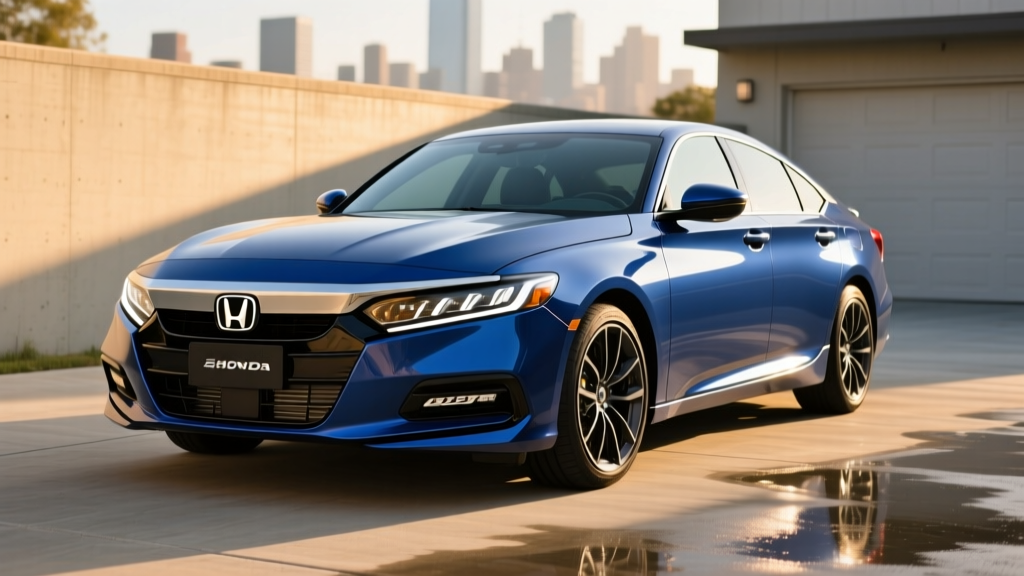
Quick Verdict: The Accord Sport Hybrid Still Makes Sense in 2026
Even three model years after its debut, the 2023 Honda Accord Sport Hybrid remains one of the smartest midsize sedan purchases on the used market. With an EPA-rated 48 MPG combined, a proven two-motor hybrid system, and no plug-in requirement, it delivers near-EV efficiency without range anxiety or charging infrastructure dependency. For buyers weighing a used hybrid against a new EV or a conventional gas sedan, the Accord Sport Hybrid occupies a compelling middle ground — and at 2026 used-car prices, the value proposition has only sharpened.
This guide covers everything a prospective buyer or current owner needs: exact fuel economy figures, how the hybrid powertrain works, real-world MPG expectations, battery longevity and warranty coverage, tax credit eligibility, and a clear decision framework for choosing this hybrid over a PHEV or full BEV.
Fuel Economy: EPA Ratings and Real-World MPG
The 2023 Accord Sport Hybrid uses Honda's fourth-generation two-motor hybrid system, which prioritizes electric-motor-driven propulsion at low and moderate speeds while the 2.0-liter Atkinson-cycle engine acts primarily as a generator. The result is fuel economy that rivals much smaller cars.
| Metric | Value |
|---|---|
| City MPG | 51 |
| Highway MPG | 44 |
| Combined MPG | 48 |
| Fuel Tank Capacity | 12.8 gallons |
| EPA Estimated Total Range | ~614 miles |
Real-World MPG vs. EPA Sticker
The Accord Hybrid's city-dominant EPA cycle is where this powertrain shines. In real-world mixed driving, owners consistently report 44–50 MPG combined, with city-heavy commutes often exceeding the 51 MPG city sticker. Highway-only trips at 75+ MPH tend to drop efficiency to roughly 38–42 MPG due to increased aerodynamic drag and the engine engaging more directly. In cold weather (below 35°F), expect a 5–10% reduction as the engine runs more frequently to generate cabin heat. Source: fueleconomy.gov.
Unlike a plug-in hybrid or full EV, the Accord Sport Hybrid recovers energy exclusively through regenerative braking and engine-generated electricity. There is no external charging port — you simply fill up with gasoline and let the hybrid system optimize the rest.
Powertrain Breakdown: How the Two-Motor System Works
Honda's hybrid architecture is fundamentally different from the planetary-gear systems used by Toyota. Instead, the Accord Sport Hybrid employs a series-parallel setup with two electric motors and a lock-up clutch that can mechanically connect the engine to the front wheels at highway cruising speeds.
| Component | Specification |
|---|---|
| Engine | 2.0L Atkinson-cycle 4-cylinder |
| Engine Output | 146 hp / 134 lb-ft torque |
| Drive Motor | AC permanent-magnet synchronous |
| Drive Motor Output | 181 hp / 247 lb-ft torque |
| Combined System Output | 204 hp / 247 lb-ft torque |
| Transmission | e-CVT (single-speed direct drive + engine clutch) |
| Drivetrain | Front-wheel drive |
| Hybrid Battery | ~1.06 kWh lithium-ion (non-plug-in HEV) |
| 0–60 MPH | ~7.0 seconds (est.) |
The key insight for buyers: the 204 combined horsepower figure reflects the battery and motor's ability to deliver peak torque instantly. The drive motor handles most acceleration duties, which is why the Accord Hybrid feels responsive off the line despite its modest engine displacement. At steady highway speeds (roughly 55–80 MPH), the lock-up clutch engages, allowing the engine to drive the wheels directly — bypassing the electrical conversion losses and improving highway efficiency.
HEV vs. PHEV vs. Full EV: Which Powertrain Fits You?
A common question from sedan shoppers is whether to choose a conventional hybrid (HEV) like this Accord, a plug-in hybrid (PHEV) such as the Toyota Prius Prime, or a battery-electric vehicle (BEV) like the Tesla Model 3 or Hyundai Ioniq 6. Each has distinct ownership requirements.
Conventional Hybrid (HEV) — 2023 Accord Sport Hybrid
- No plug-in required. The small ~1.06 kWh battery charges via regenerative braking and the engine.
- Range: ~614 miles total on a single tank of gas.
- Best for: Drivers without home charging access, high-mileage commuters, and those who want EV-like efficiency without behavioral changes.
- Fuel cost: At $3.25/gal and 48 MPG, roughly $0.07 per mile.
Plug-In Hybrid (PHEV) — e.g., Toyota Prius Prime
- Requires plug-in charging to access 25–44 miles of electric-only range.
- Larger battery: ~13.6 kWh (Prius Prime), Level 2 charge in ~4 hours, no DC fast charging.
- Best for: Drivers with home Level 2 charging and short daily commutes who want electric-only weekday driving with gas-engine flexibility for road trips.
- Fuel cost: Near-zero for daily electric miles; hybrid MPG on longer trips.
Battery Electric Vehicle (BEV) — e.g., Tesla Model 3
- 100% electric. No gasoline engine. 272–363 miles EPA range depending on trim.
- Requires reliable charging access — home Level 2 strongly recommended, DC fast charging for road trips.
- Best for: Drivers with home charging, predictable routes, and willingness to plan road-trip charging stops.
- Energy cost: At $0.14/kWh national average, roughly $0.04–0.05 per mile.
Decision Framework
Choose the Accord Sport Hybrid if you lack home charging access, drive 15,000+ miles annually, take frequent road trips through areas with sparse charging infrastructure, or want minimal ownership complexity.
Choose a PHEV if you have Level 2 home charging, commute under 40 miles round-trip, and want electric-only daily driving with gas backup.
Choose a full EV if you have reliable home charging, want the lowest per-mile operating cost, and are comfortable planning DC fast-charge stops on road trips.
Battery Longevity, Warranty, and Replacement Costs
Hybrid battery degradation is the number one concern for used-hybrid buyers — and it's the area where Honda's track record provides genuine reassurance.
2023 Accord Hybrid Battery Warranty
- Federal emissions/hybrid battery warranty: 8 years / 80,000 miles (mandated by EPA/CARB)
- CARB-state extended warranty: 10 years / 150,000 miles (applies in California and states adopting CARB standards — including New York, Massachusetts, Colorado, Oregon, Washington, and others)
- Powertrain warranty: 5 years / 60,000 miles
- Capacity retention threshold: Honda does not publish a specific percentage, but warranty covers defects and failures that cause the hybrid system to malfunction or the battery to lose significant capacity
Source: Honda Warranty Information
The 2023 Accord Sport Hybrid's lithium-ion hybrid battery pack is approximately 1.06 kWh — far smaller than a PHEV or BEV battery. This small size means lower replacement cost if failure occurs outside warranty. Based on parts pricing for Honda's fourth-generation hybrid system, a replacement hybrid battery module runs roughly $2,000–$4,000 including labor at a dealership, with independent hybrid specialists often quoting $1,500–$2,500 for refurbished units.
In practice, Honda's hybrid batteries have demonstrated strong longevity. Real-world data from high-mileage Accord and Insight owners suggests most hybrid batteries retain functional capacity well past 150,000 miles. The system's conservative charge window — the battery management system (BMS) never allows the pack to fully charge or fully discharge — significantly reduces cell stress and extends cycle life.
For a 2023 model purchased in 2026, the original 8-year/80,000-mile federal warranty still has approximately five years of coverage remaining, providing substantial protection against premature battery failure.
Pricing, Used Market Value, and Tax Credit Eligibility
The 2023 Honda Accord Sport Hybrid originally carried an MSRP of approximately $30,695 (including destination). In the 2026 used market, well-maintained examples with 25,000–45,000 miles typically list between $22,000–$27,000 depending on condition, mileage, and region.
Federal Tax Credit Eligibility (IRS §30D / §25E)
The 2023 Accord Sport Hybrid is a conventional hybrid (HEV), not a plug-in vehicle. This has direct implications for federal incentives:
- New clean vehicle credit (§30D, up to $7,500): NOT eligible. This credit applies only to battery-electric vehicles (BEVs) and plug-in hybrids (PHEVs) with sufficient battery capacity and compliant battery sourcing.
- Used clean vehicle credit (§25E, up to $4,000): NOT eligible. The used-vehicle credit also requires the vehicle to be a qualified plug-in electric or fuel-cell vehicle.
- State incentives: A small number of states offer rebates or HOV-lane access for conventional hybrids, but most state incentive programs have shifted exclusively to plug-in vehicles. Check your state's energy office or AFDC state incentive database for current programs.
Bottom line: the Accord Sport Hybrid offers no federal tax credit. Its value proposition rests entirely on fuel savings, reliability, and lower upfront cost compared to plug-in alternatives.
Ownership Economics: 5-Year Cost Breakdown
How does the Accord Sport Hybrid stack up financially against a comparable gas-only midsize sedan and a full EV over five years? The table below models a 15,000-mile-per-year driver using national average fuel and electricity prices.
| Category | Accord Sport Hybrid (HEV) | Gas Sedan Baseline (30 MPG) | BEV Baseline (4 mi/kWh) |
|---|---|---|---|
| Fuel / Energy | $5,078 (48 MPG, $3.25/gal) | $8,125 (30 MPG, $3.25/gal) | $2,625 ($0.14/kWh) |
| Maintenance (est.) | $2,200 | $3,000 | $1,500 |
| Insurance (avg.) | $7,500 | $6,500 | $8,000 |
| Total Operating Cost | ~$14,778 | ~$17,625 | ~$12,125 |
| vs. Gas Sedan Savings | ~$2,847 saved | Baseline | ~$5,500 saved |
The Accord Sport Hybrid saves roughly $2,800 over five years compared to a conventional 30 MPG gas sedan — primarily through fuel efficiency. A BEV saves more (~$5,500), but requires home charging infrastructure ($500–$2,000 installation) and carries a higher purchase price. For buyers without charging access, the Accord Hybrid's savings are accessible with zero infrastructure investment.
Reliability, Safety, and Honda Sensing
The 11th-generation Accord (2023+) earned strong safety marks. The IIHS named it a Top Safety Pick+, with Good ratings across all crashworthiness categories. The NHTSA awarded it a 5-star overall safety rating.
Every Accord Sport Hybrid includes the Honda Sensing suite of driver-assistance features:
- Adaptive Cruise Control (ACC) with Low-Speed Follow
- Lane Keeping Assist System (LKAS)
- Collision Mitigation Braking System (CMBS)
- Road Departure Mitigation (RDM)
- Traffic Sign Recognition
These are SAE Level 1–2 driver-assistance features — not autonomous driving. The driver must remain fully engaged, hands on the wheel, and eyes on the road at all times. Honda Sensing is competent for highway cruising and stop-and-go traffic, but it does not offer hands-free driving like GM's Super Cruise or Ford's BlueCruise.
Regarding mechanical reliability: Honda's hybrid system has fewer wear components than a conventional powertrain. There is no traditional automatic transmission (the e-CVT uses a direct-drive arrangement with no belts or pulleys), regenerative braking reduces brake pad wear, and the engine operates under lighter load thanks to electric-motor assist. Long-term owner forums and reliability surveys consistently rank the Accord Hybrid among the most dependable vehicles in its class.
Pros, Cons, and Who Should Buy
Pros
- 48 MPG combined EPA — 51 MPG city excels in stop-and-go traffic
- No plug-in charging required — works with existing gas-station infrastructure
- 204 hp with instant electric torque provides responsive acceleration
- ~614-mile total range eliminates range anxiety entirely
- IIHS Top Safety Pick+ with comprehensive Honda Sensing suite
- Proven hybrid reliability with 8-year/80,000-mile battery warranty (10/150k in CARB states)
- Spacious midsize cabin with 16.7 cu-ft trunk (hybrid battery under rear seats, no cargo compromise)
Cons
- No federal tax credit eligibility (HEV, not a plug-in vehicle)
- Highway MPG drops to 38–42 at sustained 75+ MPH speeds
- Front-wheel drive only — no AWD option (unlike the Toyota Camry Hybrid)
- Engine drone under hard acceleration (typical of Atkinson-cycle + e-CVT setups)
- Used market prices remain elevated — $22K–$27K for 2023 models in 2026
- No electric-only driving mode — cannot operate emission-free even at low speeds for extended distances
Frequently Asked Questions
How many MPG does the 2023 Honda Accord Sport Hybrid get?
The EPA rates it at 51 city / 44 highway / 48 combined MPG. In real-world driving, owners typically see 44–50 MPG combined, with city-heavy routes often exceeding the EPA city figure. Highway-only driving at high speeds may return 38–42 MPG.
Does the 2023 Accord Sport Hybrid need to be plugged in?
No. This is a conventional hybrid (HEV), not a plug-in hybrid (PHEV). The hybrid battery charges through regenerative braking and the gasoline engine. There is no charging port — you only need to refuel at a gas station.
How far can the Accord Sport Hybrid drive on electric only?
The Accord Sport Hybrid can operate on electric power alone for very short distances (roughly 1–2 miles) at low speeds (under 25 MPH) when the battery has sufficient charge. However, it is not designed for meaningful electric-only commuting. If electric-only range is a priority, consider a PHEV like the Toyota Prius Prime (44 miles EV range) or a full BEV.
Is the hybrid battery reliable and what does replacement cost?
Honda's hybrid batteries have demonstrated strong longevity, with many units lasting 150,000+ miles without significant degradation. The battery is covered by an 8-year/80,000-mile federal warranty (10 years/150,000 miles in CARB states). If replacement is needed outside warranty, expect $2,000–$4,000 at a dealership, or $1,500–$2,500 from an independent hybrid specialist using refurbished modules.
Does the 2023 Accord Sport Hybrid qualify for any federal tax credit?
No. Federal clean vehicle tax credits under IRS §30D (new vehicles) and §25E (used vehicles) apply only to plug-in electric vehicles (BEVs and PHEVs) and fuel-cell vehicles. As a conventional hybrid, the Accord Sport Hybrid does not qualify. Check IRS.gov for current credit rules, and consult a tax professional for eligibility specifics.
How does the Accord Hybrid compare to the Toyota Camry Hybrid?
Both are strong choices. The 2023 Camry Hybrid LE is EPA-rated at 52 MPG combined and offers available AWD — a meaningful advantage in snowy climates. The Accord Hybrid counters with a slightly more refined ride, a larger trunk (16.7 vs. 15.1 cu-ft), and a more engaging driving feel. Fuel economy is nearly identical in real-world use. The Camry Hybrid's AWD option is the key differentiator for buyers in northern states.
What is the difference between the Accord Sport Hybrid and the Accord EX-L Hybrid?
For the 2023 model year, Honda equipped all Accord Hybrid trims with the same 204-hp two-motor hybrid powertrain and 48 MPG combined rating. The Sport Hybrid trim features sport-tuned suspension, 19-inch alloy wheels, a black decklid spoiler, and specific interior trim. The EX-L Hybrid adds leather seats, a power moonroof, and a 12-speaker audio system. Fuel economy is identical across all hybrid trims.