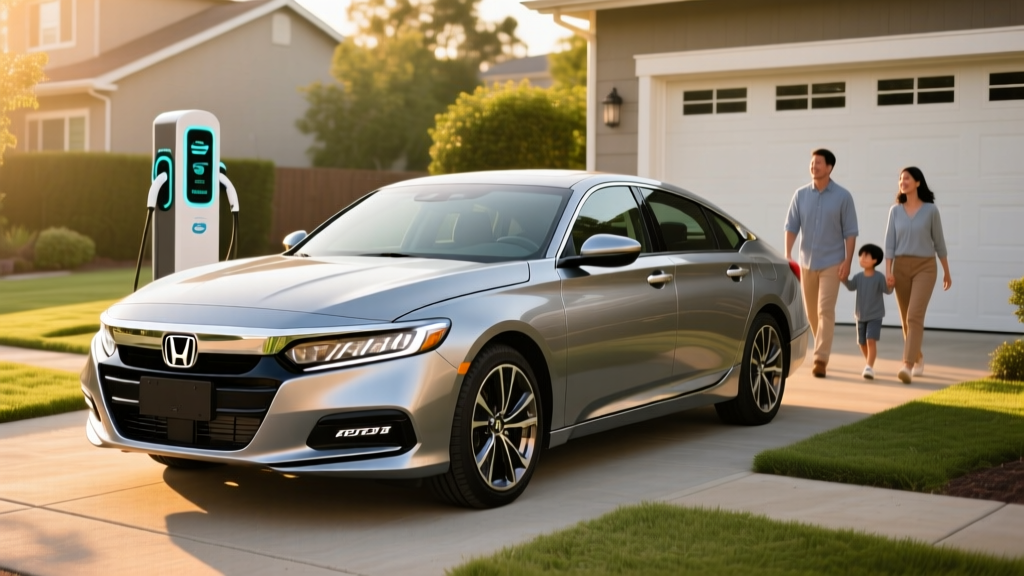
Quick Verdict: The Accord Hybrid Still Sets the Midsize Sedan Benchmark
The 2023 Honda Accord Hybrid arrived as part of the eleventh-generation Accord redesign, and it remains one of the most compelling arguments for electrification without plugging in. With an EPA-estimated 48 MPG combined on the Sport, EX-L, and Sport-L trims, a two-motor hybrid system producing 204 horsepower, and Honda's proven reliability record, it occupies a specific niche: buyers who want meaningful fuel savings without altering their refueling habits.
As of 2026, the Accord Hybrid continues in Honda's lineup with incremental updates, but the 2023 model year represents a significant generational shift worth examining closely — especially on the used and certified pre-owned market where pricing has become more attractive. This review breaks down every number that matters.
HEV vs PHEV: What the Accord Hybrid Actually Is
Before diving into specs, it's critical to establish what the 2023 Accord Hybrid is not: it is not a plug-in hybrid (PHEV). This is a conventional hybrid electric vehicle (HEV). You never plug it in. The small lithium-ion battery pack charges exclusively through regenerative braking and the gasoline engine.
| Feature | HEV (Accord Hybrid) | PHEV (e.g., Toyota Prius Prime) |
|---|---|---|
| Plug-in charging required? | No | Yes (optional but recommended) |
| Electric-only range | ~1 mile at low speed | 25–44 miles typical |
| Battery capacity | ~1.06 kWh (small buffer) | 13–18 kWh usable |
| Federal tax credit (§30D) | Not eligible | Up to $7,500 (if eligible) |
| Best for | No home charging access; simple ownership | Home chargers with short commutes |
If you have access to home Level 2 charging and a commute under 30 miles, a PHEV like the Toyota Prius Prime or the Hyundai Tucson PHEV may deliver greater daily electric driving. But if you live in an apartment, street-park, or simply want zero behavior change, the Accord HEV is the right tool.
Fuel Economy: EPA Numbers and Real-World MPG
The 2023 Accord Hybrid comes in multiple trims, and EPA ratings differ slightly depending on wheel size and equipment weight.
| Trim | City MPG | Highway MPG | Combined MPG |
|---|---|---|---|
| Sport | 51 | 44 | 48 |
| EX-L | 51 | 44 | 48 |
| Sport-L | 51 | 44 | 48 |
| Touring | 46 | 41 | 44 |
Source: fueleconomy.gov
The Touring trim drops to 44 combined due to its larger 19-inch wheels, additional sound insulation, and heavier standard equipment. That 4 MPG penalty is worth knowing if you're cross-shopping trims.
Real-World MPG: What to Actually Expect
Honda's two-motor hybrid system excels in city driving, where the electric motor handles most low-speed propulsion and the 2.0L Atkinson-cycle engine acts primarily as a generator. In our experience and aggregated owner reports:
- City / suburban driving: 48–54 MPG is routinely achievable. Hybrids often exceed their EPA city numbers because regenerative braking recovers energy that gas cars waste as heat.
- Highway cruising (70–80 mph): Expect 40–44 MPG. At sustained high speeds, the engine drives the wheels directly through a lock-up clutch, and aerodynamic drag dominates — reducing the hybrid system's advantage.
- Cold weather (below 35°F): Plan for a 5–10% drop. The engine runs more frequently to provide cabin heat and maintain battery temperature, reducing electric-motor usage.
- Mixed driving, annual average: Most owners report 45–48 MPG combined over a full tank, aligning closely with the EPA sticker on Sport/EX-L trims.
With a 12.8-gallon fuel tank, real-world range lands between 540 and 600 miles per fill-up depending on your driving mix — enough to make fuel stops a roughly monthly event for average commuters.
Powertrain and Performance Specs
The 2023 Accord Hybrid uses Honda's fourth-generation two-motor hybrid system, a fundamentally different architecture from the older single-motor setups found in early Insight and Accord Hybrid models.
| Engine | 2.0L DOHC Atkinson-cycle 4-cylinder |
| Engine power | 146 hp @ 6,100 rpm / 134 lb-ft @ 4,500 rpm |
| Drive motor power | 181 hp / 247 lb-ft |
| Combined system output | 204 hp / 247 lb-ft |
| Transmission | Direct-drive (no conventional gearbox); engine lock-up clutch at highway speed |
| 0–60 mph | ~7.5 seconds (MotorTrend tested) |
| Drivetrain | Front-wheel drive |
| Hybrid battery | Lithium-ion, ~1.06 kWh total capacity |
| Curb weight | 3,477–3,570 lbs (trim dependent) |
How it works in practice: below roughly 40 mph, the gasoline engine mostly generates electricity while the drive motor propels the car — essentially operating as a series hybrid (similar to how a diesel-electric locomotive works). Above highway speeds, a lock-up clutch mechanically connects the engine to the wheels for more efficient direct drive. The system switches between these modes seamlessly; most drivers never notice the transitions.
The 247 lb-ft of electric motor torque is available from zero RPM, which gives the Accord Hybrid strong initial acceleration that feels punchier than the 204 hp figure suggests. Merging onto highways and passing at speed are confident, if not sporty.
Pricing, Trims, and Tax Credit Eligibility
When new, the 2023 Accord Hybrid was priced as follows:
| Trim | MSRP (incl. destination) |
|---|---|
| Sport | $30,695 |
| EX-L | $34,995 |
| Sport-L | $34,970 |
| Touring | $38,985 |
As of 2026, certified pre-owned and used examples typically list between $24,000 and $33,000 depending on mileage, condition, and trim.
Federal Tax Credit: Not Eligible
Because the Accord Hybrid is a conventional HEV — not a plug-in vehicle — it does not qualify for the IRS §30D Clean Vehicle Credit. That credit, worth up to $7,500, is reserved for battery electric vehicles (BEVs) and plug-in hybrids (PHEVs) that meet battery sourcing, critical mineral, MSRP cap, and buyer income requirements.
Some states offer separate incentives for conventional hybrids, but these are increasingly rare as incentive programs shift toward plug-in vehicles. Check your state's energy office or DMV website for current local programs.
Battery Warranty, Reliability, and Replacement Cost
Hybrid battery longevity is the number-one concern for used hybrid buyers, and Honda addresses this with robust warranty coverage.
Honda Hybrid Battery Warranty
- Hybrid battery: 8 years / 100,000 miles (10 years / 150,000 miles in CARB states including CA, CT, ME, MA, NJ, NY, OR, RI, VT, WA)
- Hybrid system components: 8 years / 100,000 miles
- Powertrain warranty: 5 years / 60,000 miles
- Limited vehicle warranty: 3 years / 36,000 miles
Source: Honda Automobile Limited Warranty documentation
Real-World Battery Lifespan
Honda's lithium-ion hybrid battery packs in the Accord have demonstrated strong longevity. The battery is relatively small (~1.06 kWh), and the hybrid system's battery management software keeps the state of charge within a narrow, conservative window — typically between 40% and 70% — which dramatically reduces degradation stress. This is fundamentally different from a BEV battery that cycles through a much wider range daily.
Based on long-term owner data across Honda's hybrid lineup, hybrid battery packs routinely last 150,000–200,000+ miles before significant capacity loss. Failures within the warranty period are uncommon.
Battery Replacement Cost
If a replacement is needed out of warranty:
- OEM hybrid battery (Honda dealer): $2,000–$3,500 including labor
- Refurbished / aftermarket pack: $1,200–$2,000 installed
- Individual cell/module repair: $500–$1,000 at specialist hybrid shops
This is an order of magnitude less expensive than BEV battery replacement ($8,000–$20,000+), because the hybrid battery is small and accessible. It's also worth noting that hybrid battery failure rates are low enough that this cost is more of a theoretical concern than a likely expense for most owners.
Overall Reliability
The Accord nameplate carries a strong reliability reputation. The 2023 model year, being the first year of a new generation, may carry slightly higher risk of early-production issues than a mid-cycle refresh year — a pattern common across the auto industry. However, Honda's hybrid powertrain itself is a carryover evolution of proven technology. The IIHS awarded the 2023 Accord Top Safety Pick+ status, reflecting strong crashworthiness.
Who Should Choose the Accord Hybrid vs a Full EV or Gas Car
The Accord Hybrid occupies a specific position in the powertrain landscape. Here's how to decide if it's right for you:
Choose the Accord Hybrid (HEV) if:
- You cannot install a home charger (apartment, condo, street parking)
- You want 48 MPG with zero behavior change — no plugging in, no route planning
- Your annual mileage is 12,000–20,000+ miles, maximizing fuel savings
- You want a proven midsize sedan with strong resale value and low maintenance costs
- You're not ready to commit to a full EV but want to reduce fuel consumption meaningfully
Choose a PHEV (e.g., Toyota Prius Prime) if:
- You have reliable home Level 2 charging
- Your daily commute is under 40 miles round-trip (covering most driving on electricity)
- You want to qualify for the §30D federal tax credit (up to $7,500)
- You want electric-only driving for errands but gas flexibility for road trips
Choose a full BEV (e.g., Tesla Model 3, Hyundai Ioniq 6) if:
- You have home charging and your daily driving is under 250 miles
- You want to eliminate gasoline entirely and minimize per-mile energy cost
- You qualify for the full §30D tax credit, narrowing the price gap
- You're comfortable with public DC fast charging for road trips
The Economics: Accord Hybrid vs Gas-Only Accord
Compared to the turbocharged 1.5L gas Accord (30 city / 38 highway / 33 combined per fueleconomy.gov), the hybrid's 48 combined MPG saves roughly:
- Annual fuel savings: ~$550–$700 per year (at 15,000 miles/year and $3.50/gallon)
- 5-year fuel savings: ~$2,750–$3,500
- Hybrid premium over gas model: Approximately $1,000–$2,000 at original MSRP
The hybrid pays for its price premium within 2–4 years of average driving. For high-mileage drivers (20,000+ miles/year), the payback is faster. This makes the Accord Hybrid one of the most economically rational hybrid purchases in the midsize segment — the fuel savings are real, and there's no plug-in infrastructure cost to factor in.
Pros and Cons
Pros
- 48 MPG combined (Sport/EX-L) — best-in-class for midsize sedans
- Strong electric torque (247 lb-ft) for confident city acceleration
- No plugging in required — zero lifestyle change
- 8-year/100,000-mile hybrid battery warranty (10 yr in CARB states)
- Spacious interior with 16.7 cu ft trunk (no battery intrusion)
- IIHS Top Safety Pick+ rating
- Honda Sensing ADAS suite standard on all trims
Cons
- No federal tax credit eligibility (HEV, not PHEV)
- Touring trim drops to 44 MPG combined
- Not a PHEV — no meaningful electric-only range
- CVT-like engine drone under hard acceleration (common to Honda hybrids)
- FWD only — no AWD option (unlike Toyota Camry Hybrid)
- First model year of new generation — slightly higher early-production risk
Frequently Asked Questions
How many MPG does the 2023 Honda Accord Hybrid get?
The EPA rates the Sport, EX-L, and Sport-L trims at 51 city / 44 highway / 48 combined MPG. The heavier Touring trim is rated 46/41/44. In real-world city driving, many owners report exceeding 50 MPG, while sustained highway driving at 75+ mph typically returns 40–44 MPG.
Does the 2023 Accord Hybrid need to be plugged in?
No. The Accord Hybrid is a conventional HEV, not a plug-in hybrid. Its small lithium-ion battery charges exclusively through regenerative braking and the gasoline engine. You refuel only at gas stations, exactly like a conventional car.
How far can the Accord Hybrid drive on electric only?
Effectively zero miles in any practical sense. At very low speeds (under ~25 mph) with a charged battery, the car can travel roughly 1 mile on electric power alone before the engine starts. This is normal for conventional hybrids — the electric motor assists the engine rather than replacing it. If electric-only driving is a priority, you need a PHEV or BEV.
Does the 2023 Accord Hybrid qualify for a federal tax credit?
No. The IRS §30D Clean Vehicle Credit applies only to plug-in vehicles (BEVs and PHEVs) that meet specific battery sourcing, MSRP, and buyer income requirements. As a conventional hybrid, the Accord Hybrid is ineligible. Some state or local utility programs may offer small rebates for hybrids — check your local jurisdiction.
Is the Honda Accord Hybrid reliable? What about battery replacement cost?
Yes, the Accord Hybrid has strong reliability credentials. Honda's hybrid system is an evolution of technology used since 2014 in the Accord lineup. The hybrid battery is covered by an 8-year/100,000-mile warranty (10 years/150,000 miles in CARB states). Out-of-warranty battery replacement costs approximately $2,000–$3,500 at a Honda dealer, though hybrid battery failures are rare — most packs last 150,000+ miles.
Is the Accord Hybrid better than the Toyota Camry Hybrid?
They're closely matched. The Camry Hybrid offers available AWD and a slightly lower starting price, while the Accord Hybrid delivers marginally better city MPG (51 vs 51 city on comparable trims, but the Accord has a larger interior and trunk). The Accord's driving dynamics and interior quality are generally considered a half-step above the Camry. Both are excellent choices — the decision often comes down to AWD preference (Camry) vs interior space and refinement (Accord).
What's the difference between the Accord Hybrid Sport and Touring trims?
The Sport ($30,695 MSRP) prioritizes value with 48 MPG, cloth/leatherette seats, and 18-inch wheels. The Touring ($38,985) adds leather, ventilated front seats, heated rear seats, a premium audio system, wireless charging, and a head-up display — but drops to 44 MPG due to 19-inch wheels and added weight. For maximum fuel economy, choose Sport, EX-L, or Sport-L.