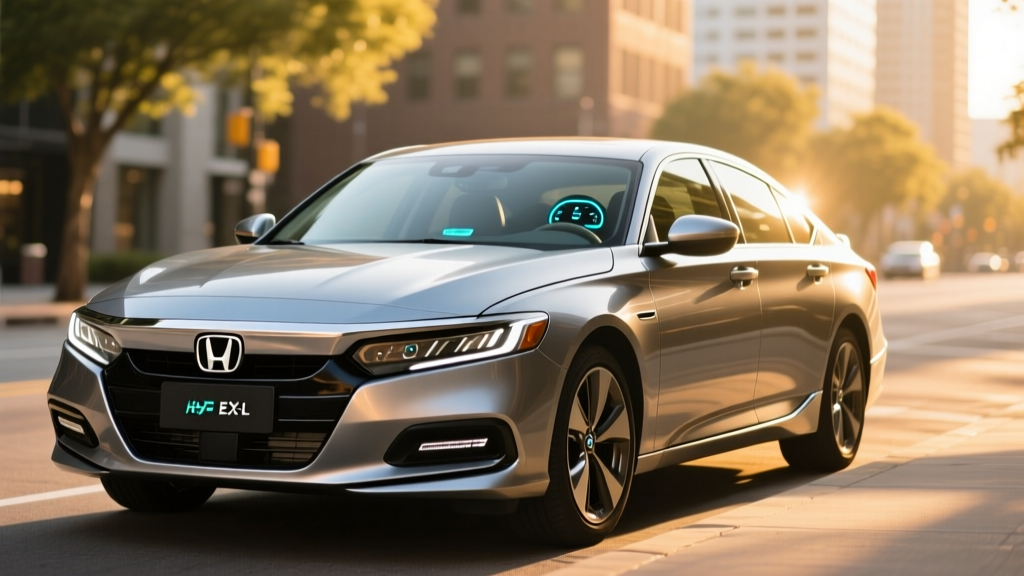
Quick Verdict: The 2023 Honda Accord Hybrid EX-L in 2026
If you're searching for a 2023 Honda Accord Hybrid EX-L on the used market in 2026, you're looking at one of the most efficient midsize sedans Honda has ever built. The 11th-generation Accord Hybrid pairs a 2.0-liter Atkinson-cycle four-cylinder with a two-motor hybrid system to deliver an EPA-estimated 48 MPG combined — and in real-world city driving, many owners see that number climb. The EX-L trim adds leather, a 12.3-inch infotainment screen, wireless Apple CarPlay/Android Auto, and Honda Sensing safety tech, making it the sweet spot between value and premium features.
This is a conventional hybrid electric vehicle (HEV), not a plug-in hybrid (PHEV). You never plug it in. It generates and recovers all its own electricity through regenerative braking and the gasoline engine. That distinction matters enormously for tax credits, daily routine, and total cost of ownership — all of which we break down with hard numbers below.
HEV vs PHEV vs EV: Where Does the Accord Hybrid Fit?
Before diving into specs, it's essential to understand what you're buying — and what you're not. The Accord Hybrid is an HEV. Here's how the three electrified powertrain types compare:
| Feature | HEV (Accord Hybrid) | PHEV (e.g., Toyota Prius Prime) | BEV (e.g., Tesla Model 3) |
|---|---|---|---|
| Plug in to charge? | No — self-charging | Yes — Level 1/2 | Yes — Level 1/2/DC |
| Electric-only range | ~1 mile at low speed | 25–44 miles typical | 250–360+ miles |
| Fuel/energy | Gasoline only | Gasoline + electricity | Electricity only |
| Federal tax credit (§30D) | Not eligible | Up to $7,500 (if eligible) | Up to $7,500 (if eligible) |
| Home charging needed? | No | Recommended | Essential |
| Best for | No garage/outlet access | Short commutes + road trips | Home charging + mostly electric |
The Accord Hybrid is purpose-built for drivers who want maximum fuel savings with zero lifestyle change. No charging cables, no range planning, no dependency on public infrastructure. You fill up at any gas station and go.
Fuel Economy: EPA Numbers vs Real-World MPG
The 2023 Accord Hybrid EX-L carries the following EPA fuel economy ratings, confirmed by fueleconomy.gov:
| Driving Cycle | EPA Estimated MPG |
|---|---|
| City | 51 MPG |
| Highway | 44 MPG |
| Combined | 48 MPG |
With a 14.8-gallon fuel tank, the real-world total range lands between 600 and 750 miles depending on your driving mix — a figure no current BEV can match without stopping to charge.
Powertrain Specs: What's Under the Hood
| Specification | 2023 Accord Hybrid EX-L |
|---|---|
| Engine | 2.0L DOHC Atkinson-cycle inline-4 |
| Engine HP / Torque | 146 hp / 134 lb-ft |
| Electric Motors | Two-motor hybrid system (propulsion + generator) |
| Electric Motor Output | 181 hp / 247 lb-ft |
| Combined System Output | 204 hp / 247 lb-ft |
| Transmission | e-CVT (no traditional gears) |
| Drivetrain | Front-wheel drive |
| 0–60 mph | ~7.2 seconds (est.) |
| Fuel Tank | 14.8 gallons |
| Curb Weight | ~3,477 lbs |
Honda's e-CVT is not a belt-driven CVT like those in older hybrids. It uses a direct-drive clutch and two motor-generators to seamlessly blend electric and gasoline power. Under light acceleration, the car runs purely on the electric motor. Under hard acceleration, both the engine and motor contribute. At highway cruising speeds, the engine can mechanically lock to the wheels for maximum efficiency — a clever design that avoids the "rubber band" feel of conventional CVTs.
Hybrid Battery: Size, Warranty, and Replacement Cost
The 2023 Accord Hybrid uses a lithium-ion hybrid battery pack located under the rear seats. Unlike a PHEV or BEV, this battery is small — approximately 1.06 kWh of total capacity — because it only needs to buffer energy for short electric-assist bursts, not sustained electric-only driving.
• 8 years / 100,000 miles (standard states)
• 10 years / 150,000 miles (CARB states: CA, CT, ME, MA, NJ, NY, OR, RI, VT, WA, and others adopting California emissions standards)
• Covers battery capacity loss below functional thresholds and defects
• The 12V auxiliary battery carries a separate 3-year/36,000-mile warranty
Battery replacement cost: As of 2026, a replacement hybrid battery pack for the 11th-gen Accord Hybrid runs approximately $2,000–$3,500 for the part, plus $500–$800 in labor at a Honda dealer. However, hybrid battery failures before 150,000 miles are rare. Honda's lithium-ion packs in the Accord and CR-V Hybrid have demonstrated strong longevity, with most units retaining over 90% of their original buffer capacity well past the warranty period. Unlike BEV batteries, the small HEV battery cycles shallowly — it never fully charges or fully depletes — which dramatically extends cell life.
Pricing, Tax Credits, and 2026 Used Market Value
The 2023 Accord Hybrid EX-L originally carried an MSRP of approximately $35,635 (including destination charge). Here's what you need to know about incentives and current pricing:
- Federal §30D tax credit: The Accord Hybrid is a conventional HEV — it does not qualify for the federal plug-in vehicle tax credit (up to $7,500). That credit applies only to PHEVs and BEVs with sufficient battery capacity and compliant sourcing.
- Federal used-EV credit (§25E): Also does not apply — this credit is limited to used PHEVs and BEVs priced under $25,000.
- State incentives: A handful of states offer rebates for hybrids, but most have shifted focus to plug-in vehicles. Check your state's energy office for current programs.
- 2026 used-market pricing: A 2023 Accord Hybrid EX-L with 25,000–40,000 miles typically lists between $27,000 and $31,000 depending on condition, mileage, and region, per Kelley Blue Book and Edmunds data.
The absence of a tax credit stings on paper, but consider the math: the Accord Hybrid EX-L costs roughly $10,000–$15,000 less than a comparably equipped BEV sedan, requires no home charger installation ($500–$2,000), and carries no range-anxiety premium. For many buyers, the total cost of ownership evens out or favors the hybrid.
Who Should Buy the Accord Hybrid EX-L vs a PHEV or Full EV?
- You lack access to home or workplace charging (apartment, street parking, no 240V outlet)
- You regularly drive 400+ miles in a day and don't want to plan charging stops
- Your budget is under $32,000 and you want a near-new midsize sedan
- You want fuel savings without any behavioral change
- You live in a region with extreme cold where BEV range loss is a concern
- You have home charging and a commute under 40 miles round-trip
- You want to drive mostly electric on weekdays but gas-free on road trips
- You qualify for the $7,500 federal tax credit (income and sourcing rules apply — see IRS.gov)
- You have reliable home Level 2 charging
- Your daily driving is under 250 miles and you rarely road-trip beyond charger coverage
- You want zero tailpipe emissions and the lowest per-mile fuel cost
Ownership Costs: 5-Year Hybrid vs Gas vs EV
To put the Accord Hybrid's value in context, here's an estimated 5-year / 75,000-mile cost breakdown compared to a gas-only midsize sedan and a comparable BEV:
| Cost Category | Accord Hybrid EX-L | Gas Sedan (28 MPG) | BEV Sedan (300 mi) |
|---|---|---|---|
| Purchase price (2026 used/new) | ~$29,000 | ~$24,000 | ~$38,000 (after credit) |
| Fuel/energy (75k mi) | ~$5,200 | ~$9,400 | ~$3,000 |
| Maintenance | ~$2,500 | ~$3,800 | ~$1,500 |
| Insurance (avg) | ~$7,500 | ~$7,000 | ~$8,500 |
| Home charger install | $0 | $0 | ~$1,200 |
| Estimated 5-yr total | ~$44,200 | ~$44,200 | ~$52,200 |
The Accord Hybrid essentially ties the gas sedan on total cost while emitting significantly less CO₂ and delivering a smoother, quieter driving experience. The BEV wins on per-mile energy cost but carries a higher upfront price and charging-infrastructure dependency. Your personal numbers will vary based on local gas and electricity rates — use the DOE fuel cost calculator for a personalized estimate.
Pros and Cons
- 48 MPG combined EPA; 50+ in city driving
- No plug-in charging required — zero lifestyle change
- 600–750 mile total range per tank
- Strong reliability record; 8–10 year battery warranty
- Spacious cabin (16.7 cu-ft trunk, generous rear legroom)
- Honda Sensing suite standard (AEB, adaptive cruise, lane keeping)
- Smooth e-CVT with no rubber-band effect
- No federal tax credit eligibility (HEV, not PHEV/BEV)
- Highway MPG drops to low 40s at 75+ mph
- 204 hp is adequate but not sporty — 0-60 in ~7.2s
- No all-wheel-drive option
- EX-L lacks navigation (requires phone projection)
- Road noise noticeable on coarse pavement
Frequently Asked Questions
How many MPG does the 2023 Honda Accord Hybrid EX-L get?
The EPA rates it at 51 city / 44 highway / 48 combined MPG. In real-world city-heavy driving, many owners report 50–54 MPG. Highway-only trips at 75+ mph typically yield 40–43 MPG. Cold weather reduces efficiency by roughly 5–10%.
Does the Accord Hybrid need to be plugged in?
No. The 2023 Accord Hybrid is a conventional HEV, not a plug-in hybrid. It charges its small lithium-ion battery entirely through regenerative braking and the gasoline engine. You simply fill up at any gas station.
How far can the Accord Hybrid drive on electric power alone?
Less than 1 mile, and only at very low speeds (under 25 mph) in EV mode. This is normal for conventional hybrids — the electric motor's role is to assist the gas engine and recover energy, not to replace it. If electric-only range is a priority, look at a PHEV like the Toyota Prius Prime (44 miles electric-only) or a full BEV.
Is the Accord Hybrid reliable, and what does a battery replacement cost?
Honda's hybrid powertrains have an excellent reliability track record. The hybrid battery is warrantied for 8 years/100,000 miles (10 years/150,000 miles in CARB states). Replacement costs approximately $2,500–$4,300 at a dealer, but failures before 150,000 miles are uncommon. The shallow charge-discharge cycles of a hybrid battery are far less stressful than the deep cycles in a BEV, contributing to long cell life.
Does the 2023 Accord Hybrid qualify for any tax credit?
No. The federal §30D clean vehicle credit and the §25E used-EV credit both require a plug-in vehicle with a minimum battery capacity. As a conventional HEV, the Accord Hybrid is not eligible. Some states may offer small hybrid rebates — check your state energy office — but most incentive programs have shifted to plug-in vehicles.
How does the Accord Hybrid compare to the Toyota Camry Hybrid?
The 2023 Camry Hybrid LE achieves 52 MPG combined (slightly higher than the Accord's 48), but the Accord offers more rear-seat legroom, a larger trunk, and a more refined ride. The Camry Hybrid SE trim sacrifices efficiency (44 MPG combined) for sportier tuning. Both are excellent choices — the Accord wins on space and refinement, the Camry on peak MPG.
What's the difference between the EX-L and Sport-L Hybrid trims?
The EX-L focuses on comfort: leather seats, heated front seats, a moonroof, and a 10-speaker audio system. The Sport-L adds sport-tuned suspension, paddle shifters, black exterior accents, and a slightly more aggressive driving mode. Both share the identical 204-hp hybrid powertrain and 48 MPG combined rating. The Sport-L carries a ~$1,200 higher MSRP.